
Hezbollah Threatens to Derail Israel Talks, Invokes 1983 Scenario

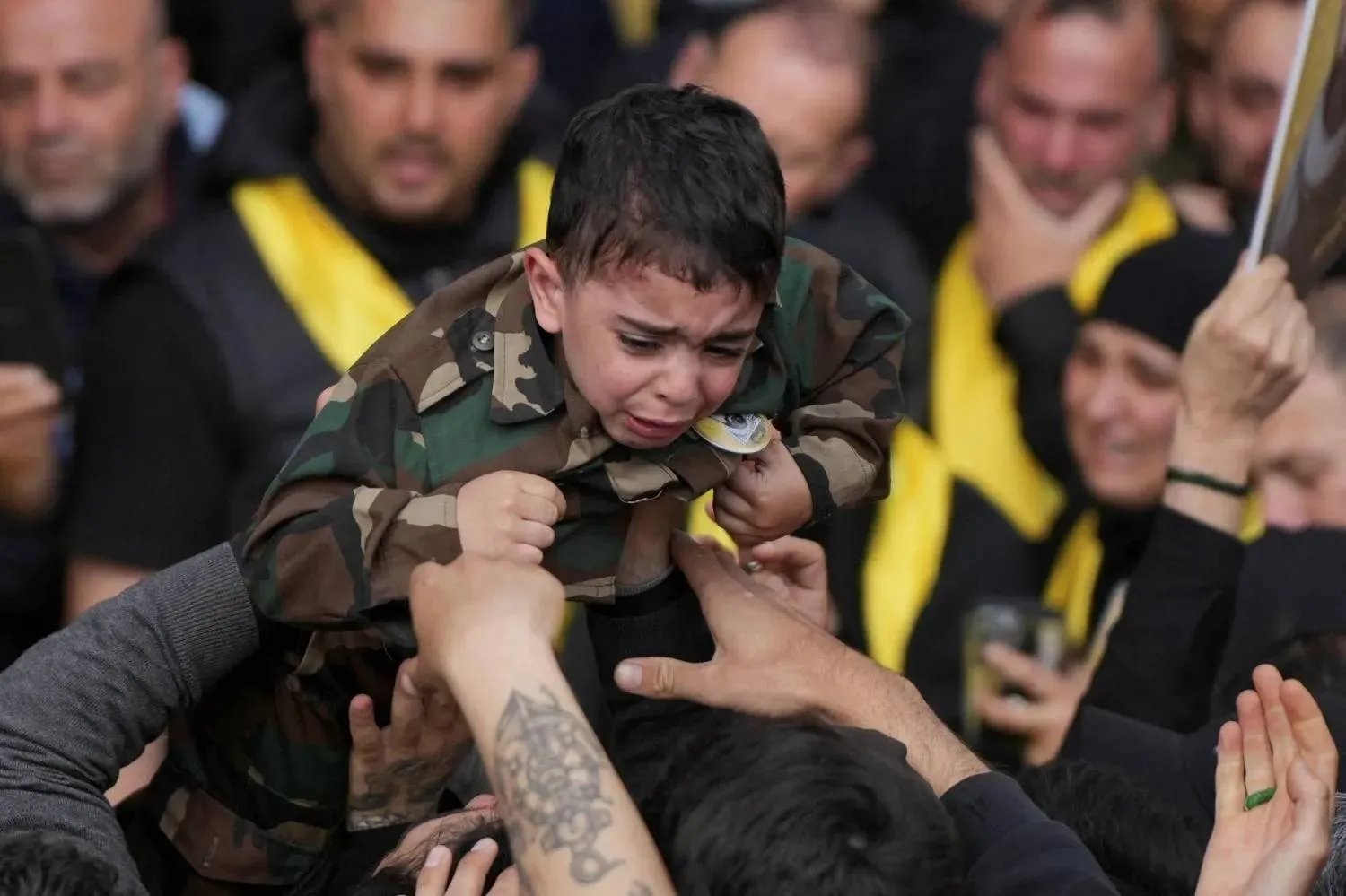
A child wearing a military uniform at the funeral of a Hezbollah fighter in Beirut’s southern suburbs during the truce with Israel (Reuters)
TT

Hezbollah Threatens to Derail Israel Talks, Invokes 1983 Scenario

A child wearing a military uniform at the funeral of a Hezbollah fighter in Beirut’s southern suburbs during the truce with Israel (Reuters)

Hezbollah has stepped up its campaign against Lebanon’s authorities, objecting to their decision to pursue direct negotiations with Israel and insisting the government reverse course, while warning it could seek to bring down the process by force.

The group argues that such talks require a broad national consensus, which it says is lacking, and has warned that the fate of any negotiations and resulting agreement would mirror that of the May 17, 1983 accord.

That agreement, reached 43 years ago, was a peace treaty between Lebanon and Israel that included security arrangements aimed at ending the state of war, securing an Israeli withdrawal from Lebanon and regulating their shared border.

It followed Israel’s invasion of Lebanon in June 1982, when Israeli forces reached Beirut and occupied large parts of the country. The deal came after Palestinian factions withdrew from Lebanon and a new president, Amin Gemayel, was elected and led the negotiations.

However, the US-brokered accord was abandoned on March 5, 1984 after broad domestic opposition from Lebanese factions, particularly nationalist, leftist and Islamist groups, as well as outright Syrian rejection at a time when Syrian military presence in Lebanon was influential.

Different circumstances

Despite Hezbollah’s fierce opposition to direct negotiations, some observers say current conditions differ from those in 1983.

MP Salim Sayegh of the Kataeb Party said that in 1983 “the Lebanese government, presidency and parliament were facing Syria, the Warsaw Pact, Israeli ill intent and weak US commitment all at once.”

“Today, regional dynamics have changed. Hezbollah no longer has strategic depth, and its capabilities are very limited,” he told Asharq Al-Awsat, warning that “any misstep in the street would turn the entire Lebanese public against it.”

Sayegh added that the Lebanese government now holds a firm position and “will act decisively,” dismissing doubts about the army’s capabilities.

“The army knows the terrain, both land and people. What it lacked was a clearly defined battle. No army can throw itself into an open-ended conflict. But if Hezbollah chooses chaos and strife, it will face a cohesive army and a united people,” he said.

Anger and threats

Anger spread among supporters of the Shiite duo, Amal and Hezbollah, after images circulated of a meeting last Tuesday in Washington between the Lebanese and Israeli ambassadors.

Commentators and activists aligned with the two groups warned that the talks could meet the same fate as the May 17 agreement.

Hezbollah MP Hassan Fadlallah said: “A large segment rejects the authorities’ path, and it was this segment, along with national forces, that brought down the May 17 accord, and it will not allow the experience to be repeated.”

“This is not limited to the Shiite community, which is a core component of the Lebanese people and rejects direct negotiations. No one can bypass its role,” he added.

Sayegh said Hezbollah also lacks the ability to create alternatives, as in the past, when Syrian influence in Lebanon allowed disruptions to serve Damascus’ interests.

“At the time, Israel was also mired in internal contradictions that led it to prefer managing the Lebanese file through security arrangements with Syria, as seen in the red lines agreement that covered Syria’s entry into Lebanon in 1976,” he said.

“Today, chaos offers zero benefit after the separation of the Lebanese and Iranian tracks. Israel will not bargain over Lebanon, having concluded that strengthening the state in Beirut secures what it wants in the south while respecting Lebanese sovereignty,” he added.

Civil war risks

While agreeing that conditions differ from 1983, political science professor Hilal Khashan of the American University of Beirut expressed a more pessimistic outlook.

“The key Syrian role in bringing down the agreement back then is absent today, and there is no longer a Syrian-Israeli struggle over Lebanon,” he said.

Khashan said Israel now seeks a peace agreement that would provide cover and legitimacy to continue fighting Hezbollah, adding that “it is clear no one can stop it, and its decision to end the group’s military presence is final.”

He warned the escalation could push Lebanon toward civil war, with a possibility of Syrian intervention from the north, noting that Hezbollah fighters are spread across the country.

“We also fear this could lead to the army splitting and ultimately the division of the country,” he said.

Khashan added that Hezbollah’s potential move to ignite internal tensions is tied to developments in the Lebanon-Israel talks and their possible outcomes, even as Israel itself does not appear to be placing much hope in the negotiations.


Palestinians Say West Bank Teen Killed by Israeli Fire

An Israeli security force personnel patrols during a military raid at the Qalandia refugee camp, south of the city of Ramallah, in the Israeli-occupied West Bank, on May 6, 2026. (AFP)
TT

Palestinians Say West Bank Teen Killed by Israeli Fire

An Israeli security force personnel patrols during a military raid at the Qalandia refugee camp, south of the city of Ramallah, in the Israeli-occupied West Bank, on May 6, 2026. (AFP)

Palestinian health officials said a teenager was killed by Israeli fire in a village in the West Bank on Wednesday, the latest in a series of violent incidents shaking the Israeli-occupied territory.

The health ministry in Ramallah identified the victim as 16-year-old Yusef Ali Kaabnah, saying he was "killed by occupation bullets" near the town of Jiljilya, north of Ramallah.

The Palestinian Red Crescent said he had been shot in the chest during a raid by Israeli settlers who were accompanied by Israeli troops.

Four others were injured in the incident, it added.

The Israeli military told AFP that security forces were dispatched to the area "following reports of several Israeli civilians who entered Jiljilya after livestock had been stolen from an illegal outpost".

Troops "operated to prevent confrontation in the area and extract the livestock" and "escort all Israeli civilians out", and as they were leaving, "a violent riot developed, which included stone-throwing," the military said.

"The soldiers responded with riot dispersal means and live fire toward the primary instigators," it added.

Violence has increased in the West Bank since the start of the war in Gaza in October 2023.

According to an AFP tally based on Palestinian health ministry figures, Israeli troops or settlers have killed at least 1,071 Palestinians in the West Bank since the war began.

Official Israeli figures show at least 46 Israelis have been killed in Palestinian attacks or during Israeli military operations in the same period.


Lebanon Says Over 10,000 Homes Destroyed or Damaged Since Israel Truce

Smoke rises from the site of an Israeli airstrike that targeted the southern Lebanese village of Jarjouaa on May 13, 2026. (AFP)
TT

Lebanon Says Over 10,000 Homes Destroyed or Damaged Since Israel Truce

Smoke rises from the site of an Israeli airstrike that targeted the southern Lebanese village of Jarjouaa on May 13, 2026. (AFP)

More than 10,000 homes have been damaged or destroyed in Lebanon since a ceasefire in the war between Israel and Hezbollah, the head of the country's National Council for Scientific Research said on Wednesday.

"Since the current ceasefire... we have witnessed 5,386 housing units that were completely destroyed, and 5,246 housing units damaged," CRNS chief Chadi Abdallah told a news conference broadcast by local media.

Israel has kept up heavy airstrikes despite the April 17 ceasefire, and Israeli soldiers are operating inside an Israeli-declared "yellow line", which runs around 10 kilometers (six miles) north of the Israel-Lebanon border where troops have been carrying out broad demolition operations.


UN Food Agency Halves Syria Food Aid, Halts Bread Subsidy Over Funding Shortages

 11 May 2026, Syria, Badama: Agricultural workers hand-harvest a fresh crop of strawberries as the season begins in the highlands of western Idlib and the coastal range. (dpa)
11 May 2026, Syria, Badama: Agricultural workers hand-harvest a fresh crop of strawberries as the season begins in the highlands of western Idlib and the coastal range. (dpa)
TT

UN Food Agency Halves Syria Food Aid, Halts Bread Subsidy Over Funding Shortages

 11 May 2026, Syria, Badama: Agricultural workers hand-harvest a fresh crop of strawberries as the season begins in the highlands of western Idlib and the coastal range. (dpa)
11 May 2026, Syria, Badama: Agricultural workers hand-harvest a fresh crop of strawberries as the season begins in the highlands of western Idlib and the coastal range. (dpa)

The World Food Program said ‌on Wednesday it had halved emergency food assistance in Syria due to funding shortages, warning that millions remained vulnerable despite signs of stabilization in parts of the country.

The UN agency's biggest donor, the United States, has slashed its foreign aid under President Donald Trump, and other countries have also made or announced cuts in development and humanitarian assistance.

The WFP said in a statement the number of people receiving emergency food aid in Syria fell to 650,000 in ‌May from 1.3 million, ‌while scaling back operations in all ‌14 ⁠Syrian governorates to just ⁠seven.

Meanwhile, 7.2 million people in Syria remain acutely food insecure, including 1.6 million facing severe hunger, the WFP said. Many households were already reducing meal portions, eating less nutritious food or skipping meals altogether, it added.

“The reduction in WFP’s assistance is driven solely by funding constraints, not by a ⁠decrease in needs,” Marianne Ward, the WFP’s country ‌director in Syria, said in ‌the statement.

The WFP also halted a bread subsidy program ‌that had supported more than 300 bakeries with fortified wheat ‌flour, helping provide subsidized bread to up to four million people daily in some of Syria’s most vulnerable areas.

Syria has faced a deep economic crisis after more than a decade of conflict ‌that devastated infrastructure, displaced millions and battered livelihoods.

Although fighting has eased in many parts of ⁠the ⁠country since the ouster of former President Bashar al-Assad at the end of 2024, aid agencies say humanitarian needs remain severe.

The WFP said it requires $189 million between June and November to sustain and restore assistance inside Syria.

It said funding shortages were also affecting Syrian refugees in neighboring countries.

In Jordan, the agency halted cash-based food assistance for 135,000 Syrian refugees living in host communities, while maintaining reduced support for around 85,000 refugees in camps.

In Egypt, support for 20,000 Syrians has been reduced, while many refugee households in Lebanon remain heavily dependent on aid.