

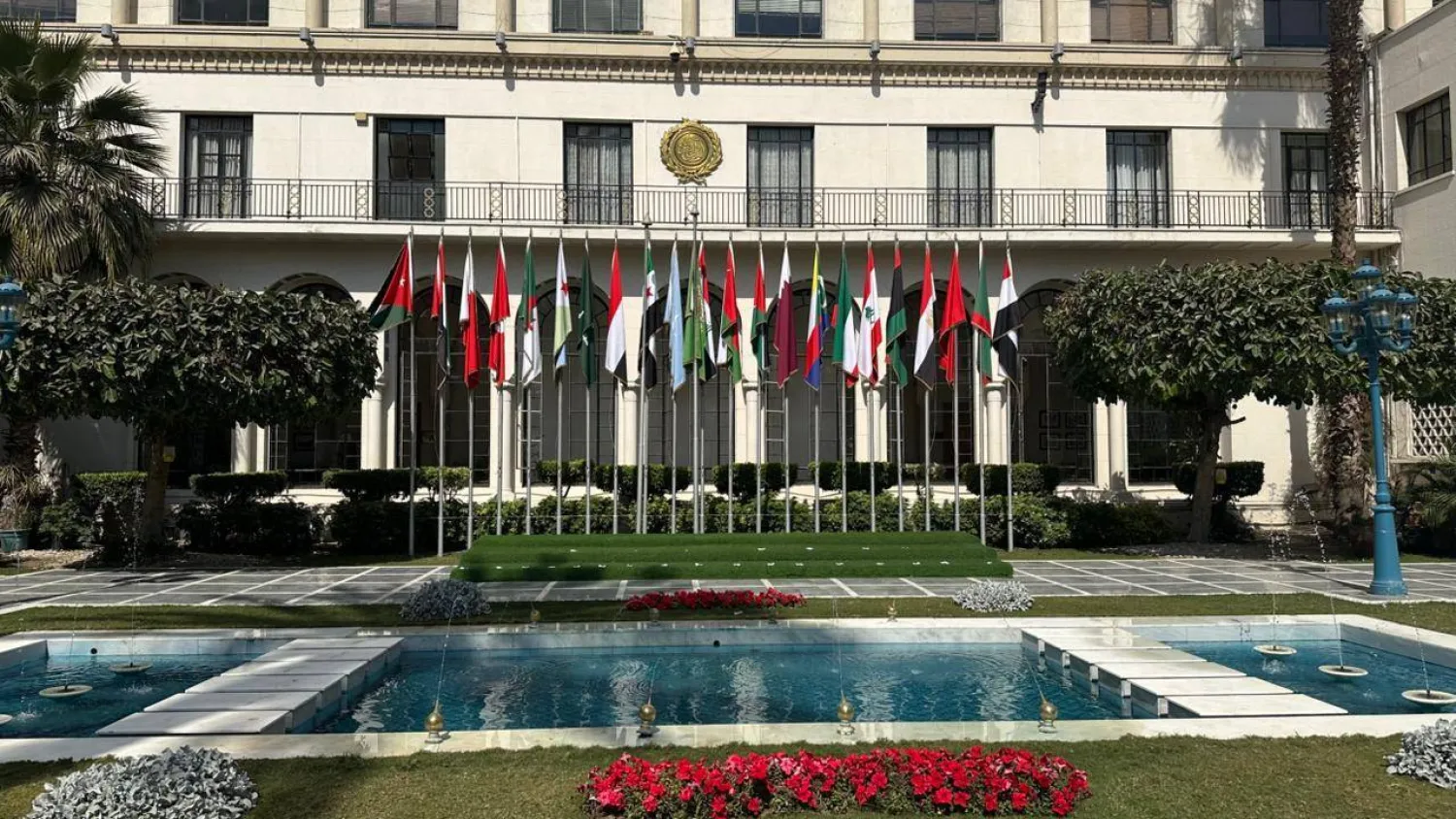

Arab Foreign Ministers Condemn Hormuz Closure, Demand Iran Pay Reparations

The Arab League headquarters in Cairo (Asharq Al-Awsat)
TT

Arab Foreign Ministers Condemn Hormuz Closure, Demand Iran Pay Reparations

The Arab League headquarters in Cairo (Asharq Al-Awsat)

Arab foreign ministers have condemned Iran's threats to close the Strait of Hormuz and disrupt international navigation, demanding, in a virtual meeting they held on Tuesday, that Tehran be compelled to compensate and make amends for the economic losses resulting from these threats.

The Secretary-General of the Arab League, Ahmed Aboul Gheit, affirmed that “Arab countries have not been, and will not be, hostages in the hands of Iran to settle scores.”

At the request of Bahrain, the Council of the League of Arab States, at the foreign ministers' level, held an extraordinary meeting on Tuesday to “discuss Iranian attacks against Arab countries, Iran's obligations under international law, and efforts made to end the crisis in the region.”

In a resolution, the ministers condemned Iranian threats to close the Strait of Hormuz and the Bab al-Mandeb Strait, calling on the UN Security Council to assume its responsibility in maintaining regional and international peace and security and to ensure accountability for attacks deliberately targeting civilian facilities and infrastructure.

They reaffirmed that these deliberate attacks constitute a grave violation of the sovereignty of those states, undermine regional peace and security, and represent a flagrant breach of international law, including international humanitarian law and the UN Charter.

Moreover, the ministers noted that Iran has failed to comply with Resolution 2817 to immediately cease its attacks against Arab states, adding that its continued deliberate targeting of civilians and civilian objects constitutes a violation of international law.

Tuesday’s resolution also stressed that Iran bears full international responsibility for its unlawful and unjustified attacks against Arab states, and is obligated under international law to make full reparation for all resulting damage and losses, including restitution and compensation.

It called on relevant Arab and regional bodies, in coordination with affected countries, to consider establishing mechanisms to document violations, assess damages and losses, and pursue avenues for redress through diplomatic, legal, and other peaceful means.

The resolution stressed that any attempt by Iran to obstruct lawful maritime passage constitutes a threat to the security of sea lanes and global energy supplies, affirming the right of Arab states to defend their vessels and means of transport in accordance with international law.

The council said that any attempt by Iran to obstruct lawful transit and freedom of navigation in the Strait of Hormuz would constitute an internationally unlawful act, adding that Iran would bear international responsibility and be obliged to provide full reparation for all resulting damage, injuries, and economic losses.

It reiterated that such actions threaten the stability of the Arabian Gulf region and its vital role in the global economy and energy supplies, as well as international peace and security.

The council also stressed its rejection and condemnation of Iran’s continued financing, arming, and mobilization of affiliated militias in several Arab countries in pursuit of its interests, describing this as a serious threat to the security and stability of those states and the region.

The Arab foreign ministers urged the Security Council to uphold its responsibility to safeguard regional and international peace and security, ensure accountability for deliberate attacks targeting civilian facilities and infrastructure, and work toward the full implementation of Resolution 2817, including requiring Iran to immediately halt all its attacks against Arab states and comply with its international obligations.

The council also affirmed the inherent right of affected Arab states to self-defense, individually or collectively, in accordance with Article 51 of the UN Charter, and to take all necessary measures to protect their sovereignty, security, and stability, stressing that the provisions of this resolution do not prejudice any rights or remedies available to states under international law.

The Secretary-General of the Arab League stated at Tuesday’s meeting that Iran has not complied with Security Council Resolution 2817 issued on March 11, calling for an immediate halt to aggression, nor has it acknowledged that its aggressions against Arab states in the Gulf, Jordan, and Iraq constituted a grave breach of international law, an unacceptable violation of state sovereignty, and a blatant disregard for all principles of good neighborliness.

Aboul Gheit demanded that Iran “immediately comply with the Security Council resolution and bear full responsibility for the damages and losses caused by these unlawful attacks, which necessitates compensation and reparation as stipulated by international law in such cases.”

He stated that “Iran's perceptions of controlling the Arabian Gulf and the Strait of Hormuz are legally null and void, lack any argument or justification, and are rejected outright.”

He emphasized that 'freedom of navigation in international straits and waterways, including the Strait of Hormuz, is guaranteed by international law... and Iran cannot give itself the right to control the Strait of Hormuz, because it simply does not own it.”

He added that the Arab League “considers aggression against any Arab state, or the practice of threatening and terrorizing its civilian population, as aggression against all Arab states,” affirming that “everyone stands united in solidarity with the countries that have been subjected to sinful attacks.”

This marks the third time, since the outbreak of Iran's war on February 28, that the Arab League Council has convened at the ministerial level to discuss developments in the region.

The foreign ministers had previously condemned Tehran's attacks on Arab countries in an emergency virtual meeting on March 8, affirming their support for all measures taken by those countries, including the option of responding to the attacks.

Again, they reiterated their condemnation of the attacks at the 165th regular session meeting end of last month.



Lebanon to Request One-month Truce Extension in Israel Meeting

Diggers remove the rubble of buildings destroyed in Israeli strikes as they look for survivors buried underneath in the southern Lebanese coastal city of Tyre on April 21, 2026. (Photo by Mahmoud ZAYYAT / AFP)
TT

Lebanon to Request One-month Truce Extension in Israel Meeting

Diggers remove the rubble of buildings destroyed in Israeli strikes as they look for survivors buried underneath in the southern Lebanese coastal city of Tyre on April 21, 2026. (Photo by Mahmoud ZAYYAT / AFP)

Lebanon will request a one-month extension of the ceasefire during its meeting with Israel in Washington on Thursday, a Lebanese official told AFP.

The official, who spoke on condition of anonymity given the sensitive nature of the topic, said "Lebanon will request an extension of the truce for one month, an end of Israel's bombing and destruction in the areas where it is present, and a commitment to the ceasefire".

Lebanese President Joseph Aoun said Wednesday that "contacts are underway to extend the ceasefire period", which began last week and is set to expire Sunday.

Israel to Lebanon: Cooperation Required on Your Side

Israeli Foreign Minister Gideon Saar, speaking to diplomats during an event marking the 78th anniversary of Israel’s “independence” on Wednesday, called on Lebanon to cooperate and make joint efforts to confront Hezbollah.

Saar said: “Tomorrow, direct talks between Israel and Lebanon will resume in Washington. I call on the Lebanese government to cooperate with us against the state of terrorism that Hezbollah has built on your territory.”

He added: “This cooperation is required more from your side than from ours. It requires moral clarity and the courage to take risks. But there is no real alternative to ensuring a future of peace for you and for us.”

Lebanon and Israel have been formally at war since 1948. Israel took control of additional areas in southern Lebanon after the Iran-backed Hezbollah fired rockets toward Israel in support of Tehran on March 2.

The war between Hezbollah and Israel has resulted in the deaths of more than 2,400 people and the displacement of around one million on the Lebanese side.

Despite a ceasefire being in effect, Israeli forces still occupy areas in southern Lebanon and continue to operate there.

Last week, Israeli Defense Minister Israel Katz warned that his country would use its “full force” in Lebanon if its soldiers were threatened.

Under the terms of the truce, Israel says it retains the right to act against “planned, imminent, or ongoing attacks.”

The Israeli army announced last week the establishment of a “yellow line” separating areas in southern Lebanon, similar to the line that separates its forces from areas controlled by Hamas in Gaza.


Report Says US Blocked $500M Cash Shipment to Iraq Over Pro-Iran Attacks

An Iraqi man walks past shops in the Jamila food market in Sadr City, east Baghdad on April 13, 2026. (AFP)
TT

Report Says US Blocked $500M Cash Shipment to Iraq Over Pro-Iran Attacks

An Iraqi man walks past shops in the Jamila food market in Sadr City, east Baghdad on April 13, 2026. (AFP)

The United States blocked a plane carrying nearly $500 million in banknotes from delivering the cash to Iraq, US media reported on Tuesday, piling pressure on Baghdad to fight Iran-backed armed factions. 

The Wall Street Journal reported that Washington has suspended cash shipments to Iraq and frozen funding for security programs following attacks on US interests in the country by groups showing solidarity with Iran. 

Iraq has long walked a tightrope between the competing influences of its allies, neighboring Iran and the United States. 

However, Iraqi leaders have struggled to maintain that delicate balance as war engulfs the Middle East. 

The US State Department said this month it had summoned Iraq's ambassador to Washington to express "strong condemnation" of attacks by pro-Iran groups on US interests, "including the April 8 ambush of US diplomats in Baghdad". 

The Wall Street Journal reported that the US Treasury Department blocked a shipment of nearly $500 million in cash from Iraqi oil sales, quoting US and Iraqi officials. 

AFP has contacted the Treasury Department for comment. 

The United States has leverage over Iraq because the country's oil export revenue is largely held at the Federal Reserve Bank in New York, under an arrangement reached after the 2003 US invasion that toppled Saddam Hussein. 

The Wall Street Journal quoted unidentified US officials as saying that the suspension on cash shipments was temporary. 

The Central Bank of Iraq has not commented specifically about the reports. 

However, it said on Tuesday it was not lacking US dollars and that it had "fulfilled all requests from banks and exchange companies for US dollars, which are intended for pilgrims, travelers and foreign transfers." 

The funding freeze to security programs includes training for Iraq's army and counterterror efforts against the ISIS group, The New York Times reported. 


Israeli Strike on Lebanon's Bekaa Kills One Despite Truce

A young boy walks amid the rubble of a building destroyed in an Israeli strike in the southern Lebanese village of Kfar Sir on April 21, 2026. (Photo by Anwar AMRO / AFP)
TT

Israeli Strike on Lebanon's Bekaa Kills One Despite Truce

A young boy walks amid the rubble of a building destroyed in an Israeli strike in the southern Lebanese village of Kfar Sir on April 21, 2026. (Photo by Anwar AMRO / AFP)

An Israeli drone strike on Lebanon's Bekaa region killed one person and injured two others on Wednesday, Lebanese state media reported, despite an ongoing truce between Israel Hezbollah.

"One person was killed and two others were wounded as a result of an attack carried out by an enemy drone at dawn on the outskirts of Al-Jabur in West Bekaa," the National News Agency (NNA) reported.

However, the Israeli military said it was unaware of the ‌strike.

Hezbollah on Tuesday said it had launched rockets and attack drones at a site in northern Israel in response to "blatant" Israeli ceasefire violations, which it said included "attacks on civilians and the destruction of their homes and villages.”

The Israeli military said that day that Hezbollah "launched several rockets" towards soldiers stationed in south Lebanon and that the military struck the launcher in response.

NNA on Wednesday reported Israeli artillery shelling and demolitions in southern towns Israel continues to occupy.

Israel conducted huge strikes across Lebanon and invaded the south after Hezbollah entered the Middle East war in support of its backer Iran on March 2.

Despite the truce which began on Friday, Israeli soldiers are still active in south Lebanon, with Defense Minister Israel Katz saying on Sunday that they would use "full force" if threatened.

Under the truce terms, Israel says it reserves the right to act against "planned, imminent or ongoing attacks.”

Israeli attacks on Lebanon have killed at least 2,454 people since the start of the war, a Lebanese government body said in its latest toll.