



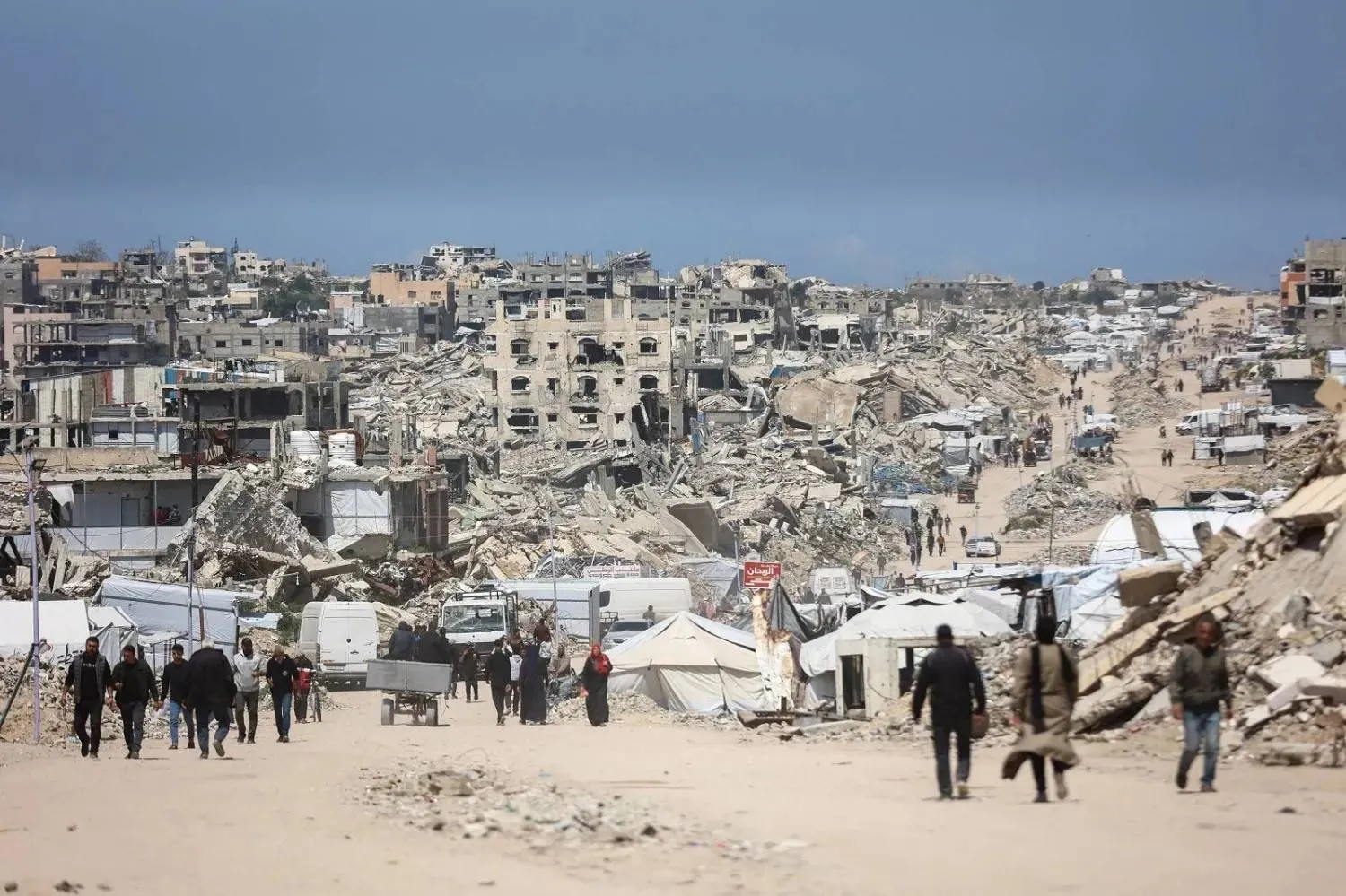

The reconstruction of the Gaza Strip has returned to the agenda in recent days during Egyptian talks with international parties, amid a stalemate in implementing the ceasefire and earlier reports of funding problems facing the “Board of Peace” led by U.S. President Donald Trump.
Those reports were later denied, but without producing tangible steps toward even early recovery.
Egyptian experts told Asharq Al-Awsat that Cairo is pushing the file forward, either by opening parallel tracks to the Board of Peace’s reconstruction plan or by breaking the deadlock in the ceasefire phases, while preserving the agreement’s effectiveness as attention shifts to the “Iran war.”
Egyptian Foreign Minister Badr Abdelatty met Japan’s envoy for Gaza reconstruction, Takeshi Okubo, days ago, discussing “early recovery and reconstruction efforts in light of the ongoing regional escalation.”
Foreign Ministry spokesperson Ambassador Tamim Khallaf said Abdelatty stressed the need to accelerate early recovery through practical projects with immediate impact on Palestinians’ lives, including medicines, construction materials, desalination plants, mobile power units, and adequate temporary housing, taking into account realities on the ground and residents’ needs.
The issue also featured during Abdelatty’s mid-April visit to Washington, where he discussed with Stefan Emblad ways to boost cooperation on early recovery and reconstruction.
Abdelatty called for a major role for the World Bank in ensuring sustainable living conditions for Palestinians, citing its experience in reconstruction. He stressed the need to prioritize urgent projects and affirmed Egypt’s readiness to fully cooperate with the Board of Peace and the bank.
Ashraf Harbi of the Egyptian Council for Foreign Affairs said reviving the reconstruction file aims to create parallel paths to the Board of Peace’s steps, which have yet to begin, adding that Cairo is counting on international and European institutions to push early recovery.
He said Egypt is also seeking to break the ceasefire deadlock and sustain momentum on the Palestinian issue and the “Gaza agreement,” amid fears of a complete freeze as global attention turns to the Iran war.
In recent weeks, Cairo hosted talks between Hamas and the Board of Peace’s representative in Gaza, Nickolay Mladenov, focused largely on Hamas disarmament, but without agreement.
Mladenov said arrangements acceptable to all parties “will take some time.”
A Reuters report in early April said the Board of Peace had received only a small share of the $17 billion pledged for Gaza, delaying Trump’s plan for the devastated territory.
The Board said it faces no funding obstacles and that all requests were met “immediately and in full,” adding it is focused on enabling a national committee to manage Gaza, restoring governance, and expanding aid.
Days before the Iran war erupted in February, Washington hosted the Board of Peace’s first meeting, where countries pledged billions for Gaza’s reconstruction and administration after two years of war.
The plan envisions large-scale reconstruction alongside Hamas disarmament and an Israeli withdrawal, paving the way for a Palestinian national committee to take over governance.
Ahmed Fouad Anwar, also of the Egyptian Council for Foreign Affairs, said Cairo is stepping up efforts to overcome Israeli obstacles that have delayed a technocratic committee from taking over in Gaza and hindered the formation of a “stabilization force,” both of which are tied to reconstruction and early recovery.
He said delays in implementing the ceasefire are also linked to funding for reconstruction and development.
Cairo is working to establish a practical starting point to boost humanitarian and development support through the World Bank or the Japan International Cooperation Agency, aiming to restore hope for Palestinians facing harsh conditions.
Anwar added that the faltering first phase of the ceasefire, Israel’s withdrawal from only 55 percent of Gaza, and the focus on the Iran war and its economic and political fallout, including the risk of renewed fighting, are shaping the Palestinian landscape and require intensified action on multiple tracks.
International institutions estimate Gaza’s reconstruction cost at about $70 billion after widespread destruction of infrastructure and buildings, leaving the enclave’s future dependent on funding and political consensus.
The World Health Organization said on Friday that rebuilding Gaza’s health system will require $10 billion over five years, with 1,800 health facilities damaged, some fully and others partially.


