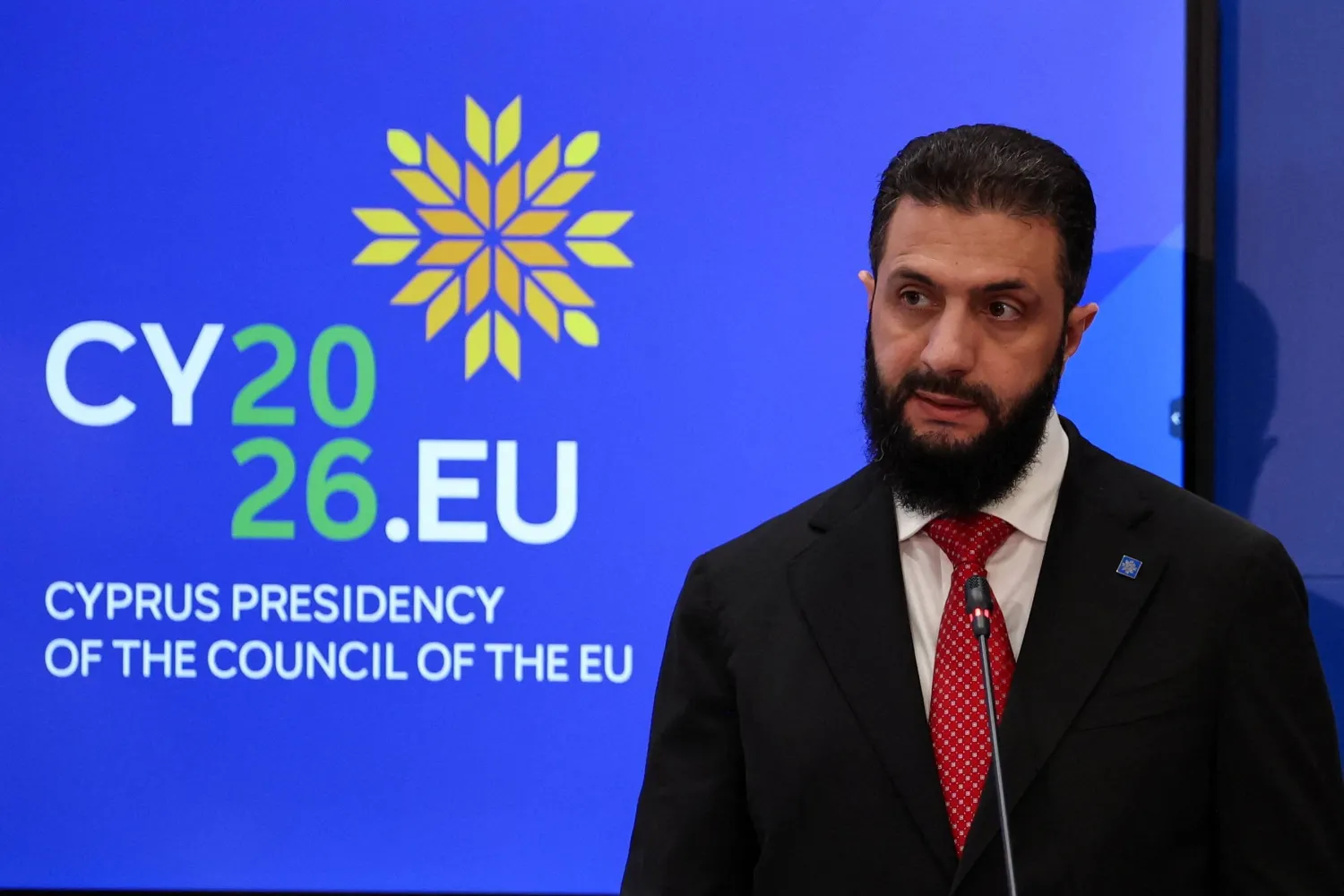

Syrian President Ahmed al-Sharaa said on Friday that a meeting of European Union leaders and regional partners in Nicosia marked a new level of political and strategic maturity, reflecting a shift toward a geopolitical reality that goes beyond traditional cooperation frameworks.
Speaking at a press conference after the informal gathering, al-Sharaa said Syria had presented the “Four Seas” and “Nine Corridors” initiatives as a safe alternative artery linking Central Asia and the Gulf to the heart of Europe.
“Standing on the shores of our shared Mediterranean confirms a firm reality that the security of the European continent and the stability of the region form a geopolitical balance that cannot be divided, and requires a spirit of partnership and collective responsibility,” he said.
He added that the weight of that responsibility was evident amid mounting challenges affecting regional security and global trade, warning that any closure of the Strait of Hormuz would pose a major risk and require a new strategy rooted in the region itself.
Al-Sharaa said Europe needs Syria as much as Syria needs Europe, describing the Euro-Arab Mediterranean partnership as an inevitable path and a safe haven for sustaining energy flows and ensuring global supply security.
He urged the international community to assume its responsibilities over what he described as ongoing Israeli violations of Syrian sovereignty, including ground incursions, airstrikes and near-daily breaches of Syrian territory and airspace, in violation of the 1974 Disengagement Agreement and international law.
“These attacks not only target Syrian security, but also undermine recovery and reconstruction efforts and destabilize the region, which forms the basis of partnership with the European Union,” he said.
Al-Sharaa called on European partners to take a firm stance obliging Israel to immediately halt its attacks, saying that protecting the political track launched at the meeting begins with safeguarding the territory on which it stands.
Syria, once a battleground for others’ conflicts, was now choosing to become “a bridge for stability and a cornerstone for solutions,” he remarked, stressing that “geography is our destiny and partnership is our decision.”
Al-Sharaa said the meeting marked a confident starting point ahead of a larger event in Brussels on May 11, where a high-level Syrian-European political dialogue would be launched.
“We have 17 days of intensive work ahead to consolidate Syria’s role as a strategic partner contributing to building Europe’s future and ensuring stability in our region,” he said.
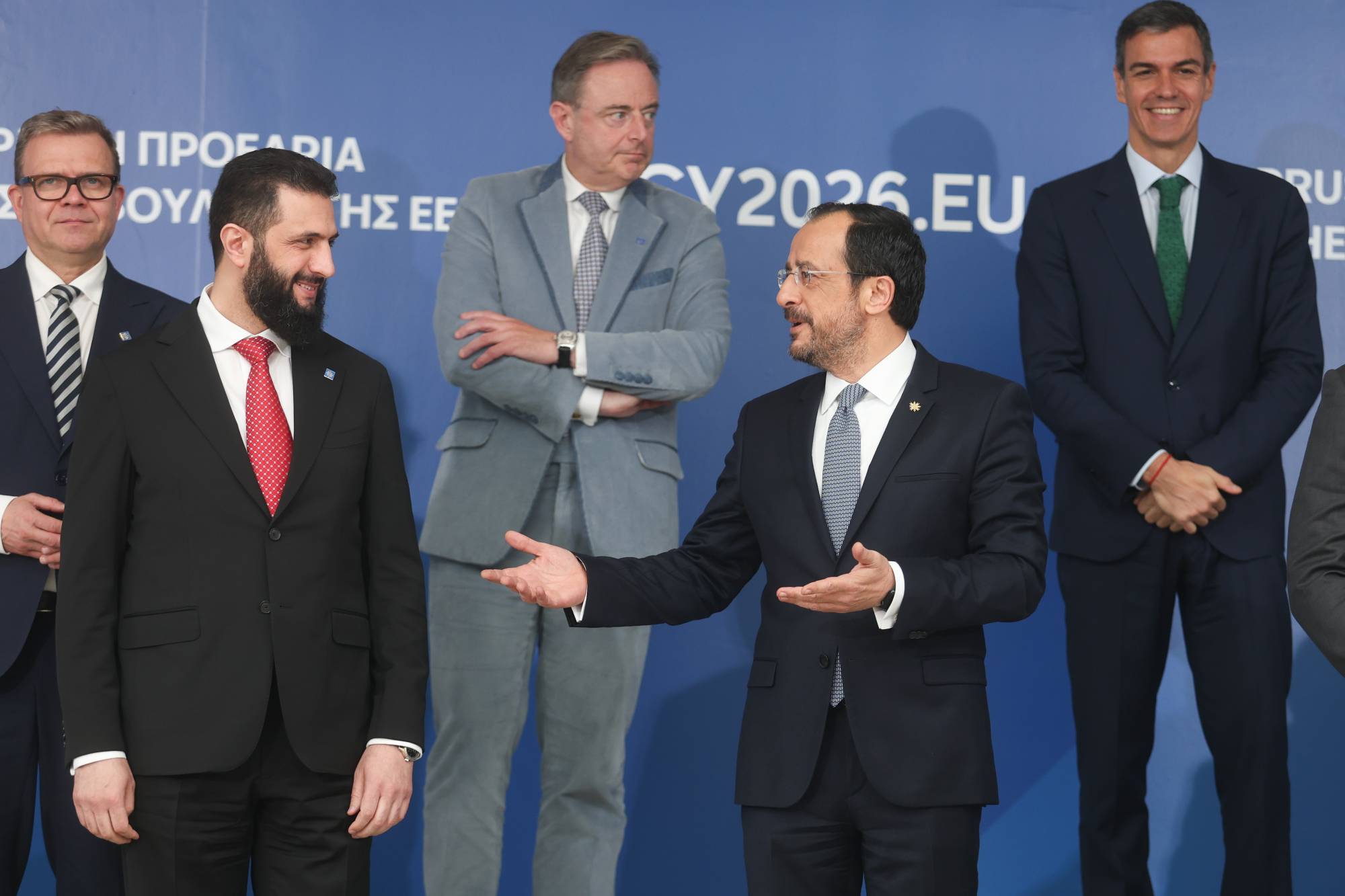
Al-Sharaa attended the informal meeting in Nicosia at the invitation of Cypriot President Nikos Christodoulides and European Council President Antonio Costa, where he stressed the need to strengthen regional stability and boost international coordination to address shared challenges.