


Washington Zigzags Between Rolling Out More Sanctions, Extending Waiver in Iran’s War

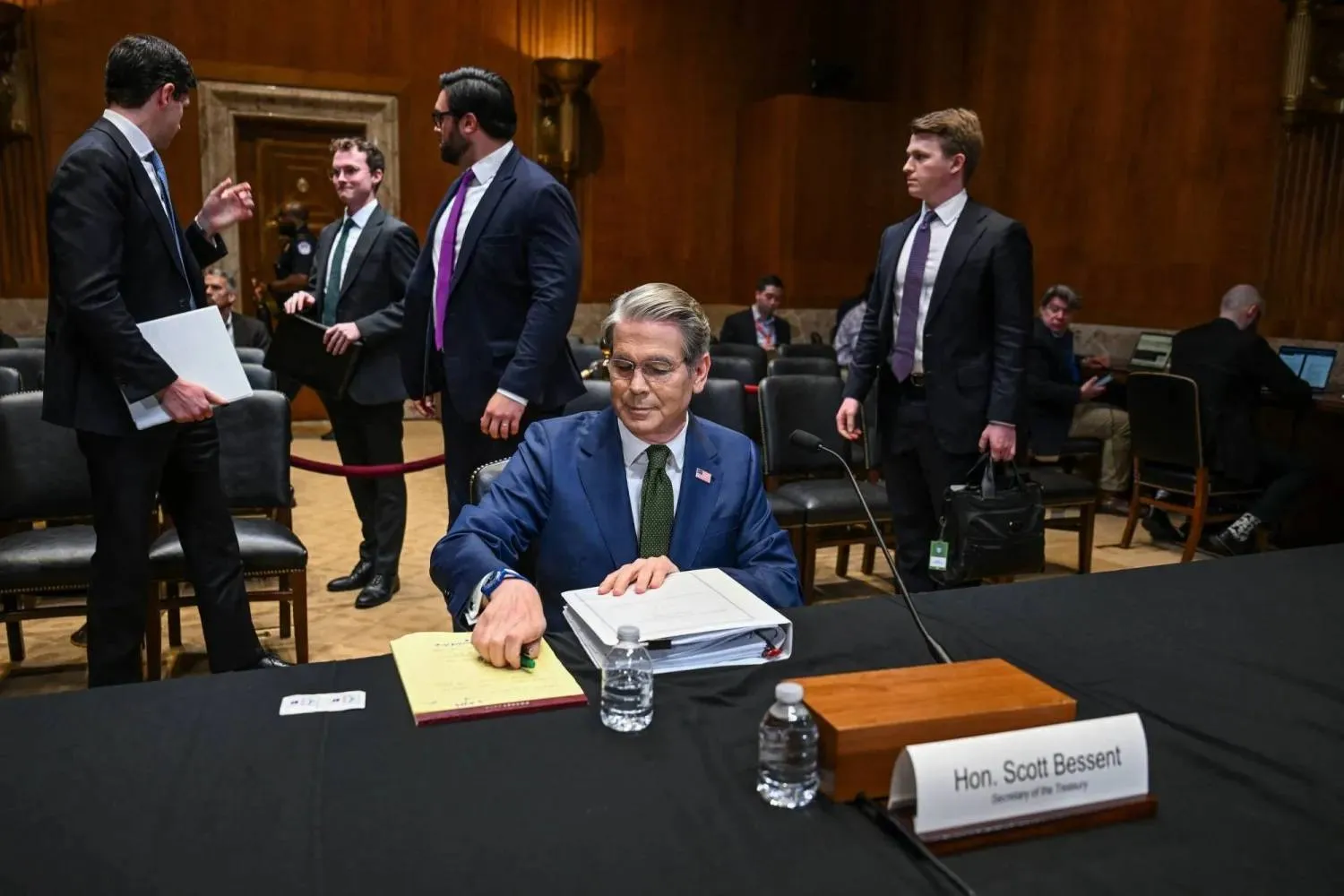
US Treasury Secretary Scott Bessent at the end of a Senate Appropriations Financial Services and General Government Subcommittee hearing on President Trump's fiscal year 2027 budget request for the Department of the Treasury, on Capitol Hill in Washington, DC, US, April 22, 2026. (Reuters)
TT

Washington Zigzags Between Rolling Out More Sanctions, Extending Waiver in Iran’s War

US Treasury Secretary Scott Bessent at the end of a Senate Appropriations Financial Services and General Government Subcommittee hearing on President Trump's fiscal year 2027 budget request for the Department of the Treasury, on Capitol Hill in Washington, DC, US, April 22, 2026. (Reuters)

Alan Rappeport and Ephrat Livni*

With oil prices in mind, the administration of US President Donald Trump has deployed a haphazard approach to sanctions on Russia and Iran.

Treasury Secretary Scott Bessent declared in mid-April that the United States would not extend a waiver allowing the sale of Russian oil. Two days later, on a Friday evening, the Treasury Department quietly issued another 30-day reprieve.

Ukraine’s President Volodymyr Zelensky condemned the waiver, saying that “every dollar paid for Russian oil is money for the war.” Senate Democrats called the 180-degree reversal a “shameful” decision.

Then, on Friday, Bessent told The Associated Press that the United States did not plan to renew the waiver for sales of Russian oil another time. The current waiver ends on May 16.

The about-face on Russian oil sanctions underscored the haphazard state of US statecraft as the Trump administration confronts the fallout from the war it and Israel started with Iran.

While the United States could once use its financial might to cripple the economies of adversaries, countries such as Russia and Iran have been using their leverage in energy markets to fight back. That has forced the Treasury Department, which oversees the US sanctions program, to improvise.

The Trump administration rolled out a blitz of sanctions on Friday, targeting 40 shipping firms and vessels that it identified as part of Iran’s so-called shadow fleet of oil tankers as it broadened its efforts to cripple the Iranian economy.

The administration also imposed sanctions on an independent Chinese refinery, Hengli Petrochemical Refinery, which is one of Iran’s largest customers for crude oil and other petroleum products.

At a Senate hearing last week, Bessent said that the decision to extend the Russia license came after developing countries lobbied him to keep more Russian oil on the market while they were in Washington for the spring meetings of the International Monetary Fund and World Bank.

“It was my belief we would not do it,” Bessent said, but added that poor countries have been struggling with the global shortfall of oil.

The White House and Treasury Department had no comment on whether the decision to continue easing the Russia sanctions came directly from Trump.

The sanctions relief has been filling Russia’s coffers with, by some estimates, as much as $200 million per day, undermining years of work by the US and Western allies that aimed to make it harder for Moscow to pay for its war in Ukraine.

“You don’t have to read ‘The Art of War’ to know that helping your adversaries gain money while you’re at war is a terrible idea,” Senator Chris Coons, Democrat of Delaware, said while questioning Bessent at the hearing on Wednesday. “No country has profited more from this war than Russia,” Coons added, noting that the country’s revenues also help support Iran militarily.

The strategy toward Iran has been equally muddled. The United States last month granted a 30-day exemption allowing the sale of Iranian oil, arguing that it would help curb global oil prices while preventing the Iranians from profiting by blocking the Strait of Hormuz.

But this month, the Trump administration changed course, letting the sanctions exemption expire and embarking on Operation Economic Fury, with new sanctions on Iran. The US military also extended its blockade on vessels coming in and out of Iranian ports to the waters of the wider world.

Bessent has likened the initiative to a financial bombing campaign.

Last week, he and Trump emphasized the economic pressures they are putting on Iran. They have argued that Iran will be unable to store any more oil in a matter of days and will be forced to shut its wells, leading to the wells’ possible eventual failure and driving economic collapse.

“It is a kind of whiplash in terms of policy,” said Jennifer Kavanagh, a senior fellow and director of military analysis at Defense Priorities, a foreign policy think tank in Washington. “This whole back and forth is evidence the Trump administration did not expect this to last this long.”

Previously, “the primary vector of pressure” was military action, and the expectation seemed to be that bombing would force Iran to capitulate, she said.

But as fighting has dragged on, raising the stakes of the war, the notion of military escalation became less palatable and Trump had already “escalated rhetorically to the maximum,” with his threat to wipe out Iranian civilization before a ceasefire, she said, leading to the focus on economics.

Iran complicated the US sanctions strategy by blocking the Strait of Hormuz, engaging in economic warfare by military means.

An analysis from Lloyd’s List, the shipping intelligence firm, noted that there are “signs of disruption to Iran’s shadow fleet operations” amid the global US blockade, with some tankers turning, diverting or pausing since its imposition. But vessel-tracking information also showed other Iran-linked tankers were actively sailing.

On Thursday, the Pentagon said US military forces stopped and boarded a second sanctioned tanker carrying oil from Iran in the Indian Ocean, following a similar interdiction on Tuesday.

“But blockades are not quick fixes,” Kavanagh said. She has argued that Iran can probably withstand the pressure because they work slowly.

The global blockade raises legal and operational questions because it has no geographical boundaries. And the United States can only seize so many ships, suggesting the practical impact could be “marginal,” she argued, while at the same time degrading the US reputation as an upholder of the international order, since many countries view such seizures as piracy.

Edward Fishman, a fellow at the Council on Foreign Relations, said that the haphazard use of sanctions by the United States reflects how economic and military warfare are merging. “We don't have a playbook for this kind of economic warfare, which may help explain some of the fumbling by the United States,” Fishman said.

*The New York Times



Russia Says Worker at Captured Nuclear Plant Killed in Ukrainian Strike

A view shows Zaporizhzhia Nuclear Power Plant from the bank of Kakhovka Reservoir near the town of Nikopol after the Nova Kakhovka dam breached, amid Russia's attack on Ukraine, in Dnipropetrovsk region, Ukraine June 16, 2023. (Reuters)
TT

Russia Says Worker at Captured Nuclear Plant Killed in Ukrainian Strike

A view shows Zaporizhzhia Nuclear Power Plant from the bank of Kakhovka Reservoir near the town of Nikopol after the Nova Kakhovka dam breached, amid Russia's attack on Ukraine, in Dnipropetrovsk region, Ukraine June 16, 2023. (Reuters)

A Ukrainian drone strike Monday on the Russian-occupied Zaporizhzhia nuclear power plant complex killed a transport worker, the site's Moscow-installed authorities said.

Zaporizhzhia is the biggest nuclear power plant in Europe. Moscow and Kyiv have repeatedly accused the other of risking a nuclear catastrophe with attacks since it was captured by Russia's forces in 2022.

"Today, a driver was killed in a strike by a Ukrainian armed forces drone on the transport shop floor of the Zaporizhzhia nuclear power plant," the plant's press service said on Telegram.

The plant -- which is in cold shutdown -- is close to the front line in southern Ukraine. Its fate is a major sticking point in stalled talks on ending the war.

Ukrainian state nuclear company Energoatom said Sunday that the plant's "power transmission line was disconnected, causing the plant to switch to blackout mode" for an hour and a half.

"This is already the 15th blackout at the Zaporizhzhia NPP since its occupation. Each such incident significantly increases nuclear and radiation safety risks not only for Ukraine, but for Europe in general."

Ukraine on Sunday marked the 40th anniversary of the Chernobyl nuclear disaster, with President Volodymyr Zelensky accusing Russia of sending drones at the site that he said amounted to "nuclear terrorism".


Iran Offers to End Chokehold on Strait of Hormuz and Asks US to End Blockade, Officials Say

 Ships and boats in the Strait of Hormuz, Musandam, Oman, April 24, 2026. (Reuters)
Ships and boats in the Strait of Hormuz, Musandam, Oman, April 24, 2026. (Reuters)
TT

Iran Offers to End Chokehold on Strait of Hormuz and Asks US to End Blockade, Officials Say

 Ships and boats in the Strait of Hormuz, Musandam, Oman, April 24, 2026. (Reuters)
Ships and boats in the Strait of Hormuz, Musandam, Oman, April 24, 2026. (Reuters)

Iran is offering to end its chokehold on the Strait of Hormuz without addressing its nuclear program, two regional officials with knowledge of the proposal said Monday, as the country's foreign minister made a visit to Russia he said was an opportunity to consult with Moscow regarding the war against Israel and the United States.

Iran also wants the US to end its blockade of the country as part of its proposal, said the two officials, who spoke on condition of anonymity to discuss the closed-door negotiations.

The new proposal, passed to the United States by Pakistan, likely won't be supported by US President Donald Trump, who wants to end Iran’s atomic program as part of an overall deal to reopen the Strait of Hormuz and make the ceasefire permanent.

“We have all the cards. If they want to talk, they can come to us, or they can call us,” Trump said Sunday to Fox News Channel.

The Axios news outlet first reported Iran’s proposal.

Iran's foreign minister visits Russia

Iran's state-run IRNA news agency said Foreign Minister Abbas Araghchi landed in St. Petersburg on Monday morning ahead of a meeting with Russian President Vladimir Putin. His trip over the weekend has included two stops in Pakistan and a visit to Oman, which shares the strait with Iran.

Araghchi’s visit comes as a standoff between Iran and the US in the crucial Strait of Hormuz persists despite a ceasefire, keeping oil prices high.

“It is a good opportunity for us to consult with our Russian friends about the developments that have occurred in relation to the war during this period and what is happening now,” Araghchi said in a video interview posted by IRNA.

Talks had been expected in Islamabad Pakistan has been seeking to revive stalled talks between Iran and the US, and negotiations had been expected in Islamabad over the weekend. But US President Donald Trump has suggested the talks could take place by phone instead.

Araghchi said it was America’s approach that “caused the negotiations to be delayed.”

“The previous one, despite the progress that had been made, could not achieve its goals,” he said, blaming what he called Washington’s “excessive demands.”

Trump has questioned who is in charge in Iran at the moment and said confusion within its theocracy made it difficult to reach a deal.

The White House last week said it would dispatch envoys Steve Witkoff and Jared Kushner to Islamabad to follow up on historic face-to-face talks earlier this month. But Araghchi left the Pakistani capital Saturday, and shortly afterward Trump said he had called off the mission because of a lack of progress with Iran.

“If they want, we can talk but we’re not sending people,” Trump told Fox News on Sunday. He said earlier on social media: “All they have to do is call!!!”

Araghchi later returned to Islamabad, and also visited Oman's capital of Muscat before heading to Russia. He also spoke by phone with counterparts in Saudi Arabia and Qatar on Sunday.

Strait of Hormuz standoff

A standoff remains on the Strait of Hormuz, the narrow mouth of the Gulf through which a fifth of all traded oil and natural gas normally passes, as Iran has restricted movement through it and the US enforces a blockade of Iranian ports.

The June contract for Brent crude, the international standard, was trading at around $107 per barrel Monday, compared with $72 a barrel before the war began.

Oil prices have risen steadily since the war began and tankers full of crude became stranded in the Gulf, unable to safely transit through the strait and reach global distribution points.

The economic fallout is growing two months into the war as global shipments of not only oil, but also liquefied natural gas, fertilizer and other supplies are disrupted by the near-closure of the strategic strait.

An official, who is involved in mediation efforts, said Iran insisted on ending the US blockade before new talks and that Pakistan-led mediators are trying to bridge significant gaps between the countries.

Trump last week indefinitely extended the ceasefire the US and Iran agreed to on April 7 that has largely halted fighting that began with joint US-Israeli strikes on Iran on Feb. 28. But a permanent settlement remains elusive in the war that has killed thousands of people and shaken the global economy.

Even before Saturday’s developments, Iran’s Foreign Ministry said any talks would be indirect and Pakistani officials would act as go-betweens, reflecting Tehran’s wariness after rounds of indirect talks last year and earlier this year ended with Iran being attacked by the US and Israel.

Trump says Iran has offered a ‘much better’ proposal

Both sides have continued to make military threats. Iran’s joint military command Saturday warned that “if the US continues its aggressive military actions, including naval blockades, banditry, and piracy” it will face a “strong response.”

Trump last week ordered the military to “shoot and kill” small boats that could be placing mines in the waterway.

Trump told journalists Saturday that within 10 minutes of him canceling Witkoff and Kushner’s trip to Islamabad, Iran sent a “much better” proposal.

He did not elaborate but stressed that one of his conditions is that Iran “will not have a nuclear weapon.” The status of Iran’s enriched uranium has long been at the center of tensions. Tehran has 440 kilograms (970 pounds) of uranium enriched to 60% purity, a short, technical step from weapons-grade levels, according to the UN nuclear watchdog agency.

Since the war began, at least 3,375 people have been killed in Iran and at least 2,509 people in Lebanon, where the Israel-Hezbollah fighting resumed two days after the Iran war started. Another 23 people have been killed in Israel and more than a dozen in Gulf Arab states. Fifteen Israeli soldiers in Lebanon, 13 US service members in the region and six UN peacekeepers in southern Lebanon have been killed.

Another ceasefire — between Israel and the Iranian-backed Lebanese Hezbollah group — has been extended by three weeks. Hezbollah has not participated in the Washington-brokered diplomacy.


Taiwan Says China Sanctions on European Arms Makers Will Not Hit Weapons Sourcing

A Taiwan flags flutters on the roof of the headquarters of Aerospace Industrial Development Corporation (AIDC) in Taichung on April 21, 2026. (AFP)
TT

Taiwan Says China Sanctions on European Arms Makers Will Not Hit Weapons Sourcing

A Taiwan flags flutters on the roof of the headquarters of Aerospace Industrial Development Corporation (AIDC) in Taichung on April 21, 2026. (AFP)

Taiwan's defense minister downplayed on Monday the impact of Chinese sanctions on seven European companies over arms sales to the island, saying it was not the first time China had taken such action and it would not affect Taipei's ability to source weapons.

China's Commerce Ministry banned exports on Friday of dual-use items to the seven companies over arms sales to Taiwan, placing them on its export control list, in a ‌rare case of Europe-targeted, ‌Taiwan-related sanctions.

Taiwan, which China views as its own ‌territory, ⁠gets most of its ⁠weapons from the United States. Europe has not sold any big-ticket items like fighter jets to Taipei for around three decades, fearful of raising the ire of Beijing.

Taking lawmaker questions in parliament, Taiwan Defense Minister Wellington Koo said it was not the first time China had implemented such measures.

"However, I think such an action, as I understand it, does not affect ⁠our ability to continue sourcing goods through relevant diversified ‌channels," he added, without elaborating.

While many ‌countries, especially in Europe, are nervous about any defense cooperation with Taiwan due to ‌fears of Chinese retaliation, Taipei has found an increasingly sympathetic ear in ‌parts of Central and Eastern Europe, especially since Russia invaded Ukraine in 2022.

Four of the seven companies on the new Chinese list are Czech.

China has repeatedly sanctioned major US arms makers over sales to Taiwan, most recently in December following ‌the US announcement of an $11 billion weapons sale package to the island.

JAPAN SCRAPS ARMS EXPORTS CONTROLS

Asked whether Taiwan ⁠could start buying ⁠weapons from Japan, after Tokyo last week scrapped restrictions on overseas arms sales, Koo said the recipients of weapons exports must be countries that have signed a defense equipment and technology transfer agreement with Japan, which Taiwan has not done.

When asked whether that could happen one day, Koo responded: "In the future, no possibility can be ruled out. I think I can only say that at present, no transfer agreement exists."

While countries such as the Philippines welcomed the change, China expressed deep concern.

Relations between Japan and China have been at a low ebb since Japanese Prime Minister Sanae Takaichi said in November that a Chinese attack on Taiwan threatening Japan's survival could trigger a military response.