
Syria’s Sharaa, Lebanon’s Jumblatt Discuss Sweida Fallout, Reject ‘Alliance of Minorities’

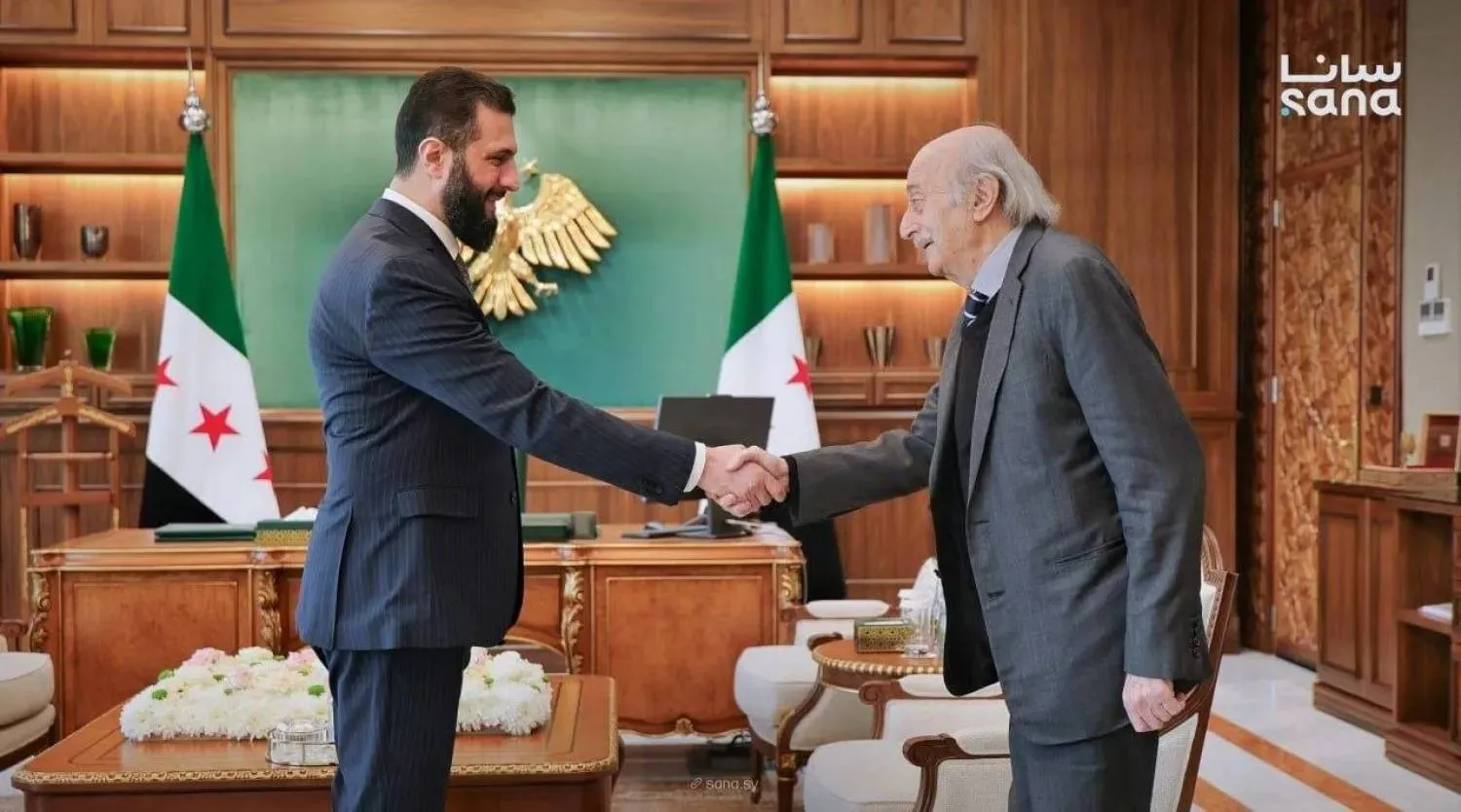
Syrian President Ahmed al-Sharaa and Lebanese Druze leader Walid Jumblatt meet in Damascus on Saturday. (SANA)
TT

Syria’s Sharaa, Lebanon’s Jumblatt Discuss Sweida Fallout, Reject ‘Alliance of Minorities’

Syrian President Ahmed al-Sharaa and Lebanese Druze leader Walid Jumblatt meet in Damascus on Saturday. (SANA)

A meeting in Damascus on Saturday between Syrian President Ahmed al-Sharaa and Lebanese Druze leader Walid Jumblatt focused on containing the fallout from violence in Syria’s Sweida province, strengthening Lebanese-Syrian ties and rejecting what both sides described as an “alliance of minorities.”

Jumblatt, former head of Lebanon’s Progressive Socialist Party, met Sharaa at the People’s Palace in Damascus amid heightened regional tensions and strains along the Lebanese-Syrian border.

A statement from the PSP said the talks stressed improving Lebanese-Syrian relations in a way that serves the common interests of both countries, while rejecting the “alliance of minorities” theory and emphasizing the social and geographic ties linking the two neighbors.

The statement reaffirmed Syria’s unity and called for addressing the aftermath of the deadly unrest in Sweida, the predominantly Druze province in southern Syria.

A brief Syrian presidency statement said the two sides reviewed recent regional developments.

Accompanying Jumblatt to Damascus, Lebanese MP Hadi Abou Al-Hassan said the talks focused on deepening bilateral ties based on respecting the sovereignty and independence of each country, while recognizing longstanding historical and social links.

He told Asharq Al-Awsat Syria’s new leadership was seeking to redefine relations with Lebanon after what he called the end of Syrian tutelage following the fall of Bashar al-Assad.

Abou Al-Hassan said “some actors in Syria and Israel were trying to revive the idea of an ‘alliance of minorities’, but that Damascus no longer viewed the concept as relevant and was instead focused on its strategic Arab ties.”

Saturday's talks also touched on what he described as shared concerns over Israeli escalation against both countries, including fears of a proposed “yellow line” security belt stretching across southern Lebanon from Naqoura to Mount Hermon and potentially into southern Syria.

He noted that such concerns reflected worries over “a dangerous Israeli plan that required coordination and joint efforts to confront.”

Developments in Sweida took up much of the discussions, particularly given Jumblatt’s role in containing the repercussions and his rejection of calls to attach the province to Israel or seek Israeli protection for the region.

Abou Al-Hassan said the talks stressed addressing the fallout from the violence and building on a meeting in Amman involving Syria, Jordan and the United States.

Jumblatt also underscored “support for Syria’s unity and for a strong central state guaranteeing equal rights for all citizens, while preventing any forces from challenging state sovereignty,” he said.

The meeting comes as Lebanese-Syrian ties have improved through border coordination and anti-smuggling efforts, despite Syrian concerns over reported weapons-smuggling tunnels and reports of a security cell in Damascus allegedly linked to Hezbollah, an ally of the ousted regime.

Abou Al-Hassan said both countries needed to dispel mutual concerns and build trust.


Israel Spy Chief Hails ‘Groundbreaking’ Ops in Iran, Lebanon

Israeli military vehicles maneuver on the Lebanese side of the border, as seen from the Upper Galilee in northern Israel, 27 April 2026. (EPA)
TT

Israel Spy Chief Hails ‘Groundbreaking’ Ops in Iran, Lebanon

Israeli military vehicles maneuver on the Lebanese side of the border, as seen from the Upper Galilee in northern Israel, 27 April 2026. (EPA)

The head of Israel's Mossad has praised the spy agency's "groundbreaking" operations in the war against Iran and Hezbollah, saying it acquired intelligence "from the heart of the enemy's secrets".

"In the campaigns against Iran and Hezbollah, we worked shoulder-to-shoulder with the army, on both defense and offence," David Barnea said, referring to the Israeli military.

His remarks were delivered during a commendation ceremony at Mossad headquarters on Monday and published on Tuesday.

"We acquired strategic and tactical intelligence from the heart of the enemy's secrets," Barnea said, adding that Mossad had "proved new, groundbreaking operational capabilities in target countries".

A ceasefire in the war with Iran, which began with US-Israeli strikes on February 28, has so far held.

In Lebanon, Hezbollah drew the country into the war on March 2 by firing rockets towards Israel to avenge the killing of Iranian supreme leader Ali Khamenei by the US and Israel.

US President Donald Trump announced a ceasefire on the Lebanese front earlier this month, which has since been extended.

Despite the truce, Israeli Prime Minister Benjamin Netanyahu said Monday that Hezbollah's rockets and drones remained a key threat demanding action by the Israeli military, adding that Israel was continuing to carry out strikes.

Hezbollah has said it is responding to Israeli ceasefire "violations".

Barnea said the military and Mossad had changed Israel's "strategic posture" and "strengthened its might", but added that the agency would "not rest on our laurels".

"When we see a threat, we will act with full force," he said.


Iran War Is Latest Blow to Somalia’s Malnourished Children

Fatima Mohamed feed Iqlas Omar Abdi, 1, with nutritious supplementary biscuit at the Daynile hospital as shortages of lifesaving therapeutic foods caused by shipping disruptions due to the Iran war have forced clinics treating severely malnourished children to turn away patients and ration supplies in drought-hit Somalia, in Daynile district of Mogadishu, Somalia April 20, 2026. (Reuters)
TT

Iran War Is Latest Blow to Somalia’s Malnourished Children

Fatima Mohamed feed Iqlas Omar Abdi, 1, with nutritious supplementary biscuit at the Daynile hospital as shortages of lifesaving therapeutic foods caused by shipping disruptions due to the Iran war have forced clinics treating severely malnourished children to turn away patients and ration supplies in drought-hit Somalia, in Daynile district of Mogadishu, Somalia April 20, 2026. (Reuters)

For Somalia's malnourished children, already suffering the twin catastrophes of looming famine and radical cuts in foreign aid, the US-Israeli war on Iran means more than soaring petrol pump prices; it is a matter of life and death.

Shortages of lifesaving therapeutic foods exacerbated by shipping disruptions are forcing clinics to turn away severely malnourished children and ration supplies, Reuters reporting shows.

Almost half a million children under 5 suffer from "severe acute malnutrition" or "wasting", the most life-threatening form of hunger, and the delays are worsening the effect of the aid reductions.

SOMALIA'S CHILDREN RELY ON EVER-SHRINKING FOOD AID

Health workers in Baidoa and Mogadishu say they have had to stretch out meagre stocks of specialized milk and nutrient-dense peanut-based paste vital to saving these children.

"Since the needs are large and we don't have a lot of supplies, we have had to keep reducing the amount we give children," nurse Hassan Yahye Kheyre said.

The 225 cartons of peanut paste remaining at his clinic, which treats more than 1,200 children, will probably be exhausted within two weeks, according to the International Rescue Committee, which supplies the facility.

"If ‌treatment is on-and-off, the ‌children will become very weak, physically and mentally. And it may not be possible to reverse it," ‌Kheyre ⁠added.

The IRC is ⁠one of three aid groups that said transport delays and rising costs linked to the war in Iran were making an already complicated situation worse.

At the clinic in the southwestern city of Baidoa, run by IRC's local partner READO, mother-of-nine Muumino Adan Aamin has been trying to get peanut paste for Ruweido, her 11-month-old daughter.

Ruweido is on a regimen of three sachets a day, but Aamin has been turned away twice because the clinic had run out each time.

Aamin nearly lost her daughter Anisa to hunger when a previous drought pushed Somalia to the brink of famine in 2017. "Just bone and skin," the toddler only survived because of peanut paste, Aamin said.

Nine years on, a new drought has pushed 6.5 million people, or one in three Somalis, ⁠into acute hunger, and aid groups are desperately trying to plug gaps.

An IRC order for peanut ‌paste that would have fed over 1,000 children got stuck two months ago in the ‌Indian port of Mundra, now congested with diverted cargoes unable to dock in the Gulf, said Shukri Abdulkadir, IRC's Somalia coordinator.

After being told that the peanut ‌paste, made in India, would take at least 30 more days to arrive, IRC cancelled the order.

It placed an emergency order for ‌400 cartons from Nairobi and is moving supplies in Mogadishu to Baidoa while awaiting them.

But the increase in freight and manufacturing costs has pushed the price of a single carton to $200 from $55, according to CARE International, whose latest order now buys enough for only 83 children rather than 300.

LIFE-SAVING FOOD AID TAKES LONGER AND COSTS MORE

In 2024, deliveries of therapeutic milk and ready-to-use therapeutic food (RUTF) from Europe to Somalia typically took 30–35 days, increasing to 40–45 days in 2025 as vessels diverted around ‌Africa owing to security threats in the Red Sea.

Since the United States and Israel attacked Iran on February 28 and Iran closed the entrance to the Gulf, a lack of ships ⁠has pushed that out to 55–65 days, ⁠said Mohamed Omar, head of Health and Nutrition at Action Against Hunger (ACF) in Mogadishu.

Meanwhile in Somalia, the IPC global hunger monitor says more than 2 million people are now in the "Emergency" phase, one level before famine.

Admissions of severely malnourished children in January-March to health centers supported by ACF were up 35% from last year.

Staff at Daynile General Hospital, which is treating 360 children for wasting, said on April 20 that they barely had enough supplies for the week.

"Some children's nutritional status has already worsened," said health and nutrition supervisor Xafsa Ali Hassan.

Somalia was not among 17 impoverished nations singled out to receive a share of this year's funds allocated to the UN Office for the Coordination of Humanitarian Affairs (OCHA) by the US, which has made the most drastic cuts among foreign aid donors.

OCHA says more than 200 health facilities have been closed and mobile teams disbanded.

It said in December that over 60,500 severely malnourished children had gone untreated as a result, and that the number could rise to 150,000 if funding gaps persisted.

Then, when the Iran war erupted, domestic fuel prices leapt 150%.

"Somalia is really hard hit by the Iran war because people are still reeling from the impact of the previous drought," said IRC's Abdulkadir. "It's very difficult for people to absorb these shocks."

OCHA has appealed for $852 million from global donors to stave off a full-blown famine.

This is far below the $1.42 billion it requested last year - yet it has still barely received 14% of this amount.


Israel Using Water Access as ‘Weapon’ in Gaza, Says MSF

 Palestinians walk past the rubble of residential buildings destroyed during the two-year Israeli offensive, in Khan Younis, southern Gaza Strip, April 15, 2026. (Reuters)
Palestinians walk past the rubble of residential buildings destroyed during the two-year Israeli offensive, in Khan Younis, southern Gaza Strip, April 15, 2026. (Reuters)
TT

Israel Using Water Access as ‘Weapon’ in Gaza, Says MSF

 Palestinians walk past the rubble of residential buildings destroyed during the two-year Israeli offensive, in Khan Younis, southern Gaza Strip, April 15, 2026. (Reuters)
Palestinians walk past the rubble of residential buildings destroyed during the two-year Israeli offensive, in Khan Younis, southern Gaza Strip, April 15, 2026. (Reuters)

Israeli authorities are systematically depriving people in Gaza of the water they need to live, Doctors Without Borders warned Tuesday, decrying a campaign of "collective punishment" against Palestinians.

The extensive destruction of civilian water infrastructure in Gaza coupled with obstruction of access constitutes "an integral part of Israel's genocide", said the medical charity, which goes by its French acronym MSF.

In a report entitled "Water as a Weapon", MSF said the "engineered scarcity" was occurring alongside "direct killing of civilians, the devastation of health facilities, (and) the destruction of homes".

Together, this amounted to "the deliberate infliction of destructive and inhumane conditions of life on the Palestinian population in Gaza", warned the report, based on testimonies and data MSF collected in 2024 and 2025.

"Israeli authorities know that without water, life ends," MSF emergency manager Claire San Filippo said in a statement.

"Yet they have deliberately and systematically obliterated water infrastructure in Gaza, whilst consistently blocking water-related supplies from entering."

Despite an October ceasefire that largely halted the Gaza war that began after Hamas's 2023 attack on Israel, the territory remains gripped by daily violence as Israeli strikes continue and both the Israeli military and Hamas accuse each other of breaking the truce.

- 'Engineered' scarcity -

The MSF report pointed to data from the United Nations, European Union and World Bank indicating that Israel had destroyed or damaged nearly 90 percent of water and sanitation infrastructure in Gaza.

"Desalination plants, boreholes, pipelines and sewage systems have been rendered inoperable or inaccessible," it said.

The charity documented several incidents where it clearly identified water trucks and boreholes had been shot at or destroyed.

"Palestinians have been injured and killed simply trying to access water," San Filippo said.

The charity said that besides the local authorities, it was the largest producer and main distributor of drinking water in Gaza.

Last month, it provided more than 5.3 million liters of water each day, which meets the minimum needs of more than 407,000 people, or a fifth of Gaza's population.

However, throughout the war, "Israeli military displacement orders have locked our teams out of areas where we had provided water to hundreds of thousands of people," the MSF statement said.

- 'Perfect storm' -

MSF said a third of its requests to bring in critical water and sanitation supplies, including water desalination units, pumps, water tanks, insect repellent, chlorine and other chemicals to treat water, had "been rejected or left unanswered".

San Filippo also cautioned that the deprivation of water, "combined with dire living conditions, extreme overcrowding, and a collapsed health system, create a perfect storm for the spread of diseases".

MSF called on Israel to "immediately restore water for people at the required levels in Gaza".

It urged Israel's allies to "use their leverage to pressure Israel to stop impeding humanitarian access".