


Summer Movie Preview: Nolan, Spider-Man and ‘Toy Story’ Light Up the Cinemas

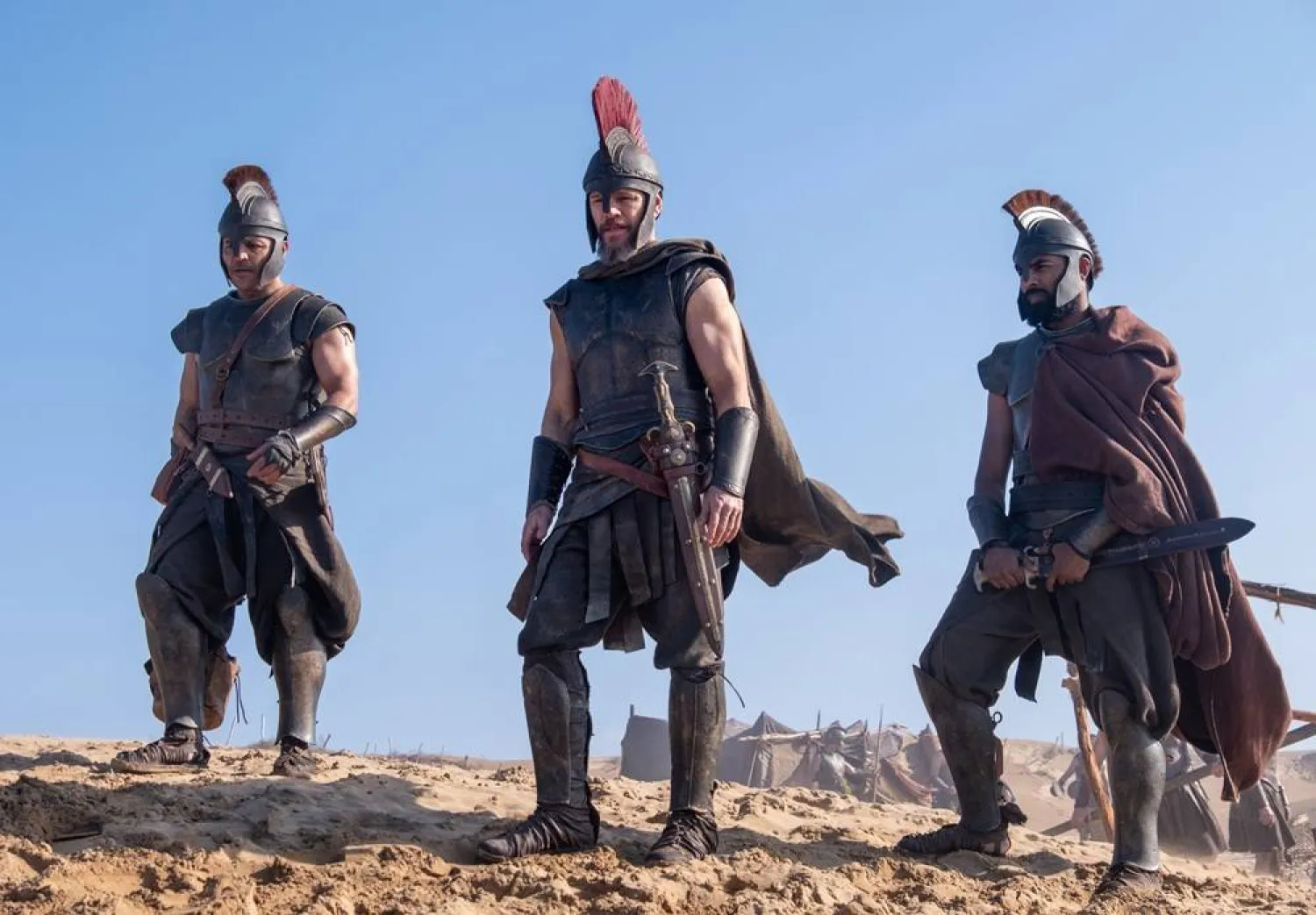
This image released by Universal Pictures shows, from left, Jimmy Gonzales ia Cepheus, Matt Damon as Odysseus and Himesh Patel as Eurylochus in a scene from "The Odyssey." (Melinda Sue Gordon/Universal Pictures via AP)
TT

Summer Movie Preview: Nolan, Spider-Man and ‘Toy Story’ Light Up the Cinemas

This image released by Universal Pictures shows, from left, Jimmy Gonzales ia Cepheus, Matt Damon as Odysseus and Himesh Patel as Eurylochus in a scene from "The Odyssey." (Melinda Sue Gordon/Universal Pictures via AP)

The movies always feel bigger in the summer. The budgets. The ambition. The names. The stakes. This summer, Hollywood has many of the regulars on the lineup: “Spider-Man,” “Minions,” “Star Wars” and “Toy Story.” But the most eagerly anticipated is not a superhero, toy, or franchise: It’s a 3,000-year-old epic poem.

For filmmaker Christopher Nolan, “The Odyssey,” out July 17, isn't just a story. It's the story: A foundational piece that deserved to be done on the biggest possible scale, with all the resources modern Hollywood had to offer.

“There’s a massive amount of pressure,” Nolan told The Associated Press. “Anyone taking on ‘The Odyssey’ is taking on the hopes and dreams of people for epic movies everywhere and that comes with a huge responsibility.”

It's a familiar feeling, though. He did three Batman films after all.

“What I learned from that experience is that what people want from a movie about a beloved story, a beloved set of characters, is they want a strong and sincere interpretation,” Nolan said. “They want to know that a filmmaker has gone to the mat for it. I really tried to make the best film possible.”

Three summers ago, “Oppenheimer” made nearly a billion dollars. “The Odyssey” has battles, creatures and an army of movie stars — Matt Damon, Anne Hathaway, Zendaya and Tom Holland included. It's also the first movie shot entirely on IMAX film. Tickets for some IMAX 70 mm showings sold out in under an hour a full year in advance.

“The Odyssey” will be shorter than “Oppenheimer”; Three hours is the longest they’ve been able to get onto an IMAX film projector, after all.

“It’s an epic film, as the subject matter demands,” Nolan said. “But it is shorter.”

Summer movie season's fashionable kickoff

Hollywood may not save all its blockbusters for the hottest months anymore, but the 18-week corridor running from the first weekend in May through Labor Day remains the industry’s most important, accounting for around 40% of the year’s box office. And it's only surpassed $4 billion once since the pandemic, in 2023.

Marvel movies often kick off the season, but last year filmmaker David Frankel got a call from Disney: “Avengers: Doomsday” wasn’t going to be ready by the first weekend in May; Could “The Devil Wears Prada 2” step up?

May 1 is just days before the Met Gala and it would give the movie a long runway to play, he figured. It would also require a bit of a sprint — they finished the film just weeks ago. But the enthusiasm was motivating, from fans snapping photos of Hathaway and Meryl Streep on the New York streets, to support from Anna Wintour.

Love for “Prada” isn’t the only thing that’s changed in 20 years; Magazines have also become an endangered species.

“How does Miranda Priestly deal with this changing world and what’s her future?” Frankel said. “The same with Andy Sachs: If all your ambition has been funneled in this one direction, what happens when you have to pivot and how do you adapt?”

The $4 billion question

The movie industry is also adjusting to a new paradigm. Box office is down over 20% from pre-COVID levels. The rise in streaming, the pandemic and shifting theatrical windows altered people’s moviegoing habits, perhaps permanently. And there may be one less major studio if Paramount acquires Warner Bros.

But, as James Cameron said, “hope springs eternal.

“We still have a very robust theatrical industry at a time when it was kind of almost pronounced dead,” Cameron said.

The gap is not widening. Studios are committing to longer exclusive theatrical windows. Original movies and premium formats are drawing crowds. And the market continues to expand globally.

Cameron is behind one of those only-in-a-theater experiences with the 3D Billie Eilish concert film (May 8). Using new technology, they used 17 camera systems to capture four nights of her Manchester shows last year.

“Seeing it in 3D is astonishing,” Cameron said. “You really feel an intimacy with her and yet you feel the scale of the spectacle.”

A summer for heavyweights

Nolan isn’t Universal’s only giant of cinema on its summer roster: Steven Spielberg is also returning to one of his most beloved genres with “Disclosure Day” (June 12). There are superhero movies as well, with “Supergirl” (June 26), which DC Studios co-head Peter Safran said is “is something cool and original and we haven’t seen before,” and “Spider-Man: Brand New Day” (July 31). The last Spidey film, which made over $1.9 billion, ended with Holland’s Peter Parker erasing himself from everyone’s memory.

“This is a blockbuster action movie with all the humor and emotion we love about Spider-Man,” director Destin Daniel Cretton said. “But at its heart, it’s a story about learning how to reconnect with the ones you love.”

A lot of power recently has shifted to PG-rated offerings. This summer has “Toy Story 5” (June 19), “Minions & Monsters” (July 1) and a live action “Moana” (July 10), which could all very well hit a billion dollars each.

One non-franchise family friendly film is “The Sheep Detectives” (May 8), in which the animals (Julia Louis-Dreyfus, Bryan Cranston) investigate the death of their beloved owner (Hugh Jackman). Writer Craig Mazin understands the hurdle: There have been a lot of stupid talking animal movies. But this one is different, he said, it's not just silly sheep doing silly things.

“There are some really beautiful moments and themes and things that parents can talk about with their kids,” Mazin said. “And most importantly, it is legitimately a movie that is meant for everyone.”

Then there's “Star Wars: The Mandalorian and Grogu” (May 22), which is rated PG-13 but has an impossibly cute alien going for it. It’s also one of several made for IMAX.

“People have got great TVs at home,” said director Jon Favreau. “You’ve got to give them a reason to go out.”

The scary movies

Movie studios also continue to lean into horror and this summer has both franchises, like “Evil Dead Burn”(July 10) and “Insidious: Out of the Further” (Aug. 21) and unnerving indies, including the “conversion therapy” horror “Leviticus,” “Rose of Nevada” (both June 19), and “Backrooms” (May 29).

And then there is “Scary Movie 6" (June 5), which sees the return of Regina Hall and Anna Faris, as well as Marlon and Shawn Wayans, who haven't been involved in the franchise they helped create since the 2001 sequel. And there were so many movies ripe for parody, like “M3GAN,” “Get Out,” “Weapons,” the just-released “Michael,” and “Sinners,” which Marlon Wayans was most excited about.

“Mockery is the greatest form of flattery,” Wayans said. “Sending up their movie was definitely tipping our hat to them.”

The festival darlings and other gems

Audiences want more than brands and blockbusters though. This year moviegoers have already proven they’ll turn out when the buzz is right, whether it’s for a big crowd pleaser like “Project Hail Mary” or for something more challenging like “The Drama.”

One that has the potential to break through is Olivia Wilde’s “The Invite” (June 26), a chamber dramedy about two very different couples (Wilde, Seth Rogen, Penélope Cruz and Edward Norton) over one night that sparked a bidding war at the Sundance Film Festival. Wilde was heartened that most studios were offering theatrical releases, and ultimately chose A24. They’ve even made a 35 mm print.

“The whole project for me is really tipping my hat to Mike Nichols,” Wilde said. “We thought of the audiences that have always loved those films.”

There are plenty of indies and originals to choose from throughout the summer, including Daniel Roher’s “Tuner,” about a piano prodigy turned safecracker, Boots Riley’s colorful shoplifting movie “I Love Boosters,” (both May 22) and a John Carney musical with Paul Rudd (“Power Ballad,” June 5).

As Wilde said, there’s room for both originals and franchises.

“The audience really likes to recognize risk,” she said. “There’s something exciting about that.”



Hollywood Studios and Actors’ Union Find Common Ground on AI

 SAG-AFTRA chief negotiator Duncan Crabtree-Ireland attributed the mostly drama-free agreements with studios during this round of negotiations to a new mindset. (AFP)
SAG-AFTRA chief negotiator Duncan Crabtree-Ireland attributed the mostly drama-free agreements with studios during this round of negotiations to a new mindset. (AFP)
TT

Hollywood Studios and Actors’ Union Find Common Ground on AI

 SAG-AFTRA chief negotiator Duncan Crabtree-Ireland attributed the mostly drama-free agreements with studios during this round of negotiations to a new mindset. (AFP)
SAG-AFTRA chief negotiator Duncan Crabtree-Ireland attributed the mostly drama-free agreements with studios during this round of negotiations to a new mindset. (AFP)

As Hollywood's performers cast their ballots to approve the latest negotiated contract, union leaders say they have made some progress in conversations with studio bosses since the massive strike in 2023, especially when it comes to concerns about artificial intelligence.

SAG-AFTRA chief negotiator Duncan Crabtree-Ireland attributed the mostly drama-free agreements in this round of negotiations to a new mindset, "because the studios and streamers came to the table with a different perspective."

With 160,000 members working in film, television and video games, SAG-AFTRA is the largest and most influential union of its kind globally.

Members of the actors' union are voting on a newly negotiated agreement that was approved by the national board earlier this month, ahead of the current contract's expiration at the end of June.

"The tone of the negotiation was much more collaborative and a lot more creativity was brought by both sides, so I really believe that the 2023 strikes -- while they were very difficult for all of us -- did help effectuate a reset in the relationship between the studios and the unions in general," Crabtree-Ireland told AFP.

Approval would mean avoiding a repeat of disastrous 2023 strikes that shuttered productions, costing studios billions of dollars, while actors stood their ground against AI and other issues.

- AI's evolutions -

The strike by the Screen Actors Guild-American Federation of Television and Radio Artists (SAG-AFTRA) lasted 118 days, with star-studded picket lines outside major studios in Los Angeles and New York, marking the longest such revolt in Hollywood history.

AI technology was a sticking point for many, and that tension persists, Crabtree-Ireland said.

"They do feel more secure than they did in 2023 but there's still a very, very strong concern about AI -- and especially because the generative AI tools have advanced so much in the last three years," he said.

The latest agreement does not close the door on AI, but it does introduce new protections.

Under the new contract, digital replicas -- which use AI or any technology to replicate an actual living or deceased performer -- must "have informed consent and fair compensation," Crabtree-Ireland said.

The contract allows for limited use of synthetics, under "unusual circumstances," when a generative AI system can be used to create a character who is not based on any actual person in the world.

"There's now process in place which would require the companies to come to the union if they want to use a synthetic in a project, they have to demonstrate to us that this synthetic brings a significant additional value to the production," Crabtree-Ireland said.

"While this doesn't rise quite to the level of a complete prohibition, it's a very strong disincentive."

Voting on the latest contract closes June 4.


Oscar-Winning ‘Star Wars’ Editor Marcia Lucas Dies at 80

Marcia Lucas, wife of director George Lucas, right, carries her Oscar statuette as they arrive at a post Academy Awards party at the Beverly Hilton Hotel in Los Angeles, April 4, 1978. (AP)
TT

Oscar-Winning ‘Star Wars’ Editor Marcia Lucas Dies at 80

Marcia Lucas, wife of director George Lucas, right, carries her Oscar statuette as they arrive at a post Academy Awards party at the Beverly Hilton Hotel in Los Angeles, April 4, 1978. (AP)

Marcia Lucas, who won an Oscar as editor of the original 1977 “Star Wars" and was part of a group of women whose editing was essential to film's New Hollywood era, has died, a lawyer for her family said Friday. She was 80.

Lucas, who was married to “Star Wars” creator George Lucas from 1969 to 1983, died Wednesday from metastatic cancer, attorney Deidre Von Rock said in an email to The Associated Press. She died in Rancho Mirage, California, surrounded by loved ones, Von Rock said.

Marcia Lucas was the editor on 1983's “Return of the Jedi” and the pre-“Star Wars” George Lucas-directed films “THX 1138” and “American Graffiti.”

She was also part of the editing team for director Martin Scorsese's 1970s films “Taxi Driver,” “Alice Doesn't Live Here Anymore” and “New York, New York.”

Editor was a rare senior creative position where a woman could find a foothold in Hollywood. Marcia Lucas became one of several women whose work in the editing chair made sense of the work of the overwhelmingly male directors of the New Hollywood of the late 1960s through the early 1980s, including Dede Allen, editor of “Bonnie and Clyde” and “Dog Day Afternoon”; Verna Fields, editor of “Paper Moon” and “Jaws"; and Thelma Schoonmaker, editor of most of Scorsese's films starting with 1980's “Raging Bull.”

Lucas was often called the unsung hero of “Star Wars,” the original film that after sequels, prequels and spinoffs has come to be known by its subtitle, “A New Hope.”

She convinced her then-husband that he should have Obi-Wan Kenobi, played by Alec Guinness, die in his lightsaber battle with Darth Vader and become a spirit guide to Mark Hamill's Luke Skywalker.

And she had to make sense of raw footage that could have been a mess in the wrong hands, including the climactic rebel attack on the Death Star.

“It was extremely complex and we had 40,000 feet of dialogue footage of pilots saying this and that. And she had to cull through all that, and put in all the fighting as well,” George Lucas told Rolling Stone in an interview a few months after the film came out. “Nobody really has ever tried to interweave an actual plot story into a dogfight, and we were trying to do that."

Lucas was born Marcia Griffin in Modesto, California shortly after the end of World War II. She moved to Los Angeles with her mother after her parents divorced when she was a small child.

She began working as a film librarian and moved into working as an editor on commercials, trailers and promotional films. She was an assistant editor on the documentary “Journey to the Pacific” for Fields, who also hired George Lucas, then a film student at the University of Southern California.

The couple became engaged soon after. Their marriage would essentially end in 1982, but they kept their divorce under wraps until after the release of “Return of the Jedi” in 1983. Marcia Lucas was then married to Tom Rodrigues, a production manager at the Skywalker Ranch production center, from 1983 to 1993.

She is survived by her daughters, Amanda Lucas and Amy Soper, and grandchildren Felix Hallikainen, Aeliana Hallikainen and Knox Soper.

"Her influence on film is indelible, but those who knew her best will remember the way she made life feel more vivid, more beautiful, more fun, and more full of love,” a family statement said. “Her work was known for its emotional intelligence, rhythm, and humanity — a rare ability to find the truth of a scene and bring heart, momentum, and clarity to the screen.”


The Golden Trailer Awards: Hollywood’s ‘Oscars’ for Movie Previews

The gala started in 1999 when co-founders Monica Brady and Evelyn Watters were looking for a team to produce a trailer. (Getty Images/AFP)
TT

The Golden Trailer Awards: Hollywood’s ‘Oscars’ for Movie Previews

The gala started in 1999 when co-founders Monica Brady and Evelyn Watters were looking for a team to produce a trailer. (Getty Images/AFP)

The Golden Trailer Awards, which recognize the people behind Hollywood's best-made movie previews, returned for its 26th edition Thursday.

The gala started in 1999 when co-founders Monica Brady and Evelyn Watters were looking for a team to produce a trailer, only to find that those who worked in the field were practically anonymous.

"Trailer editors, the people creating some of the most memorable moments of the moviegoing experience, were completely unrecognized," Brady told AFP.

"They weren't credited on trailers, they weren't credited in films, and there wasn't even a directory to find them."

The pair, who remain as executive producers on the award show, oversaw 19 prizes given out during the inaugural ceremony in New York.

The ceremony was held in Los Angeles and recognized achievements in more than 100 categories.

The night's most coveted statuette for Best of Show went to the trailer for sci-fi movie "Project Hail Mary", starring Ryan Gosling, which was created by Wild Card Creative Group.

But what makes one movie trailer stand out from the rest?

"What makes a great trailer, first and foremost, is a great hook," Watters said.

- 'A tempting appetizer' -

An honoree will likely have "a fresh storyline, compelling characters, an emotional moment, and something audiences haven't seen before," she explained ahead of the ceremony.

"A winning trailer is a tempting appetizer, it is not the whole meal."

Taylor Engel, a creative director at Create Advertising Group -- which received 16 nominations this year for the company's work on trailers for "Sinners,Tron: Ares" and "Only Murders in the Building" -- said editing a trailer is like putting together pieces of a puzzle.

"We get materials at the beginning of the project, and it could be anything. Sometimes you get the movie, sometimes you get just dailies, you know, just the scenes that they shot," Engel said.

The challenge lies in combining the audio, video and editing effects to "tell maybe a different story or showcase the movie in some way."

Like film editing, movie trailers have evolved over the decades in Hollywood, and the crowded marketplace for attention has led to fierce competition.

Sometimes, the trailer ends up being better than the movie itself -- something that has become its own category in the Golden Trailer Awards.

Dubbed the "Golden Fleece," this year's nominees include trailers for the horror film "Shell" starring Elisabeth Moss and "The Strangers: Chapter 3."

- No AI used -

Despite the intense competition and demand, Engel said that the work in making movie trailers is not under the same pressure to utilize artificial intelligence as other sectors of Hollywood.

"Every cut is very specific in why you pair a shot with a certain piece of music," Engel said.

AI tools "may get better at recreating what's been done in the past, but what's exciting about trailers is when you see something that you've never seen before, you see it done in a different way," the creative director said.