

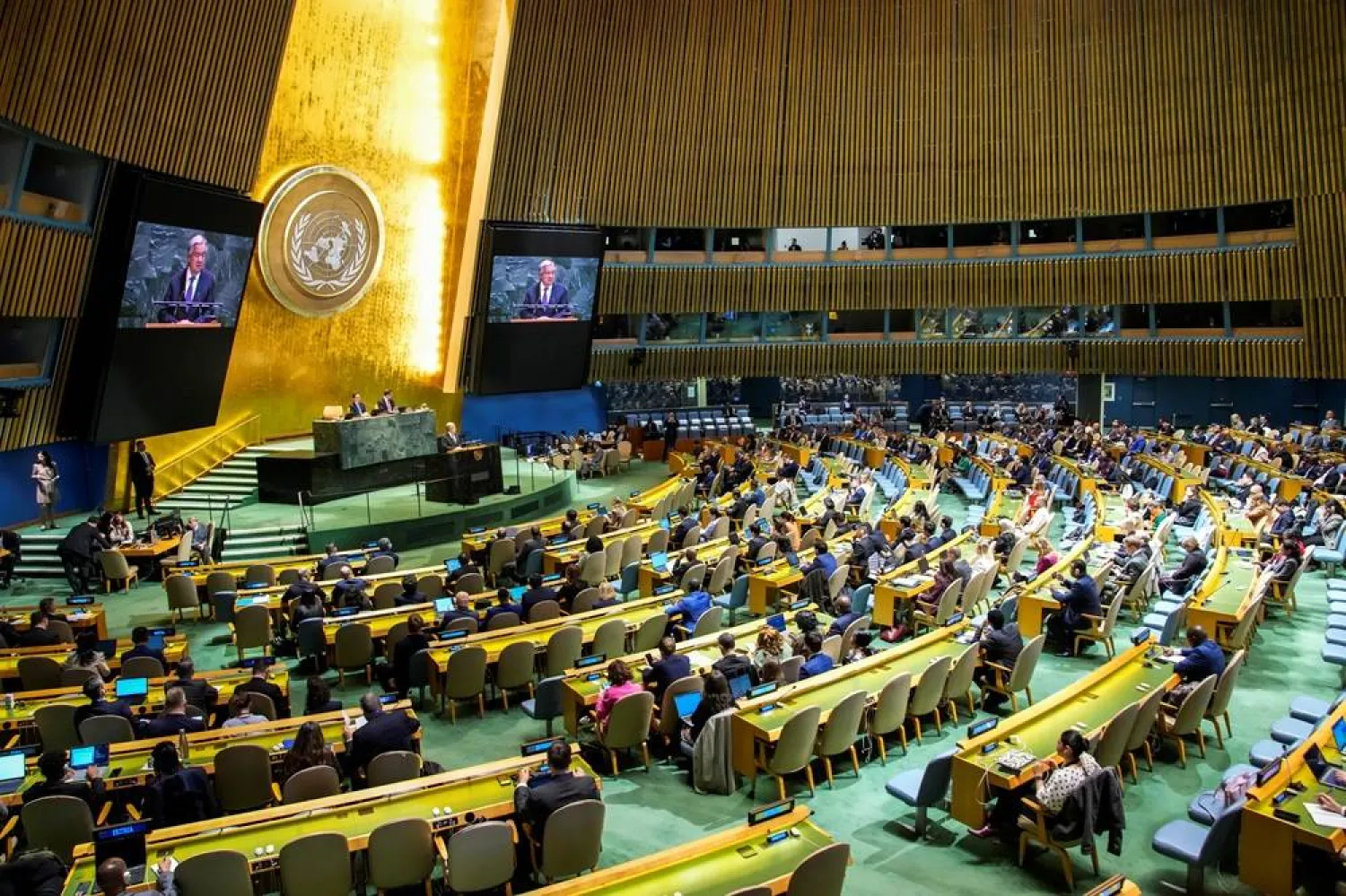

‘Looming’ Risk of Nuclear Arms Race, UN Proliferation Meeting Hears

United Nations Secretary-General Antonio Guterres speaks to delegates during a meeting on Nuclear Non-Proliferation Treaty at UN headquarters in New York City, US, April 27, 2026. (Reuters)
TT

‘Looming’ Risk of Nuclear Arms Race, UN Proliferation Meeting Hears

United Nations Secretary-General Antonio Guterres speaks to delegates during a meeting on Nuclear Non-Proliferation Treaty at UN headquarters in New York City, US, April 27, 2026. (Reuters)

Signatories of the landmark nuclear non-proliferation treaty began a meeting at the UN on Monday as fears of a renewed arms race escalate, with atomic powers once again at loggerheads over safeguards.

In 2022, during the last review of the treaty considered the cornerstone of non-proliferation, UN Secretary-General Antonio Guterres warned humanity was "one misunderstanding, one miscalculation away from nuclear annihilation."

On Monday he warned "the drivers" of nuclear weapons proliferation were accelerating.

"For too long, the Treaty has been eroding. Commitments remain unfulfilled. Trust and credibility are wearing thin. The drivers of proliferation are accelerating. We need to breathe life into the Treaty once more," Guterres said in opening remarks.

With global geopolitical friction only heightened since the last meeting, it was unclear what the two-week gathering at UN headquarters in New York could achieve.

"We should not expect this conference to resolve the underlying strategic tensions of our time... but a balanced outcome that reaffirms core commitments and set out practical steps forward would strengthen the integrity of the NPT," said Do Hung Viet, Vietnam's UN ambassador and president of the conference.

"The success or failure of this conference will have implications way beyond these halls and way beyond these next five years, the prospects of a new nuclear arms race are looming over us," he said.

The nuclear non-proliferation treaty (NPT), signed by almost all the countries on the planet -- with notable exceptions including Israel, India, and Pakistan -- aims to prevent the spread of nuclear weapons, to promote complete disarmament, and to encourage cooperation on civilian nuclear projects.

The nine nuclear-armed states -- Russia, the United States, France, the United Kingdom, China, India, Pakistan, Israel, and North Korea -- possessed 12,241 nuclear warheads in January 2025, according to the latest report by the Stockholm International Peace Research Institute (SIPRI).

The United States and Russia hold nearly 90 percent of nuclear weapons globally and have carried out major programs to modernize them in recent years, according to SIPRI.

China has also rapidly increased its nuclear stockpile, SIPRI said, with the G7 raising the alarm Friday over Moscow and Beijing boosting their nuclear capabilities.

US President Donald Trump has indicated his intention to conduct new nuclear tests, accusing others of doing so clandestinely.

In March, France's President Emmanuel Macron announced a dramatic shift in nuclear deterrence, notably an increase in the atomic arsenal, currently numbering 290 warheads.

- 'Affront' to NPT -

"It is obvious that trust is eroding, both inside and outside the NPT," Seth Shelden of the International Campaign to Abolish Nuclear Weapons (ICAN), a Nobel Peace Prize laureate, told AFP.

He questioned the likely outcome of the four-week summit.

Decisions on the NPT have to be agreed by consensus, with the previous two conferences failing to adopt final political declarations.

In 2015, the deadlock was largely due to opposition by Israel's arch-ally Washington to the creation of a nuclear-weapon-free zone in the Middle East.

In 2022, the impasse was due mainly to Russian opposition to references to Ukraine's nuclear power plant at Zaporizhzhia, occupied by Moscow.

This year's summit could fall on any number of stumbling blocks.

The ongoing war in Ukraine, Iran's nuclear program and the war there, non-nuclear states' fears over proliferation and North Korea's developing arsenal could all be deal-breakers.

The United States along with its allies Britain and Australia spoke out at Iran's appointment as a conference vice president.

Washington's envoy to the meeting said conferring a leadership role on Tehran was an "affront" to countries that take the NPT "seriously."

Artificial intelligence could be a prominent issue as some countries call for all sides to keep human control over nuclear weapons.



US Military Conducts Rapid Response Exercise at Embassy in Venezuela

US Embassy holds emergency and air evacuation drill in Caracas, Venezuela, Saturday, May 23, 2026. (AP Photo/Pedro Mattey)
TT

US Military Conducts Rapid Response Exercise at Embassy in Venezuela

US Embassy holds emergency and air evacuation drill in Caracas, Venezuela, Saturday, May 23, 2026. (AP Photo/Pedro Mattey)

The US military conducted a rapid response exercise involving Marines and military aircraft in Venezuela’s capital Saturday, over four months after the ouster of then-President Nicolás Maduro.

Two Marine Corps Osprey aircraft, which have characteristics of both a helicopter and a fixed-wing airplane, flew over the recently reopened US Embassy in Caracas. They landed in the parking lot with the downdraft blowing tree branches. Forces then descended from the aircraft.

“Ensuring the military’s rapid response capability is a key component of mission readiness, both here in Venezuela and around the world,” The Associated Press quoted the embassy as saying on Instagram.

Venezuela’s government had announced the drill earlier this week. Foreign Minister Yván Gil said the US would conduct the exercise to prepare “in the event of medical emergencies or catastrophic emergencies.”

The drill comes almost two months after the US formally reopened its embassy in Caracas. The reopening followed the restoration of full diplomatic relations with the South American country after Maduro 's ouster in early January.

Some Caracas residents Saturday gathered near the embassy to watch the aircraft, while a few dozen others gathered elsewhere in the city to protest the exercise. Protesters held a Venezuelan flag with the message “No to the Yankee drill” written over it.

US military aircraft last flew over Caracas on Jan. 3, when elite forces rappelled down from helicopters and captured Maduro and his wife. Both were taken to New York to face drug trafficking charges. They have pleaded not guilty.


Trump Says Negotiators Are Getting Closer to Iran Deal

FILE PHOTO: US President Donald Trump leaves Marine One to board Air Force One en route to Joint Base Andrews, Maryland, as he departs Morristown Airport in Morristown, New Jersey, US, May 22, 2026. REUTERS/Kylie Cooper/File Photo
TT

Trump Says Negotiators Are Getting Closer to Iran Deal

FILE PHOTO: US President Donald Trump leaves Marine One to board Air Force One en route to Joint Base Andrews, Maryland, as he departs Morristown Airport in Morristown, New Jersey, US, May 22, 2026. REUTERS/Kylie Cooper/File Photo

President Donald Trump said on Saturday that negotiators for the United States and Iran were "getting a lot closer" to finalizing an agreement to end the war, according to an interview with CBS News.

He said a final agreement would prevent Iran from obtaining a nuclear weapon and would ensure that Iran's enriched ⁠uranium would be "satisfactorily handled," ⁠according to CBS.

"I will only sign a deal where we get everything we want," Trump was quoted as saying.

But in the interview with the TV network, Trump also warned that if the US and Iran do not come to an agreement, "we're going to have a situation where no country will ever be hit as hard as they're about to be hit."

Iran, the United States and mediator Pakistan all said on Saturday that ⁠progress had been made in talks on ending almost three months of war.

Trump said he would discuss the latest Iran draft agreement with advisers on Saturday and might make a decision on whether to resume the war by Sunday, he told Axios in a separate interview.

"Either we reach a good deal or I'll ⁠blow ⁠them to a thousand hells," Trump said, according to Axios.

Trump has vacillated between the two poles of diplomacy and military strike since a ceasefire was declared six weeks ago to allow the sides to come to agreement on Iran's nuclear program and on reopening the Strait of Hormuz, a critical oil and gas supply route now controlled by Tehran.

Iran signaled on Saturday “narrowing differences” in negotiations with the US after Pakistan’s army chief held more talks in Tehran, and US Secretary of State Marco Rubio told journalists in India that “there’s been some progress made" and “there may be news later today.”


Rubio Says Progress Made on Iran

US Secretary of State Marco Rubio looks on as he speaks with reporters during a meeting of NATO foreign ministers, in Helsingborg, Sweden May 22, 2026. Julia Demaree Nikhinson/Pool via REUTERS
TT

Rubio Says Progress Made on Iran

US Secretary of State Marco Rubio looks on as he speaks with reporters during a meeting of NATO foreign ministers, in Helsingborg, Sweden May 22, 2026. Julia Demaree Nikhinson/Pool via REUTERS

US Secretary of State Marco Rubio said on Saturday that some progress has been made on Washington's dispute with Iran and that the US might have "something to say" on the issue in the coming days.

"There's been some progress done, some progress made, even as I speak to you now, there's some work being done. There is a chance that, whether it's later today, tomorrow, in a couple days, we may have something to say," Rubio told reporters during his visit to New Delhi.

Meanwhile, Iranian foreign ministry spokesman Esmaeil Baqaei said on Saturday that Tehran was in the final stages of drafting a framework for a deal to end the war with the United States.

"Within a reasonable period of 30 to 60 days, the details of these points will be discussed and a final agreement will ultimately be concluded. We are currently in the process of finalizing these memoranda of understanding," he told state broadcaster IRIB.