


Senior Hezbollah Commander Reportedly Killed by Israel in Beirut Suburbs Strike

The scene following an Israeli airstrike on Dahieh, Beirut, Lebanon, 06 May 2026. EPA/WAEL HAMZEH
TT

Senior Hezbollah Commander Reportedly Killed by Israel in Beirut Suburbs Strike

The scene following an Israeli airstrike on Dahieh, Beirut, Lebanon, 06 May 2026. EPA/WAEL HAMZEH

A senior commander from Hezbollah's elite force was killed in an Israeli strike on Beirut's southern suburbs on Wednesday, the first on the area in nearly a month, a source close to the group said.

At least 11 other people were killed in strikes across the south and east, according to the Lebanese health ministry.

Israeli Prime Minister Benjamin Netanyahu said his military had targeted "the commander of Hezbollah's Radwan force.”

The source close to Hezbollah told AFP on condition of anonymity that "Malek Ballout, the operations commander in the Radwan force" was killed.

Lebanon's state-run National News Agency had reported that "Israeli warplanes launched an attack, targeting Ghobeiri" in the southern suburbs, a Hezbollah stronghold.

An AFP correspondent saw a building covered in rubble following the strike, as people left the area with their belongings.

Many of the southern suburbs' residents had already left after Hezbollah drew Lebanon into the Middle East war in March, and have not returned despite the truce in force since April 17.

A Lebanese security source told AFP on condition of anonymity that the strike hit an apartment in which Radwan leaders were holding a meeting.

Beirut and its southern suburbs had been spared Israeli attacks since April 8, when massive Israeli strikes across the country killed more than 350 people.

Wednesday's attack came as US President Donald Trump said there was "a very good chance" of sealing a peace deal with Iran.
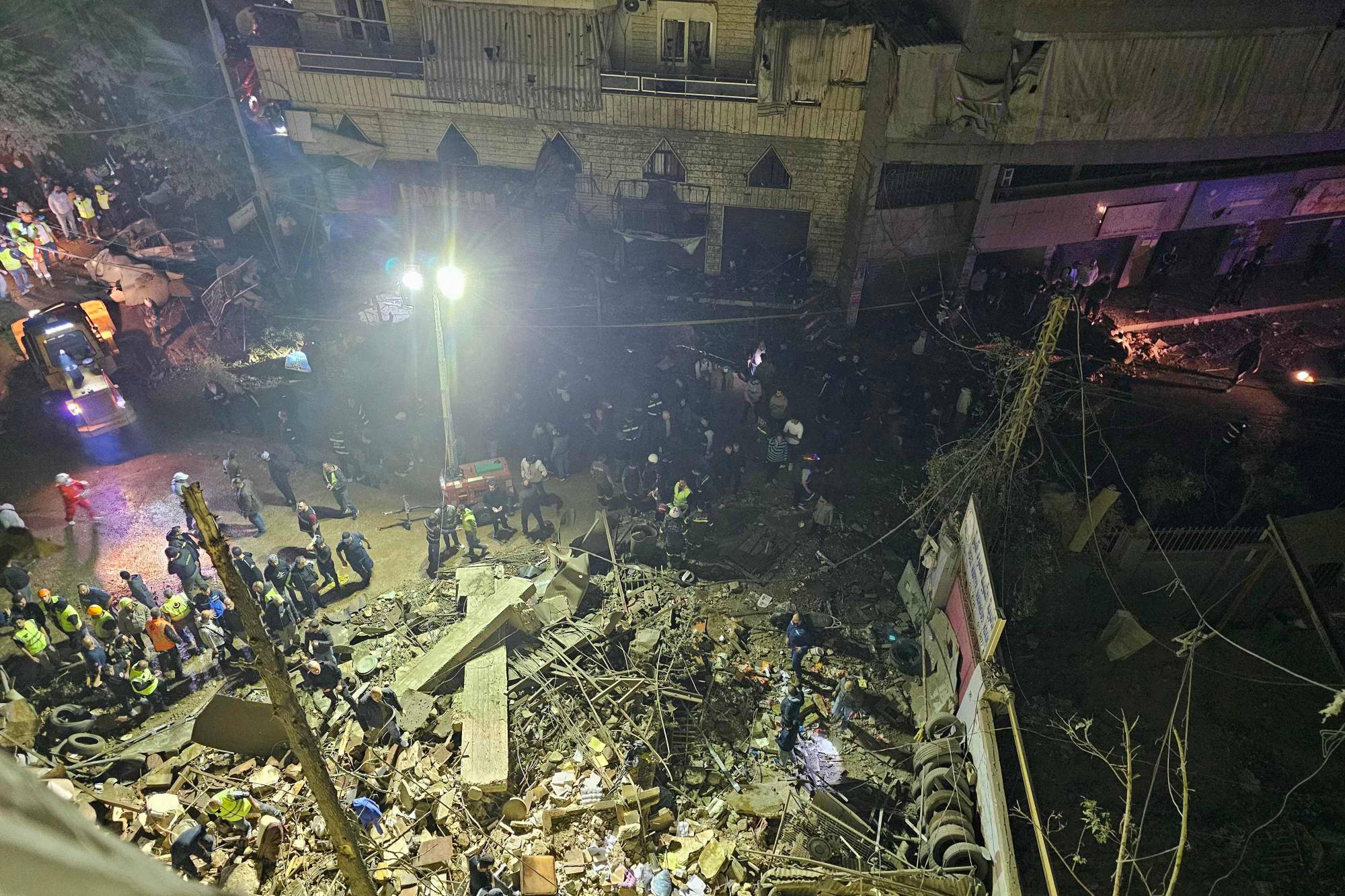
First responders gather at the site of an Israeli airstrike in Beirut's southern suburbs on May 6, 2026. (Photo by AFP)

Israel has repeatedly bombed Lebanon, particularly the south, since the truce, with Hezbollah retaliating by launching attacks on Israeli troops.

The Israeli military said in a statement Thursday that an "explosive drone impact" wounded four soldiers -- one severely -- in southern Lebanon the previous day.

At least 11 people were killed in earlier Israeli strikes on southern and eastern Lebanon, the Lebanese health ministry said.

In Saksakiyeh, four people were killed and 33 wounded, including six children and four women.

The NNA also reported strikes across the south, including several on the town of Yater.

Israeli strikes on Lebanon have killed more than 2,700 people and displaced more than a million, particularly from southern and eastern Lebanon and Beirut's southern suburbs, since March 2.

World Health Organization chief Tedros Adhanom Ghebreyesus said on Wednesday it had "verified 152 attacks on healthcare that resulted in 103 deaths and 241 injuries.”

"These attacks have resulted in the closure of three hospitals and 41 primary health centers and caused damage to a further 16 hospitals."

The terms of the ceasefire allow Israel to act against "planned, imminent or ongoing attacks" by Hezbollah.

Visiting troops in southern Lebanon, where Israel has established a "yellow line,” Israeli army chief Eyal Zamir said they will "seize every opportunity to deepen the dismantling of Hezbollah and continue weakening it.”



Lebanese President Stresses National Unity, PM Says No Normalization with Israel

Parliament Speaker Nabih Berri meets with Prime Minister Nawaf Salam. NNA
TT

Lebanese President Stresses National Unity, PM Says No Normalization with Israel

Parliament Speaker Nabih Berri meets with Prime Minister Nawaf Salam. NNA

Lebanese President Joseph Aoun has stressed the importance of “national unity” as Prime Minister Nawaf Salam said it was premature to talk of any high-level meeting between Lebanon and Israel.

Speaking during a meeting with heads of Akkar municipal federations and mukhtars at Baabda Palace on Wednesday, Aoun stressed “the importance of strengthening national unity,” noting that “preserving Lebanon requires not repeating the mistakes of the past.”

“We will preserve Lebanon, and we will not forget the past so that we do not repeat it in the present or the future. Let this past be a lesson from which we learn; we must always remember that we have always been together in this country and will remain so, and this is our shared responsibility,” Aoun added.

Hostilities between Israel and Hezbollah have continued to rage in southern Lebanon despite a US-mediated ceasefire between Lebanon and Israel announced on April 16.

Washington last month hosted two meetings between the Israeli and Lebanese ambassadors to the United States.

In his remarks on Wednesday, Salam said Lebanon was not seeking "normalization with Israel, but rather achieving peace.”

The current circumstances "are not ripe to talk about high-level meetings," he added.

"Our minimum demand is a timetable for Israel’s withdrawal," he said, adding that the government would develop its plan to restrict weapons to state control - an effort aimed at securing Hezbollah's disarmament.

Also Wednesday, the Council of Maronite Bishops reiterated its support “for all efforts made by the President of the Republic, the government, and the Parliament to stop the war, reclaim Lebanese territories, rebuild, and facilitate the return of displaced persons and prisoners.”

The Council meeting, which was chaired by Maronite Patriarch Beshara al-Rahi, stressed in a statement that “the moment Lebanon is experiencing is historic and pivotal, requiring courageous and responsible national stances rooted in Lebanon's supreme interest and national security.”

The Council affirmed that “Lebanon is not merely a circumstantial political entity, but a message founded on freedom, pluralism, and coexistence,” emphasizing that “the full and non-selective implementation of the Taif Agreement remains the fundamental entry point for rebuilding the state, consolidating the principle of exclusive state control over arms, and strengthening the role of institutions.”

It also considered that “the language of treason, threats, and blatant media campaigns serves only the enemies of Lebanon,” affirming Lebanon's commitment to Arab and international legitimacy and to international resolutions, especially Security Council resolutions 1559, 1680 and 1701.

The Council spoke of “major transformations in the region,” noting that they “necessitate an approach to the negotiation process with Israel under Arab and international sponsorship in a way that serves Lebanon's supreme interest,” considering that “a return to the 1949 Lebanese-Israeli Armistice Agreement can constitute a fundamental milestone in this path.”


Syrian Forces Detain Uzbek Fighters in Security Sweep

Syrian security forces in Aleppo on May 27 (Reuters)
TT

Syrian Forces Detain Uzbek Fighters in Security Sweep

Syrian security forces in Aleppo on May 27 (Reuters)

Syrian forces have arrested Uzbek fighters during a security sweep in the northwest, after a dispute involving one of them escalated into protests outside a government security facility, two Syrian security officials said.

The tensions began after authorities sought to detain an Uzbek fighter accused of opening fire in Idlib city, prompting demonstrations by armed Uzbek fighters demanding his release, according to the officials and locals.

The Syrian Ministry of the Interior did not immediately respond to Reuters' request for comment.

The incident underscores a delicate challenge facing Syria’s government as it attempts ‌to exert state ‌authority over foreign extremists who came to Syria ‌to ⁠fight in the ⁠civil war after 2011.

Security forces carried out arrests in several areas of Idlib countryside, including the towns of Kafriya and al-Foua, targeting Uzbek fighters who participated in the protest, locals and officials said. Military ⁠reinforcements and convoys were deployed around Kafriya and al-Foua ‌towns in Idlib province, where sporadic gunfire ‌was heard.

It was not immediately clear how many of the Uzbek ‌fighters had been arrested.

A Syrian security source told Reuters last year ‌there were around 1,500 Uzbek fighters in Syria, some with families.

It marks the second confrontation in recent months between Syrian government forces and foreign militants in Idlib, after tensions surrounding a camp led by French extremist Omar Diaby, known as ‌Omar Omsen, near the Turkish border last October.

The Syrian government has sought to formalize the ⁠status of many of ⁠the foreign fighters, bringing thousands of them into the structure of the new Syrian army.

Reuters reported last year that the United States had given its blessing to a Syrian plan to integrate around 3,500 foreign fighters, mainly Uyghurs from China and neighboring countries, into a newly formed army division, arguing that bringing them under state control was preferable to leaving them outside official structures.

Sharaa has built close ties to the United States over the last year, and Damascus joined a US-led coalition against the ISIS extremist group in November.


Egypt Steps Up Regional De-escalation Contacts

Egypt Steps Up Regional De-escalation Contacts
TT

Egypt Steps Up Regional De-escalation Contacts

Egypt Steps Up Regional De-escalation Contacts

Egyptian contacts with regional leaders and officials continue as part of de-escalation efforts to calm tensions between Washington and Tehran and positive signals over a possible memorandum of understanding to end the war.


Egyptian President Abdel Fattah al-Sisi stressed the need to intensify efforts to reduce regional tension during a phone call with Oman’s Sultan Haitham bin Tariq.


During the call which highlighted the regional developments, Sisi praised Oman’s constructive role in this matter.


He also reviewed Egypt’s efforts toward the same goal. According to a statement by the Egyptian presidency, he stressed the importance of preserving peace and stability in the Middle East, avoiding escalation, and resolving the current crisis through peaceful means.


Egyptian Foreign Minister Badr Abdelatty also held a phone call with Qatar’s Prime Minister and Foreign Minister Sheikh Mohammed bin Abdulrahman Al Thani to discuss ways to advance de-escalation efforts in the region, Egypt’s Foreign Ministry said on Wednesday.


During the call, the two sides stressed the importance of continuing the negotiating track between the US and Iran. They said a political and diplomatic solution was the only and most effective way to address the current crisis.


Abdelatty welcomed a US decision to temporarily halt a military operation linked to reopening the Strait of Hormuz, saying it would provide space for ongoing efforts to reach a final agreement with Iran.


Responsibility and wisdom


The two sides said they hoped all concerned parties would act with responsibility and wisdom, and remain fully committed to diplomacy, negotiations, and dialogue as the main way to address all concerns.


They said lasting regional security and stability depend primarily on prioritizing political solutions that protect the resources of the region’s peoples and safeguard their interests.


At the end of the call, the two ministers agreed to continue their efforts, in cooperation with regional partners and in full coordination with the United States, to quickly reach an agreement on general principles between Washington and Tehran that would address all concerns. Negotiations would then begin on putting those principles into effect.


Abdelatty stressed the need to take into account the security concerns of Gulf states and other countries in the region.


The Egyptian foreign minister also briefed German National Security Adviser Günter Sautter during a phone call on Wednesday on Egypt’s efforts to stop the escalation and contain tensions.


Abdelatty stressed the importance of continuing the negotiating track between the United States and Iran, describing it as the most suitable way to resolve the current crisis.


Continuing contacts


Egyptian contacts have continued notably since the war with Iran broke out in late February. On Tuesday, Abdelatty held phone calls with his counterparts in Saudi Arabia, Prince Faisal bin Farhan; Oman, Badr Albusaidi; Kuwait, Abdullah Ali Al-Yahya; Bahrain, Abdullatif Al Zayani; and the US Middle East envoy, Steve Witkoff.


The calls addressed coordination of regional and international efforts to reduce escalation and contain the current tension.


Abdelatty warned that continued escalation threatens to drag the entire Middle East into chaos, with consequences for international security and stability.


Influential role

The Egyptian contacts are particularly important as hopes grow for a possible final agreement to end the war between Washington and Tehran, according to former Assistant Foreign Minister Ambassador Raouf Saad.

Speaking to Asharq Al-Awsat, Saad said Egypt’s role, whether public or behind the scenes, is calculated and influential, and that everyone in the region understands the importance of its continuation.

He said Egypt’s ongoing contacts to reduce escalation are part of Cairo’s continued role in this track, whether publicly or privately. He added that the move was not a reaction, but a calculated intervention, especially as hopes for an agreement increase.

Saad said everyone understands, especially since the Gaza war, that Egypt’s role is not optional, but central to regional balances. He said stability and balance cannot be achieved without it, and that this role should not be linked to Egypt’s economic situation or crises.

He said the role was not new, but had intensified since the Gaza war and the subsequent tension with Iran. He added that contacts between Cairo and Tehran had continued uninterrupted, reflecting Egypt’s ability to engage with various parties.