Japan Confirms Year's First Fatal Bear Attack, 2 Others Suspected

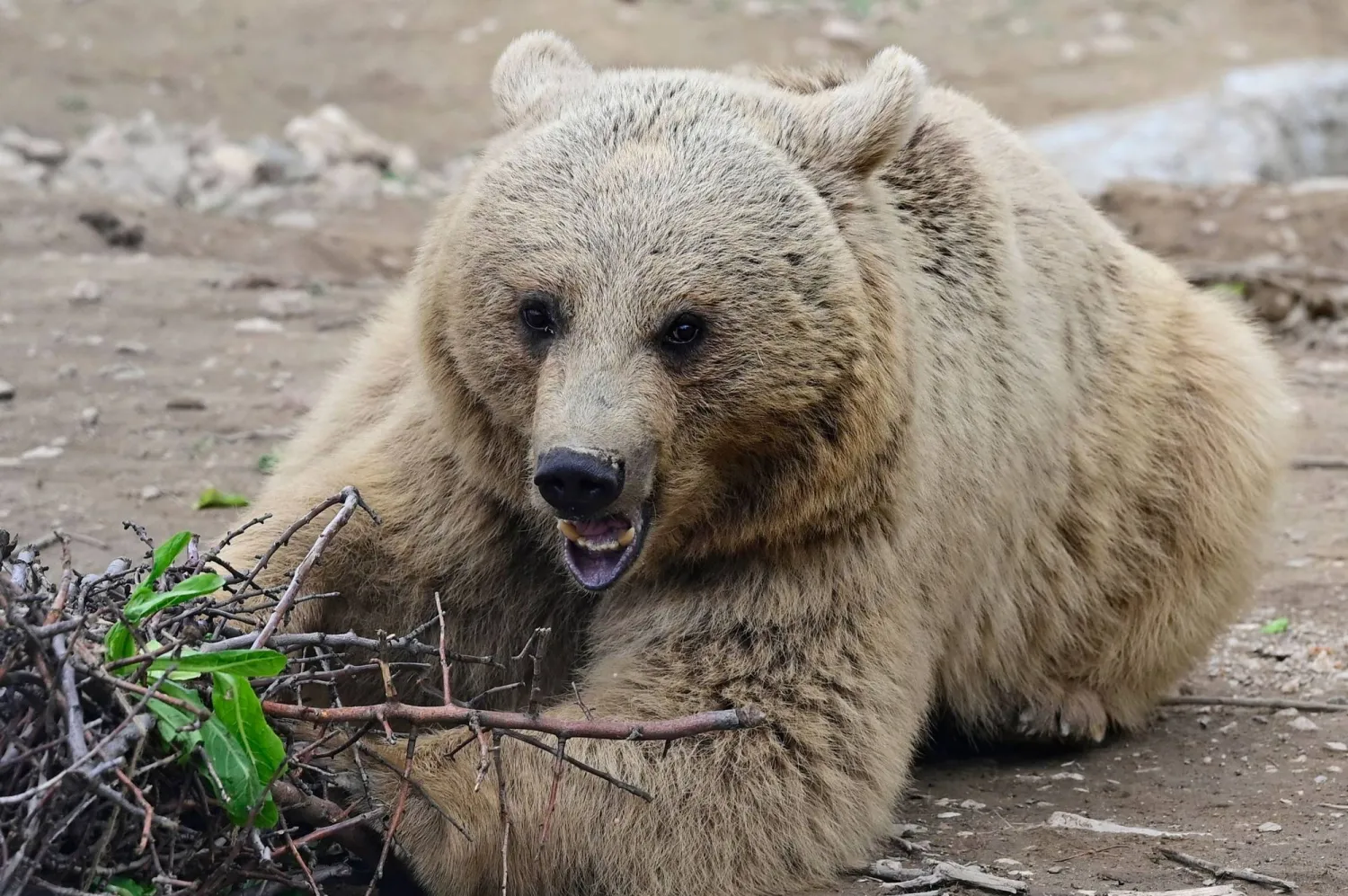
A bear, who was rescued from captivity, is seen in an enclosure at the Foundation for the Preservation of Wildlife and Cultural Assets (FPWC) - in Armenia's highlands near the village of Urtsadzor, 68km from Yerevan, on April 21, 2026. (Photo by KAREN MINASYAN / AFP)
TT

Japan Confirms Year's First Fatal Bear Attack, 2 Others Suspected

A bear, who was rescued from captivity, is seen in an enclosure at the Foundation for the Preservation of Wildlife and Cultural Assets (FPWC) - in Armenia's highlands near the village of Urtsadzor, 68km from Yerevan, on April 21, 2026. (Photo by KAREN MINASYAN / AFP)

Japanese authorities confirmed Friday the first fatal bear attack of 2026, with media reports saying police were also investigating two other possible cases.

The victim, reportedly a 55-year-old woman, died on April 21 in Iwate prefecture in northern Japan, an environment ministry official said.

Media reports said police were investigating two other deaths potentially caused by bears.

One body was discovered elsewhere in the Iwate region on Thursday and another in a forest in Yamagata prefecture on Tuesday.

Police confirmed to AFP that two people had died but could not immediately verify other details.

Last year, Japan saw a spate of deadly bear attacks, with a record 13 people killed.

In the latest suspected attack in Iwate, Kumagai Chiyoko, 69, went missing after going to a mountain forest to pick edible wild plants, broadcaster NHK reported.

Police and rescuers launched a search on Thursday in the forest where her car was parked and found her body shortly after 8:00 am (2300 GMT Wednesday), NHK reported.

She reportedly had injuries on her face and head that appeared to have been caused by an animal's claws.

City officials said local hunters were expected to begin patrolling the area on Friday, according to the broadcaster.

In the fiscal year between April 1, 2025 and March 31, 2026, bear attacks injured 216 people, according to environment ministry data.

This marked a sharp increase from the previous year, when three people died and 82 were hurt.

Scientists say the crisis is being driven by a fast-growing bear population, combined with a falling human population.

Last year also saw a poor acorn harvest pushing bears to seek food elsewhere.

Scrambling to respond, the government has deployed troops to help with trapping and hunting the animals.

Riot police have also been tasked with shooting them, with several thousand of the animals killed every year.

Brown bears are found only in the main northern island of Hokkaido, where their population has doubled over three decades to more than 11,500 as of 2023.

Japanese black bears, meanwhile, are common across large parts of the country including on the main island of Honshu which includes Iwate and Yamagata.

In 2024, the government added bears to the list of animals subject to population control, reversing protection that had helped the mammals thrive.


Study Shows How Potato-based Diet Changed Genetics of Andean People

FILE PHOTO: A woman sells potatoes at La Parada market in La Victoria district of Lima, Peru, June 14, 2017. REUTERS/Mariana Bazo/File Photo
TT

Study Shows How Potato-based Diet Changed Genetics of Andean People

FILE PHOTO: A woman sells potatoes at La Parada market in La Victoria district of Lima, Peru, June 14, 2017. REUTERS/Mariana Bazo/File Photo

Indigenous people in the Andes domesticated the potato - a great source of starch, vitamins, minerals and fiber - 6,000 to 10,000 years ago, making this tuber a central part of their diet.

These people then experienced genetic adaptations beneficial for such a diet that are still seen in their descendants living in Peru.

New genomic research documents how these descendants - speakers of the Quechua language of the once-great Inca Empire - underwent fortification involving a gene called AMY1 that is involved in starch digestion, a function useful for people with a potato-centric diet.

The study found that these people possess an average of 10 copies of AMY1 - two to four more than most people. No other known population globally exceeds that number. According to Reuters, the study also showed that the onset of these genetic changes in this population coincided with the advent of potato domestication.

"It is a wonderful case of culture shaping biology," said evolutionary and anthropological geneticist Omer Gokcumen of the University at Buffalo, one of the senior ⁠authors of the ⁠research published this week in the journal Nature Communications.

"This highlights the importance of dietary adaptation in human evolutionary history, with implications for metabolism, health and the impact of domestication events on human biology," said UCLA anthropological geneticist Abigail Bigham, also one of the study's senior authors.

At the molecular level, AMY1 governs an enzyme called amylase that is present in saliva and is responsible for breaking down starch in the mouth when a person eats starchy foods. A person with more copies of the gene may produce more of the enzyme.

This greater dosage, the researchers said, may facilitate better metabolism of ⁠high-starch diets. Amylase may also be involved in regulating the microbiome - the body's natural collection of microbes - which can shift with dietary change.

Lactose tolerance is another example of diet-driven evolutionary adaptation, involving a gene related to an enzyme that breaks down lactose in milk.

In the new study, the researchers analyzed genomic data spanning more than 3,700 people across 85 populations in the Americas, Europe, Africa and Asia, including 81 native Quechua speakers of Andean ancestry in Peru.

The researchers said it appears that over time evolutionary forces favored extra copies of AMY1 in the ancient Andeans.

In order to become widespread, a genetic variant may provide some advantage.

"Therefore, one hypothesis is that people with more copies of AMY1 may have been better able to process starch-rich foods, including potatoes," University at Buffalo doctoral student and study co-lead author Luane Landau said.

"Individuals who were born with the higher copies of AMY1 may have had an ⁠advantage as compared to ⁠individuals who did not have it, and left more descendants over generations.

Over time, this could explain why the genetic version linked to high AMY1 copy number became more common in Andean populations today," Landau said.

Potatoes represented a reliable food source - a crop that thrived at the high altitudes these people inhabited.

"They were one of the main sources for calories in the ancient Andean diet," University at Buffalo doctoral student and study co-lead author Kendra Scheer said.

Potatoes were at the heart of the Inca food supply. They were brought to Europe and the rest of the world following the Spanish conquest of the Inca Empire in the 16th century.

"Their global culinary spread is a testament to their broad likeability," Bigham said.

At markets in the Andean highlands and elsewhere in Peru, Quechua speakers sell a wide variety of potatoes, with flesh of various colors including purple, blue, red, gold, white and even black.

"In Peru, there are about 3,000 to 4,000 different kinds of potato, but the majority of the world has access to only a select few strains. Therefore, there is a whole world of different types of French fries that are possible," Scheer said.


Court Rules in ‘Sunbed War,’ Towels Lose

A pool with sunbeds at a luxury resort (Shutterstock)
TT

Court Rules in ‘Sunbed War,’ Towels Lose

A pool with sunbeds at a luxury resort (Shutterstock)

A German tourist has won a payout of more than €900 (£850) after he was unable to secure a sun lounger due to other guests reserving them with towels, according to BBC.

The man, who has not been identified, was on holiday in Greece with his family in 2024, and said he spent 20 minutes a day trying to find a sun lounger, despite waking up at 06:00.

He then sued his tour operator for allowing the reservation system, arguing the sunbeds were reserved so often, they were unusable.

Judges at a district court in Hanover ruled in his favor, and said the family of four were entitled to a larger refund on their package holiday as it had been “defective.”

The man had initially paid €7,186 (£6,211) to take his wife and their two children on the package holiday to Kos, an island in Greece.

In his arguments to court, he said that his tour operator had failed to enforce the resort's ban on towel reserving, and did not confront guests who were engaging in the practice.

He added that even when his family rose at 06:00, loungers were unavailable, and his children were forced to lie on the floor.

Though the tour operator had initially paid out a refund of €350 (£302), judges in Hanover ruled the family was entitled to a refund of €986.70 (£852.89).

They said that although the travel company did not run the hotel and could not ensure every customer could access a sunbed at any given time, the operator did have an obligation to make sure there was an organizational structure that would guarantee a “reasonable” ratio of sunbeds to guests.

Many tourists will have encountered “sunbed wars” or “dawn dash” on holiday, which is the practice of reserving loungers with towels.


Malaysia Plans Cloud Seeding for Drought-hit 'Rice Bowl'

A farmer carries rice seedlings to plant in a paddy in Sekinchan, Malaysia's Selangor state. Mohd RASFAN / AFP/File
TT

Malaysia Plans Cloud Seeding for Drought-hit 'Rice Bowl'

A farmer carries rice seedlings to plant in a paddy in Sekinchan, Malaysia's Selangor state. Mohd RASFAN / AFP/File

Malaysia is resorting to cloud seeding to bring much-needed rain to the country's "rice bowl" north, where a drought has delayed planting of the staple crop and raised supply fears.

"This year... has been affected by prolonged dry weather, low rainfall and reduced dam water levels," the Minister of Agriculture and Food Security of Malaysia, Mohamad Sabu, told AFP.

The conditions mean farmers have missed two of the three usual planting phases for so-called "wet direct seeding" of rice, a technique that requires fields to be flooded. Dry direct seeding is an alternative, and deadlines for that extend until June.

But farmers argue the technique provides lower yields, and that scattered recent rainfall has rendered it impossible in some fields anyway.

While more than 50 percent of the region's rice fields have been prepared, just a fraction have been planted as farmers await the rain.

Planting has "not been cancelled", Mohamad insisted, but "temporary adjustments and mitigation measures are being implemented".

In Kedah's Muda Agricultural Development Authority areas, the main dam reservoir for the region is at just eight percent, according to local reports.

- High costs -

Farmer Abdul Rashid Yob, who has a three-hectare paddy in the region, told AFP the drought's impact was being compounded by rising fuel costs linked to the war in Iran.

"Even where water is available, many cannot afford to proceed due to high costs."

Rice is a staple crop in Malaysia, which consumes around 2.5 million tons a year, around half of which is produced domestically.

Most of that comes from northern peninsular Malaysia, with Kedah the biggest producer.

The region is "strategically important to Malaysia's food security", Mohamad said.

So with farmers facing arid brown fields that should be flooded, lush paddies, Malaysian Prime Minister Anwar Ibrahim this week announced cloud-seeding operations to trigger rain.

The process involves spraying particles such as silver iodide and salt into clouds from aircraft to produce rainfall, and is widely used to affect weather patterns or even tamp down air pollution.

But success depends on atmospheric conditions -- without clouds, seeding will not work. Reports suggest officials hope to begin seeding soon, but no date has been publicly set.

The government has also announced programs to offset fuel costs, including boosts to existing aid programs.

- Struggling with conditions -

Fitri Amit, a small-scale rice farmer in Perak region further south, was skeptical of the measures, which he said were often delayed, arriving only once farmers' "capital has already been drained".

"Farmers prefer that support be given by increasing the paddy price," he said, referring to the sale price of cultivated rice.

"If the paddy price is guaranteed, once they sell, they get the money," he told AFP.

Though he is south of worst-hit Kedah, he too has been struggling with dry conditions.

"Irrigation was stopped because the reservoir levels were low," he said.

While Malaysian rice farmers have struggled with drought or erratic rainfall in the past, "this year's challenges are more significant", said Mohamad, citing "prolonged hot weather, lower-than-usual rainfall and declining water reserves in several irrigation dams".

The crisis comes with Asia bracing for a possible return of the El Nino weather phenomenon, which brings worldwide changes in winds, air pressure, and rainfall patterns.

Forecasters say it could develop as soon as May to July, and initial observations suggest it could be particularly strong.

Asia is often heavily affected by El Nino systems, which bring heatwaves and droughts to part of the region, and heavy rains elsewhere.