



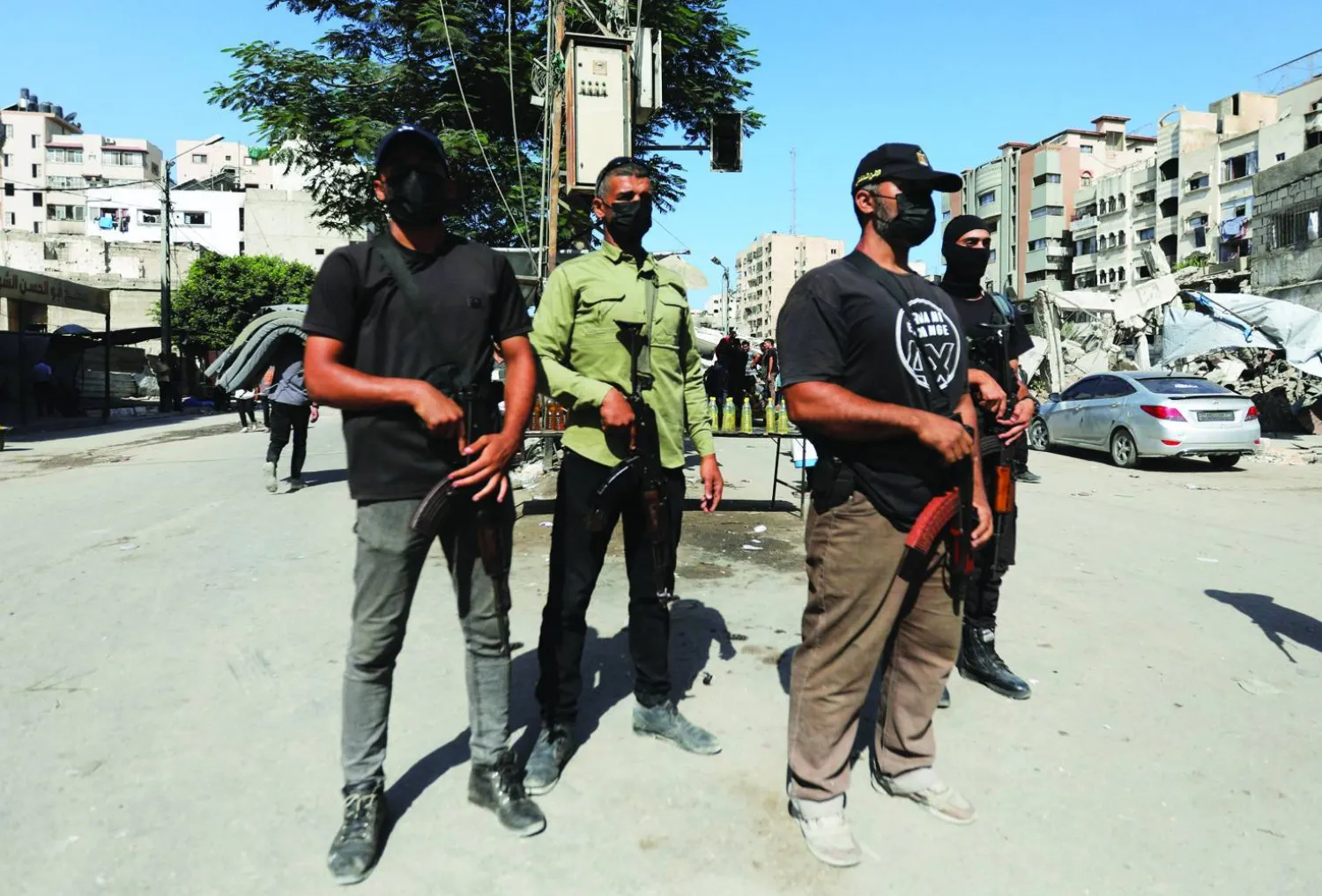

The issue of allowing the National Committee for the Administration of Gaza into the enclave to begin its work remains unresolved. Israel continues to refuse its entry, while other complications persist over the conditions under which it would operate, including the creation of a police force under its authority instead of Hamas police and its government security agencies.
One of the 15 clauses in the “roadmap” presented to Hamas and other Palestinian factions during Cairo negotiations, specifically on April 19, clearly states that Hamas, the factions, clans, and individuals must hand over their weapons to the committee that would run the enclave.
The committee would have a security force to enforce the law.
The fate of Hamas employees was one of the unresolved issues in the negotiations that preceded and followed the latest roadmap. Their number is estimated in the tens of thousands, and their future remains unclear.
Sources from Hamas and other factions told Asharq Al-Awsat that the issue had largely been resolved, that fair solutions had been found for all sides, and that only final agreement remained.
The sources said Hamas and the factions had agreed to allow a new police force to enter Gaza and operate under the authority of the Gaza administration committee.
The main obstacle was Israel, which has so far refused to allow the committee itself to enter the enclave and assume its duties, they stressed.
Under the proposed plan, prepared within the Board of Peace, particularly by its director-general Nickolay Mladenov in consultation with the Gaza Administration Committee and mediators, 12,000 police officers would initially work under the committee’s supervision. Of those, 5,000 would be deployed in the first phase.
According to the plan, as Asharq Al-Awsat learned from sources within the factions and others in contact with the committee, the first 5,000 officers were selected from Palestinians who had been receiving training at police colleges in several Arab countries after leaving Gaza, both before and during the war.
The sources said they would undergo Israeli security screening.
Many Palestinians receive training at police colleges in countries including Egypt, the United Arab Emirates, Algeria, Qatar, Türkiye, and others.
It remains unclear whether the remaining 7,000 officers would also be drawn from that pool, whose numbers appear to be far short of the required number. Israel is expected to reject students trained in Doha and Ankara.
It is also unclear whether the plan would include training for Gaza students at Al-Istiqlal University, which specializes in graduating police and military personnel. Officers from the Palestinian Authority inside the enclave had sent their sons there for education and training.
Many retired officers from the Palestinian Authority security services are now in Cairo. Some arrived from Gaza weeks ago as part of preparations for a comprehensive security plan led by Sami Nasman, the official in charge of security in the Gaza administration committee.
The same sources said there is a plan to use some Palestinian Authority security employees known as the “2005 enlistments,” along with police personnel from Hamas government employees who are under 45 and pass Israeli security screening.
They said this arrangement could be temporary until the recruitment of a new police force is completed. Former employees would be treated fairly through practical solutions that preserve their rights, while thousands of them would remain in police duties without weapons.
In February, the Gaza administration committee posted a registration link on its website for the new police force. More than 100,000 young Palestinians from inside Gaza registered for jobs. At the time, discussions focused on selecting only 2,000 of them as a first step, followed by another 3,000.
The Times of Israel on Friday quoted a US official and a Middle Eastern diplomat as saying the UAE had transferred $100 million to the Board of Peace to train the new police force.
The website said the transfer was the largest received by the Board of Peace to date, following pledges worth $17 billion announced at a donor conference hosted by US President Donald Trump in February.
The new Palestinian police force is viewed as a top priority for the Board of Peace, which seeks to create new civilian and security bodies to govern Gaza, with the aim of removing Hamas from power and pushing toward an Israeli withdrawal, the website said.


