


Lebanon Says Two Paramedics Affiliated with Hezbollah Killed by Israeli Strikes in South

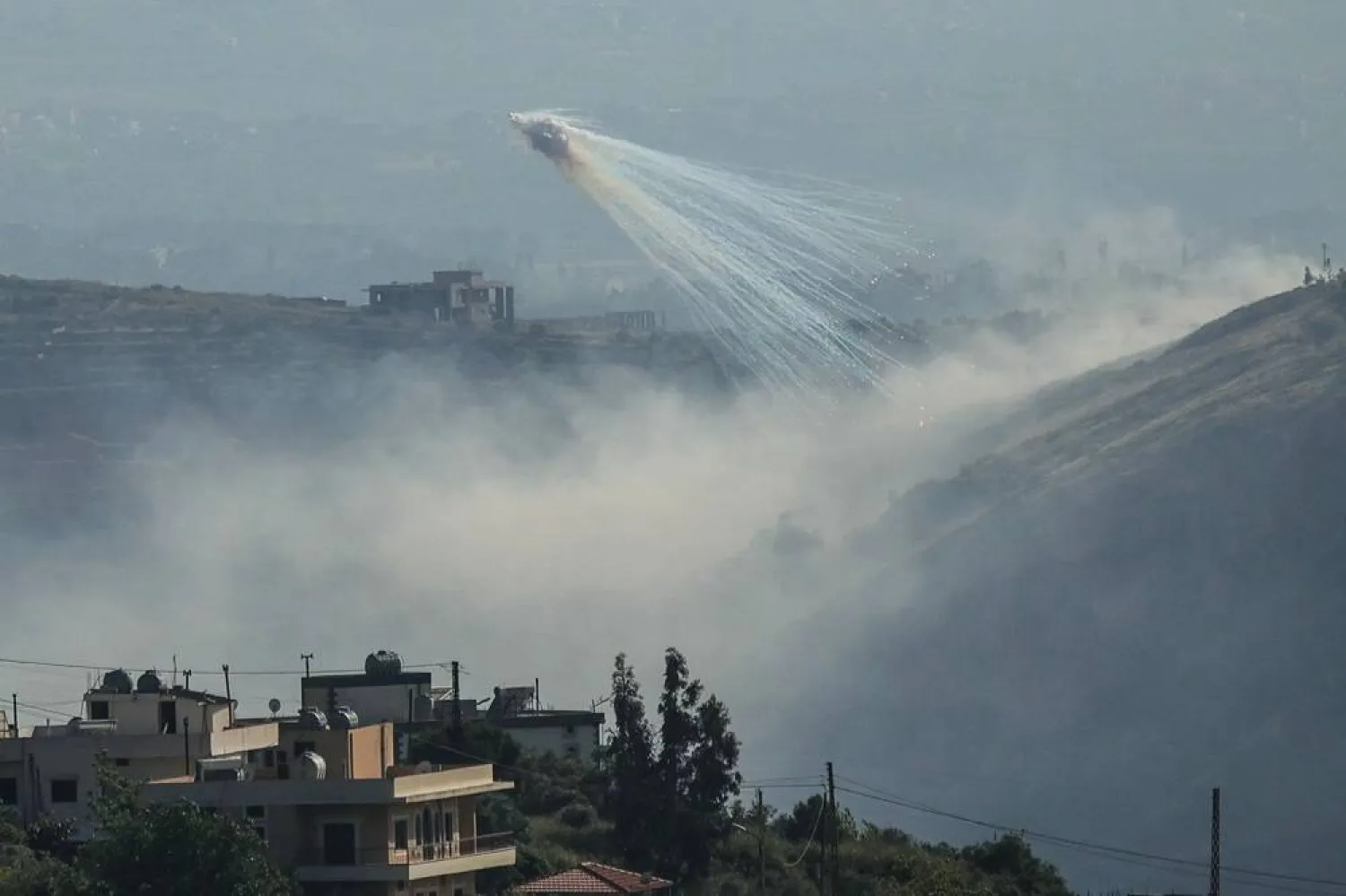
A photograph taken from the southern area of Marjeyoun shows trails of smoke during Israeli shelling on the outskirts of the village of Yohmor on May 10, 2026. (AFP)
TT

Lebanon Says Two Paramedics Affiliated with Hezbollah Killed by Israeli Strikes in South

A photograph taken from the southern area of Marjeyoun shows trails of smoke during Israeli shelling on the outskirts of the village of Yohmor on May 10, 2026. (AFP)

Lebanon's health ministry said two paramedics from the Hezbollah-affiliated Islamic Health Committee were killed and five others wounded on Sunday in two Israeli strikes on the country's south despite a ceasefire.

As the state-run National News Agency (NNA) reported Israeli airstrikes and artillery shelling on a variety of other south Lebanon areas, Israel's army warned residents of three villages to evacuate, saying it would act forcefully against the Iran-backed group there.

Israel has kept up strikes despite a ceasefire in place since April 17 that was supposed to halt hostilities with Hezbollah, while the armed group has pressed on with its own attacks, mainly on Israeli troops operating in southern Lebanon but also across the border.

A Lebanese health ministry statement said that Israel "directly targeted, with two strikes, two Health Committee sites", killing one paramedic and wounding three others in Qalaway, and killing another paramedic and wounding two others in Tibnin.

The statement decried what it called Israel's continued "violation of international laws".

The Israeli military said in a statement that on Sunday its forces had struck "more than 20 terror infrastructure" targets in southern Lebanon, including Hezbollah weapons storage facilities and headquarters.

Israel has expanded its strikes in recent days, and the health ministry on Sunday raised the overall death toll from Israeli strikes since war erupted to 2,846 killed, including 108 health and emergency workers.

Israeli raids have killed dozens of people in Lebanon since the ceasefire.

Under the terms of the truce released by Washington, Israel reserves the right to act against "planned, imminent or ongoing attacks".

Its troops are operating behind an Israeli-declared "yellow line" which runs around 10 kilometers (six miles) north of Lebanon's border.

Residents have been warned not to return to the area.

On Saturday, the NNA reported heavy Israeli strikes in various parts of Lebanon including one that killed seven people, and several raids around 20 kilometers south of Beirut outside Hezbollah's traditional strongholds.

Lebanon and Israel are preparing to hold a third round of talks on May 14-15 in Washington, with veteran Lebanese diplomat Simon Karam recently appointed by President Joseph Aoun to lead his country's delegation.

A first landmark meeting between the countries, which have no diplomatic relations, was held days before US President Donald Trump announced the ceasefire, while the second round came as he announced a three-week truce extension.

Hezbollah drew Lebanon into the Middle East conflict on March 2 when it launched rockets at Israel to avenge the killing of Iran's supreme leader in US-Israeli strikes.



Hamas Seeks to Put Gaza on US-Iran Talks Agenda

A Palestinian child weeps next to the body of his brother, killed in an Israeli strike in Khan Younis, southern Gaza, on Wednesday (AFP)
TT

Hamas Seeks to Put Gaza on US-Iran Talks Agenda

A Palestinian child weeps next to the body of his brother, killed in an Israeli strike in Khan Younis, southern Gaza, on Wednesday (AFP)

At a time when a purported ceasefire agreement in the Gaza Strip faces continued Israeli breaches and violations, Hamas has moved toward Iran in a step that showed it was counting on a “supportive” position on Gaza by having the issue placed on the agenda of ongoing talks between Washington and Tehran.

The Hamas move came in an announced phone call on Tuesday between Basem Naim, deputy head of the movement’s Arab and Islamic Relations Office, and Iranian Foreign Minister Abbas Araghchi.

According to a Hamas statement, Araghchi and Naim “discussed the latest developments in the Iranian-US negotiations and the Palestinian issue, especially as it relates to the Gaza Strip,” with Naim praising “Iran’s positions toward the Palestinian cause and its continued support for Gaza amid the continued Israeli aggression.”

A statement published by Iran’s Tasnim news agency on Wednesday quoted Araghchi as telling Naim that “the Iranian team will raise the Palestinian issue in the ongoing negotiations,” adding that it would also raise “the issue of the occupation’s continued aggression in all international forums.”

The call came amid Iranian-US negotiations that include an understanding on a ceasefire in Lebanon between Hezbollah and Israel.

It was the second Hamas-Iran call in June. On June 4, Araghchi called Khalil Al-Hayya, Hamas’s leader in Gaza and head of its negotiating delegation. The statement at the time, however, did not clearly refer to bringing Gaza into the Iranian-US negotiations.

It only said Hayya had praised the Iranian negotiating team’s position, which stressed the need for a simultaneous halt to the war on all fronts in the region.

Asharq Al-Awsat tried to contact Hamas official Basem Naim, but he did not respond to calls.

“Not a replacement for mediators”

Two senior Hamas sources abroad told Asharq Al-Awsat in separate remarks that the call between Naim and Araghchi came as part of “continued communication with various parties in an attempt to consolidate the ceasefire in Gaza.”

One of them said: “This does not amount to abandoning the negotiations track through the main mediator countries, Egypt, Qatar and Türkiye.”

One source said Naim’s mandate was to communicate with all Arab and Islamic parties as part of a policy of openness to all sides, in a way that serves the interests of the Palestinian people, especially in Gaza, as Israeli violations continue and no party has been able to compel Benjamin Netanyahu’s government to stop its violations in the enclave.

Still, the second source did not conceal that Hamas was “looking for a pressing Iranian role in the current negotiations to place Gaza on their agenda, as was the case in Lebanon, where Iran succeeded through its efforts in reaching a ceasefire,” according to his assessment.

The second source said: “We, Hamas, count on any position that supports us, the Gaza Strip and the Palestinian cause in general. But it is unlikely that such a step will succeed, given the insistence of the United States and Israel on separating the fronts as much as possible, and given the consensus and understanding inside the movement that the Gaza file has for some time been separate during the war.”

“Positive signs from Lebanon create an opening”

The two sources agreed, however, that there had been “a positive development on the Lebanon front” imposed by the Iranian-US negotiations. That has tempted some Hamas leadership circles to try to “use the opportunity to push for placing Gaza on the negotiations agenda, even though they expect their efforts to fail.”

In recent days, Hamas media outlets have intensified a similar narrative, attributed to an unnamed Iranian source, saying the negotiations include consolidating the ceasefire in Gaza.

A third Hamas source in Gaza said the movement had consistently looked for an Iranian position in support of it in the negotiations during the war. But “it is clear that the United States did not allow, and will not allow, that. It considers Gaza a separate front, and there are efforts being made on that front to consolidate the ceasefire.”

The source added: “It can be said clearly that Iran adopted the halt to the war on the Lebanon, Yemen, and Iraq fronts on the basis that those fronts entered the war more broadly after the assassination of former Iranian Supreme Leader Ali Khamenei, while the war in Gaza had started much earlier.”

A fourth source from a Palestinian faction that receives support from Iran said, “The leaders and members of factions linked to Tehran had hoped it would succeed in stopping the war in Gaza.”

“That would have counted heavily in their favor and in favor of the factions, given the inability of mediators and guarantors to compel Israel to abide by the agreement and stop the violations.”

Factional sources had said that “during the factions’ meetings in Cairo, leaders from several sides advised the Hamas leadership not to count on the Iranian negotiations track, and to take more important steps within the framework of a unified Palestinian position to produce a positive response to proposals related to weapons and other issues.”

Hamas’s evolving position, after the latest call between Naim and Araghchi, appears to come amid voices rejecting amendments made by Nickolay Mladenov, the High Representative for Gaza at the Board of Peace.

Some parties inside the movement viewed the amendments as “primarily serving Israel, and not adhering to US President Donald Trump’s plan, under which the ceasefire agreement was signed in October 2025.”


Israel Army Says Struck Suspected Hezbollah Fighters in Lebanon ‘Security Zone’

Stray dogs walk past the rubble of flattened homes and businesses, destroyed by the Israeli military, in the southern Lebanese village of Tibnin on June 24, 2026. (AFP)
TT

Israel Army Says Struck Suspected Hezbollah Fighters in Lebanon ‘Security Zone’

Stray dogs walk past the rubble of flattened homes and businesses, destroyed by the Israeli military, in the southern Lebanese village of Tibnin on June 24, 2026. (AFP)

The Israeli military said it carried out an airstrike targeting suspected Hezbollah fighters who crossed into the so-called "security zone" it has created in southern Lebanon, the second such incident it reported within hours on Wednesday.

"A short while ago, a vehicle carrying suspects was identified crossing the security zone in the Ali al-Taher Ridge area, posing a threat to Israeli soldiers," the military said.

"Following the identification, the Israeli Air Force struck the suspects in order to remove the threat," it added, vowing that the military "would not allow Hezbollah" fighters to harm its troops.


Who Is Wassim al-Assad, Who Used Syrian Regime Influence to Lead Captagon Trade?

Wassim al-Assad appears in court. (Syrian Justice Ministry)
TT

Who Is Wassim al-Assad, Who Used Syrian Regime Influence to Lead Captagon Trade?

Wassim al-Assad appears in court. (Syrian Justice Ministry)

Wassim Badih al-Assad, a cousin of ousted Syrian President Bashar al-Assad, faces charges of forming and leading armed groups, suppressing civilians, involvement in wide-ranging abuses and illicit enrichment during the rule of the former regime.

He appeared in court on Wednesday to stand trial as Syria’s new rulers pursue transitional justice.

Syrian Justice Minister Mazhar al-Wais said: “The trial of Wassim al-Assad is only one stage in a comprehensive national process.”

In a post on X, he pledged that “justice will remain a firm approach, and state institutions will move with confidence and resolve toward building a state of law and institutions.”

Wassim al-Assad was born in Qardaha, in the countryside of Latakia, in 1980. His name has appeared on sanctions lists over his alleged role in drug smuggling and support for the former regime.

Syrian authorities arrested Wassim al-Assad in June 2025 during a security operation carried out by the General Intelligence Service in cooperation with units from the ministry.

He was lured from Lebanon to Syria in an intelligence operation and arrested in an ambush as part of a campaign to pursue people accused of committing crimes during the rule of the former regime.

Wassim al-Assad’s name emerged in Syria in the first years after the 2011 uprising against Bashar al-Assad, when he became known as one of the commanders of militias auxiliary to the former regime’s forces.

He led the “Military Security Shield” militia, later known as the “Assad Shield,” and also led and formed groups affiliated with the Baath Brigades and the National Defense militia.

Those groups were active mainly in the provinces of Latakia and Tartous, as well as the cities of Qardaha and Jableh. They pursued and arrested opponents of the Assad regime and fought as auxiliary forces alongside regime troops in other Syrian provinces.

Noah Zaiter (R) and Wassim al-Assad. (Facebook)

The groups were also active at ports and crossings on the border with Lebanon in the Tal Kalakh area of rural Homs, facilitating the smuggling of Captagon and fuel.

The political and security cover he enjoyed enabled him to use his influence to impose payments on merchants along the coast and run cross-border smuggling networks. The names of those militias were linked to killings, kidnappings, extortion and theft.

Wassim al-Assad did not hide his ties with drug traffickers in Lebanon. He appeared in photos on social media with notorious drug baron Noah Zaitar, who has been detained in Lebanon for drug and arms trafficking.

Unlike other leaders of militias auxiliary to the former regime’s forces, Wassim al-Assad flaunted his lavish lifestyle, cars and apartments in Latakia and Tartous in videos on social media. In those videos, he called for opponents of Bashar al-Assad to be stripped of Syrian nationality.

According to international reports, Wassim al-Assad oversaw Captagon shipments from manufacturing facilities in Syria to the Lebanese border, as well as to Gulf Arab states and Europe, all under the protection of security networks affiliated with the former regime.

In 2023, the US Treasury Department sanctioned Wassim al-Assad, citing his role in supporting the former regime through Captagon smuggling and the regional drug trade.

The European Union also listed him, along with other Assad family members, for his active participation in organized networks for the manufacture and export of drugs, and for illegal and criminal activities and cross-border money laundering.

In his last public security activity, Wassim al-Assad announced in early 2024 the formation of “special support and protection groups,” pledging to pay monthly salaries of $300 to volunteers from the coastal region who supported the former regime, in an attempt to counter the Deterrence of Aggression Operation led by now President Ahmed al-Sharaa, which succeeded in ousting Bashar al-Assad.