

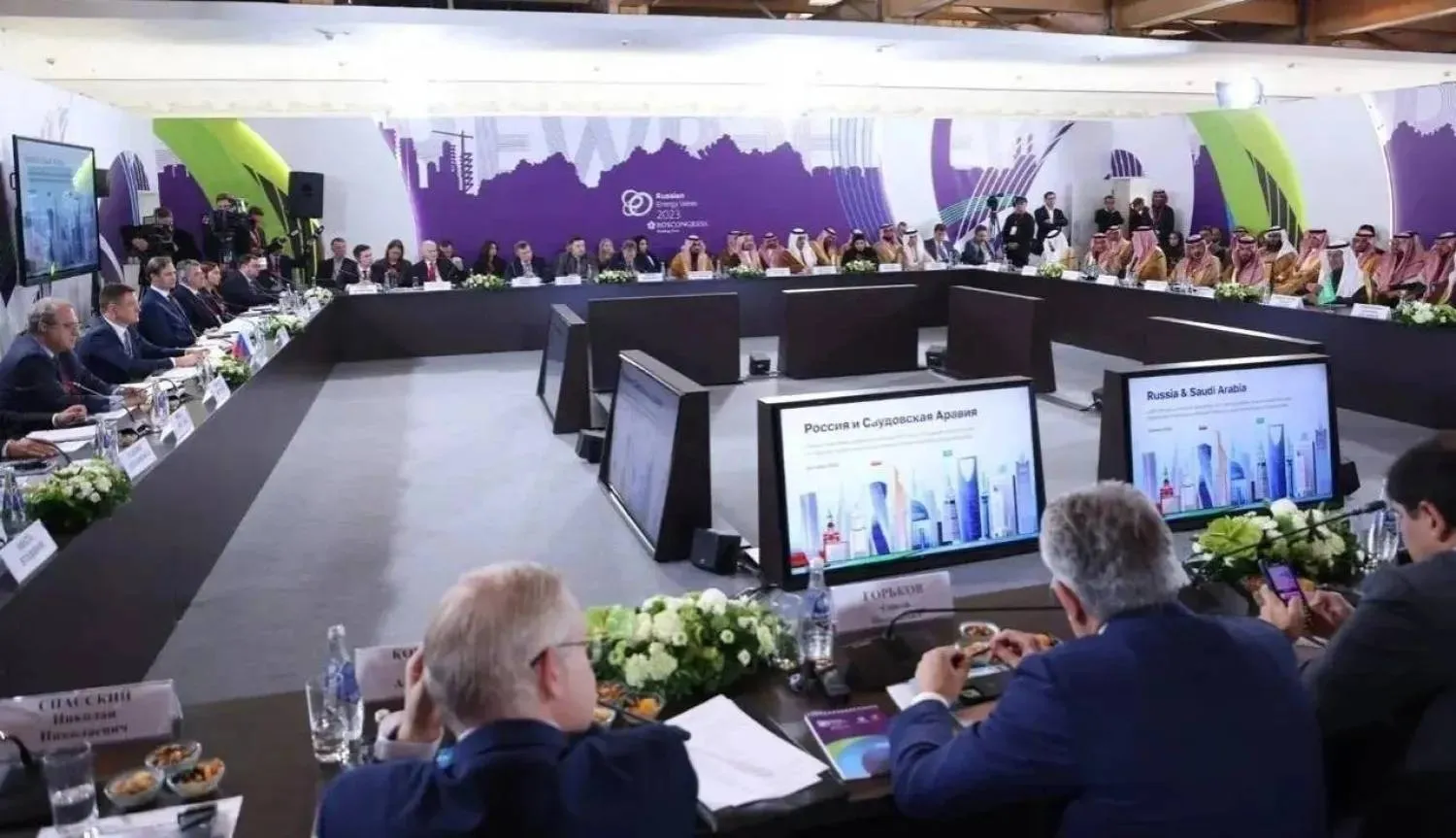

Riyadh, Moscow Take Strategic Step toward Free Movement, Support for Investment and Tourism

Officials are seen at a joint Saudi-Russian committee meeting. (SPA file)
TT

Riyadh, Moscow Take Strategic Step toward Free Movement, Support for Investment and Tourism

Officials are seen at a joint Saudi-Russian committee meeting. (SPA file)

The mutual visa waiver for visits between Saudi Arabia and Russia took effect on Monday, marking a significant strategic step to strengthen economic and tourism openness between them.

The waiver helps save time and simplify procedures, and reduces costs for businesspeople, investors, and tourists, helping increase the frequency of direct travel and expanding opportunities for establishing business and investment partnerships.

On the business level, facilitating visa-free entry for up to 90 days gives Saudi and Russian companies greater flexibility to hold meetings, explore opportunities, and participate in trade fairs and economic events without bureaucratic complications, especially in sectors such as energy, industry, technology, tourism, and logistics.

This also boosts private sector confidence and encourages greater trade and joint investments.

The volume of trade between Saudi Arabia and Russia increased by more than 60% in 2024, reaching $3.8 billion. Both countries are taking accelerated steps to expand this trade and increase the volume of investments.

For tourism, the decision paves the way for more travel between the two countries, given the growing interest of Russian tourists in new Saudi destinations under Vision 2030, such as AlUla and the Red Sea, as well as entertainment and cultural events and tourist seasons. In return, Saudis are given greater flexibility to explore Russian cities, and cultural and natural destinations.

Facilitating movement

The agreement carries an important diplomatic dimension as it reflects the development of Saudi-Russian relations and their shift towards a deeper partnership at the economic, tourism, and cultural levels, in line with global trends aimed at facilitating the movement of people and deepening international cooperation.

Speaking to Asharq Al-Awsat, experts believe that the mutual visa waiver is a significant shift in relations as they are no longer limited to political coordination and energy, but are moving towards strengthening direct economic and tourism exchanges.

The experts said these steps often have a quick impact on investors and companies as they reduce procedural barriers and provide greater flexibility for holding meetings and exploring business opportunities, especially in sectors that attract mutual interest such as tourism, energy, technology, and logistics services.

Trade exchange

Dr. Salem Baajajah, an economics professor at King Abdulaziz University, told Asharq Al-Awsat that the move will pave the way for investment and increase the volume of trade between the two countries, allowing businesspeople to discover commercial and investment opportunities in Saudi Arabia and Russia.

From a tourism perspective, the agreement comes at an important time with the rapid development of the Saudi tourism sector under Vision 2030 as the Kingdom seeks to attract more international tourists and diversify its target markets, he added.

Economic researcher Fadwa AlBawardi told Asharq Al-Awsat the implementation of the mutual visa waiver is an important strategic step that deepens bilateral relations between the two countries at all levels.

The agreement is part of Saudi Arabia and Russia’s efforts to facilitate the movement of citizens and businesspeople, and to boost cultural and economic exchange, especially amid aspirations to achieve sustainable development and strengthen economic ties between the two sides, she went on to say.



IAE: Iran War Undermines Confidence in Strait of Hormuz

 Vessels in the Strait of Hormuz, Musandam, Oman, May 8, 2026. (Reuters)
Vessels in the Strait of Hormuz, Musandam, Oman, May 8, 2026. (Reuters)
TT

IAE: Iran War Undermines Confidence in Strait of Hormuz

 Vessels in the Strait of Hormuz, Musandam, Oman, May 8, 2026. (Reuters)
Vessels in the Strait of Hormuz, Musandam, Oman, May 8, 2026. (Reuters)

The reputation of the Strait of Hormuz as a reliable artery for global energy trade may be permanently damaged by its prolonged closure, International Energy Agency Executive Director Fatih Birol said.

Even if movement is restored, “the vase has been broken. You can’t glue it back together,” Birol said, warning that the disruption has undermined confidence in what was once one of the world’s most critical oil and gas choke points.

“If it was once closed, it can be closed again,” he said, according to Bloomberg.

Speaking to reporters in Vienna, ahead of a meeting with Haitham Al Ghais, OPEC Secretary General, Birol reiterated the historic nature of the current upheaval in global energy markets.

“We are going through a historical period in terms of energy, foreign policy and geopolitics,” he said. “The world is going to understand very soon that it has devastating consequences for our economy.”

The double blockade by the US and Iran of the waterway, which handled about a fifth of the world’s oil and liquefied natural gas flows, has had consequences far beyond energy markets. Everything from farm inputs to air travel has been impacted.


Oil Prices Rise as Fragile US-Iran Talks Sustain Supply Worries

FILE PHOTO: Cargo ships in the Gulf, near the Strait of Hormuz, as seen from northern Ras al-Khaimah, near the border with Oman’s Musandam governance, amid the US-Israeli conflict with Iran, in United Arab Emirates, March 11, 2026./File Photo
TT

Oil Prices Rise as Fragile US-Iran Talks Sustain Supply Worries

FILE PHOTO: Cargo ships in the Gulf, near the Strait of Hormuz, as seen from northern Ras al-Khaimah, near the border with Oman’s Musandam governance, amid the US-Israeli conflict with Iran, in United Arab Emirates, March 11, 2026./File Photo

Oil prices rose nearly 1% on Tuesday as talks to end the US-Israeli war on Iran appeared fragile, with Tehran's response to a Washington proposal highlighting stark differences that have kept supply concerns alive.

Brent crude futures were up 86 cents, or 0.8%, at $105.07 per barrel, while US West Texas Intermediate gained 99 cents, or 1%, to $99.06 at 0411 GMT. Both benchmarks increased nearly 2.8% on Monday.

US President Donald Trump ‌on Monday said ‌the ceasefire with Iran was "on life support," pointing to ‌disagreements ⁠over several demands, such ⁠as the cessation of hostilities on all fronts, the removal of a US naval blockade, the resumption of Iranian oil sales and compensation for war damage, Reuters said.

Tehran also emphasized its sovereignty over the Strait of Hormuz, through which about a fifth of global oil and liquefied natural gas flows.

"Optimism regarding an imminent (peace) deal seems to be fading again and if we don’t see a ⁠deal by the end of May, then upside risks for ‌oil prices are definitely on the ‌table," said DBS Bank energy sector team lead Suvro Sarkar.

Disruptions linked to the near-closure ‌of the strait have prompted producers to curtail exports, with a Reuters ‌survey on Monday showing OPEC oil output in April falling to its lowest level in more than two decades.

"A genuine breakthrough toward a peace deal could trigger a sharp $8-$12 correction, while any escalation or renewed blockade threats would quickly push Brent ‌back toward $115+," said Tim Waterer, chief market analyst at KCM Trade.

Saudi Aramco CEO Amin Nasser on Monday warned ⁠that disruptions to oil ⁠exports through the strait could delay a return to market stability until 2027, with the loss of about 100 million barrels of oil per week.

Elsewhere on the supply front, US crude stocks were forecast by analysts in a Reuters poll to be down by around 1.7 million barrels in the previous week.

The draw comes against "a backdrop of continued strong net waterborne export flows for crude and products, across the next several weeks," said Walt Chancellor, an energy strategist at Macquarie Group.

Meanwhile, market participants were also keeping a close eye on Trump's planned meeting with Chinese President Xi Jinping on Wednesday, after Washington imposed sanctions on three individuals and nine companies for facilitating Iranian oil shipments to China.


Ongoing Strait of Hormuz Disruption Could Drag Oil Market Recovery into 2027, Aramco CEO Says

Aramco CEO Amin Nasser speaks at a conference. (Reuters file)
TT

Ongoing Strait of Hormuz Disruption Could Drag Oil Market Recovery into 2027, Aramco CEO Says

Aramco CEO Amin Nasser speaks at a conference. (Reuters file)

The ongoing energy supply shock is the largest the world has ever experienced, and continued disruption of the Strait of Hormuz could delay oil market normalization into 2027, Saudi Aramco CEO Amin Nasser warned on Monday.

"The longer the supply ‌disruptions continue, even ‌for another few more weeks, it ‌is ⁠going to take ⁠a much longer time for the oil market to rebalance and stabilize," he told analysts on a call to discuss the company's first-quarter results, which were released on Sunday and beat expectations.

The recovery could drag into 2027 if the situation continues until ⁠mid-June, Nasser said.

Iranian authorities effectively blocked ‌the vital waterway ‌in response to the US-Israel attacks on Iran that began ‌on February 28, sending energy prices surging and ‌stoking fears of spiraling inflation and a looming economic downturn.

Aramco has ramped up its East-West pipeline to its expanded capacity of 7 million barrels per day (bpd) to ‌divert crude from its production heartland to the Red Sea port of Yanbu.

⁠Nasser on Sunday ⁠called the pipeline a "critical lifeline".

The market is losing around 100 million barrels of oil for every week the maritime chokepoint remains closed, Nasser said, adding that only two to five vessels are now crossing the strait daily compared to around 70 before the war.

Even if the strait opens today, it will still take months for the market to rebalance, he said.

Nasser, however, predicted a very robust return to demand growth once normal shipping and trade resume.