


Israel Crosses Litani by Fire, Tests New Border Strip

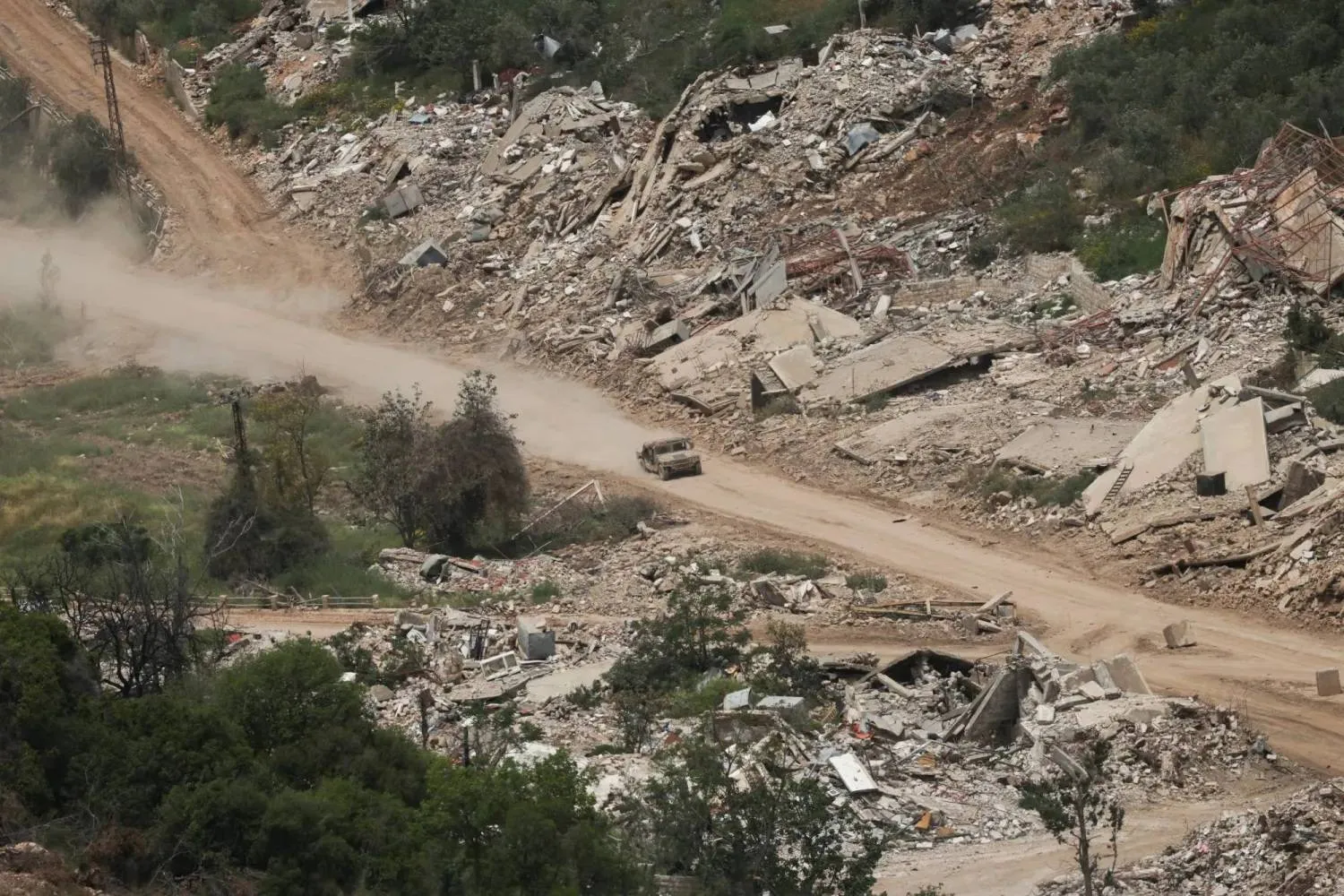
An Israeli military vehicle moves inside Lebanese territory (Reuters)
TT

Israel Crosses Litani by Fire, Tests New Border Strip

An Israeli military vehicle moves inside Lebanese territory (Reuters)

Israeli escalation in southern Lebanon has entered a new phase after the Israeli army announced operations north of the Litani River, as heavy vehicles crossed toward the outskirts of eastern Zawtar.

The move signaled a shift from limited strikes to an effort to impose new facts on the ground north of the river.

Israeli Army Radio said forces from the Egoz Unit and the Golani Reconnaissance Unit carried out an operation lasting about a week on the outskirts of eastern Zawtar, after heavy military vehicles crossed the Litani.

It said the operation aimed to reach areas from which Hezbollah had fired rockets, mortar shells, and drones at Israeli forces.

Israel’s Channel 12 said the operation lasted 10 days and sought to reach the launch zone used by Hezbollah rockets and drones. Channel 14 reported engineering work above the Litani that could allow armored and infantry forces to cross in the future if needed.

The developments came with an Israeli media push. Prime Minister Benjamin Netanyahu posted a video backing the soldiers involved, saying: “We are proud of our heroic fighters, the best in the world, who continue to intensify operations in Lebanon.”

Israel also widened evacuation warnings in the western Bekaa. At 4 a.m., residents of Sohmor were told to evacuate before heavy strikes began.

Later in the morning, Israeli army spokesperson Avichay Adraee twice issued urgent warnings to residents of Arzoun, Tayr Debba, Bazouriyeh, and Housh, telling them to leave and move 1,000 meters away toward open areas.

Zawtar, a military node north of the Litani

A local source in southern Lebanon told Asharq Al-Awsat that Zawtar is “one of the most sensitive points for Israel, given its geographic location and proximity to the border.” The source said it is “the closest point north of the Litani to the Israeli border compared with other areas, and is also exposed on the ground to drone activity.”

The source said Zawtar is “a strategic node” linking western Zawtar, Yohmor, and Arnoun. “Any control over it would effectively mean the surrounding villages fall militarily,” the source said, adding that Israel regards the area as “a key zone for Hezbollah drone activity” because it is “geographically open and lacks natural obstacles” that limit drone movement.

Israel seeks to recreate the border strip, but major expansion remains costly

Retired Brig. Gen. Bassam Yassin told Asharq Al-Awsat that Israel’s announcement that its forces had crossed the Litani toward Zawtar “cannot be separated from the nature of the military zone where Israeli forces have been operating for weeks.”

He said “the clashes had effectively begun about a week ago in Wadi Raj,” the corridor linking the Litani to Zawtar, while eastern and western Zawtar and Yohmor fall “within what is known as the area under the yellow line, meaning within the scope of Israeli military operations.”

Yassin said Zawtar’s importance for Israel “stems from its strategic location,” because it protects the Israeli presence along the Taybeh, Deir Seryan axis and gives Israel fire control over wide areas north of the Litani.

“If Israel manages to entrench its presence on the heights of Beaufort Castle, Yohmor and Zawtar, it would be able to place the areas of Nabatieh, Kfar Tebnit, Nabatieh al-Fawqa and Nabatieh al-Tahta under direct fire pressure, given the elevated nature of the area,” he said.

He said the scene “closely resembles a reproduction of the border strip that existed before 2000,” when Arnoun, Yohmor, Beaufort Castle (Qal’at al-Shaqif), and Zawtar were under direct Israeli military pressure, and towns such as Kfar Tebnit were almost emptied of residents because they were constantly targeted by fire.

Yassin said Israel “has already announced the expansion of its ground operations,” but military estimates suggest the move may remain limited to areas Israel considers necessary for its security. North of the Litani, he said, is Hezbollah’s second line of defense, and any broad advance there would mean “a harsh and costly confrontation.”

“If Israel is able to consolidate its control in this area, this could later open the door to a wider expansion toward the Zahrani, which would effectively mean turning the area stretching from the Zahrani to the international border into an isolated military strip. But I do not believe the Israeli decision has reached that point yet,” he said.

Yassin tied any major shift to the fate of political negotiations.

“If negotiations fail and Israel receives an international green light, then we can speak of an entirely different phase,” he said.

What about the western Bekaa?

In the western Bekaa, Yassin said Israel is pursuing a policy of “pressure through fire, warnings and gradual displacement.”

He said strikes are focused on areas believed to be used for launching drones or rockets, while other areas are sometimes bombed without warning when direct field targets are available.

“The warnings that targeted Sohmor, Zellaya, and their surroundings fall within an attempt to empty the area of residents, because evacuating villages facilitates any later military movement and increases pressure on Hezbollah’s support base,” he said.

Yassin said current indicators do not suggest Israel intends to launch a wide ground operation in the western Bekaa or north of the Litani unless negotiations collapse completely.

“I believe Israel currently has room to maneuver to reach some of the points it has identified within the yellow zone, but it does not have sufficient capacity to expand its ground occupation on a large scale. That is why it is currently focusing on threats, shelling, and emptying areas of their residents,” he said.

Military escalation and direct targeting of civil defense

On the ground, Israeli military escalation continued in the south, where civil defense personnel in Nabatieh had been targeted. The General Directorate of Civil Defense said two members of its Nabatieh regional center were killed and a third was wounded in an Israeli strike while they were trying to rescue someone wounded in an earlier Israeli strike in Nabatieh.

Israeli strikes also hit several southern towns, including Hinniyeh, Khirbet Selm, eastern Zawtar, and Nabatieh, while Mansouri and Majdal Zoun came under shelling.

Three people from Aadchit were killed in a strike on a car in Doueir while transporting a wounded person. A Syrian man was killed, and his wife was wounded when a motorcycle was targeted in Tayr Debba. A drone caused injuries in Mansouri. An archaeological area near an army position in Ras al-Ain was also hit.

Israeli strikes on Nabatieh, Jibsheet, and Kafra caused deaths.

Hezbollah said Tuesday it had attacked two Merkava tanks in Bayyada and Khirbet al-Manara, a gathering of soldiers near Deir Seryan, and a soldier with a drone opposite Houla.


Lebanon ‘Not Informed’ of Terms of Iran-US Deal, Says Official

A photograph taken from the southern area of Marjeyoun shows smoke rising from fires reportedly ignited at a site targeted by Israeli artillery shelling in the southern village of Kfar Tibnit on June 15, 2026. (AFP)
TT

Lebanon ‘Not Informed’ of Terms of Iran-US Deal, Says Official

A photograph taken from the southern area of Marjeyoun shows smoke rising from fires reportedly ignited at a site targeted by Israeli artillery shelling in the southern village of Kfar Tibnit on June 15, 2026. (AFP)

Lebanon has not been informed of details of an agreement between the United States and Iran to end the Middle East war on all fronts including in Lebanon, an official source told AFP on Monday.

Lebanon's state-run National News Agency (NNA) reported intermittent artillery shelling in the country's south on Monday but no airstrikes -- a lower level of violence compared to previous days.

Hezbollah has not commented on the agreement, but the Iran-backed group has not claimed any fresh attacks on Monday on Israeli targets.

"Lebanon was not informed of the terms of the agreement or the time of the ceasefire," the source said on condition of anonymity.

Few details have been made public about the agreement announced overnight.

Lebanese parliament Speaker Nabih Berri, a Hezbollah ally who acts as an intermediary between the group and the US, praised the deal, thanking the United States and Tehran for their "insistence on including... an essential and binding clause on halting the Israeli aggression on all of Lebanon".

Israel and Hezbollah have been at war since March 2 when the Iran-backed group fired rockets at Israel to avenge the killing of Iran's supreme leader in US-Israeli strikes days earlier.

Israel responded with a campaign of airstrikes and a ground invasion. Previous ceasefire announcements have failed to stop the fighting.

Pakistan's Prime Minister Shebhaz Sharif, whose country has been mediating between Tehran and Washington, said that "both sides have declared the immediate and permanent termination of military operations on all fronts, including in Lebanon".

Iran's Deputy Foreign Minister Kazem Gharibabadi said that "a permanent and immediate end to the war has been declared on all fronts, including Lebanon".

AFP correspondents on Monday reported a cautious return of some residents to their homes in areas of south Lebanon not occupied by Israel's army.


Police Captain Injured in Car Bomb Explosion in Syria’s Aleppo

 A damaged car is seen after an explosion in the city of al-Bab, Aleppo, on Sunday. (Syrian Al-Ikhbariya TV)
A damaged car is seen after an explosion in the city of al-Bab, Aleppo, on Sunday. (Syrian Al-Ikhbariya TV)
TT

Police Captain Injured in Car Bomb Explosion in Syria’s Aleppo

 A damaged car is seen after an explosion in the city of al-Bab, Aleppo, on Sunday. (Syrian Al-Ikhbariya TV)
A damaged car is seen after an explosion in the city of al-Bab, Aleppo, on Sunday. (Syrian Al-Ikhbariya TV)

A Syrian police officer holding the rank of captain was among two people injured Sunday when an explosive device detonated inside a vehicle in the city of al-Bab in eastern Aleppo province, according to local media.

Syrian state-affiliated media said the blast occurred near the al-Center roundabout and was caused by a bomb placed inside the vehicle. The explosion wounded two people, who were transported to nearby hospitals for treatment.

A source told Syria TV that, according to preliminary information, the vehicle was parked near the city’s Grand Mosque when the explosion occurred.

The incident comes amid heightened security tensions across Aleppo province.

Authorities have reported a recent increase in attacks targeting checkpoints and facilities operated by government Internal Security Forces, particularly around the city of Kobani, or Ain al-Arab, in northeastern Aleppo.

Syrian officials have blamed many of the attacks on the Revolutionary Youth movement, a group linked to the Syrian Democratic Forces (SDF), although the allegations have not been independently verified.

On Friday, Aleppo Internal Security Commander Col. Mohammed Abdel Ghani sought to reassure residents of Kobani, stressing that maintaining security, stability, and public safety remained the authorities’ top priority.

His remarks followed a series of attacks on security personnel and installations, including an incident last Thursday in which unidentified assailants fired RPG rounds at an Internal Security Forces checkpoint near Kobani.

The violence has fueled debate over the motives. A tribal elder from Hasakah described the attacks as an attempt to pressure the Syrian government into making further concessions during the implementation of an agreement with Kurdish forces reached on Jan. 29.

By contrast, an official from the Syrian Democratic Council (SDC), the political wing associated with the SDF, said the incidents were isolated acts carried out by individuals rather than an organized campaign.


Lebanon Warns Displaced against Rushing Home after US-Iran Deal

This photograph taken from the southern Lebanese area of Marjayoun shows smoke as it rises from the site of an Israeli airstrike that targeted the village of Kfar Tibnit on June 11, 2026. (Photo by AFP) /
TT

Lebanon Warns Displaced against Rushing Home after US-Iran Deal

This photograph taken from the southern Lebanese area of Marjayoun shows smoke as it rises from the site of an Israeli airstrike that targeted the village of Kfar Tibnit on June 11, 2026. (Photo by AFP) /

Authorities in southern Lebanon warned people displaced by three months of war between Israel and Hezbollah against rushing home on Monday despite a US-Iran deal to end the wider conflict, as Israel said it would not withdraw troops from the south.

Lebanon has suffered the deadliest spillover of the conflict between the US and Iran, with thousands of people killed and some 1.2 million people uprooted by an Israeli offensive against the Iran-backed Hezbollah group, which ‌opened fire on ‌Israel in support of Tehran on March 2.

Pakistani ‌Prime ⁠Minister Shehbaz Sharif, ⁠a key mediator between Tehran and Washington, announced that a deal was struck early on Monday local time, and that the pact called for "the immediate and permanent termination of military operations on all fronts, including in Lebanon".

In south Lebanon, where Israeli forces have occupied a self-declared security zone, municipal councils issued statements calling on residents to hold off on returning, the state-run National News ⁠Agency reported.

Mona Mazeh, a displaced woman sheltering in Beirut's ‌Hamra district, had no immediate plans to ‌return to her village near the southern city of Tyre. "Frankly, we are hesitant; ‌Israel cannot be trusted," she said.

ISRAEL IS NOT A PARTY TO US-IRAN ‌DEAL

Israeli Defense Minister Israel Katz, whose country is not a party to the US-Iran deal, said Israel would not withdraw from security zones in southern Lebanon, Gaza and Syria, and that it would retaliate if Iran attacked Israel due to ‌events in Lebanon.

Katz said the security zone in southern Lebanon would be cleared of local residents, and "all terrorist ⁠infrastructure, including houses in ⁠contact villages", in reference to Hezbollah.

The Israeli military has been razing villages in southern Lebanon for weeks, saying it is acting against Hezbollah militants embedded in civilian areas of the predominantly Shi'ite Muslim region.

Hundreds of thousands of Lebanese Shi'ites are sheltering in other parts of the country.

In Nabatieh, a devastated city in the south, Mohammed Daqdouq said he had returned on Monday morning to check on his home. "We'll need a lifetime to rebuild - to rebuild it again and bring Nabatieh back to how it was," he said.

Iran, whose Revolutionary Guards established Hezbollah in 1982, had insisted that a Lebanon ceasefire be included as part of any broader deal with the United States.
