

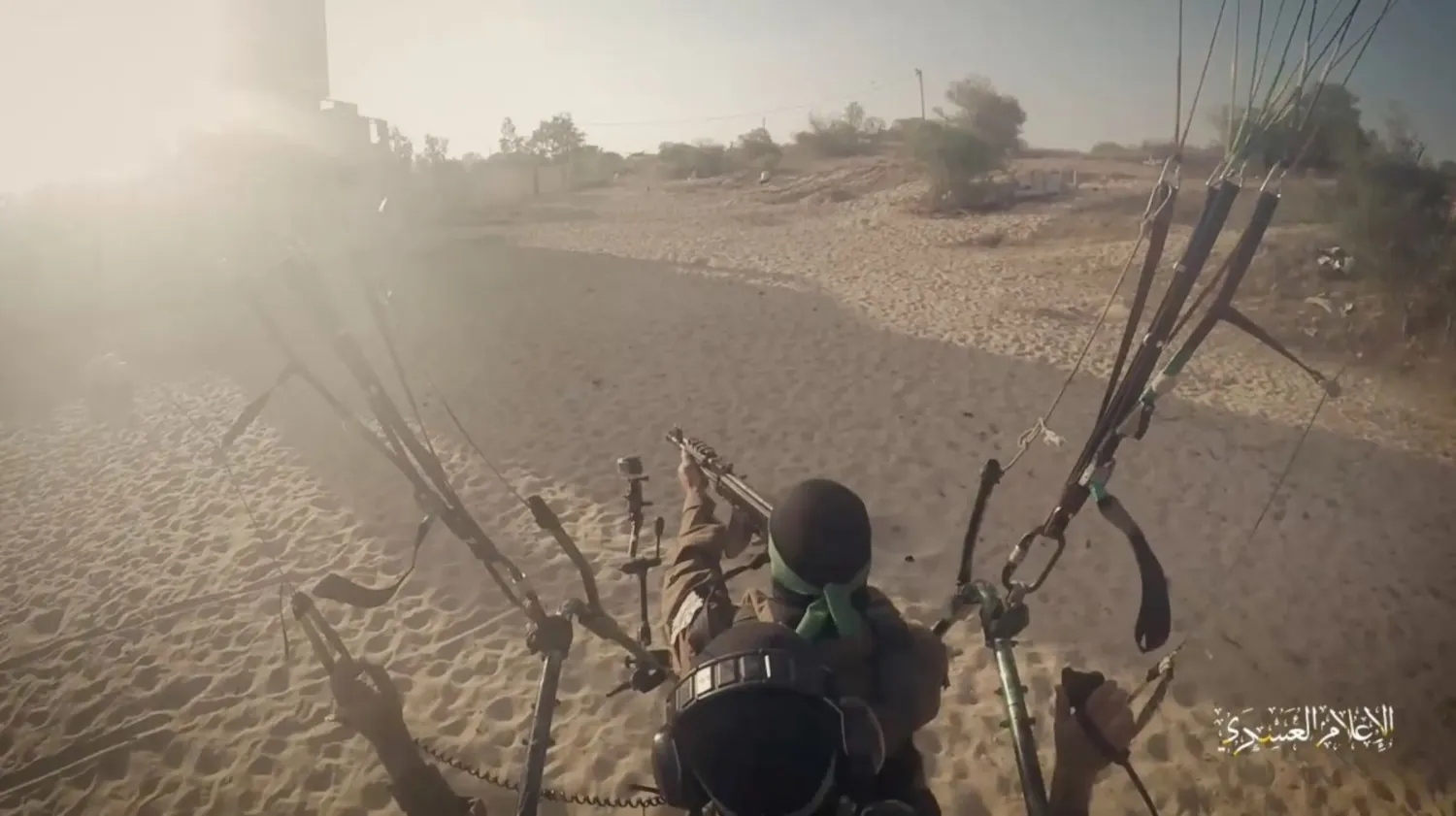

Gaza Board Envoy Says Ceasefire Holding but ‘Far from Perfect’

A still from a video published by Hamas's military media showing an Al-Qassam Brigades fighter during the October 7, 2023 attack (Reuters)
TT

Gaza Board Envoy Says Ceasefire Holding but ‘Far from Perfect’

A still from a video published by Hamas's military media showing an Al-Qassam Brigades fighter during the October 7, 2023 attack (Reuters)

The high representative for Gaza in US President Donald Trump's Board of Peace on Wednesday said the fragile ceasefire in the Palestinian territory was holding despite daily violations. 

"We have a ceasefire. It is holding... It is far from perfect. There are violations every day, and some of them are very serious," said Nickolay Mladenov during a meeting with the Foreign Press Association in Jerusalem. 

The ceasefire officially came into force on October 10, shortly after the second anniversary of the outbreak of the war triggered by Hamas's attack on Israel on October 7, 2023. 

Gaza remains gripped by violence, as Israeli strikes continue and both sides trade blame over ceasefire violations. 

The first phase of the truce saw the release of the last hostages seized in October 2023, in exchange for Palestinians detained by Israel. 

The transition to the second phase -- involving Hamas's disarmament and a gradual withdrawal of the Israeli army, which still controls more than 50 percent of the Gaza Strip -- has been stalled for weeks, while international attention has been focused on Iran and the Strait of Hormuz. 

Mladenov urged Hamas on Wednesday to relinquish power over the parts of the Gaza Strip it controls and lay down its weapons. 

"We are asking the political leadership of those who govern Gaza now to step aside. This is required by the Security Council resolution in the 20-point plan," said the envoy, referring to the peace plan for the territory sponsored by the US president. 

"We are not asking Hamas to disappear as a political movement. A political party that disavows armed activity can compete in national Palestinian elections," he said. 

"What is not negotiable, however, is that armed factions or militias... can exist alongside a transitional Palestinian authority," he continued. 

For those who refuse disarmament, the plan offers the option of "safe passage to third countries", he added. 

Mladenov meanwhile pointed to the scale of destruction in the Palestinian territory, noting that it would take a long time to rebuild. 

"If we look at the tens of millions of tons of rubble that needs to be removed, at the number of people, over a million people, who need some sort of permanent shelter and basic water and sanitation -- this is, by any scale, a generation of work for Gaza," said Mladenov. 


UN Rights Chief Calls on Israel to Abolish Oct 7 Military Tribunal

FILED - 07 October 2023, Palestinian Territories, Khan Yunis: Palestinians take control of an Israeli tank after crossing the border fence with Israel from Khan Yunis. Photo: Abed Rahim Khatib/dpa
TT

UN Rights Chief Calls on Israel to Abolish Oct 7 Military Tribunal

FILED - 07 October 2023, Palestinian Territories, Khan Yunis: Palestinians take control of an Israeli tank after crossing the border fence with Israel from Khan Yunis. Photo: Abed Rahim Khatib/dpa

The United Nations rights chief on Wednesday called on Israel to repeal a newly established special military tribunal to try Palestinian militants accused of taking part in Hamas's October 7 attacks.

Israel's parliament passed a law establishing the tribunal, with the authority to hand down the death penalty, late on Monday.

The special court is set to try attackers captured during or after the Hamas-led onslaught. It will also try those suspected of holding or abusing hostages in Gaza.

According to Israeli media, around 400 suspects are expected to stand trial before the court.

"There must be full accountability for these horrific attacks, but this cannot be achieved through trials that fall short of international standards," Volker Turk, the UN High Commissioner for Human Rights, said in a statement, AFP reported.

"This law must be overturned," he said.

"This law will inevitably institutionalize one-sided justice and discrimination against Palestinians, which cannot be in anyone's interest and runs counter to international human rights law," he said.

Hamas's attack resulted in the deaths of 1,221 people on the Israeli side, the majority of them civilians, according to an AFP tally based on official data, making it the deadliest day in Israel's history.

Militants also took 251 people hostage, including 44 who were already dead.

Israel's retaliatory military campaign has devastated the Gaza Strip and killed more than 72,000 people, according to the health ministry in the Hamas-run territory, whose figures are considered reliable by the UN.


Formation of Lebanese-Syrian Higher Business Council to Revive Economic Relations

Syrian President Ahmed al-Sharaa and Lebanese Prime Minister Nawaf Salam in Damascus (Lebanese Prime Minister’s Office)
TT

Formation of Lebanese-Syrian Higher Business Council to Revive Economic Relations

Syrian President Ahmed al-Sharaa and Lebanese Prime Minister Nawaf Salam in Damascus (Lebanese Prime Minister’s Office)

Lebanon and Syria are expected in the coming weeks to translate the agreements and understandings reached during the recent visit of the Lebanese prime minister to Damascus into a series of measures and decisions to be issued successively, underscoring a clear decision by both states to move their relationship to a new level of cooperation and coordination after years of a strained relationship that negatively affected both sides.

Among the most prominent steps already under way is the formation of the “Lebanese-Syrian Higher Business Council,” aimed at revitalizing economic and trade relations between the two countries and involving the private sector.

Economy and Trade Minister Amer Bisat explained that “talks on establishing this council began some time ago, and it was agreed that its first meeting would be held at the end of June.” He noted that “it will comprise representatives from the private sector, while the Economy Ministry will oversee it, support and monitor its work, help set its agenda, and provide guidance.”

Bisat stressed to Asharq Al-Awsat the “importance of Lebanese-Syrian relations given that the two countries are bound by geography and history, and therefore advancing these relations is a strategic objective for our government.”

He added: “Institutional economic relations with Syria require modernization, or even a rebuild from scratch. It can now be said that matters have been placed on the right track, and we have embarked on a path that may be long.”

Bisat said the Syrian state had met Lebanon’s desire to improve bilateral relations with “welcome, commitment, and positive will,” explaining that “both sides are convinced that Syria’s success is part of Lebanon’s success, and vice versa, and that the relations being built today are based on shared interests, new and healthy foundations, and mutual respect.”

Abolishing the Higher Council

In October 2025, Syria announced the suspension of the Lebanese-Syrian Higher Council, a body established under the “Treaty of Brotherhood, Cooperation and Coordination” between Lebanon and Syria, signed in 1991. The treaty marked “a major turning point” in relations between the two countries, as it entrenched “Syrian tutelage” over Lebanon, which continued until the withdrawal of Syrian troops in 2005.

According to an official Lebanese source, the treaty and the council “are effectively no longer in existence, although legal steps are still expected to be taken in this regard.”

Professor Maroun Khater, a writer and researcher in financial and economic affairs, said that “talk of establishing a new higher business council between Lebanon and Syria goes beyond the technical economic dimension to reopening the broader question of the nature of bilateral relations themselves.”

He noted that “Lebanon’s experience with the Lebanese-Syrian Higher Council, which emerged under the Brotherhood, Cooperation and Coordination Agreement signed in 1991, remained highly controversial in Lebanon because of the major imbalance in power relations and the political and security overlap that, in most cases, undermined the concept of a normal relationship between two independent states.”

“Based on that,” he added, “no new economic or institutional framework can succeed unless it begins with a deep critical review of the experience of those agreements and the flaws that accompanied their implementation.”

He continued: “Any attempt to conclude new agreements or establish modern frameworks for cooperation will remain incomplete unless the issue of revoking and abolishing the Brotherhood, Cooperation and Coordination Agreement in its current form, which is unfair to Lebanon, is clearly addressed.”

Organizing Economic Relations

Khater stressed to Asharq Al-Awsat that “the need to organize economic relations between the two countries is realistic and necessary given geography and the deep strategic economic interconnection.”

He explained that “higher business councils are usually established to provide a permanent institutional platform for dialogue between the public and private sectors and to follow up on issues related to trade, investment, energy, transport, border crossings, and customs coordination, in addition to removing obstacles to the movement of goods and capital.”

As for the outstanding economic issues between the two countries, Khater said they are “numerous and accumulated, foremost among them the smuggling of weapons, goods, and money, as well as illicit trade through illegal crossings and tunnels, which has drained the Lebanese economy for decades.”

He added that the issue of overland transit, which represents a vital artery for Lebanese exports to the Gulf, also remains key.

“Energy, and the imports of gas and electricity through Syrian territory, also stands out, in addition to customs cooperation, fees, and financial coordination, which has become complicated and opaque following the international sanctions previously imposed on Syria,” he said.

“Among the most prominent issues are the exchange of security information and the issue of Syrian refugees, which remains one of the most sensitive matters given the heavy economic, social, and financial repercussions it has imposed on Lebanon,” he added.


Lebanon Says Israeli Strikes on Cars Kill 12

Lebanese rescuers and army soldiers inspect the wreckage of a vehicle that was hit in an Israeli strike in Jiyyeh town, south of Beirut, Lebanon, 13 May 2026. (EPA)
TT

Lebanon Says Israeli Strikes on Cars Kill 12

Lebanese rescuers and army soldiers inspect the wreckage of a vehicle that was hit in an Israeli strike in Jiyyeh town, south of Beirut, Lebanon, 13 May 2026. (EPA)

Israel intensified strikes on Lebanon on Wednesday with the health ministry reporting 12 people killed in attacks targeting cars, mostly south of Beirut, despite a ceasefire between Israel and Hezbollah. 

The fresh raids, which also targeted various areas of the country's south, came on the eve of a new round of direct negotiations between Lebanon and Israel in Washington brokered by the United States, as Hezbollah remains strongly opposed to the move. 

Lebanon's health ministry said three strikes on cars along or near the coastal highway around 20 to 30 kilometers (12-19 miles) from capital Beirut "resulted in eight martyrs, including two children". 

Lebanon's National News Agency (NNA) said two strikes hit cars on the busy highway linking Beirut to the country's south, while a third struck nearby. 

An AFP photographer saw a burnt-out car and rescuers carrying a body at one of the sites, near Jiyyeh. 

A fourth strike hit a car in Sidon, southern Lebanon's largest city, around 40 kilometers south of Beirut, with the health ministry reporting one dead there. 

The ministry also said Israeli strikes on another three cars in south Lebanon's Tyre district killed three more people. 

Under the terms of the April 17 ceasefire released by Washington, Israel reserves the right to act against "planned, imminent or ongoing attacks". 

- Drone attacks - 

Israeli attacks since the ceasefire have killed more than 400 people in Lebanon, according to an AFP tally of health ministry figures. 

Israel's army said it struck Hezbollah infrastructure, weapons storage facilities and rocket launchers in south Lebanon on Wednesday. 

The NNA reported strikes on several south Lebanon locations, including in the Tyre district. 

An AFP correspondent saw thick smoke from Burj al-Shemali, one of nine areas where Israel's army issued evacuation warnings on Wednesday. 

Hezbollah claimed several attacks on Israeli troops who have invaded southern Lebanon, including with drones, and said its fighters "ambushed" and clashed with Israeli forces in one area. 

The United Nations Interim Force in Lebanon (UNIFIL) said it was "increasingly concerned" about the activities of Hezbollah fighters and Israeli soldiers near UN positions in south Lebanon. 

That includes "the increased use of drones, which has resulted in explosions in and around our bases and put peacekeepers at risk", a UNIFIL statement said. 

It noted several incidents in recent days in which drones presumed to belong to Hezbollah detonated in or near UN positions, including the force's Naqoura headquarters. 

Hezbollah has increasingly been using cheap fiber-optic drones for its attacks on Israeli forces. 

- Civil defense funeral - 

In Sidon, an AFP correspondent saw dozens of mourners at the funeral for two Lebanese civil defense personnel killed in an Israeli strike a day earlier. 

Fellow civil defense personnel holding Lebanese flags lined up for an honor guard as the coffins passed, also draped in the national flag, with a rescue helmet and flak jacket placed on top. 

This week Beirut asked Washington to pressure Israel to halt its strikes ahead of the talks on Thursday and Friday. 

Veteran diplomat Simon Karam will head the talks for Lebanon for the first time, as Washington seeks a historic breakthrough between the two sides despite the ongoing hostilities. 

On Tuesday, Hezbollah leader Naim Qassem warned that his fighters would turn the battlefield into "hell" for Israel. 

Since Hezbollah drew Lebanon into the wider regional war in early March, authorities say more than 2,800 people have been killed, including at least 200 children. 

Hezbollah says the toll includes its fighters. 

Israeli troops are operating inside an Israeli-declared "yellow line" which runs around 10 kilometers north of the Israel-Lebanon border.
