


Lebanon Enters Talks Constrained by Adamant Israel, Hezbollah Positions

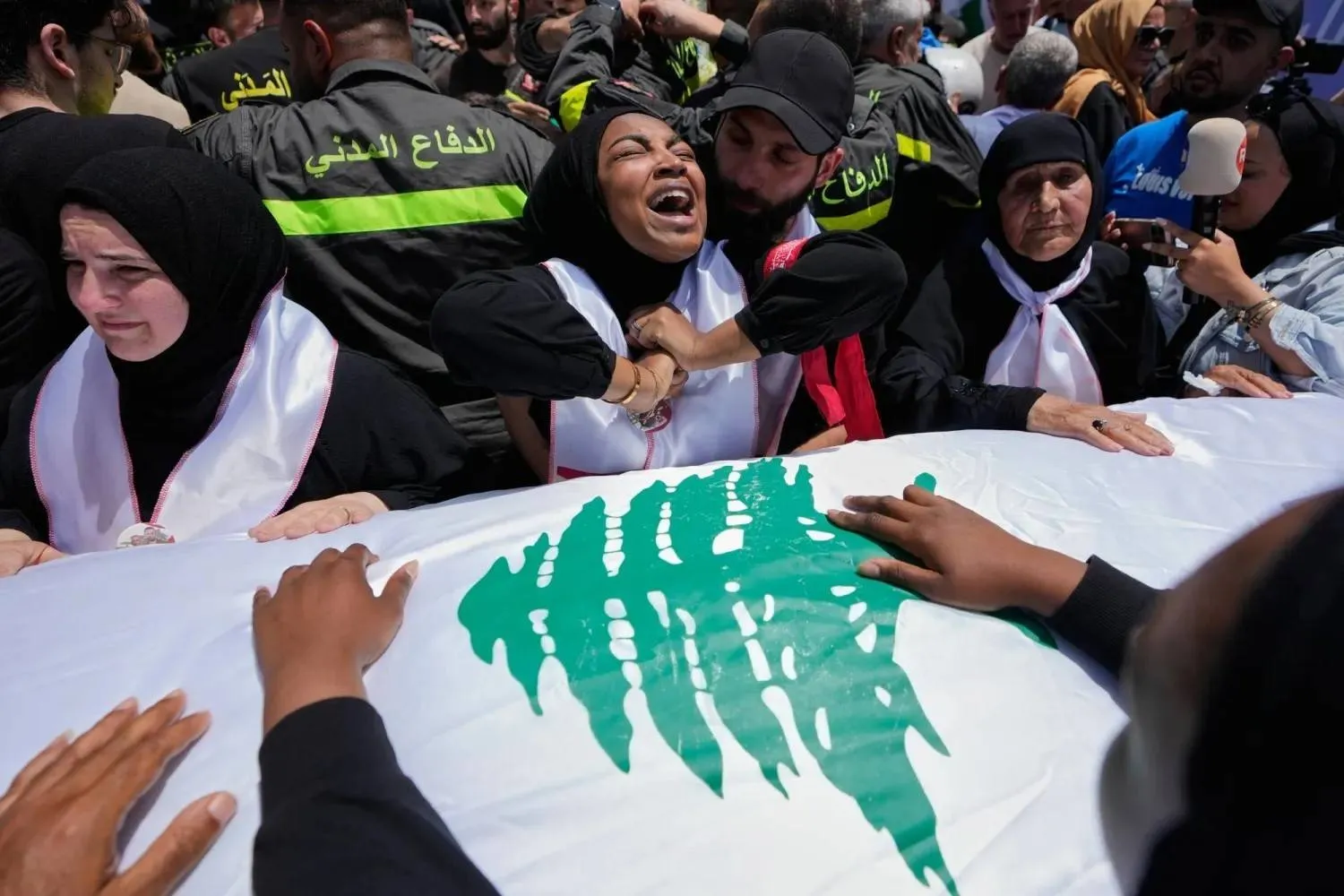
Women mourn over the coffin of a civil defense member killed in an Israeli strike in south Lebanon during his funeral on Wednesday (AP)
TT

Lebanon Enters Talks Constrained by Adamant Israel, Hezbollah Positions

Women mourn over the coffin of a civil defense member killed in an Israeli strike in south Lebanon during his funeral on Wednesday (AP)

Lebanon heads into direct talks with Israel on Thursday, with little room to maneuver as positions harden on both sides. Officials in Beirut believe Israel does not want to end the war soon, while Hezbollah, fully aligned with Iran, has largely cut off contact with Lebanese authorities.

The third challenge is the US position, which appears close to “understanding” Lebanon’s stance, without fully “sympathizing” with it.

A Lebanese official source told Asharq Al-Awsat that Lebanon is pressing Washington hard to secure a real ceasefire before negotiations begin, but has not yet received answers, making that effort likely to fail.

The source said Lebanon cannot boycott the negotiations, both to avoid embarrassment with the US side, which is playing a supporting role for Lebanon, and to avoid giving pretexts to Israeli Prime Minister Benjamin Netanyahu, who appears clearly unwilling to engage in the talks.

The source said the Lebanese delegation would enter the negotiating room with one issue on the table, a ceasefire, before moving into any other discussion. But the source would not say whether this could obstruct the negotiation process.

A meeting between President Joseph Aoun and Netanyahu was “not on the table”, the source said.

They added that Ambassador Simon Karam, who heads Lebanon’s negotiating delegation, had arrived in Washington and would meet separately with US State Department officials before the talks begin, in a bid to urge Washington to keep pressure on Netanyahu to secure a ceasefire.

The source said another obstacle to a ceasefire was internal and Lebanese, represented by Hezbollah’s lack of communication.

Washington had responded to Lebanon’s demand by asking what guarantees existed that the party would abide by a ceasefire if one were declared.

The source revealed that Aoun had sent questions to Hezbollah on the matter, but had received no answers. They went further, saying Aoun had invited MP Hassan Fadlallah, the new official handling the file, to visit him, but had received no response so far.

Negotiating agenda, a “truce +”

Lebanon is heading into these negotiations with a clear headline that does not end with “a peace agreement or normalization with the Hebrew state.”

Sources say the president is treating the talks as limited to measures and security arrangements that would ultimately lead to a formula resembling the 1949 armistice agreement, albeit in an updated form described by some of those close to him as a “truce plus.”

In principle, this approach includes cementing a ceasefire, followed by the withdrawal of Israeli forces to the border and a halt to attacks, after which the Lebanese army would deploy and assume responsibility for security in the south, and then across all of Lebanon.

The source concluded that Lebanon wants the negotiations to end the state of hostility, not to produce a peace agreement tied to an Arab track that has not yet matured.

Lebanon’s position is caught in a difficult place between two electoral processes. The first is Israeli, where the source does not express much optimism that Israeli operations in Lebanon will stop soon, citing Netanyahu’s clear desire to keep them going as Israel’s general elections approach.

The second is American, where Lebanon fears it could lose the attention of the US administration as elections approach, when elections in “Nevada become far more important than all the crises of the Middle East.”

Hezbollah’s weapons

As for Hezbollah’s weapons, sources say Lebanon’s vision is to “address” the issue at a later stage, based on an official view that dealing with it under military confrontation and security pressure remains unrealistic.

Any approach to it would first require stabilizing the situation and halting military operations, with a clear commitment by Lebanon to end this file in line with the provisions of the president’s oath of office, which firmly stated that no weapons should exist outside the framework of the state.

The source voiced frustration with Hezbollah’s conduct, saying the party shows no regard for Lebanon’s situation or for the heavy losses suffered by Lebanese citizens, foremost among them the people of south Lebanon.

They said many southerners have been deprived of their land and homes and forced to leave with no clear prospect of return, either because the fighting continues or because their houses may not remain standing as they are systematically destroyed in violation of norms and international conventions.

The source pointed to what he described as a striking incident on the day the ceasefire was announced, when Hezbollah fired heavy rocket barrages during the preliminary Lebanese-Israeli meeting attended by US President Donald Trump.

The Israeli delegation quickly used the news with Trump to point to the “danger posed by the party.”

A hot summer

The source fears what he describes as a “hot summer” if the negotiations become more complicated, amid a clear bet on a position by Trump that could break the deadlock and impose a ceasefire.

Growing domestic support

Inside Lebanon, support is growing for the negotiation track pursued by Aoun.

MP Mohammed Suleiman, spokesman for the National Moderation bloc, said after the bloc met the president: “We affirmed to President Aoun our full support for every path that strengthens state-building, preserves the higher national interest, and protects civil peace and national unity.”

Suleiman added that “the sovereign decisions taken by the government regarding the monopoly of arms, reclaiming authority over the decision of war and peace, and extending state authority over all Lebanese territory represent the demand of the majority of Lebanese. Implementing them lies at the heart of applying the law and respecting the constitution.”

He continued: “We called for intensified coordination with Arab and foreign countries, especially the Kingdom of Saudi Arabia, in order to end the Israeli attacks in a formula that preserves the dignity of Lebanon and the Lebanese.”

The right track

In addition to domestic support, the track has international backing. Egypt’s ambassador to Beirut, Alaa Moussa, said after meeting Maronite Patriarch Bechara al-Rai that he discussed the situation in Lebanon and the region with the patriarch.

“This concern greatly preoccupies His Beatitude, and we exchanged some assessments about the present and the future. I heard positive ideas from him, and confidence that the path the Lebanese state is taking is the right path and must be pursued, strengthened and given the chance to succeed in everything that serves the restoration of the Lebanese state’s sovereignty over all its territory, as it was before,” Moussa said.

He added: “We also discussed the path the Lebanese state is now taking, and we hope it will bring positive results. We can speak specifically of a round of negotiations beginning Thursday. Naturally, His Beatitude carries all positive wishes for positive results that will help achieve more accomplishments in the future.”



Israel Plans Major Settlement Push Across Occupied West Bank

A photograph taken from a land corridor that Israel plans to use for its controversial E1 settlement project, near the Arab town of al-Tur in Israel-annexed east Jerusalem, shows camels belonging to Bedouins gathered on a hill overlooking the Israeli settlement of Maale Adumim (background) on May 31, 2026. (Photo by AHMAD GHARABLI / AFP)
TT

Israel Plans Major Settlement Push Across Occupied West Bank

A photograph taken from a land corridor that Israel plans to use for its controversial E1 settlement project, near the Arab town of al-Tur in Israel-annexed east Jerusalem, shows camels belonging to Bedouins gathered on a hill overlooking the Israeli settlement of Maale Adumim (background) on May 31, 2026. (Photo by AHMAD GHARABLI / AFP)

Israel's hardline finance minister announced on Wednesday a major expansion by more than 2,000 homes of three Jewish settlements in the occupied West Bank that Palestinians hope will be part of a future independent state.

Most nations consider Israeli settlements there to be illegal under international law and a major obstacle to a two-state solution for long-term peace.

Bezalel Smotrich, who holds authority over parts of Israel's civilian administration in the West Bank, said a planning committee approved the construction of 2,162 new Jewish homes.

They include 1,006 units in a new settlement near Jerusalem, 922 near the Palestinian city of Nablus and 234 near ⁠Hebron.

"We are continuing ⁠to build the Land of Israel in practice," said Smotrich, an ultranationalist sanctioned by Britain, France and others who accuse him of inciting violence against Palestinians.

Smotrich has denounced the sanctions against him, saying the measures would not change Israeli policy.

The new homes would "strengthen our hold on the land, reinforce Israel's security, and establish clear facts on the ground that prevent the creation of an Arab terror state ⁠in the heart of the country," Smotrich said in a statement, without specifying when construction would begin.

Since becoming a minister three years ago, Smotrich has sought to tighten Israel's control and presence in the West Bank while advocating against the idea of a Palestinian state.

Prime Minister Benjamin Netanyahu's right-wing government has overseen the significant expansion of Jewish settlements in the West Bank and the establishment of new settlements.

Palestinians want the West Bank as part of a future independent state that includes East Jerusalem and Gaza. Around half a million Israelis live in the West Bank among about 3 million Palestinians.

US President Donald Trump's administration has been ⁠far less critical of ⁠the fast-expanding Israeli settlements.

However, Trump did say last September that he would not allow Israel to annex the West Bank, angering some right-wing Israeli lawmakers.

Condemning Wednesday's announcement, Palestinian President Mahmoud Abbas' office warned that Israel's "provocative" policies were pushing the region towards more rounds of violence and called on the US to stop the Israeli "madness.”

Smotrich on May 19 said he would wage "war" on the Palestinian Authority, which exercises limited civic rule in the West Bank, after he said he was told the International Criminal Court (ICC) prosecutor had sought a confidential arrest warrant against him. The ICC has not confirmed that.


UNIFIL Peacekeeper Killed in South Lebanon

A United Nations Interim Force in Lebanon (UNIFIL) convoy maneuvers within southern Lebanon, as seen from the Israeli side of the border in the Upper Galilee, northern Israel, 02 June 2026, amid a ceasefire between Israel and Hezbollah. EPA/ATEF SAFADI
TT

UNIFIL Peacekeeper Killed in South Lebanon

A United Nations Interim Force in Lebanon (UNIFIL) convoy maneuvers within southern Lebanon, as seen from the Israeli side of the border in the Upper Galilee, northern Israel, 02 June 2026, amid a ceasefire between Israel and Hezbollah. EPA/ATEF SAFADI

The United Nations Interim Force in Lebanon said Thursday that a peacekeeper was killed and two others wounded when shelling hit their base in the country's south the previous night.

"A UNIFIL peacekeeper died early this morning from critical injuries sustained when mortar shells struck his position," a statement from the force said, adding that an investigation had been launched.

The peacekeeper was Serbian, the country's defense ministry confirmed on Thursday, specifying that he died from injuries caused by a missile strike on the UN base.

"Senior Sergeant Milovan Jovanovic was given emergency medical care at a hospital inside the base after being wounded and then transported by helicopter to the University Medical Center in Beirut, where he died," the statement said.


Lebanon-Israel Ceasefire Deal: Complete Cessation of Hezbollah Attacks, Creation of Pilot Zones

(L/R) Israel's Ambassador to the US Yechiel Leiter, State Department Chief of Staff Daniel Holler, US Ambassador to Lebanon Michel Issa and Lebanese Ambassador to the US Nada Hamadeh attend a meeting between Israeli and Lebanese delegations hosted by the United States at the State Department in Washington, DC, on June 3, 2026. (Photo by Oliver Contreras / AFP)
TT

Lebanon-Israel Ceasefire Deal: Complete Cessation of Hezbollah Attacks, Creation of Pilot Zones

(L/R) Israel's Ambassador to the US Yechiel Leiter, State Department Chief of Staff Daniel Holler, US Ambassador to Lebanon Michel Issa and Lebanese Ambassador to the US Nada Hamadeh attend a meeting between Israeli and Lebanese delegations hosted by the United States at the State Department in Washington, DC, on June 3, 2026. (Photo by Oliver Contreras / AFP)

Israel and Lebanon on Wednesday agreed to a new ceasefire following talks mediated by the United States. Under the agreement, Hezbollah is to stop all attacks on Israel and withdraw its fighters from the area south of the Litani River in southern Lebanon.

In a joint statement, the US, Israel and Lebanon said “the ceasefire is contingent on a complete cessation of Hezbollah fire and the evacuation of all Hezbollah operatives from the South Litani Sector.”

Israel and Lebanon agreed with US guidance “to swiftly advance the creation of pilot zones” in which the Lebanese army “will take exclusive control of the territory to the exclusion of all non-state actors.”

“These steps will enable progress towards a comprehensive peace and security agreement,” the statement said, adding that both sides “rejected any attempt, by any state or non-state actor, to hold Lebanon’s future hostage.”

Hezbollah has yet to comment on the ceasefire. Before it was announced, the group said it had conducted two drone and rocket attacks on Israeli troops inside Lebanon that it said took place just after midnight local time on Wednesday.

In their statement, “Israel and Lebanon reaffirmed that they have no hostile intent toward one another and committed to continuing direct negotiations to build confidence, resolve all outstanding issues, and work toward a comprehensive agreement between the two countries.”

The US reaffirmed that any agreement to cease hostilities must be reached directly between the two governments, brokered by Washington, and not through any separate track.

As for Israel, it said that its security and respect for its territorial integrity can only be achieved through Hezbollah’s disarmament and the dismantlement of its infrastructure across Lebanon.

In the statement, “Lebanon reaffirmed the necessity for mutual respect of internationally recognized borders, the urgent need for full implementation of the cessation of hostilities, underscoring the principles of territorial integrity and full state sovereignty.”

It stressed commitment to enhancing the capacity of the Lebanese army, with US support, to assert effective control across the country.