


Mladenov Considers Gaza Committee Entry into Areas Israel May Leave

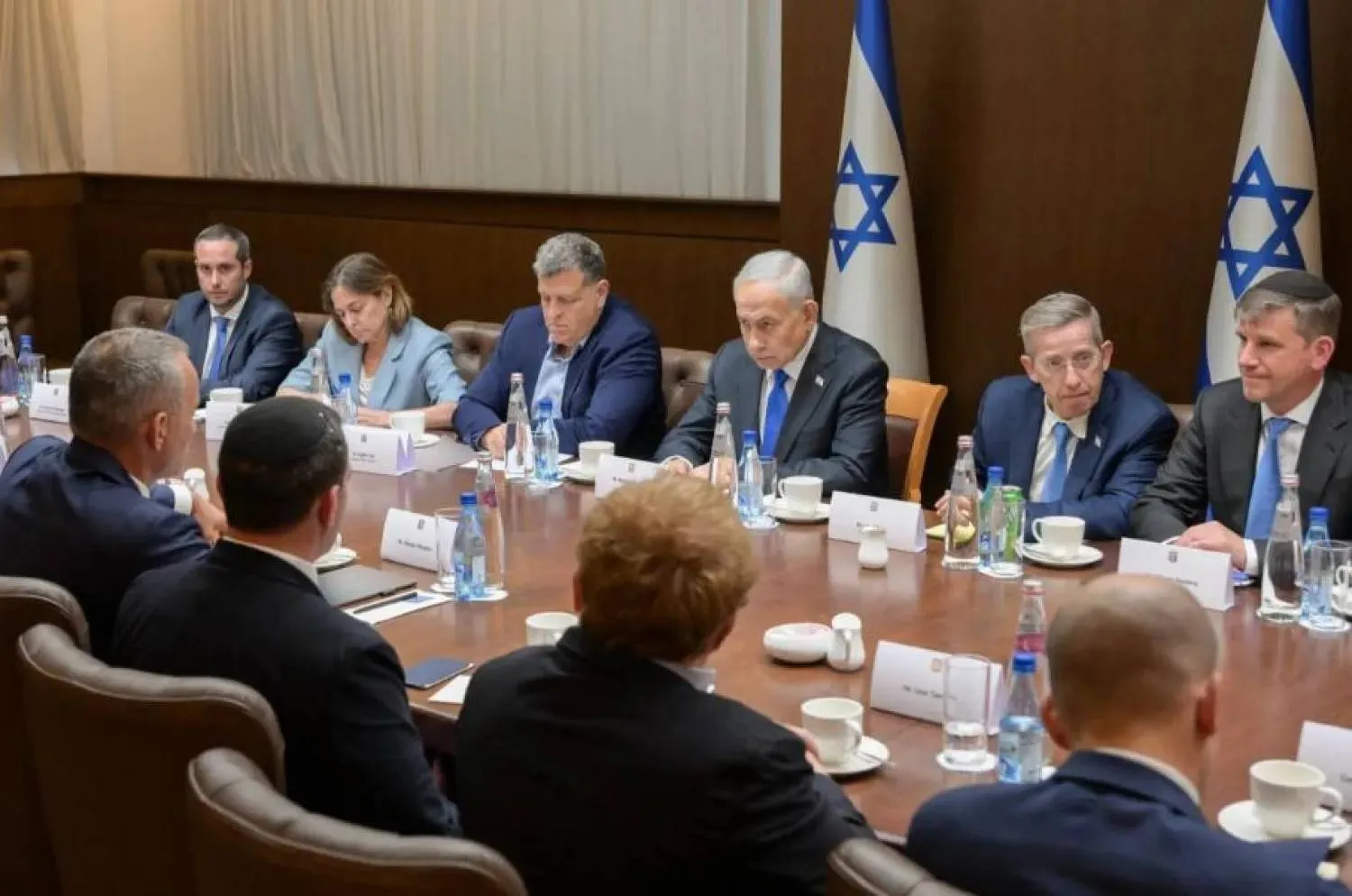
Israeli Prime Minister Benjamin Netanyahu meets Nikolay Mladenov, the Board of Peace representative for Gaza, on Wednesday (Israeli Prime Minister’s Office)
TT

Mladenov Considers Gaza Committee Entry into Areas Israel May Leave

Israeli Prime Minister Benjamin Netanyahu meets Nikolay Mladenov, the Board of Peace representative for Gaza, on Wednesday (Israeli Prime Minister’s Office)

A Palestinian source and a Western source close to the office of Nickolay Mladenov, the High Representative for Gaza at the Board of Peace, said Mladenov is studying “new options” with Israel on moving forward with the second phase of US President Donald Trump’s Gaza ceasefire plan.

The options include “allowing the Gaza Administration Committee, led by Ali Shaath, to enter areas from which Israel will withdraw inside Gaza, with the committee assuming civilian government responsibility there and deploying members of its new police force with support from Arab countries.”

Since the ceasefire agreement between Hamas and Israel took effect last October, Israel has controlled more than 55 % of the Gaza Strip, east of the notional “yellow line” that separates it from areas under Hamas influence west of the line.

The Western source told Asharq Al-Awsat that “this approach points to a decision being taken without coordination with or approval from Hamas,” adding that “the goal is to encourage Gaza residents to move to areas where the committee will assume responsibility and governance and improve their living conditions.”

Hamas and other factions insist that Israel withdraw from the areas it occupies under the ceasefire agreement.

Negotiations have stalled over a mechanism to implement the terms of the first phase, which Hamas is demanding, including humanitarian commitments, as well as the second phase, which Israel is pressing to activate, particularly the provision on “disarming” Gaza.

It is unclear whether the Gaza Committee can succeed in extending its authority over areas from which Israel withdraws without coordination with Hamas.

But the move is in line with Israeli measures in recent months, including expanding its control by shifting the “yellow line,” attacks by pro-Israel armed gangs on contact areas to force residents to move to zones under Israeli control, and a plan to rebuild sites in Rafah in the southern Gaza by placing temporary mobile homes, or caravans.

Dispute and Hamas attack

Public disagreements between Hamas and Mladenov have widened in recent weeks. One episode came on Wednesday, when Hamas political bureau member Bassem Naim attacked the senior Board of Peace official, saying he had adopted “fascist and racist positions and terminology against Hamas,” as he put it.

The remarks came after Mladenov reposted on X a post sharply criticizing Hamas and accusing it of preventing Palestinian contractors from moving from areas under its control toward sites controlled by Israel.

Israel’s public broadcaster reported on Tuesday evening that Hamas had prevented, “under threat of arms,” contractors living in Gaza from working in the planned new Palestinian city in Rafah, a city controlled by Israel.

It said the move had been fully coordinated with the United States and marked the first time Hamas had blocked activity coordinated by the US leadership and approved by the Board of Peace.

The Western source said they had confirmed information that Hamas had prevented the contractors, but that the Board of Peace had not been informed of any intention to resume the war in Gaza.

The Palestinian source close to the Gaza Administration Committee said they had “learned from Mladenov about the ban, and do not have further details about what is happening.”

Asharq Al-Awsat learned that Mladenov returned to Israel two days ago and is holding meetings with officials there. He is expected to hold another meeting with Israeli Prime Minister Benjamin Netanyahu, whom he met last Tuesday.

Resuming negotiations

Sources in Hamas and Palestinian factions said Cairo will host a new round of negotiations before Eid al-Adha to try to bridge gaps and bring views closer with Israel on the ceasefire in Gaza and the transition to the second phase.

Two Hamas sources and a third source from a Palestinian faction currently in Cairo told Asharq Al-Awsat that Egypt, on behalf of the mediators, had invited the Hamas delegation to return to Cairo in the coming days to resume negotiations and resolve outstanding disputes.

The talks come as Israel insists on its conditions related to weapons, while the factions insist that the first phase must be implemented before entering negotiations on the second phase.

The three sources said that delegations from the factions remain in Cairo, while some leaders from those factions, along with the Hamas delegation, will return in the coming days.

The sources said mediators, particularly Egypt, had prepared a new paper after consultations among themselves and with the US, to present to the factions for renewed discussion.

They said a draft of the paper had also been discussed briefly with Hamas leaders to speed up talks in the coming days.

Hamas may settle the election of its new political bureau chief before heading to Cairo, a step that could affect decision-making on the ceasefire negotiations.



The Veteran Envoys Leading Lebanon-Israel Direct Talks

US Secretary of State Marco Rubio (C) speaks during a meeting with Lebanon's Ambassador to the US Nada Hamadeh Moawad (2R) and Israeli Ambassador to the US Yechiel Leiter (2L) at the State Department in Washington, DC, on April 14, 2026. AFP, Oliver Contreras
TT

The Veteran Envoys Leading Lebanon-Israel Direct Talks

US Secretary of State Marco Rubio (C) speaks during a meeting with Lebanon's Ambassador to the US Nada Hamadeh Moawad (2R) and Israeli Ambassador to the US Yechiel Leiter (2L) at the State Department in Washington, DC, on April 14, 2026. AFP, Oliver Contreras

Lebanon's Simon Karam and Israel's Yechiel Leiter, both political veterans with entrenched views, will come face to face in Washington for talks Thursday after decades in a state of war.

Lebanon and Israel have no formal ties, but US President Donald Trump is hoping for a historic breakthrough even as Israeli forces remain deployed in south Lebanon to fight Iran-backed Hezbollah.

While Lebanon is seeking to consolidate a ceasefire in the latest war and to obtain the withdrawal of Israeli troops, Israel wants to ensure Hezbollah is disarmed, said AFP.

Here are profiles of the envoys leading their countries' third round of negotiations:

- Karam: the quiet negotiator -

Simon Karam, a lawyer known for his decades in politics and fierce defense of Lebanon's sovereignty, was appointed by President Joseph Aoun last month for the thorny task of helming the direct talks with Israel.

Beirut insists Israel must end its attacks before starting negotiations, while Hezbollah rejects outright any direct engagement between the two countries.

A former ambassador to Washington and independent politician, 76-year-old Karam is known for his defense of Lebanese unity in a country riven by sectarian divisions.

He is also known for his support for extending state sovereignty across all of Lebanon, where Hezbollah has long kept a huge arsenal and thrown the country into war after war.

Late last year, Karam was appointed as Lebanon's civilian representative to a committee comprising Lebanon, Israel, the United States, France and UN peacekeepers that was tasked with monitoring a 2024 ceasefire.

Karam is known for his calm demeanor and makes few media appearances, but those who know him say he has remained uncompromising in his convictions on a sovereign, stable Lebanon.

During his participation in two previous ceasefire monitoring committee meetings, Karam "was a decisive and rational negotiator", a source familiar with the talks told AFP on condition of anonymity.

"He was particularly insistent on the demand that southern residents return to their towns, and spoke at length about the emotional ties linking villagers to their lands," the source added.

Political analyst Ali al-Amin, who has known Karam for decades, praised his upstanding character.

"He doesn't make deals under the table," Amin said, noting Karam had not sought high office despite his connections.

Karam entered public life in 1990, first being appointed governor of east Lebanon's Bekaa region and then Beirut.

He was named ambassador to Washington in 1992 but stepped down the following year, in a move observers said was linked to his diverging views from authorities who at the time were under the influence of Syria, whose occupation Karam opposed.

Karam, who is fluent in Arabic, French and English, hails from south Lebanon's Jezzine district and is married with three children.

- Leiter: the Netanyahu ally -

Israel's ambassador to the United States, Yechiel Leiter, is a longtime ally of Prime Minister Benjamin Netanyahu.

Well-versed in Israeli settler politics, conservative activism and hard-edged diplomacy, Leiter, 67, took up his post as Israel's top envoy to Washington in January 2025.

Born in the United States, he emigrated to Israel at 18 and later served as a combat medic in the military in 1982, when Israel invaded Lebanon.

Leiter first gained prominence in the 1990s as a leading figure in the Yesha Council, the umbrella organization representing Israeli settlers in the occupied West Bank.

During some of the most divisive years of the Israeli-Palestinian peace process, Leiter became a forceful advocate for the settlement movement and a prominent nationalist.

His influence later extended into government, holding several senior positions in the ministries of education, finance and transportation.

Leiter served as chief of staff to Netanyahu when the latter served as finance minister in the early 2000s, helping cement a longstanding political alliance.

A member of Netanyahu's Likud party, he also worked as a strategist and adviser to several right-wing Israeli think tanks.

The war in Gaza struck him personally.

In November 2023, his son, Moshe Leiter, was killed in combat in the Gaza Strip, a month after Hamas's October 7 attack on Israel.

Leiter was also an outspoken critic of President Joe Biden, before Trump returned to the White House.

In a 2024 interview with Israel's Channel Tov, he denounced what he described as "American pressure" on Israel under Biden during the war in Gaza.

After being appointed ambassador, Leiter renounced his US citizenship as Israelis with dual citizenship are not permitted to serve as diplomats in countries where they hold a citizen status.

In May 2025, he was summoned by the foreign ministry after accusing Netanyahu's opponents of spreading "blood libels" against the prime minister -- breaching norms against Israeli diplomats making political statements, according to media reports.

Leiter has positioned himself as an advocate for a broader regional realignment, and following talks in Washington with his Lebanese counterpart in April, he praised what he called a "wonderful exchange".

His portfolio also includes normalization talks with Syria, according to the Israeli embassy in Washington.


Amnesty Calls for 'War Crimes' Probe into Israeli Destruction of South Syria Homes

The disengagement zone in the Golan between Syria and Israel (Archive - Reuters)
TT

Amnesty Calls for 'War Crimes' Probe into Israeli Destruction of South Syria Homes

The disengagement zone in the Golan between Syria and Israel (Archive - Reuters)

Amnesty International said on Thursday that the Israeli army's destruction of civilian homes in southern Syria since the fall of longtime ruler Bashar al-Assad should be investigated as "war crimes".

Israel moved its forces into a UN-patrolled demilitarized zone on the Israeli-occupied Syrian Golan Heights after Assad's December 2024 toppling by opposition forces.

It has also launched hundreds of strikes on Syria and carries out regular incursions into the country's south where it demands a demilitarized zone, said AFP.

"The Israeli military's deliberate destruction of civilian homes" in southern Syria's Quneitra province since December 2024 "with no absolute military necessity, should be investigated as war crimes", Amnesty said in a statement.

"Israel has an obligation to make reparations for these serious violations of international humanitarian law," the rights group added.

Amnesty said that the day Assad fell, Israeli forces entered three villages and towns in the UN-demilitarized zone in Quneitra province, "conducting home raids and ordering residents to leave".

"Over the following six months, the Israeli military destroyed or damaged at least 23 civilian structures in three villages," Amnesty said, adding that witnesses described the buildings as "their and their neighbors' homes".

The rights group said it used satellite imagery to verify damage and destruction to 23 structures in the villages.

"Securing Israel's border cannot be used to justify bulldozing and blowing up people's homes and villages on the territory of another country," Kristine Beckerle, Amnesty's deputy regional director for the Middle East and North Africa said in the statement.

Israeli operations in south Syria have continued even as the new authorities in Damascus have held talks with Israeli officials in recent months as they edge towards a security agreement after decades of hostilities.

Israel has occupied most of Syria's Golan Heights since 1967, annexing it in 1981 in a move not recognized by most of the international community.


Egypt Launches Digital Visa at Cairo Airport to Ease Tourist Entry

Egyptian Prime Minister Mostafa Madbouly after the signing of two agreements to manage and operate the new digital system at Cairo airport on Wednesday (Egyptian Cabinet Facebook page)
TT

Egypt Launches Digital Visa at Cairo Airport to Ease Tourist Entry

Egyptian Prime Minister Mostafa Madbouly after the signing of two agreements to manage and operate the new digital system at Cairo airport on Wednesday (Egyptian Cabinet Facebook page)

Egypt will begin issuing instant digital visas at Cairo International Airport in August, as part of efforts to facilitate tourist entry into the country, ahead of expanding the service to other airports.

President Abdel Fattah al-Sisi affirmed last week Egypt’s keenness to continue developing the tourism sector to reach a target of receiving 30 million tourists a year.

The government says it is working to “strengthen mechanisms to drive more inbound tourism and facilitate procedures related to tourists’ entry and departure through all airports and various points of entry.”

Prime Minister Mostafa Madbouly spoke on Wednesday about the importance of the new system during a ceremony to sign two agreements on the “management and operation of the newly introduced digital system” for obtaining visas on arrival at Cairo airport.

He said the system supports the state’s efforts to improve the tourist experience from the moment of arrival and to facilitate procedures at airports, as part of efforts to raise the quality of tourism services and in line with the state’s strategic direction to strengthen digital transformation.

According to a Cabinet statement, the signing of the two agreements marks a step toward the actual launch of the newly introduced system, scheduled to be rolled out across all terminals at Cairo International Airport next August, ahead of a gradual expansion and the generalization of the experience across all airports.

The Cabinet said the system is expected to help reduce airport congestion by allowing travelers to obtain visas on arrival quickly and smoothly, replacing the paper stamp currently in use.

Last month, government data showed that Cairo airport “continued to achieve positive growth rates in travel movement during the first quarter of 2026, both in passenger numbers and flights, compared with the same period in 2025.”

The data showed that the number of flights rose by 10% to 59,400, compared with 54,000, while passenger numbers increased by 9.5% to 8.1 million, compared with 7.4 million.

Facilitating procedures

Ahmed Wahid, a member of the Egyptian Tourism Federation, spoke of the advantages of introducing the instant digital visa, saying it would “help facilitate procedures for visitors and reduce waiting times and congestion inside airports.”

He told Asharq Al-Awsat that procedures for obtaining stamps and entry visas had previously taken a long time, adding that he expected the new facilitation measures to help attract larger numbers of tourists in the coming period.

Asked about the readiness of all airports to implement the system, Wahid said: “The new step aims to restructure and digitize all airports.”

He added: “The renewal will take time, but applying it at Cairo airport as a first phase is an important step.”

Civil Aviation Minister Sameh el-Hefny told a Senate session on Tuesday that efforts were ongoing to modernize the civil aviation sector, including improving the efficiency of the airport system, increasing its capacity, and upgrading services provided to travelers in line with international practices.

Egypt has 23 airports, and the government aims to increase annual passenger capacity from 66.2 million to 109.2 million by 2030, according to official data. Cairo, Hurghada, Sharm el-Sheikh and Marsa Alam airports topped the list of Egyptian airports receiving the largest numbers of tourists in 2025.

Boosting tourism

According to the Cabinet statement on Wednesday, visitors seeking to obtain the digital visa will enter their details via self-service machines at airports and entry points, the system’s official website, or a mobile phone application.

The statement said visitors will pay the visa fee and service charges electronically through the channels available on the system.

The visa stamp will then be issued as a QR code, which passport control officers will scan to verify its validity and match the traveler’s information. The visa can also be obtained 48 hours before arrival or through tourism companies.

On efforts to boost tourism, particularly amid regional tensions, Wahid said: “There are government instructions to companies and all those working in tourism to facilitate all procedures for tourists, in addition to President Sisi’s directives to reach 30 million tourists annually. All of this will help increase arrivals to the country in the coming period.”

He added: “There are therefore major moves underway, especially with the efforts made over the past year, including improving hotel standards and paying attention to archaeological sites.”

Egypt relies on tourism as one of its most important sources of national income. The government announced last week that tourism had recorded a monthly growth of 20% since the start of this year, compared with the same period in 2025.

The Ministry of Tourism and Antiquities also said last week that “2025 ended with significant growth in tourism movement, reaching 21% compared with 2024.”
