


SoftBank Profit More Than Triples on OpenAI Stake Gains

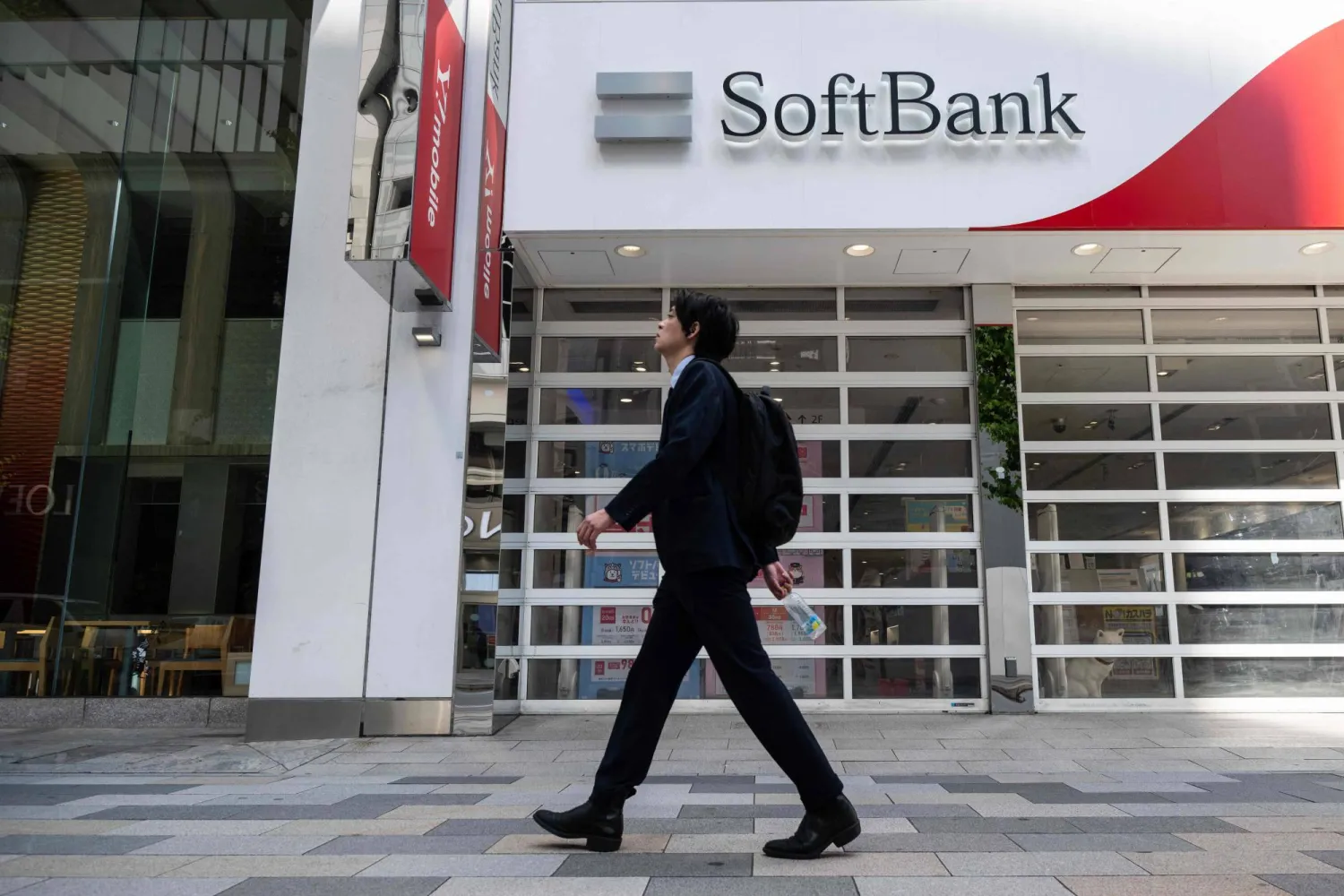
A man walks past a Softbank branch in Tokyo on May 13, 2026. (Photo by Andrew CABALLERO-REYNOLDS / AFP)
TT

SoftBank Profit More Than Triples on OpenAI Stake Gains

A man walks past a Softbank branch in Tokyo on May 13, 2026. (Photo by Andrew CABALLERO-REYNOLDS / AFP)

Technology investor SoftBank Group reported on Wednesday that its net profit more than tripled to 1.83 trillion yen ($11.60 billion) in the January-March quarter, as it booked gains on the value of its investment in ChatGPT-maker OpenAI.

It was SoftBank's fifth consecutive quarterly profit, with the Vision Fund investing arm booking an OpenAI-driven gain of 3.1 trillion yen in the quarter, according to Reuters.

Founder and CEO Masayoshi Son is one of OpenAI's most enthusiastic backers, with the group saying its cumulative gains on the investment total $45 billion.

SoftBank has sold off stakes in holdings such as T-Mobile and Nvidia, issued bonds and taken out loans, backed by its holdings in chip designer Arm and its domestic telecommunications arm SoftBank Corp.

SoftBank arranged ⁠a bridge loan agreement totaling $40 billion in March.

On Wednesday, it said $20 billion was drawn down in April, primarily for the OpenAI investment, and $2.5 billion had already been repaid.

SoftBank had previously said it had agreed to invest a further $30 billion in OpenAI over the course of 2026, which would bring its cumulative investment to $64.6 billion for a 13% stake.

Beyond OpenAI, the group booked a 278.6 billion yen gain on its investment in chipmaker Intel, which is led by former SoftBank board member Lip-Bu Tan.

SoftBank has ⁠also sought to build a portfolio of robotics firms, looking to gain a foothold in an industry that is in its infancy but is seen by analysts and investors as having potential to drive profits into the future.

It agreed to acquire the robotics business of Swiss engineering group ABB in a $5.4 ⁠billion deal last year, and created a new subsidiary within the group to hold its robotics-related stakes.



World Bank Approves $1.1 Billion Emergency Financing for Bangladesh

Mohammad Yusuf, a farmer, speaks on his phone as he arrives at a fuel station to buy diesel to irrigate his paddy field, but finds none available amid a fuel crisis, in Manikganj, Bangladesh, April 8, 2026. (Reuters)
TT

World Bank Approves $1.1 Billion Emergency Financing for Bangladesh

Mohammad Yusuf, a farmer, speaks on his phone as he arrives at a fuel station to buy diesel to irrigate his paddy field, but finds none available amid a fuel crisis, in Manikganj, Bangladesh, April 8, 2026. (Reuters)

The World ‌Bank approved $1.1 billion in emergency financing for Bangladesh to help secure food supplies, support vulnerable households and businesses due to the rising prices of fertilizer, fuel and food from the Middle East conflict.

Bangladesh is also seeking additional external financing from development partners, including the International Monetary Fund (IMF), to shore up foreign exchange reserves and ease pressure on public finances following a surge in ‌energy import costs and ‌broader economic challenges.

The World Bank ‌package ⁠comprises two projects ⁠aimed at helping the country manage external shocks and maintain economic stability.

Of the total, $300 million will be provided under the Emergency Support for Food Security Project to finance imports of 600,000 metric tons of fertilizer for the upcoming ⁠rice seasons. Bangladesh imports more than 85% ‌of its fertilizer requirements, ‌making it vulnerable to disruptions in global supply chains.

"Rising ‌food, fertilizer and fuel prices stemming from ‌the Middle East conflict, coupled with tighter fiscal space, have deeply affected Bangladesh's economy, particularly smallholder farmers and poor and vulnerable households," Jean Pesme, the World Bank's ‌division director for Bangladesh and Bhutan, said in a statement.

The project will ⁠support rice ⁠cultivation across 1.4 million hectares (3.46 million acres) of farmland.

The remaining $713 million, approved under the Contingent Emergency Response Project, will finance emergency expenditures, including cash transfers and livelihood support for affected households and small businesses.

It will also help fund fuel and energy imports needed to sustain essential services, including healthcare, food distribution, electricity and water supplies.

The World Bank said the financing would help Bangladesh respond rapidly to economic shocks while protecting jobs, livelihoods and critical services.


Trump Threatens 100% Tax on European Imports if Countries Impose Tax on Digital Services

US President Donald Trump speaks at a rally to kick off the 16-day Great American State Fair as part of Washington, DC's celebration of the nation's 250th birthday, on the National Mall in Washington, DC, USA, 24 June 2026. (EPA)
TT

Trump Threatens 100% Tax on European Imports if Countries Impose Tax on Digital Services

US President Donald Trump speaks at a rally to kick off the 16-day Great American State Fair as part of Washington, DC's celebration of the nation's 250th birthday, on the National Mall in Washington, DC, USA, 24 June 2026. (EPA)

President Donald Trump on Friday threatened a 100% tax on imports from any country that imposes a tax on digital services from United States companies.

In a post on social media, Trump took aim at European countries that he said are discussing “imminent” implementation of taxes on American companies.

“Please let this statement serve to represent that any Country that imposes such a Tax will immediately be met with a 100% TARIFF on any and all Goods sent to the United States of America,” Trump wrote.

He added that the new tax would supersede any previously negotiated trade deals. Trump said the penalty would apply to any country that moves forward with such a tax, but he singled out European nations in his post.

Trump has repeatedly pushed against foreign efforts to tax or regulate American tech giants. Last year he threatened new tariffs on any country that moved to do so. A post from last August said that digital taxes and regulation “are all designed to harm, or discriminate against, American Technology.”


US Goods Trade Deficit Hits 14-month High in May as Imports Surge

APM Terminals' facility at the Port of Los Angeles in California. (Reuters)
TT

US Goods Trade Deficit Hits 14-month High in May as Imports Surge

APM Terminals' facility at the Port of Los Angeles in California. (Reuters)

The US trade deficit in goods swelled to a 14-month high in May as businesses boosted imports, likely to avoid shortages and higher prices related to the Middle East conflict, suggesting trade remained a drag on economic growth in the second quarter.

The sharp deterioration in the goods trade deficit reported by the Commerce Department on Friday also reflected a decline in exports.

Recent business surveys have shown front-loading of orders by firms. Sponsors of the surveys attributed the behavior to the US-led war against Iran, which raised commodity prices, including for oil and fertilizers, and disrupted shipping in the Strait of Hormuz.

But after the United States and Iran last week signed a preliminary peace deal, shipments through the strait have picked up, driving oil prices sharply lower. Even if supply chains returned to normal, economists warned that the trade deficit would likely remain elevated because of an artificial intelligence investment boom that is largely reliant on imports.

"The widening trade deficit is bad news for national income growth, and it suggests that net exports might drag down real GDP growth too," said Carl Weinberg, chief economist at High Frequency Economics. "The AI boom had better generate a corresponding increase in services exports to offset the influx of equipment. If it doesn't, then this AI bubble is a losing proposition for the economy."

The goods trade gap increased 27.4% to $105.8 billion last month, the highest level since March 2025, the Commerce Department's Census Bureau said. Economists polled by Reuters had forecast the deficit at $85.0 billion.

Imports of goods increased $10.9 billion, or 3.6% to $313.4 billion, also a 14-month high. They were driven by a 6.3% surge in imports of automotive vehicles. Imports of consumer goods soared 5.7%. Despite high inflation, mostly stemming from the Iran war, consumer spending has remained strong, thanks to large tax refunds this year and a stock market rally.

BROAD INCREASE IN IMPORTS

Imports of industrial supplies, which include petroleum, increased 4.8%. Capital goods imports rose 0.4%. They surged 41.9% on a year-on-year basis, reflecting the AI spending spree.

Imports of foods, feeds and beverages increased 4.3%, while those of other goods advanced 11.5%. Overall imports have remained high despite tariffs imposed by the Trump administration.

Goods exports dropped $11.8 billion, or 5.4%, to $207.7 billion in May. They were weighed down by a 9.2% plunge in exports of consumer goods. Industrial supplies exports tumbled 7.0%, while those of capital goods dropped 5.0%. Exports of other goods decreased 6.8%. But food, feed and beverage exports increased 3.9%. Automotive vehicle exports rose 0.5%.

"Imports are moving sharply higher and this will subtract from GDP growth this quarter," said Christopher Rupkey, chief economist at FWDBONDS. "The import drag on domestic economic growth is back because factories here cannot make it here no matter how Washington economic officials try to spin it."

Trade had been a drag on gross domestic product for two straight quarters. Growth estimates for the second quarter were converging around a 2.5% annualized rate before the trade data.

The economy grew at a 2.1% annualized rate last quarter after expanding at a 0.5% pace in the October-December quarter.