

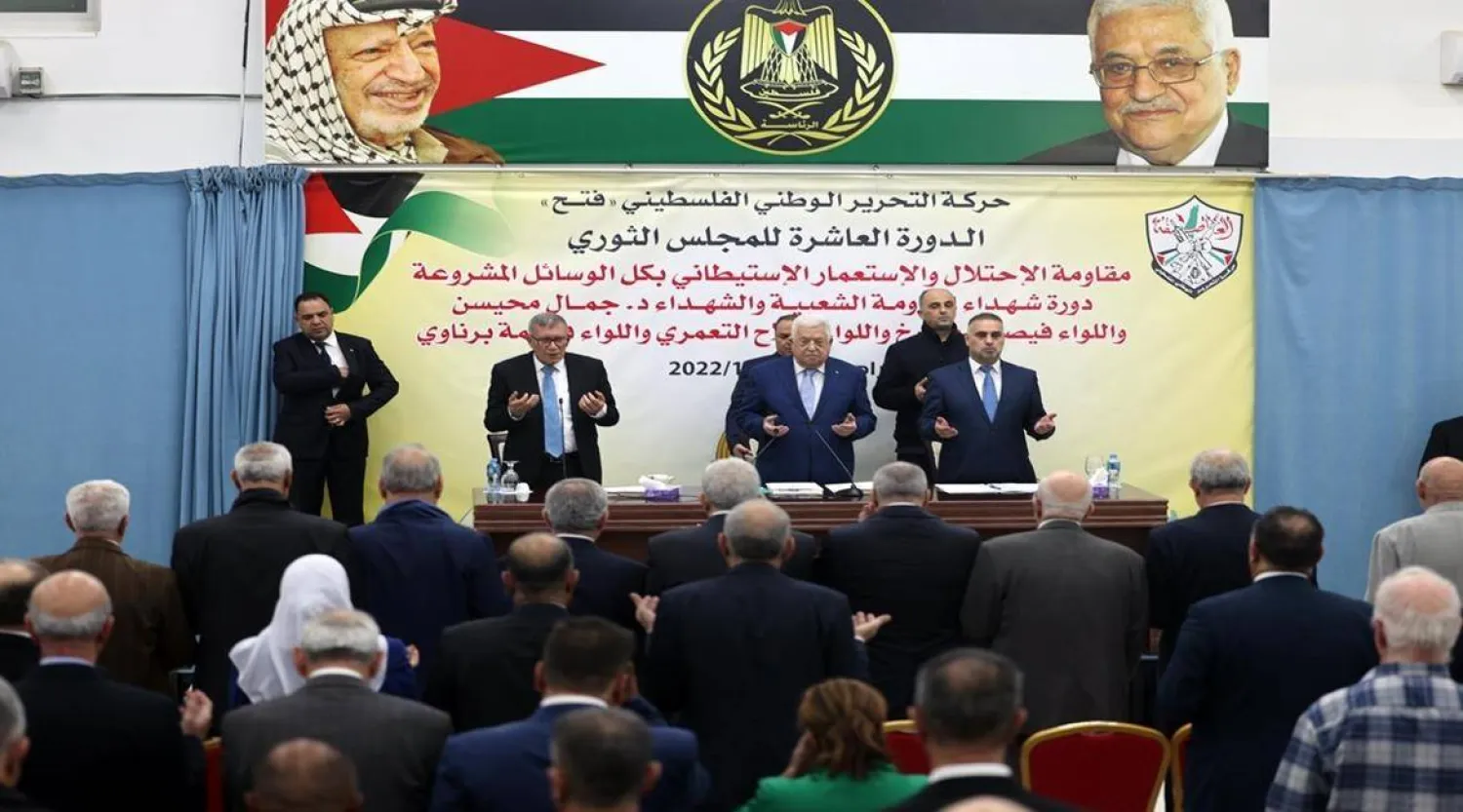

Palestinian Fatah Party to Elect Leaders for First Time in Decade

President Mahmoud Abbas presiding over a meeting of Fatah's 'Revolutionary Council' (Archive - WAFA)
TT

Palestinian Fatah Party to Elect Leaders for First Time in Decade

President Mahmoud Abbas presiding over a meeting of Fatah's 'Revolutionary Council' (Archive - WAFA)

Palestinian president Mahmoud Abbas's Fatah movement is due on Thursday to elect a new central committee for the first time in 10 years, as it faces existential challenges in the wake of the Gaza war.

During the three-day general conference, the movement will vote on the central committee, its highest leadership body, even as analysts warn of Fatah's diminishing legitimacy in the face of endemic corruption and its lack of progress on Palestinian statehood -- especially amid an intensified Israeli settlement drive, reported AFP.

The committee is expected to play a key role in the post-Abbas era, with some wondering whether the 90-year-old leader might finally step down after more than two decades at the helm, despite the lack of a clear heir apparent.

The conference comes as the Palestinian national movement is facing some of "the most serious challenges in our struggle", said Jibril Rajoub, the current secretary general of the committee.

He expressed hope that the conference, repeatedly delayed, would contribute to "ensuring and protecting the establishment of a Palestinian state on the world's agenda and protecting the Palestine Liberation Organization as the sole legitimate representative of the Palestinian people".

Fatah has historically been the main component of the PLO, which includes most Palestinian factions but excludes Hamas and Islamic Jihad groups.

In recent decades, Fatah's popularity and influence have dwindled amid internal divisions and growing public frustration over the stagnation of the Israeli-Palestinian peace process.

The sense of disappointment led to a surge in support for rival Hamas, which made huge political gains in the occupied West Bank in 2006 elections that it won handily, before going on to expel Fatah from the Gaza Strip almost entirely after a bout of factional fighting.

Hani al-Masri, director of the Palestinian Center for Policy Research and Strategic Studies (Masarat), told AFP that Fatah now merely uses the PLO to provide itself with legitimacy, "a legitimacy that is eroding in the absence of a unified national project, elections and national consensus".

He added that Thursday's conference was overshadowed by competition over seats on the central committee, "while the national project is conspicuously absent from the discussions".

Rajoub nonetheless declared that the conference was a first step towards "putting the Palestinian house in order, to build a partner for establishing a (Palestinian) state".

- Succession -

The conference will be held over three days, with approximately 2,580 Fatah members participating, the majority of them in Ramallah, though several hundred are also spread across Gaza, Cairo and Beirut.

They are expected to elect 18 representatives to the central committee and 80 to the movement's parliament, known as the revolutionary council.

Fatah is the main party within the Palestinian Authority (PA), which has been touted abroad as a natural partner in rebuilding and running the Gaza Strip after Israel's devastating war with Hamas there.

But Fatah remains marginalized in the territory, and Israeli Prime Minister Benjamin Netanyahu has repeatedly vowed that it, the PA and Hamas will have no role in post-war governance.

Despite repeated declarations from the movement that it is working as a "united front", major figures will be absent from Thursday's conference, notably Nasser al-Qudwa, a key Palestinian leader who is boycotting the gathering.

"This conference is illegitimate, and this leadership that has usurped power is illegitimate and its time is up," said Qudwa, a nephew of late Palestinian leader Yasser Arafat.

Key figures competing to replace Abbas include Rajoub and PA deputy Hussein al-Sheikh.

Also missing is Marwan Barghouti, who is considered a uniquely unifying Palestinian leader often cited as a possible successor to Abbas, but is serving a life sentence in Israeli prison after being found guilty of involvement in deadly attacks.

Meanwhile, the president's eldest son, Yasser Abbas, is on the ballot to join the central committee, having risen in prominence over recent years after he was named the president's special representative despite largely residing in Canada.

Al-Masri said the president's son's bid for a seat "indicates a trend towards dynastic succession", which is "extremely dangerous for Fatah, the Palestinian Authority and the Palestinian cause".



Syria, Iraq Agree to Expand Cooperation in Energy, Security and Economy

Syrian President Ahmed al-Sharaa receives Iraqi FM Fuad Hussein in Damascus on Monday. (SANA)
TT

Syria, Iraq Agree to Expand Cooperation in Energy, Security and Economy

Syrian President Ahmed al-Sharaa receives Iraqi FM Fuad Hussein in Damascus on Monday. (SANA)

Iraqi Foreign Minister Fuad Hussein visited Damascus on Monday on his first trip since there since the ouster of Bashar al-Assad's regime in December 2024.

He held talks with President Ahmed al-Sharaa and his Syrian counterpart Asaad al-Shaibani.

The meeting with Sharaa focused on bilateral relations and ways to expand cooperation across various sectors, reported Syria’s state news agency SANA.

The two sides also discussed regional and international developments and stressed the importance of strengthening coordination and consultation between Syria and Iraq in addressing shared challenges.

Talks with Shaibani focused on practical mechanisms to strengthen bilateral relations and advance mutual cooperation across various sectors.

The FMs agreed to establish a high committee for joint coordination, co-chaired by both ministers, to ensure the consistent follow-up and execution of outcomes stemming from bilateral cooperation while streamlining joint initiatives.

The discussions also focused on energy infrastructure, specifically looking into mechanisms for oil transit and grid integration, alongside a project to rehabilitate oil pipelines extending from Iraq to Syria.

They also addressed frameworks for strategic cooperation in the sectors of water management and agriculture, which aims to boost mutual food security, stimulate economic integration, and serve shared bilateral interests.

They explored avenues to upgrade security coordination and intelligence sharing, bolstering regional stability and supporting collaborative efforts to confront mutual security challenges.


UN Chief Slams ‘Relentless’ Israeli Settlement Expansion

United Nations Secretary-General Antonio Guterres delivers a statement during a media conference at the EU summit in Brussels, March 19, 2026. (AP)
TT

UN Chief Slams ‘Relentless’ Israeli Settlement Expansion

United Nations Secretary-General Antonio Guterres delivers a statement during a media conference at the EU summit in Brussels, March 19, 2026. (AP)

UN chief Antonio Guterres has condemned the "relentless" expansion of Israeli settlements in the West Bank, saying in a report seen Monday by AFP they are contributing to the territory's worst displacement crisis since 1967.

The secretary-general, in a quarterly report on the West Bank, said an increase in settler outposts was leading to an upsurge in violence and restricting Palestinians' access to their land.

"These developments fuel tensions, further entrench the unlawful Israeli occupation, undermine the right of the Palestinian people to self-determination, and threaten the viability of a fully independent, contiguous, and sovereign Palestinian State," Guterres said.

He specifically warned against Israeli plans to develop in the so-called E1 area of the West Bank, saying new settlements "would effectively sever the connection between the northern and southern West Bank."

"As such, it would have severe consequences for the territorial contiguity of the Occupied Palestinian Territory and present an existential threat to the two-state solution," Guterres said.

The report also denounced impunity towards violence by Israeli settlers, pointing out it often occurs in the presence of -- or with the support of -- Israeli security forces.

"Settler violence, access restrictions, demolitions and prolonged security operations have intensified in recent years, resulting in the largest displacement crisis in the West Bank since 1967," Guterres said.

In a joint statement ahead of a UN Security Council meeting on the West Bank, five European members of the council -- France, Britain, Greece, Latvia and Denmark -- condemned settlement activity.

"We call on the Israeli Government to end its expansion of settlements and administrative powers, ensure accountability for settler violence and investigate allegations against Israeli forces," France's UN envoy Jerome Bonnafont said.


Iraq Sets September 30 Deadline for Pro-Iran Groups to Disarm

 Vehicles drive along the Al-Jumhuri street in central Baghdad on June 28, 2026. (AFP)
Vehicles drive along the Al-Jumhuri street in central Baghdad on June 28, 2026. (AFP)
TT

Iraq Sets September 30 Deadline for Pro-Iran Groups to Disarm

 Vehicles drive along the Al-Jumhuri street in central Baghdad on June 28, 2026. (AFP)
Vehicles drive along the Al-Jumhuri street in central Baghdad on June 28, 2026. (AFP)

Iraq's government has given pro-Iran armed groups in the country until September 30 to disarm, coinciding with the end of the US-led anti-ISIS coalition's mission, its spokesman said on Monday.

The announcement comes ahead of a visit to the United States by new Prime Minister Ali al-Zaidi, with Washington exerting pressure on Baghdad to ensure the factions turn in their weapons.

"All the armed groups have been informed of a specific date that marks the end of this issue (of disarmament) ... which is September 30, which also marks the end of the international coalition's presence," government spokesman Haidar al-Aboudi said in a weekly press conference.

"After this date, all weapons outside the state framework will be subject to legal redress," he added.

Iraq is home to dozens of Iran-backed armed factions, many of which form part of the Popular Mobilization Forces (PMF).

Many emerged in the wake of the 2003 US-led invasion of Iraq and gained further power and prominence during the fight against the ISIS group from 2014 onwards.

Under heavy US pressure in recent months, Iraqi authorities said they would seek the full integration of those member factions in the PMF into government forces in a bid to limit the possession of weapons to the hands of the state.

The government aims to include within the integration drive brigades that currently operate outside the framework of the PMF.

The move came after some of the factions with forces in the PMF launched attacks on US interests in Iraq following the start of the Middle East war in late February.

Washington in turn launched its own attacks on the factions, before withholding cash payments for Iraqi oil revenues that are paid as part of a deal following the 2003 US-led invasion.

Iraqi authorities have repeatedly attempted to fully integrate the PMF into the state forces, but some of the groups have cited the continued presence of US forces in Iraq as a reason to delay the disarmament process.

Earlier in June, Iraqi authorities announced that they had received data on weapons belonging to the pro-Iran faction Kataeb Imam Ali, a first step in the plan to integrate such groups into the state forces.

Shortly before, two pro-Iran factions, the Kataeb Imam Ali and Asaib Ahl al-Haq, announced they would be handing over administration of their brigades in the PMF to the state.

The PMF was formed in 2014, bringing together armed factions to fight the ISIS group after it seized swathes of the country.