




As Sudan’s war enters its fourth year, civilians are enduring worsening hardship on an unprecedented scale, with prolonged power outages and the broad collapse of basic services turning access to water into one of the harshest challenges of daily life.
Obtaining drinking water is no longer routine. It has become a daily struggle, no less grueling than the sound of artillery and shells, draining time, effort, and money amid suffocating humanitarian and economic conditions.
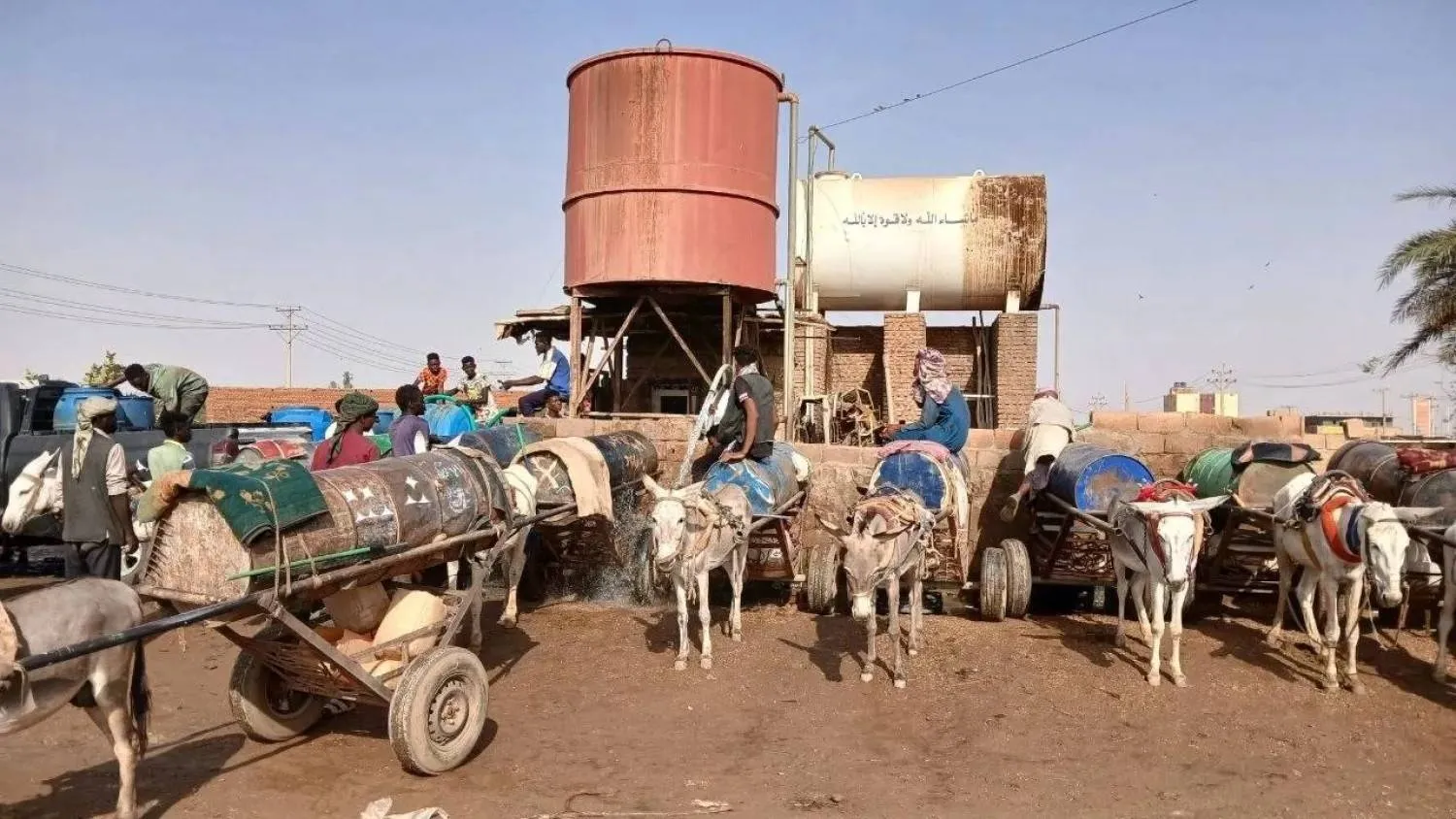
Since the war erupted, drinking water has shifted from an available basic service into a heavy burden on Sudanese families. Residents spend long hours in extended queues to obtain barrels of water that cover their daily needs and keep life going in homes, markets, and small restaurants, many of which have been disrupted by the lack of water supplies.
In several outskirts of the capital, Khartoum, the impact of the crisis is clear in the details of daily life. Children and women carry containers over long distances, while donkey-drawn carts have become the main means of transporting water to homes.
Residents complain of rising prices and declining water quality, amid growing fears of the spread of diseases linked to contamination and the lack of safe alternatives. They are increasingly calling for urgent intervention by the authorities to restore basic services and ease the suffering of the population.
A grinding daily struggle
Al-Tayeb Bilal, who owns a donkey-drawn cart used to transport water, said the crisis had worsened sharply because of continuous power outages, which have knocked water stations out of service in many areas.
Speaking to Asharq Al-Awsat, he said he sometimes spends more than 10 hours waiting to obtain a barrel of water, which he buys for 5,000 Sudanese pounds, about $1, before selling it for around 20,000 pounds, or $4, at parallel market rates to cover transport costs and the effort of his daily work.
Resident Zeinab al-Tom described the suffering as “harsh and continuous,” saying families have been forced to buy water daily for more than a year despite deteriorating living conditions. She said some of the water that reaches residents is contaminated or not fully fit for use, but people are forced to use it because there are no alternatives.
Makkah Abdullah, a tea seller, said power outages have imposed growing burdens on small business owners. She said she has to buy two 24-pound containers of water every day, along with charcoal and other supplies, which consume most of her limited income.
She appealed to the authorities to intervene urgently to restore electricity and water services, saying the continued crisis has greatly deepened people’s suffering.
In the same context, Fatima Hassan, a restaurant owner, said the steady rise in the prices of water and ice had directly affected her business, with most of her revenue going toward operating costs, leaving little profit.
She said she works under difficult conditions to support her family, while her husband suffers from illness and hemiplegia, and her five children continue their studies amid rising expenses.
Mohamed al-Nour, a butcher, said the water crisis had become one of the most serious problems facing citizens, given its direct impact on daily life and professional activity. He called on the relevant authorities to act urgently to find lasting, fundamental solutions that ensure regular water supplies to residential neighborhoods.
Resident Abbas Mahjoub said about 60,000 people in the East Nile and Green Valley areas, east of Khartoum, were still facing a severe water shortage, amid a weak official response and, in some areas, reliance on local efforts to repair groundwater wells.
Consumption rises sharply
Relevant authorities attributed the worsening crisis to repeated power outages and unstable electricity supplies feeding water stations, as well as declining electricity production and higher consumption during the summer.
Al-Tayeb Saadeddin, spokesman for the Khartoum state government, said authorities had resorted to operating some water stations using diesel generators to keep supplies running. He said the Al-Manara water station in Omdurman alone needs about 80 barrels of diesel a day to operate normally.
Saadeddin said urgent interventions had been carried out in recent days to address the water crisis in the Umm Badda locality, west of Khartoum. These included drilling 10 high-output wells to cover the areas of Umm Badda al-Sabeel and Dar al-Salam. He said he expected the crisis to ease gradually once the Al-Manara water station becomes fully operational.
In a country exhausted by war and weighed down by successive crises, Sudanese hardship is no longer limited to fear, displacement, and loss of security. It has extended to the most basic necessities of life.
Between waiting in queues, soaring prices, and the continued collapse of services, civilians continue their daily struggle to survive in a scene that reflects the scale of the humanitarian deterioration engulfing the country.


