


End of the ‘People’s Army’ Myth: Israel Weighs Resorting to Mercenaries

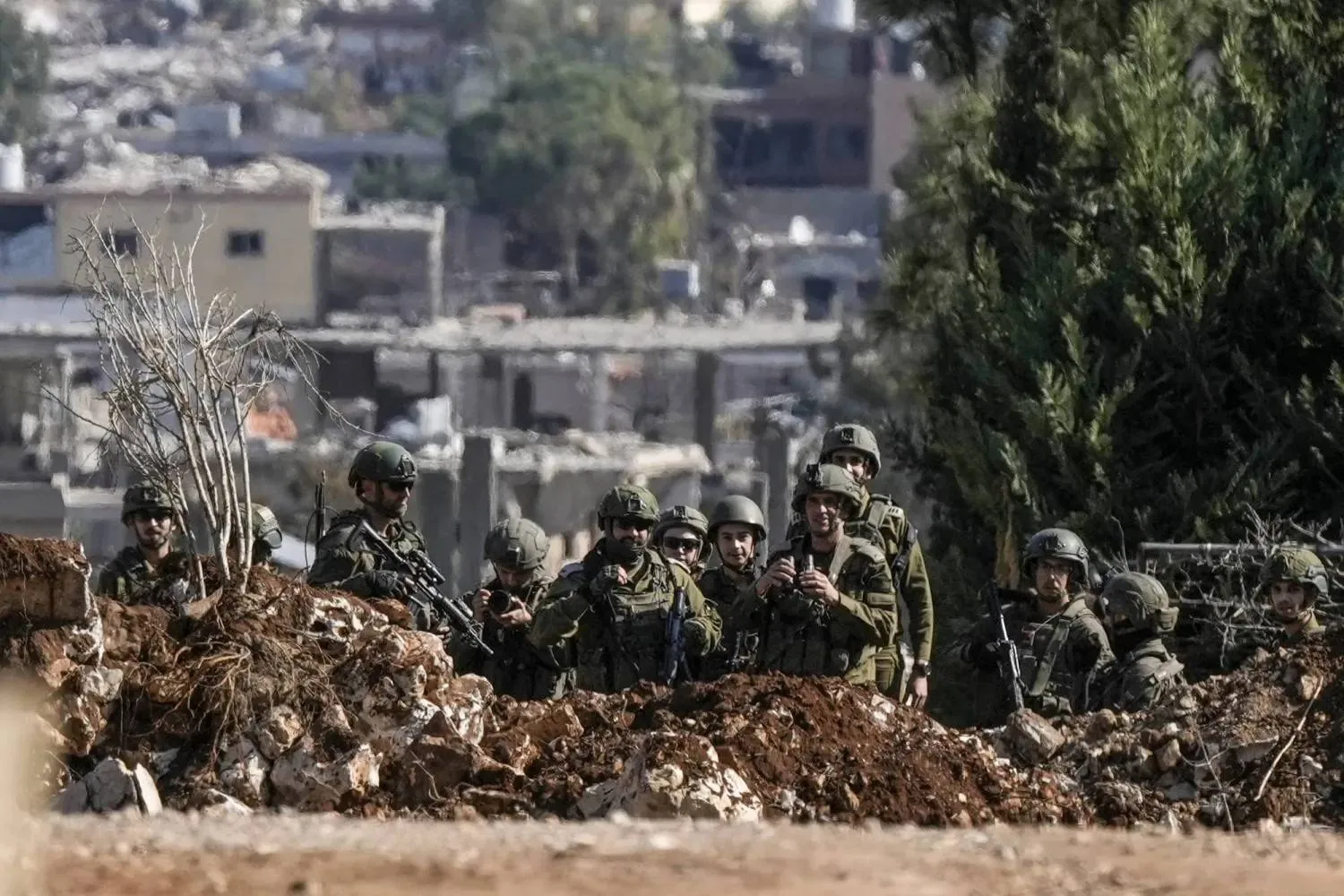
Israeli soldiers seen in the village of Aitaroun in southern Lebanon, January 27, 2025. (AP)
TT

End of the ‘People’s Army’ Myth: Israel Weighs Resorting to Mercenaries

Israeli soldiers seen in the village of Aitaroun in southern Lebanon, January 27, 2025. (AP)

As Israel’s military grapples with a severe manpower shortage estimated at 15,000 troops — a situation Chief of Staff Eyal Zamir has described as “dangerous for the future of the Jewish state” —

Israeli ultra-Orthodox parties continue to reject military service in favor of Torah study even as Israel’s military grapples with a severe manpower shortage estimated at 15,000 troops - a situation Chief of Staff Eyal Zamir has described as “dangerous for the future of the Jewish state”.

Former senior government official Shlomo Maoz has proposed recruiting 12,000 mercenary soldiers with generous pay packages to address the shortage.

Maoz presented the idea as a personal initiative inspired by Ukraine’s recruitment of 10,000 foreign fighters, however, he said the Israeli army has long relied on a similar force known as “lone soldiers,” currently numbering 7,365.

According to Maoz, 52 percent are soldiers from Jewish families living abroad, while the remaining 48 percent are effectively mercenaries “in every sense of the word.” They come from several countries, including 30 percent from the US, 12 percent from France and 7 percent from Ukraine, while the rest come from Spain, Italy, Germany, Canada and Britain.

These soldiers receive salaries equivalent to $4,000 a week and they currently serve through “secret” arrangements, he revealed.

His new proposal is aimed at bringing these arrangements into the open and formalize the system publicly through the creation of an “Israeli Foreign Legion” composed of four brigades operating under Israeli officers.

Speaking to Israel’s Maariv daily, Maoz stressed that the main problem with the proposal was moral rather than military, as it would mark Israel’s abandonment of the “people’s army” myth.

He described the Israeli military as historically built on the integration of Israelis from more than 100 cultural backgrounds — Ashkenazi and Mizrahi Jews, urban and rural communities, native-born Israelis and new immigrants, people from Europe and Western countries, as well as from Arab and Muslim states, alongside Jews, Muslims, Christians, Druze and Circassians — into what he called a cohesive force that overcame social divisions.

But Maoz argued that the benefits of recruiting mercenaries outweigh the symbolic costs.

He said the military faces an acute shortage, with even conservative estimates pointing to a need for 15,000 additional troops, including at least 9,000 combat soldiers, while religious Jews remain adamantly opposed to conscription.

At the same time, he said, the government is waging an ongoing war on seven fronts, pursuing further occupation and expansion, and establishing 134 new settlements and outposts that all require protection.

“To fill this need, solutions outside the box must be explored,” Maoz urged.

He added that hundreds of thousands of retired military officers from around the world, including fighters, snipers, tank operators, drone specialists and even pilots, could be recruited easily, particularly from Eastern European countries.

Maoz, an economist by background, said financing the project was one of its key challenges. He estimated each soldier would cost between $8,000 and $10,000 a month, with additional state expenses amounting to roughly half that figure.

He revealed that the total cost of a mercenary force would reach around $2.5 billion — a manageable amount given Israel’s foreign currency reserves of $236 billion, equivalent to about 38 percent of gross domestic product.

Pointing to the Ukrainian model, Maoz said around 600 mercenaries join Ukraine’s army every month, bringing the total number of foreign fighters there to 10,000 from 75 nationalities. Kyiv pays them an average of $4,000 per month.

Maoz added that Israel was particularly suited to integrating mercenaries because it has millions of citizens who speak foreign languages as their mother tongue, such as Russian, Slavic languages, English and Spanish.

France’s Macron Slams Migrant ‘Return-Hubs’, EU Funding Push

French President Emmanuel Macron addresses a press conference during a European Council summit in Brussels, Belgium, 19 June 2026. (EPA)
TT

France’s Macron Slams Migrant ‘Return-Hubs’, EU Funding Push

French President Emmanuel Macron addresses a press conference during a European Council summit in Brussels, Belgium, 19 June 2026. (EPA)

French President Emmanuel Macron on Friday slammed the idea of creating deportation centers for irregular migrants outside the EU, saying Paris will oppose efforts to have the bloc fund them.

So-called "return hubs" outside the EU's borders are one of the main features of a tightening of migration rules criticized by human rights groups that won the final approval of the European Parliament this week.

"France does not support that policy," Macron told journalists after a summit of European leaders in Brussels, noting the new rules allowed for people to be sent to countries they had no ties to -- which could receive money in turn.

"I'm not sure that's the Europe we want. I'm not sure those are the fundamental principles on which our Europe was built. And I don't believe, for that matter, that it's effective. The proof is that, so far, I haven't seen anyone make it work."

France was in favor of stricter rules to boost returns of people with no right to stay to their country of origin, but would not be building return hubs, he added.

"I don't believe that this is either effective or in line with our principles," Macron said.

While other EU members were free to go ahead with such plans, Paris was against a move supported by many other member states to have EU money help pay for them, Macron said.

Proponents say return hubs -- which would serve either as the final destination or as transfer centers for those expelled -- could facilitate repatriations and act as a deterrent for would-be irregular migrants

But rights groups have criticized them as "legal black holes" that could see migrants stranded in limbo with little oversight.

Britain abandoned a scheme to deport undocumented migrants to Rwanda, while Italian-run facilities to process migrants in Albania have faced legal challenges and a slow uptake.


Iran Mediators to Meet in Egypt on Sunday

Smoke rises following Israeli bombardment in southern Lebanon as seen from a position across the border in the Upper Galilee in northern Israel on June 19, 2026. (AFP)
TT

Iran Mediators to Meet in Egypt on Sunday

Smoke rises following Israeli bombardment in southern Lebanon as seen from a position across the border in the Upper Galilee in northern Israel on June 19, 2026. (AFP)

Mediators in the US-Iran conflict, including Saudi Arabia, Pakistan and Türkiye, are due to gather for talks in Egypt on Sunday, Cairo and Islamabad said.

Pakistan's foreign ministry said on Friday that the four-way meeting would bring together the foreign ministers of Saudi Arabia, Pakistan, Türkiye and Egypt to "discuss regional developments and exchange views on issues related to peace, security and stability".

Egypt's foreign ministry said late Thursday that the meeting would be followed by expanded talks and a joint news conference.

The ministry initially said the meeting would be held in the Egyptian resort of El Alamein, before updating the location to Cairo.

The four foreign ministers last met in April on the sidelines of a diplomatic forum in the Turkish resort city of Antalya.

The Cairo meeting comes after US-Iran talks scheduled in Switzerland for Friday, aimed at following up on the agreement to end the war, were postponed, according to the Swiss foreign ministry.

The White House confirmed that US Vice President JD Vance's planned trip to Switzerland for the talks had been cancelled.

The deal, signed this week by President Donald Trump and his Iranian counterpart Masoud Pezeshkian, aims to end a conflict that began on February 28 with US-Israeli strikes on Iran.

It also provides for the reopening of the Strait of Hormuz and the launch of a 60-day negotiation period on broader issues, including Tehran's nuclear program.

The agreement was also meant to halt fighting in Lebanon, but some clashes have since broken out between Israeli forces and Iran-backed Hezbollah fighters.


EU Leaders Squabble Over Outreach to Moscow as Ukraine War Rages on

European Council President Antonio Costa speaks during a press conference at the end of European Council summit in Brussels, Belgium, 19 June 2026. (EPA)
TT

EU Leaders Squabble Over Outreach to Moscow as Ukraine War Rages on

European Council President Antonio Costa speaks during a press conference at the end of European Council summit in Brussels, Belgium, 19 June 2026. (EPA)

European Union leaders have been unable to agree on setting up a back-channel with Moscow to ensure that the bloc’s interests are protected should progress be made in negotiations to end Russia’s war on Ukraine, some of them said on Friday.

European Council President Antonio Costa, who chaired their two-day summit, had directed his office to reach out to the Kremlin and proposed a senior official to make contact. Costa said his aim was not to mediate or set up a parallel negotiating track to the one led by the United States, which is making little progress.

Debate has been swirling around Europe in recent months about whether to appoint a mediator for talks with Russia to help get things moving again, but this has been largely rejected as many believe that Russian President Vladimir Putin would be unlikely to negotiate anyway.

Instead, the 27 EU countries have focused on concessions that Russia should make to secure peace.

Speaking to reporters, Czech Prime Minister Andrej Babiš said the leaders had failed to resolve their differences over the approach overnight. “Europe is unable to agree even on whether there will be negotiations or who will lead them,” he said.

Irish Prime Minister Micheál Martin said that “opening up a channel is not a mistake in our view, and I trust António Costa.”

“What was very clear last evening is that any negotiations would have to be first and foremost between Ukraine and Russia, but there are no indications that Russia is coming to the table at all,” he said.

German Chancellor Friedrich Merz stressed that peace negotiations must ultimately be conducted by Ukraine, Russia, Europe and the US.

“Who speaks for the European Union is something we don’t need to decide on today,” he said. “We will decide on that when talks come about.”

He added that Costa has “an important to role to play” as president of the European Council, representing the EU, preparing and organizing summits, and “we don’t need to make decisions going beyond that at the moment.”

Merz highlighted efforts to coordinate diplomacy by the so-called E3 group of countries — Germany, France and Britain — a format that he said came about “at the explicit wish of Ukraine.”

Putin has tried to cut out Europe and Kyiv from negotiations with the US over Ukraine’s future. But the Kremlin said on Friday it was “ready for contact” with Europe, on the condition it abandon its desire to talk to Moscow from the position of force.

At the same time, Russian Foreign Minister Sergei Lavrov argued that the EU can not be an impartial peace broker. He again rejected Western claims that Moscow was harboring plants to attack Europe as “provocation” and “nonsense” while warning that Europe’s military buildup poses growing security threats.

“A direct confrontation between NATO and Russia could rapidly escalate into an exchange of nuclear strikes, with catastrophic consequences,” Lavrov said in an essay released by the Russian Foreign Ministry.

As the leaders left their meeting overnight, Belgian Prime Minister Bart De Wever joked that Costa would be the envoy to Moscow.

“I was just talking about you, António,” De Wever said while laughing and shaking Costa’s hand. “I was full of praise, saying you are the only one who can represent us and that we will send you to Moscow.”

Margus Tsahkna, foreign minister of Estonia — a nation on the EU’s eastern flank that has faced drone incursions and was once occupied by the Soviet Union — said that “Europe must not assume the role of a neutral mediator” and instead buttress Ukraine’s position to “force the Kremlin into serious negotiations.”
