


Govt's ‘Wheat Pricing’ Fuels Farmer Protests across Syrian Provinces

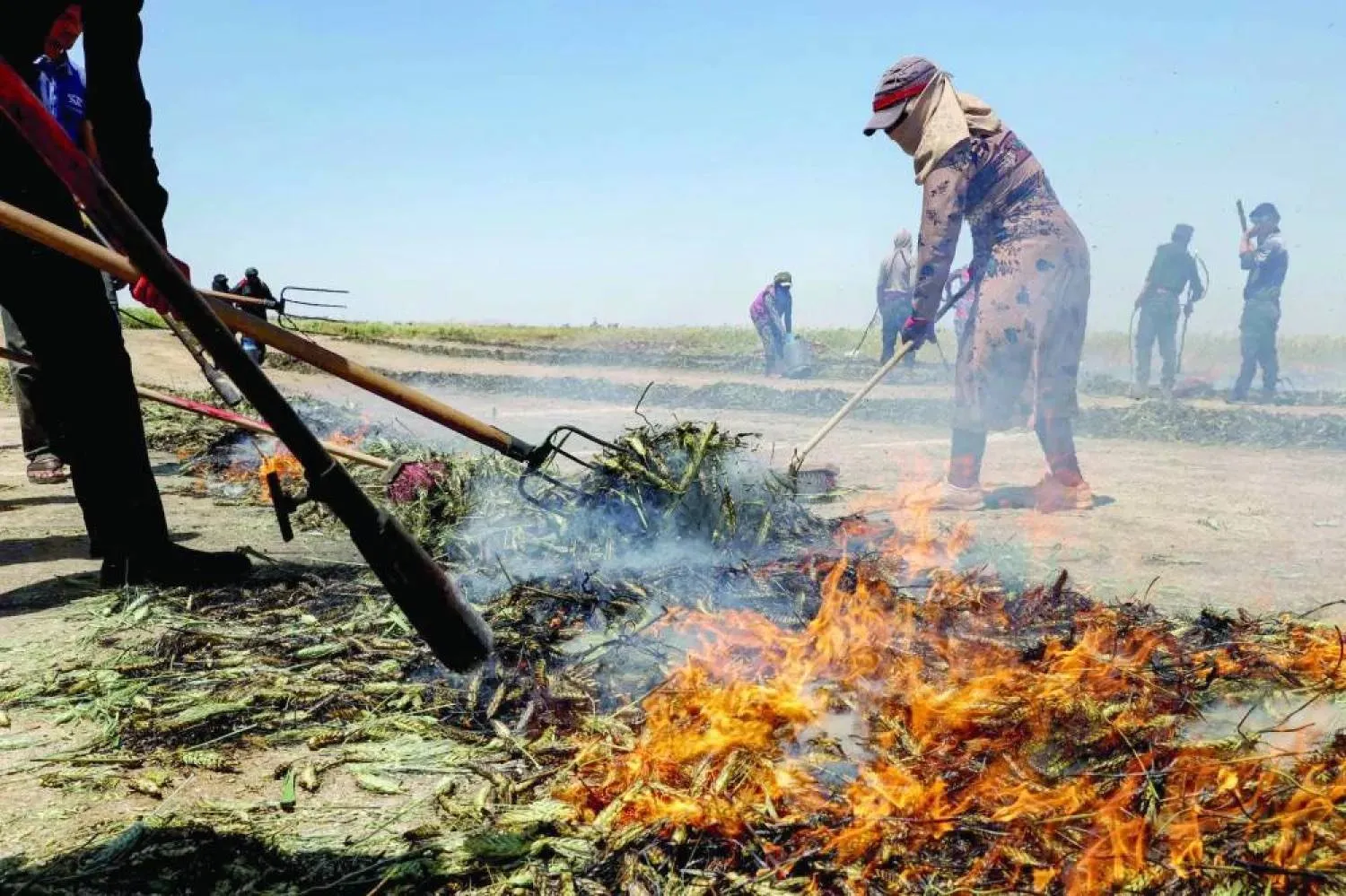
Syrians roast wheat in the town of Binnish, in the countryside of Idlib province in northwestern Syria (file photo - AFP) 
TT

Govt's ‘Wheat Pricing’ Fuels Farmer Protests across Syrian Provinces

Syrians roast wheat in the town of Binnish, in the countryside of Idlib province in northwestern Syria (file photo - AFP) 

Hundreds of farmers staged protests for a second consecutive day across several Syrian provinces over the government’s wheat purchase price for the current harvest season, denouncing it as unfair and insufficient to cover production costs.

Demonstrators warned the pricing policy would discourage wheat cultivation and called for the dismissal of the economy minister, saying the decision threatened farmers’ livelihoods at a time when Syria is already grappling with deep economic hardship.

The Ministry of Economy and Industry recently set the purchase price for first-grade durum wheat for the 2026 season at 46,000 Syrian pounds per ton in the country’s new currency — about $330 at the exchange rate on the day of the announcement, based on the parallel market rate of 138 pounds to the dollar.

The decision sparked anger among farmers, particularly in eastern and northern Syria — the country’s main wheat-producing region.

Khalil al-Nuaimi, an agricultural engineer and farmer, told Asharq Al-Awsat that growers had pinned high hopes on this year’s harvest following heavy rainfall, after years of drought, war and destruction.

“Farmers were hoping to repay debts and improve their living conditions, but the pricing decision crushed those hopes,” he said.

Al-Nuaimi, who lives in Raqqa province, said most farmers borrow money to finance cultivation and repay loans after the harvest. He added that many rural families postpone major life decisions until the wheat season ends, including engagements, weddings, medical treatment, home repairs and vehicle purchases.

“A decision like this has serious social consequences,” he underlined.

He accused the government of failing to consider the impact of the measure, particularly in eastern and northern Syria, where many residents already feel economically and politically marginalized.

Al-Nuaimi also pointed to what he described as a major discrepancy between production costs and the new pricing policy. He noted that the government had earlier set the price of wheat seed for the 2025-2026 season at $500 per ton, while the official purchase price for harvested wheat was lower.

“This is a gap farmers cannot absorb,” he said, adding that even raising the purchase price to $500 per ton would not fully offset losses because of exchange-rate volatility and grading-based pricing.

He continued that while the government faced a severe economic crisis, “supporting farmers is an essential part of supporting rural development and a cornerstone of the economy in an agricultural country like Syria.”

State media said the government defended the new pricing by arguing it was aligned with global wheat prices and exceeded them by around 10 percent to support local farmers and offset transportation and labor costs.

Following the announcement, hundreds of farmers protested on Sunday and Monday in the provinces of Raqqa, Deir Ezzor, Hasakeh, Daraa, Hama and Idlib, as well as other wheat-growing areas.

Protesters rejected comparisons with international prices, arguing that production conditions in Syria — devastated by years of war and drought — were not comparable to those in other countries.

The conflict and prolonged drought have severely damaged Syria’s agricultural sector, transforming the country from a wheat exporter into a wheat importer.

Eight Kurdish political parties in Hasakeh province also rejected the new pricing, describing it as “unrealistic” and warning of “negative repercussions for food security and economic and social stability.”

Syria needs around 2.55 million tons of wheat annually to meet basic consumption needs and maintain bread supplies.

During the 18-month transitional period, Syria imported around 1.3 million tons of wheat, mainly from Russia and Ukraine. The government is counting on this year’s harvest to fully meet domestic demand.


Morocco, France Prepare Treaty to Foster Ties

France's Foreign Affairs Minister Jean-Noel Barrot (L) is received by Morocco's Minister of Foreign Affairs Nasser Bourita (R) in Rabat on May 20, 2026. (AFP)
TT

Morocco, France Prepare Treaty to Foster Ties

France's Foreign Affairs Minister Jean-Noel Barrot (L) is received by Morocco's Minister of Foreign Affairs Nasser Bourita (R) in Rabat on May 20, 2026. (AFP)

Moroccan and French foreign ministers said on Wednesday the two countries are preparing to sign a treaty to strengthen ties during an upcoming state visit by King Mohammed VI to France.

The treaty will be the first Morocco signs with a European country, Moroccan Foreign Minister Nasser ‌Bourita told reporters after ‌talks with his French counterpart, ‌Jean-Noel ⁠Barrot.

The two ministers ⁠did not specify when the King's visit will take place. Relations between the two countries have improved since Paris recognized Rabat's sovereignty over the disputed Western Sahara territory in 2024.

"Moroccan-French partnership is living its best era at all levels," Bourita said, citing defense industry, ⁠security, aeronautic cooperation.

Barrot also said that "this will be ‌the first treaty of ‌its kind with a non-European country," adding that the goal ‌is to lay the basis for long-term relations ‌between the two countries.

Neither party specified what the treaty implies and its details.

France backs the resumption of direct talks between parties involved in the Western Sahara conflict on the ‌basis of autonomy under Moroccan sovereignty and in line with the most recent UN Security ⁠Council ⁠resolution 2797, Barrot said.

This position led to worsening ties with Algeria which hosts and backs the Polisario Front, an armed group seeking Western Sahara's independence.

Morocco is France's top economic partner in Africa, and a logistical and financial hub between France and part of the continent, Barrot said, adding that it was "natural" for the two countries to work together in Africa.


Jordan Says Shot Down Drone in its Airspace

AP file photo shows Jordanian soldiers
TT

Jordan Says Shot Down Drone in its Airspace

AP file photo shows Jordanian soldiers

The Jordanian military announced it had shot down a drone of unknown origin in its airspace on Wednesday. No casualties were reported.

"This morning, the Jordanian Armed Forces engaged with a drone of unknown origin that entered Jordanian airspace and was brought down in Jerash Governorate, without any injuries," the military said of an area located around 50 kilometres (30 miles) north of the capital Amman.


First of Hundreds of Detained Gaza Flotilla Activists Arrive in Israel

 Israeli soldiers are seen on a vessel bearing symbols of the Global Sumud Flotilla, with an Israeli military ship behind it, as seen from Ashdod, southern Israel, May 19, 2026. (Reuters)
Israeli soldiers are seen on a vessel bearing symbols of the Global Sumud Flotilla, with an Israeli military ship behind it, as seen from Ashdod, southern Israel, May 19, 2026. (Reuters)
TT

First of Hundreds of Detained Gaza Flotilla Activists Arrive in Israel

 Israeli soldiers are seen on a vessel bearing symbols of the Global Sumud Flotilla, with an Israeli military ship behind it, as seen from Ashdod, southern Israel, May 19, 2026. (Reuters)
Israeli soldiers are seen on a vessel bearing symbols of the Global Sumud Flotilla, with an Israeli military ship behind it, as seen from Ashdod, southern Israel, May 19, 2026. (Reuters)

Israeli authorities have begun detaining hundreds of activists seized from a Gaza-bound flotilla at the southern port of Ashdod on Wednesday, a rights group said, after Israeli forces intercepted their vessels at sea.

The Global Sumud Flotilla set sail from Turkey last week in the latest attempt by activists to breach Israel's blockade of the Palestinian territory, after Israeli forces intercepted a previous convoy last month.

Israeli authorities said 430 activists aboard the flotilla were en route to Israel, while rights group Adalah said some had already arrived at Ashdod port and were being held there.

"Having set sail toward Gaza to deliver humanitarian aid and challenge the unlawful blockade, these civilian participants were forcefully abducted from international waters and taken into Israeli territory entirely against their will," Adalah said.

"These acts are a direct extension of Israel's policies of collective punishment and starvation of Palestinians in Gaza."

The Israeli foreign ministry dismissed the operation as a publicity stunt serving the Palestinian movement Hamas.

"Another PR flotilla has come to an end. All 430 activists have been transferred to Israeli vessels and are making their way to Israel, where they will be able to meet with their consular representatives," a spokesman from the foreign ministry said late on Tuesday.

"This flotilla has once again proved to be nothing more than a PR stunt at the service of Hamas," the spokesman added.

Prime Minister Benjamin Netanyahu earlier denounced the flotilla as "a malicious scheme designed to break the blockade we have imposed on Hamas terrorists in Gaza".

The United States on Tuesday sanctioned four people associated with the Global Sumud Flotilla and accused them of being "pro-terrorist".

Around 50 ships had departed from southwestern Türkiye on Thursday.

Nine Indonesian citizens who were part of the flotilla "have all been reported arrested by Israel," a spokeswoman for Indonesia's foreign ministry said, citing information dated Wednesday.

Indonesia called on Israel to immediately release all vessels and crew members, adding that "every diplomatic channel and consular measure will continue to be fully utilized".

Indonesian newspaper Republika earlier said two of its journalists were among the nine Indonesians detained.

Türkiye and Spain have condemned the interception.

Organizers said the flotilla also included 15 Irish citizens, including Margaret Connolly, sister of President Catherine Connolly.

Israel controls all entry points into Gaza, which has been under an Israeli blockade since 2007.

During the Gaza war, triggered by Hamas's October 2023 attack on Israel, the territory has suffered severe shortages of food, medicine and other essential supplies, with Israel at times halting aid deliveries entirely.

A previous flotilla attempt was intercepted last month in international waters off Greece, with most activists expelled to Europe.

Two were brought to Israel, detained for several days and then deported.
