


Israeli Forces Intercept 6 More Activist Flotilla Vessels Headed for Gaza

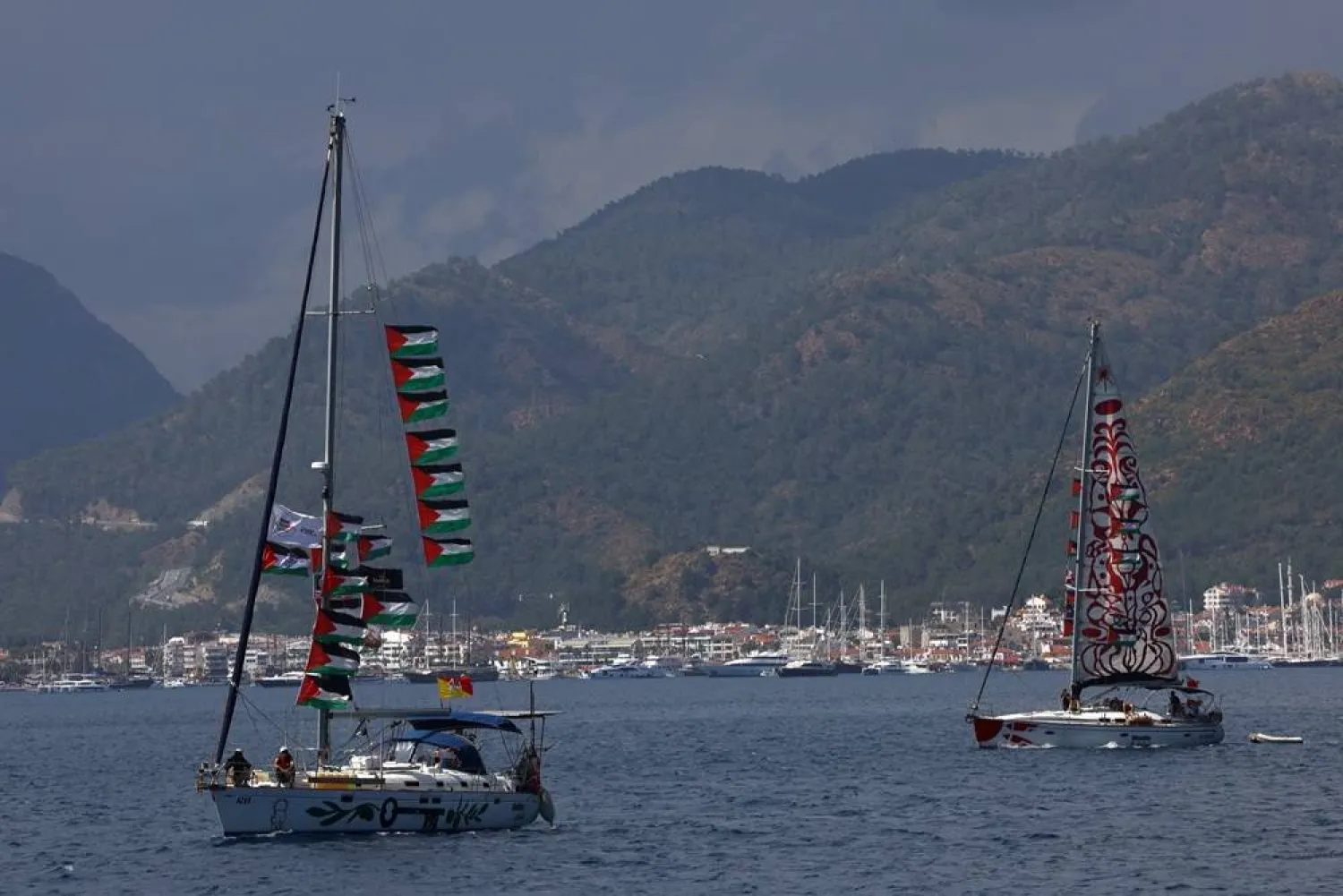
Boats taking part in the Global Sumud Flotilla, which aims to reach Gaza and break Israel’s naval blockade, set sail from a port in the southern Turkish resort of Marmaris, Türkiye, May 14, 2026. (Reuters)
TT

Israeli Forces Intercept 6 More Activist Flotilla Vessels Headed for Gaza

Boats taking part in the Global Sumud Flotilla, which aims to reach Gaza and break Israel’s naval blockade, set sail from a port in the southern Turkish resort of Marmaris, Türkiye, May 14, 2026. (Reuters)

Israeli forces on Tuesday intercepted six remaining vessels from a much larger activist flotilla attempting to challenge Israel’s naval blockade of Gaza. Two other boats are still on their way to the Palestinian territory, according to the activist group's livestream. 

A live feed on the Global Sumud Flotilla website showed armed Israeli soldiers on Zodiac boats boarding the Andros, Zefiro, Don Juan, Alcyone and Elengi vessels as activists donning life vests held their arms up. Israeli soldiers then destroyed cameras mounted on the activists’ boats. 

This is the group’s latest effort to underscore the grim living conditions of nearly 2 million Palestinians in the coastal territory, suffering from severe shortages of housing, food, and medicine. 

The flotilla boats were stopped around 90-100 miles (145-160 kilometers) from the Gaza coastline, according to the flotilla’s website tracker. 

The vessels departed last week from the port of Marmaris, Türkiye, in what flotilla organizers described as the final leg of their planned journey to Gaza’s shores. 

‘Forcibly transported’  

On Monday, the Israeli navy stopped some 41 boats from the activist flotilla in international waters off Cyprus, detaining those on board. 

The Global Sumud Flotilla said Tuesday that hundreds of detained activists from over 40 nations were “being forcibly transported” by an Israeli naval ship to an unnamed port, due to arrive at its destination shortly. 

More than a dozen Irish nationals were aboard the Global Sumud Flotilla, including the sister of Irish President Catherine Connolly. Ireland's Prime Minister Micheál Martin on Monday called Israel’s interception of the Gaza-bound boats in international waters “absolutely unacceptable.” 

The Flotilla said it demanded the “immediate, unconditional release of all our participants, alongside the more than 9,000 unjustly detained Palestinian political prisoners” and urged world leaders to press for the same. 

The activist group also warned of “grave and immediate concerns” about the physical safety of all those detained following testimonies from other activists detained during an April 30 interdiction. At the time, the activists detailed “patterns of torture, severe physical abuse, and invasive sexual violence” by Israeli forces, allegations Israel denies. 

Several nations have condemned the interdictions, with Türkiye and Hamas calling them an act of “piracy.” Italy, Spain and Indonesia called on Israel to release all the detained activists and to ensure their safety and well-being. An estimated 45 Spanish nationals took part in the flotilla. 

Israel has called the flotilla “a provocation for the sake of provocation” with no real intent to deliver any aid to Gaza. The boats carry a symbolic amount of aid. 

The Israeli defense body overseeing humanitarian aid to Gaza claims that sufficient aid is entering the territory, with around 600 trucks delivering assistance daily, similar to prewar levels. 

According to a World Food Program report, the number of humanitarian and commercial trucks entering the Gaza Strip declined sharply in March compared with previous months following the Iran war. A daily average of only 112 trucks entered in March, compared to 230 in February and 225 in January. 

Activist determined to carry on 

Italian activist Daniele Gallina was with six others aboard a sailboat that diverted to a harbor in the Cypriot town of Paphos because of technical issues. He said he and his fellow activists see their mission as an attempt to open Gaza up to the world. 

“What matters is not only the aid itself, important as it is, but the structural change it represents. It is also about challenging the collaboration of our own governments with these policies,” Gallina told The Associated Press in an online interview from Paphos. 

Gallina said such interdictions of civilian vessels in international waters have driven people to understand how “governments are tolerating or enabling these actions.” 

Even though the Flotilla’s mission was “entirely pacifist,” the Israeli military’s actions have demonstrated how international law is now “openly disregarded.” 

“Acts of piracy and violations of international maritime law should never be acceptable, especially against peaceful civilian missions carrying no weapons,” Gallina said. 

“We know we are doing the right thing. We are not heroes. We are ordinary people carrying out a protest mission, just as others protest in the streets,” he said, adding that he and his fellow activists remained determined to continue their protests “until Gaza is reached.” 

A nearly two-decade blockade Israel has maintained a sea blockade of Gaza since the Palestinian group Hamas took control of the territory in 2007. Israeli authorities intensified it in the aftermath of the Oct. 7, 2023, Hamas-led attacks on Israel, which killed around 1,200 people and saw more than 250 taken hostage. 

Critics say the blockade amounts to collective punishment. 

Israel has said the blockade, which restricts the movement of goods and people in and out of Gaza, was meant to prevent Hamas from arming itself. 

Gaza has seen near-daily Israeli fire with more than 850 people killed in the territory despite a ceasefire that went into effect in October, according to Gaza’s Health Ministry. 

The ministry says Israel’s retaliatory offensive following the Oct. 7 attack has killed more than 72,700 people. The ministry, part of Gaza’s Hamas-run government, does not give a breakdown between civilians and fighters. 


Tetteh Says Moving Libya's Political Process Forward Remains Crucial

The UN Security Council discusses the situation in Libya. Photo: The Security Council
TT

Tetteh Says Moving Libya's Political Process Forward Remains Crucial

The UN Security Council discusses the situation in Libya. Photo: The Security Council

Special Representative of the Secretary General and Head of the United Nations Support Mission in Libya (UNSMIL) Hanna Tetteh has revealed that Libya that possesses Africa’s largest oil reserves, yet hundreds of thousands of people spent nearly a month and a half without electricity or water.

“The need to move Libya's political process forward remains crucial,” Tetteh told the Council on Tuesday.

“The recent widespread electricity outages and public discontent, exacerbated by a prolonged heat wave, have exposed the consequences of institutional fragmentation,” she said.

“Approximately $1 billion is spent monthly on fuel imports. Yet electricity systems remain vulnerable to fuel shortages,” she said, seen as “evidence of large scale diversion of subsidized fuel in the electricity and security sectors.”

Politically, she said the UN roadmap is based on three mutually reinforcing pillars: A credible path to presidential and legislative elections through electoral reforms, an inclusive, structured dialogue and the reunification of executive institutions through a unified government.

She told the Council that the Four Plus Four Committee, since its inaugural meeting on April 29 has met seven times, “having addressed some of the most contentious issues” and is set to meet again on August 20.

“Its recommendations, which I presented to the Council in my last briefing, address governance, the economy, security, reconciliation and human rights,” Tetteh said.

On fiscal affairs, she said that the central Bank of Libya commenced in June implementing salary increases for military and security personnel in eastern Libya following a request from the Libyan National Army (LNA) in December 2025, and subsequent legislation for this by the House of Representatives.

A similar request was reportedly made to the central bank from western Libya.

On August 9, the governor of the Central Bank submitted a letter to the two chambers requesting to be relieved of his position. “The move is an indication of the mounting pressure on the central bank,” Tetteh told Council members.

On Security issues, she mentioned that on August 3 heavy clashes erupted among armed actors engaged in trafficking, illicit drugs, human trafficking and fuel smuggling in residential areas across Zawiya and Sorman, resulting in civilian deaths and injuries.

“Furthermore, the use of several drones against the oil refinery and other vital infrastructure in Zawiya is an emerging and worrying development, suggesting deliberate targeting of the oil facility, causing structural damage, risk of fire and disruption of water supplies.

“On the 10th of August, the National Oil Corporation declared a state of emergency at the refinery and called for urgent investigations into these attacks,” she added.

She also referred to the assassination of Major General Fawzi Mansouri, director of the Military Intelligence Department for the LNA, in Benghazi on August 10 in a reported car bombing.

In a positive development, the two Chiefs of General Staff from the West and East met in Sirte on July 12, attended by the Five Plus five Joint Military Commission and the three plus three military committee established under the US track and UNSMIL.

“The meeting demonstrated that practical confidence building measures remain possible,” she said.

“The chiefs agreed on the principle to establish a joint border force and undertake joint exercises, regular coordination and harmonized training,” she added.


Palestinian-American Hoists US Flag on Home Besieged by Israeli Settlers

Palestinian-American dual citizen Louai Abu Ridi, whose home in the occupied West Bank village of Qusra is besieged by Israeli settlers, poses for a picture next to a US flag on the roof of the building in Qusra on August 18, 2026. (AFP)
TT

Palestinian-American Hoists US Flag on Home Besieged by Israeli Settlers

Palestinian-American dual citizen Louai Abu Ridi, whose home in the occupied West Bank village of Qusra is besieged by Israeli settlers, poses for a picture next to a US flag on the roof of the building in Qusra on August 18, 2026. (AFP)

A Palestinian-American has raised the US flag on his home besieged by Israeli settlers, as the United States renewed criticism of the siege that has generated condemnation around the world.

Louai Abu Ridi, who owns one of three houses in Qusra, near Nablus in the occupied West Bank, flew back from his adopted home of Ohio on Monday after settlers trapped residents inside and refused to let in food or other supplies for more than a week.

He was flying the Stars and Stripes outside his home on Tuesday and said he has asked the US embassy to keep raising his case.

"It's my message to all Americans in the United States to see what's going on here in the West Bank, how the settlers put us under siege trying to take my own house in the West Bank," Abu Ridi told AFP reporters inside his home.

Under US pressure, the Israeli military said last week it had given orders to remove the settlers.

Troops took down their tent and detained one Israeli but settlers repeatedly came back by foot or in vehicles.

"The settlers come in freely into my house and they're not doing anything," he said of the soldiers.

"They even shake hands with the settlers. It's like they're friends."

- Rare US criticism -

Israeli settlers in the West Bank have been increasingly harassing and assaulting Palestinian residents in recent months, often with an aim to take their property.

Prime Minister Benjamin Netanyahu's right-wing government has pushed to support settlements backed by the Jewish right ahead of close-fought October 27 elections.

US Ambassador to Israel Mike Huckabee, an evangelical pastor who has long supported settlers, has offered rare criticism over the Qusra siege and said he had asked Israel to intervene.

In interviews aired late Tuesday on Israeli television, Huckabee said the United States was committed to defending its own citizens.

"We would like to see severe consequences for people who engage in -- and I'll use the term -- terrorist activity," Huckabee told Channel 13.

"It's not fair to the families who are Palestinian, who own their homes, who have a right to raise their families without fear," said Huckabee, who before becoming ambassador had rejected the term Palestinian.

Of the extremist settlers, Huckabee said, "If this little minority, if they think they're doing their cause a favor, they are making a horrific mistake."

Around 500,000 Israelis live in the West Bank on settlements considered illegal under international law, amid three million Palestinians. Israel has occupied the West Bank since the 1967 Six-Day War.


Tunisia: Sousse Turns to Seawater Desalination to Fight Water Shortage

A seawater desalination plant in Tunisia
TT

Tunisia: Sousse Turns to Seawater Desalination to Fight Water Shortage

A seawater desalination plant in Tunisia

The head of the seawater desalination plant project in the coastal Tunisian city of Sousse has said that the facility entered its trial phase at a time when the region and the country are facing a severe water shortage that has sparked protests.

Moncef Ammar, the project director, told Tunisia’s state-run National Radio that the plant is now 100 percent complete and is currently undergoing testing.

The plant has a production capacity of 50,000 cubic meters per day, with the possibility of expansion to reach 100,000 cubic meters per day.

Once officially operational, the facility, which is primarily intended to serve the regions of Sousse, Monastir, and Mahdia, is expected to provide an additional water supply equivalent to about 25 percent of peak consumption levels, according to the official.

Several regions in Tunisia, particularly the Monastir governorate, have been suffering from frequent interruptions in drinking water supplies that last for several hours. These disruptions are caused either by water scarcity or by weak water flow resulting from network failures and delayed maintenance operations.

The outages have led to rising prices for bottled water, an increase in hoarding and profiteering, and angry protests in several cities.

Ammar said that the Tunisian state has pursued non-traditional water resources and turned to seawater desalination, considering it a necessity rather than an option in light of growing water scarcity, despite its high cost.

In April, the World Bank approved financing for two projects under Tunisia’s “Water Security and Resilience Program.”

The country has been suffering from water shortages due to repeated drought seasons and the effects of climate change.

The projects have a total cost of $332.5 million, of which $208.5 million is allocated to sustainably improve drinking water services for around 2.3 million Tunisians.

Lack of water has caused agricultural output to decline over recent years and production costs to rise, threatening the viability of certain crops that require large quantities of water.

To secure the future of Tunisian agriculture and strengthen the resilience of rural areas against mounting environmental challenges, there is an increasing need to expand irrigation technologies, preserve drought-adapted seeds, and establish more sustainable management of water resources.

Tunisia began using desalination technology in 1995 with the construction of a groundwater desalination plant in Gabès, following a modest pilot project on the island of Kerkennah in 1983. The country’s most significant achievement came when the Djerba desalination plant began production in May 2018 at a cost of nearly 200 million Tunisian dinars.

After decades of reluctance to expand desalination projects because of high investment costs and the expense of producing desalinated water, Tunisia’s National Water Distribution and Exploitation Company stated that turning to desalination is now “the only solution to secure new water resources.”
