


Board of Peace Will Ask the UN Security Council to Press Hamas to Disarm

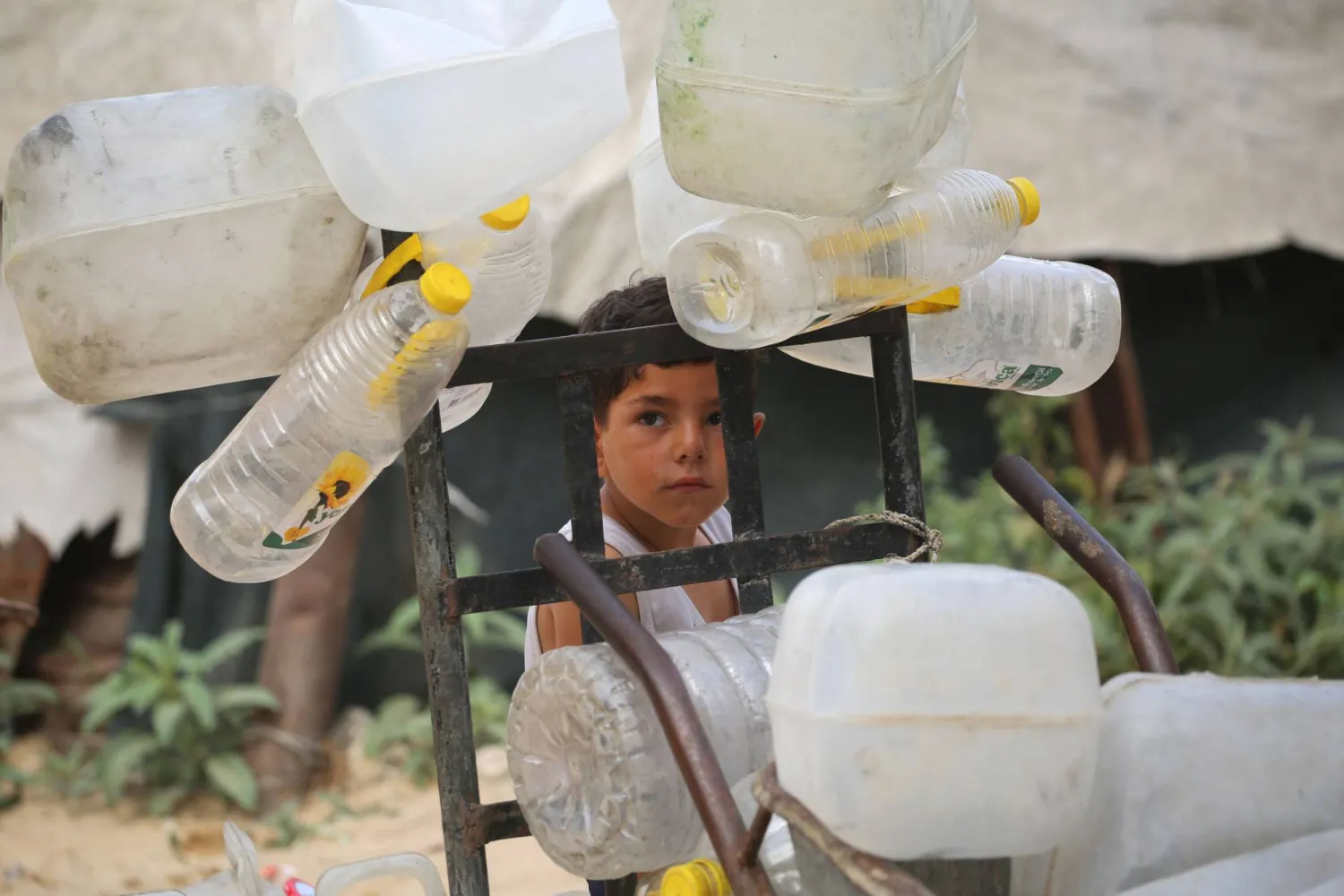
A Palestinian boy stands next to plastic containers on a trolley, as he and others collect portable drinking water for their displaced family living in shelters after homes were destroyed in Israeli bombardment, in the Bureij refugee camp, in the central Gaza Strip on May 18, 2026. (AFP)
TT

Board of Peace Will Ask the UN Security Council to Press Hamas to Disarm

A Palestinian boy stands next to plastic containers on a trolley, as he and others collect portable drinking water for their displaced family living in shelters after homes were destroyed in Israeli bombardment, in the Bureij refugee camp, in the central Gaza Strip on May 18, 2026. (AFP)

The body overseeing the US-brokered ceasefire in Gaza will ask the United Nations Security Council to press the Hamas group to disarm, according to a report seen by The Associated Press on Tuesday.

The report by the Board of Peace, an international body set up by US President Donald Trump and tasked with overseeing the fragile ceasefire between Hamas and Israel, is expected to be discussed by the Security Council on Thursday when it meets on the situation in the Middle East.

“At this stage, the principal obstacle to full implementation (of the ceasefire) remains Hamas’ refusal to accept verified decommissioning, relinquish coercive control, and permit a genuine civilian transition in Gaza,” the report said.

Hamas in a statement rejected the report and said it contains “fallacies.”

A diplomat familiar with the report confirmed its authenticity, speaking on condition of anonymity because it has not been made public.

Trump’s 20-point ceasefire plan calls on Hamas to surrender its weapons and destroy its vast network of tunnels. It also envisions Israeli forces withdrawing from Gaza, the arrival of a new technocratic Palestinian government, deployment of an international security force and the rebuilding of the battered Palestinian enclave after more than two years of war.

Board of Peace head has said the ceasefire has stalled

Last week, the head of the Board of Peace, former UN Mideast envoy Nickolay Mladenov, acknowledged that the truce had stalled since taking effect in October, saying the deadlock over disarming Hamas had paralyzed progress.

“Reconstruction cannot commence where weapons have not been laid down,” the board’s report to the Security Council says. “The critical variable — the single factor that unlocks every other element of the plan — is the conclusion of an agreement on the Roadmap for the full implementation of the plan that includes full decommissioning by Hamas and all armed groups in Gaza.”

The Palestinian group, which led the Oct. 7, 2023, attack on Israel that sparked the war in Gaza, has accused Israel of failing to meet its obligations under the first phase of the ceasefire and has sought to link any demilitarization to Israeli troop pullbacks. Israel’s military has expanded its control of Gaza since the truce took effect and now controls some 60% of the territory.

The new report calls on the Security Council to “reiterate publicly, clearly and consistently that the decommissioning of weapons in Gaza is not merely a requirement (of the UN’s resolution to end the war) but critical for reconstruction to begin, for a timebound Israeli forces withdrawal, and for a credible pathway to Palestinian self-determination and statehood to be pursued.”

The Security Council endorsed the Board of Peace in a resolution in November.

Hamas says the report tries to derail the ceasefire

Hamas said the report “contains a number of fallacies that absolve the occupying government of its responsibilities for the daily violations of the ceasefire agreement in Gaza.”

The group said the report ignored Israel’s “failure to uphold the majority of its commitments” in the ceasefire deal, including the continued restrictions on crossings into the Palestinian territory and preventing the entry of material and equipment needed to repair basic infrastructure and shelter for the largely displaced population.

“The report’s adoption of the occupation’s conditions regarding disarmament is a dubious attempt to muddy the waters and derail the ceasefire agreement,” Hamas said in a statement.

It called on the Security Council and Mladenov to compel Israel to fulfill its commitments under the ceasefire' deal's first phase, "foremost among them the cessation of the daily aggression against our Palestinian people in Gaza.”

The ceasefire has seen numerous violations The report noted near-daily ceasefire violations, “some of which are serious, and their human consequences — civilians killed, families living in fear, and continued impediments to humanitarian access — cannot be minimized.”

Israel’s military still carries out airstrikes in Gaza despite the ceasefire and has pushed deeper into the territory, where it now controls more than it was granted under the ceasefire agreement. Living conditions are dire, with most of the territory’s 2 million people living in tent camps lacking basic services.

Mladenov last week said his office is addressing violations by both sides on a daily basis. But he repeatedly cited the disarmament issue as a central sticking point, saying Hamas’ obligation to give up its arsenal is “not negotiable" and that progress on all other issues was being held up.



Hospital Says 5 People Killed in Gaza

Palestinians walk amid war-damaged buildings in Gaza City, Wednesday, Sept. 23, 2026. (AP Photo/Jehad Alshrafi)
TT

Hospital Says 5 People Killed in Gaza

Palestinians walk amid war-damaged buildings in Gaza City, Wednesday, Sept. 23, 2026. (AP Photo/Jehad Alshrafi)

Israeli strikes overnight in Gaza killed five people, according to al-Shifa Hospital, where the casualties were taken. Four women were among the dead. A mother and daughter among them were Christians, a minority in Gaza, the hospital said,

A large fire burned at the site, where the strikes tore a gaping hole in the ground floor of a multistory building. The hospital said people were still reported missing beneath the debris.

Israel's military did not immediately comment, saying it was checking for information.

Israeli strikes have killed at least 1,439 Palestinians in Gaza since a ceasefire was reached with the Hamas militant group nearly a year ago, according to the territory’s Health Ministry. Its figures are seen as generally reliable by UN agencies and independent experts. It does not give a breakdown of civilians and militants.

Israel says it is targeting Hamas and other militants who pose a threat, and in response to ceasefire violations, including occasional attacks.


Aoun: Army, Security Forces Sole Authorities Responsible for Lebanese Security

Lebanese President Joseph Aoun meets with a delegation from the southern town of Deir Mimas (National News Agency). 
TT

Aoun: Army, Security Forces Sole Authorities Responsible for Lebanese Security

Lebanese President Joseph Aoun meets with a delegation from the southern town of Deir Mimas (National News Agency). 

Lebanese President Joseph Aoun said the army and state security forces alone were responsible for citizens’ security, as Israeli attacks continued across southern Lebanon and Maronite bishops called for all weapons to be brought under state control.

Aoun made the remarks during a meeting with a delegation from Deir Mimas, a predominantly Christian town south of the Litani River, where he reaffirmed the state’s commitment to residents facing Israeli attacks and displacement.

He described the determination of southern residents to remain on their land as the strongest response to Israeli displacement and intimidation, pledging continued support for those who stayed in their villages and those forced to flee.

Municipal chief Tania Bernaba welcomed Aoun’s insistence that weapons remain exclusively in state hands and that decisions on war and peace rest with its legitimate institutions, particularly the army and security forces.

She outlined the town’s difficult security, economic and humanitarian conditions, stressing that residents wanted to remain connected to state institutions and services rather than feel abandoned or isolated.

In response, Aoun expressed solidarity with residents affected by Israeli attacks and pledged that the state would provide protection and support wherever security conditions permitted.

“The Lebanese army and legitimate security forces will be the sole authorities responsible for citizens’ security,” he said, describing the state’s responsibility toward southern residents as a non-negotiable national priority.

He added that political, diplomatic and negotiating efforts were continuing to halt Israeli attacks, secure a complete withdrawal from occupied territory and deploy the army to the internationally recognized southern border.

Maronite bishops back negotiations

Aoun’s position was echoed by the Council of Maronite Bishops, which condemned continued Israeli attacks on southern Lebanon following its monthly meeting in Bkerke.

The bishops urged the international community to help displaced residents return to their homes, support ongoing negotiations and back efforts to place all weapons under state control.

Meanwhile, several residents of Nabatieh al-Fawqa entered their town on foot despite Israeli threats, coinciding with Prime Minister Nawaf Salam’s visit to Nabatieh.

Their return underscored the determination of southern residents to reclaim their homes, while highlighting the gap between government efforts to restore normal life and conditions on the ground, where Israeli threats and military operations continue.

Israeli attacks continue across southern Lebanon

The political statements came amid continued Israeli military operations across several southern towns, including artillery shelling, airstrikes and demolitions.

Field reports indicated that Israeli artillery targeted Mays al-Jabal, while troops fired machine guns toward the outskirts of Baraachit and carried out major demolitions in Beit Lif and Aitaroun, in the Bint Jbeil district.

Israeli aircraft also launched two rounds of strikes on Mansouri, south of Tyre, where a powerful explosion sent tremors through Tyre and neighboring towns.

In Majdal Zoun, Israeli forces carried out two successive demolitions after artillery struck Beit Yahoun, Mansouri, Wadi Zibqin and Wadi al-Slouqi at dawn. Machine-gun fire was also reported toward Hadatha and the outskirts of Baraachit.


Sudanese Army Expands Control in North Kordofan

Sudanese army soldiers take part in a military parade in Gedaref on August 17 (AFP). 
TT

Sudanese Army Expands Control in North Kordofan

Sudanese army soldiers take part in a military parade in Gedaref on August 17 (AFP). 

The Sudanese army said Friday it had recaptured the strategic town of Al-Mazroub in North Kordofan, a week after retaking Sodari, as a deadly drone strike on student housing in the state capital, El-Obeid, highlighted the growing use of unmanned aircraft in the conflict.

The developments come as the UN Security Council prepares for fresh negotiations over a US proposal to extend the arms embargo on Darfur to all of Sudan.

In a statement, the army’s General Command said its troops and allied forces had retaken Al-Mazroub after “fierce battles,” inflicting heavy casualties and vehicle losses on the paramilitary Rapid Support Forces (RSF).

The army pledged to continue operations on all fronts, protect civilians and secure property, urging residents of recaptured areas to resume their normal lives.

Mohamed Deidan, spokesman for the Special Operations Forces in North Kordofan, announced on Facebook that army troops had entered Al-Mazroub at 9 a.m. Friday, a development corroborated by field sources.

Located about 130 kilometers northwest of El-Obeid, Al-Mazroub is an important livestock market that has also served as a military supply route during the war. It had long been under RSF control.

Witnesses reported that RSF fighters withdrew from the town in September but returned after the army captured Sodari, before retreating again as government forces advanced Friday morning.

Holding Al-Mazroub strengthens the army’s ability to monitor movements west of Bara and restrict the town’s use as a transit and supply hub. Consolidating the gain, however, depends on securing surrounding roads and rural areas.

The advance follows recent army gains in Sodari, Um Sharo, Bara, Jabra al-Sheikh and Um Sayala. Field reports indicated that RSF units had retreated toward Um Badr, Hamrat al-Sheikh and the state’s far west, although their current positions remain independently unverified.

Kordofan’s strategic importance stems from its location linking central Sudan to Darfur, making control of its towns and roads critical to troop movements and supply lines.

Meanwhile, the Sudan Doctors Network reported that five people were killed and 47 wounded in a drone strike on University of Kordofan student housing in El-Obeid.

The network blamed the RSF, describing the attack as an escalation in strikes against civilian and educational facilities.

The paramilitary group made no immediate comment, and responsibility for the strike could not be independently established.

El-Obeid has faced repeated drone attacks in recent weeks, reflecting the weapon’s growing use alongside ground operations.

Burhan addresses military recruits

In Khartoum, Sudan’s Sovereignty Council chairman and army chief Abdel Fattah al-Burhan told newly admitted military academy recruits that the armed forces must safeguard the country’s security and unity, with loyalty transcending political, tribal and regional affiliations.

He described the army as a national institution serving all Sudanese and urged recruits to develop their military and technical skills to keep pace with advances in weaponry and equipment.

The Security Council is expected to revisit Sudan sanctions before the current temporary extension expires on October 9.

In September, disagreements over a US proposal to expand the Darfur arms embargo nationwide forced the council to extend the existing measures by just one month.

Washington also seeks tighter restrictions on weapons, drones, related technology and foreign fighters, while Russia and China have expressed reservations about widening the embargo.

Sudan’s government opposes a nationwide ban, arguing it could undermine the army’s ability to defend the country. Instead, it wants tougher measures to prevent weapons and foreign support from reaching the RSF.

The latest escalation in Kordofan adds significance to the Security Council debate, as military operations and drone warfare have spread beyond Darfur, for which the embargo was established more than two decades ago.