
Xi, Putin Highlight Their Friendship and Cooperation on Energy and Other Issues in Beijing Visit

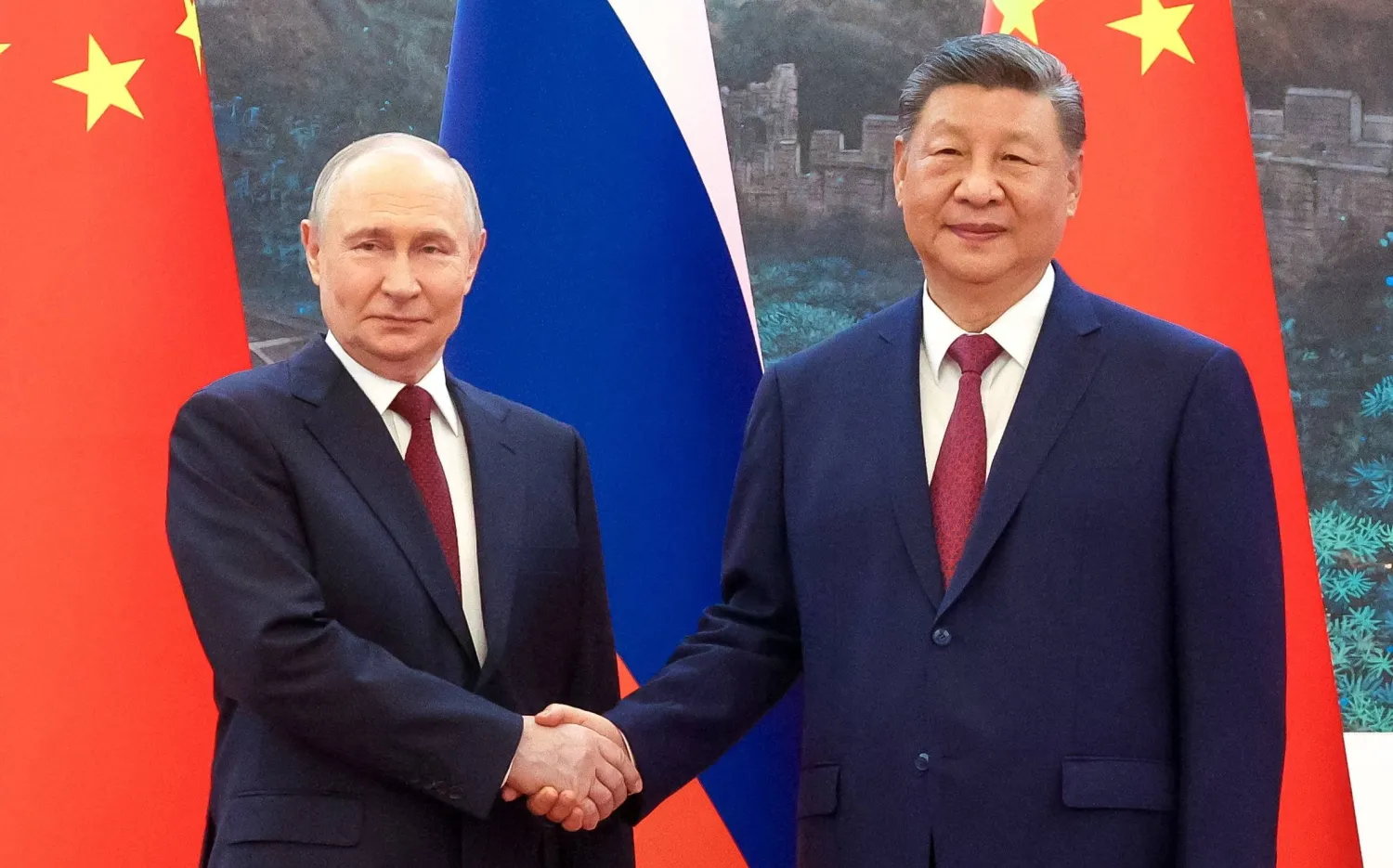
 Russian President Vladimir Putin and Chinese President Xi Jinping pose for a picture during a meeting at the Great Hall of the People in Beijing, China May 20, 2026. (Sputnik/Maxim Stulov/Pool via Reuters)
Russian President Vladimir Putin and Chinese President Xi Jinping pose for a picture during a meeting at the Great Hall of the People in Beijing, China May 20, 2026. (Sputnik/Maxim Stulov/Pool via Reuters)
TT

Xi, Putin Highlight Their Friendship and Cooperation on Energy and Other Issues in Beijing Visit

 Russian President Vladimir Putin and Chinese President Xi Jinping pose for a picture during a meeting at the Great Hall of the People in Beijing, China May 20, 2026. (Sputnik/Maxim Stulov/Pool via Reuters)
Russian President Vladimir Putin and Chinese President Xi Jinping pose for a picture during a meeting at the Great Hall of the People in Beijing, China May 20, 2026. (Sputnik/Maxim Stulov/Pool via Reuters)

Russian President Vladimir Putin praised his close ties with Chinese leader Xi Jinping and said their countries are partners in trade and international affairs as they opened bilateral talks Wednesday on his trip to Beijing. 

Xi welcomed Putin with a ceremony at the Great Hall of the People only days after meeting with US President Donald Trump. The quick succession of Trump’s and Putin’s visits highlighted Beijing’s growing role as an international superpower, experts say. 

Putin greeted Xi warmly as they met for bilateral talks at the Great Hall of the People. 

“My dear friend,” Putin said. “We are truly delighted to see you. We keep in constant touch, both personally and through our aides in the government.” 

Xi also stressed the “political mutual trust and strategic cooperation” between the countries, according to Chinese state media. The two leaders have praised each other profusely in the past, with Xi at one point describing Putin as his “best and most intimate friend.” 

Energy purchases top meeting’s agenda  

Xi and Putin were set to focus on energy and security as well as their overall ties. The two sides agreed to extend a friendship treaty first signed in 2001, Chinese state media reported. 

China became Russia’s top trading partner after Moscow’s full-scale invasion of Ukraine in 2022. Beijing has said it is neutral in the conflict while maintaining trade ties with the Kremlin despite economic and financial sanctions by the US and Europe. 

China is the top customer for Russian oil and gas supplies, and Moscow expects the war in Iran to increase the demand. 

In his meeting with Xi, Putin stressed their countries’ economic ties. 

“The driving force behind economic cooperation is Russian-Chinese collaboration in the energy sector,” Putin said. “Amid the crisis in the Middle East, Russia continues to maintain its role as a reliable supplier of resources, while China remains a responsible consumer of these resources.” 

Xi stressed the need of “complete cessation of hostilities” in the Middle East, according to Chinese state media. 

“An early end to the conflict will help reduce disruptions to energy supply stability, the smooth flow of industrial and supply chains, and international trade order,” Xi said. 

A Russian presidential aide said earlier Russia’s oil exports to China grew by 35% in the first quarter of 2026 and that Russia is one of the biggest exporters of natural gas to China. 

United front on international affairs  

Putin also stressed China and Russia’s cooperation in foreign policy as “one of the key stabilizing factors on the international stage.” 

“In the current tense situation on the international stage, our close cooperation is particularly in demand,” he said. 

In February 2022, just weeks before Russia’s invasion of Ukraine, China and Russia announced a “no limits” partnership during a trip by Putin to Beijing. 

Beijing says it is neutral in the conflict, though in practice it supports Moscow through frequent state visits, growing trade and joint military drills. China has also ignored demands from the West to stop providing high-tech components for Russia’s weapons industries. 

Cooperation agreements 

The two leaders are scheduled to sign cooperation agreements during Putin’s two-day visit. 

But regardless of specific deals, the primary purpose of the visit is to reaffirm the countries’ ties as well as project Beijing’s image as an influential superpower, experts say. 

“The optics matter,” said Steve Tsang, director of the SOAS China Institute at the University of London. 

“The message is clearly one that China maintains friendship and strategic partnership with whichever power it likes, and the US is just one of them.” 

Putin and Xi both need to use their close ties in order to prop up their images at home, said Willy Lam, a senior China fellow at the Jamestown Foundation. 

Putin “needs to tell his countrymen and the world that Russia has China’s support in terms of buying its oil and gas and other tangible and intangible financial support,” Lam said. 

Meanwhile, for Xi, having both Trump and Putin visit in such close succession is a major source of credit with the country’s top Communist leadership. 

Putin noted earlier this month that Moscow and Beijing have reached “a very substantial step forward in our cooperation in the oil and gas sector.” 

“Practically all the key issues have been agreed upon,” he said. “If we succeed in finalizing these details and bringing them to a conclusion during this visit, I will be extremely pleased.” 

Putin also praised their bilateral relationship as a crucial, balancing force in international relations. 

“Interaction between such nations as China and Russia undoubtedly serves as a factor of deterrence and stability,” he said. 

Moscow welcomes China’s dialogue with the US as another stabilizing element for the global economy, Putin added. 

“We stand only to benefit from this, from the stability and constructive engagement between the US and China,” he said. 


Suspected Measles Cases Kill Nearly 1,000 as Bangladesh Struggles to Contain Outbreak

A child receives treatment for measles, at Bangladesh Shishu Hospital & Institute in Dhaka on September 3, 2026. (Photo by Salahuddin Ahmed / AFP)
TT

Suspected Measles Cases Kill Nearly 1,000 as Bangladesh Struggles to Contain Outbreak

A child receives treatment for measles, at Bangladesh Shishu Hospital & Institute in Dhaka on September 3, 2026. (Photo by Salahuddin Ahmed / AFP)

Eight-month-old Rojatun Jannat Ramisa is struggling to breathe in a hospital in Bangladesh’s capital as her parents sit helplessly beside her. She's one of thousands of children sickened by a measles outbreak that's sweeping across the country and has killed hundreds of children following setbacks to the country's vaccine program.

Ramisa’s mother Ranu Akhter traveled hundreds of kilometers (miles) after doctors in eastern Bangladesh referred her to a specialized child hospital in Dhaka to seek treatment for the life-threatening condition, The Associated Press said.

“Fourteen days ago, when we were at the district hospital, there were other children being treated alongside my daughter. I saw that those children also had red rashes on their bodies, sores in their mouths and fevers,” Akhter told The Associated Press at Dhaka Shishu Hospital.

“It made me realize how widespread the measles outbreak is,” she said.

Every day, the death toll is rising.

Bangladesh races to vaccinate children Bangladesh has been racing to halt the outbreak's spread since March, when more than 100 children died in less than a month. By Tuesday, the death toll from suspected measles cases reached 999 since the start of the year, according to the government’s Directorate General of Health Services.

Since March, the country has recorded more than 166,000 suspected measles cases, including 19,835 laboratory-confirmed infections, according to the Ministry of Health.

The government launched an emergency vaccination drive in March together with the World Health Organization, the UN children’s agency and the Gavi vaccine alliance. It began with a focus on children from 6 months to 5 years old and later expanded nationwide in phases.

Measles is a highly contagious airborne disease that causes fever, respiratory symptoms and a characteristic rash. It can sometimes have severe or fatal complications, especially in young children, according to the WHO.

Two doses of a vaccine provide strong protection against measles, but the WHO says 95% of the population has to be vaccinated in order to stop the disease from spreading — which protects children like Ramisa who are too young to be vaccinated as well as immunocompromised people.

The pandemic and political upheaval set back vaccinations

A few years ago, Bangladesh had measles largely under control, with a vaccination program that was credited for decades for protecting children and mothers from the deadly diseases of tuberculosis, diphtheria, whooping cough, tetanus, poliomyelitis and measles. Between 2021 and 2025, the country recorded just 100 to 300 cases per year, down from 2,410 cases in 2020.

But in the last few years, disruptions to the vaccine program have left a growing number of children unvaccinated.

First the pandemic interrupted routine vaccinations, and then in 2024 the government largely missed a vaccination campaign previously carried out every four years.

Atiqul Islam, a neonatal and child specialist at Bangladesh Shishu Hospital and Institute, said during the pandemic period in 2021 and 2022, many did not take their children to get vaccinated.

“So, if you look at children who are now four or five years old, many of them missed their vaccinations. That created a gap. During the previous interim government, vaccines were also unavailable at many vaccination centers,” he said.

Rival politicians trade blame for vaccine shortfall Bangladesh's current government, headed by Prime Minister Tarique Rahman, said the failures in planning under ousted Prime Minister Sheikh Hasina and interim leader Muhammad Yunus left the country with shortages of vaccines and far behind on coverage.

The 2024 measles vaccination campaign was disrupted during the political upheaval that led to Hasina’s ouster. She left the country in the face of a mass uprising in August 2024, and was followed by Yunus, who led an interim administration that transferred power to an elected government after an election in February.

From exile in India, Hasina blamed the Yunus-led government for the disaster.

Doctor says things are getting better, but not fast enough At Bangladesh Shishu Hospital, Islam said the situation has improved, but not enough.

The doctor said his colleagues are struggling to treat infected children who often arrive at the hospital with serious complications like pneumonia, diarrhea and encephalitis, or brain swelling.

“For the past six months, we have been treating measles patients continuously, and we are exhausted,” he said.


Merz Says Disaster Narrowly Averted in Russia-Prepared Drone Attack at Airport

German Chancellor Friedrich Merz looks on during a debate at the German parliament, the Bundestag, in Berlin, Germany, 09 September 2026. (EPA)
TT

Merz Says Disaster Narrowly Averted in Russia-Prepared Drone Attack at Airport

German Chancellor Friedrich Merz looks on during a debate at the German parliament, the Bundestag, in Berlin, Germany, 09 September 2026. (EPA)

German Chancellor Friedrich Merz said on Wednesday that an attempted drone attack at Leipzig/Halle airport had been prepared in Russia over an extended period and that a disaster was only narrowly ‌averted.

"This attack ‌was planned in ‌Russia ⁠for months and ⁠was specifically targeted at Germany, and only by pure chance was major material damage and harm to people ⁠prevented," Merz told the lower ‌house ‌of parliament.

Merz spoke after ‌the far-right Alternative for ‌Germany scored a major victory in a state election in Saxony-Anhalt on Sunday, running ‌on a platform that includes calls for ⁠closer ties ⁠with Moscow.

Russia has rejected any involvement in the drone incident at Leipzig airport, and its foreign minister has said these accusations were "the start of a real war".


UK Rejects Israel’s ‘Damaging’ Sanctions Retaliation

A view shows the British Consulate General in East Jerusalem, 09 September 2026. (EPA)
TT

UK Rejects Israel’s ‘Damaging’ Sanctions Retaliation

A view shows the British Consulate General in East Jerusalem, 09 September 2026. (EPA)

British foreign minister Ed Miliband on Wednesday condemned as "regrettable and damaging" Israel's decision to order the closure of the UK's consulate in Jerusalem as retaliation for London-led Western sanctions over settler violence. 

"We anticipated this might happen because we saw other countries, the Dutch, for example, who had announced sanctions, who had seen these reprisals from Israel. I think they're regrettable and damaging," Miliband told BBC Radio. 

Israel on Tuesday ordered the closure after 12 countries including Britain, Canada and France announced they would sanction trade with Israeli settlements in the West Bank, following a surge in settler attacks against Palestinians in the occupied West Bank. 

Israel said it would also expel British representatives at a center monitoring the US-brokered ceasefire plan in Gaza, bar British training for Palestinian Authority forces and ban 12 Britons, mostly members of parliament, from visiting the country. 

Miliband rejected suggestions that the sanctions would impact intelligence cooperation with Israel. 

"We have important intelligence and security relationships with Israel, and I'm confident they will continue," he said, declining to go into details. 

"And I was very clear yesterday that we do believe in working with our Israeli partners when it comes to the threats they face from Iran," he added. 

Miliband also dismissed the criticism of the sanctions by Britain's chief rabbi. 

Ephraim Mirvis on Tuesday called the measures "little more than political flag-bearing". 

He said it was a "truly a dark day for British Jews", predicting that the measures "will succeed only in bolstering the very extremism they seek to target". 

Several antisemitic attacks in London this year have targeted synagogues and other Jewish sites.