


Hezbollah Rejects Lebanon-Israel Talks While Backing Negotiations Between Iran and the US

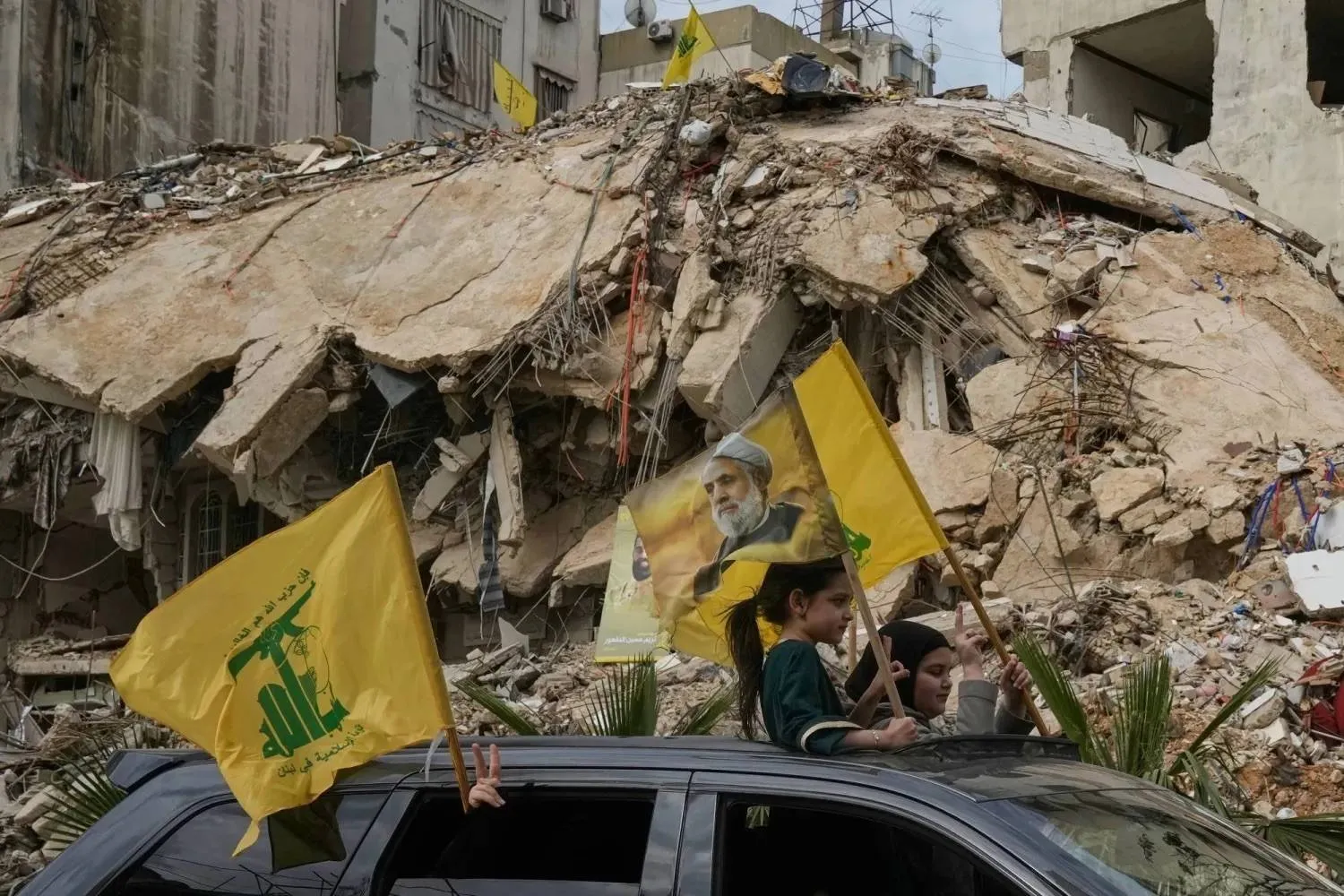
Displaced people return to Beirut’s southern suburbs carrying the party’s flag and a picture of its Secretary-General (AP)
TT

Hezbollah Rejects Lebanon-Israel Talks While Backing Negotiations Between Iran and the US

Displaced people return to Beirut’s southern suburbs carrying the party’s flag and a picture of its Secretary-General (AP)

Hezbollah’s position on negotiations tied to the war in Lebanon has exposed a growing contradiction - the group fiercely opposes direct talks between the Lebanese state and Israel, yet supports Iranian-American negotiations that Tehran says include Lebanon.

The discrepancy has fueled political debate over whether Hezbollah truly rejects negotiations in principle or simply opposes talks led by the Lebanese state that could threaten its weapons and influence inside Lebanon.

The issue resurfaced Tuesday after Iranian Deputy Foreign Minister for Legal and International Affairs Kazem Gharibabadi said Tehran’s proposal includes “ending the war on all fronts, including Lebanon.”

His remarks revived questions about Lebanon’s role in any broader regional settlement and Hezbollah’s selective approach to diplomacy.

Different Standards for Beirut and Tehran

Hezbollah has repeatedly condemned direct Lebanese-Israeli negotiations as a dangerous path leading to concessions. At the same time, it has portrayed Iranian-American talks as a possible route to ending the war.

Hezbollah Secretary-General Sheikh Naim Qassem previously described a potential Iran-US agreement that includes Lebanon as “perhaps the strongest card” for stopping Israeli attacks, while thanking Iran for its support of Lebanon.

Hezbollah MP Hassan Fadlallah similarly praised what he called the “Islamabad track,” saying Iran had suspended negotiations “for Lebanon’s sake,” even as he denounced direct Lebanese negotiations with Israel as “a dead-end.”

Another Hezbollah lawmaker, Hussein al-Hajj Hassan, argued that direct talks conducted by Lebanese authorities had placed the government “in a deadlock that will produce only concessions without results.”

The discrepancy has raised a main question in Lebanon: Is Hezbollah opposed to negotiations themselves, or only to talks carried out by the Lebanese state?

A ministerial source close to the Lebanese presidency described Hezbollah’s position as “clearly contradictory,” arguing that “what is permitted for Iran appears forbidden for Lebanon,” despite the fact that Beirut is negotiating exclusively over Lebanese sovereignty and Israeli occupation.

Speaking to Asharq Al-Awsat, the source said Lebanon’s negotiations concern practical issues imposed by Israeli occupation, including withdrawal from Lebanese territory and restoring state authority. The source stressed that President Joseph Aoun and the government have maintained one principle from the outset: “No one but the state negotiates on behalf of Lebanon.”

Responding to arguments that Iran negotiates with the United States rather than directly with Israel, the source said Lebanon’s situation is fundamentally different because Israeli forces occupy Lebanese land. “Any country facing occupation negotiates to secure withdrawal and end that occupation,” the source underlined.

Hezbollah’s Deeper Concern

Imad Salamey, head of the Department of Political and International Studies at the Lebanese American University, said Hezbollah fears that any direct negotiations led by the Lebanese state, particularly with Arab and international backing, would gradually shift control of the conflict with Israel away from the party and back to state institutions.

He noted that such a process would likely involve tighter border controls, security arrangements, and ultimately limiting arms to the state while placing decisions on war and peace exclusively in official hands.

“That would effectively end Hezbollah’s independent military status and reduce Iranian influence inside Lebanon,” Salamey remarked.

By contrast, Hezbollah accepts Iranian-American negotiations because Tehran approaches them as part of a broader regional framework linking Lebanon, Gaza, Iraq, and Yemen to wider security and US interests.

According to Salamey, Hezbollah believes Iranian-led negotiations are more likely to preserve its role within Lebanon and the region, whereas direct Lebanese negotiations could place the group against a growing domestic and international consensus favoring a stronger Lebanese state with a monopoly on arms.



Morocco, France Prepare Treaty to Foster Ties

France's Foreign Affairs Minister Jean-Noel Barrot (L) is received by Morocco's Minister of Foreign Affairs Nasser Bourita (R) in Rabat on May 20, 2026. (AFP)
TT

Morocco, France Prepare Treaty to Foster Ties

France's Foreign Affairs Minister Jean-Noel Barrot (L) is received by Morocco's Minister of Foreign Affairs Nasser Bourita (R) in Rabat on May 20, 2026. (AFP)

Moroccan and French foreign ministers said on Wednesday the two countries are preparing to sign a treaty to strengthen ties during an upcoming state visit by King Mohammed VI to France.

The treaty will be the first Morocco signs with a European country, Moroccan Foreign Minister Nasser ‌Bourita told reporters after ‌talks with his French counterpart, ‌Jean-Noel ⁠Barrot.

The two ministers ⁠did not specify when the King's visit will take place. Relations between the two countries have improved since Paris recognized Rabat's sovereignty over the disputed Western Sahara territory in 2024.

"Moroccan-French partnership is living its best era at all levels," Bourita said, citing defense industry, ⁠security, aeronautic cooperation.

Barrot also said that "this will be ‌the first treaty of ‌its kind with a non-European country," adding that the goal ‌is to lay the basis for long-term relations ‌between the two countries.

Neither party specified what the treaty implies and its details.

France backs the resumption of direct talks between parties involved in the Western Sahara conflict on the ‌basis of autonomy under Moroccan sovereignty and in line with the most recent UN Security ⁠Council ⁠resolution 2797, Barrot said.

This position led to worsening ties with Algeria which hosts and backs the Polisario Front, an armed group seeking Western Sahara's independence.

Morocco is France's top economic partner in Africa, and a logistical and financial hub between France and part of the continent, Barrot said, adding that it was "natural" for the two countries to work together in Africa.


Jordan Says Shot Down Drone in its Airspace

AP file photo shows Jordanian soldiers
TT

Jordan Says Shot Down Drone in its Airspace

AP file photo shows Jordanian soldiers

The Jordanian military announced it had shot down a drone of unknown origin in its airspace on Wednesday. No casualties were reported.

"This morning, the Jordanian Armed Forces engaged with a drone of unknown origin that entered Jordanian airspace and was brought down in Jerash Governorate, without any injuries," the military said of an area located around 50 kilometres (30 miles) north of the capital Amman.


First of Hundreds of Detained Gaza Flotilla Activists Arrive in Israel

 Israeli soldiers are seen on a vessel bearing symbols of the Global Sumud Flotilla, with an Israeli military ship behind it, as seen from Ashdod, southern Israel, May 19, 2026. (Reuters)
Israeli soldiers are seen on a vessel bearing symbols of the Global Sumud Flotilla, with an Israeli military ship behind it, as seen from Ashdod, southern Israel, May 19, 2026. (Reuters)
TT

First of Hundreds of Detained Gaza Flotilla Activists Arrive in Israel

 Israeli soldiers are seen on a vessel bearing symbols of the Global Sumud Flotilla, with an Israeli military ship behind it, as seen from Ashdod, southern Israel, May 19, 2026. (Reuters)
Israeli soldiers are seen on a vessel bearing symbols of the Global Sumud Flotilla, with an Israeli military ship behind it, as seen from Ashdod, southern Israel, May 19, 2026. (Reuters)

Israeli authorities have begun detaining hundreds of activists seized from a Gaza-bound flotilla at the southern port of Ashdod on Wednesday, a rights group said, after Israeli forces intercepted their vessels at sea.

The Global Sumud Flotilla set sail from Turkey last week in the latest attempt by activists to breach Israel's blockade of the Palestinian territory, after Israeli forces intercepted a previous convoy last month.

Israeli authorities said 430 activists aboard the flotilla were en route to Israel, while rights group Adalah said some had already arrived at Ashdod port and were being held there.

"Having set sail toward Gaza to deliver humanitarian aid and challenge the unlawful blockade, these civilian participants were forcefully abducted from international waters and taken into Israeli territory entirely against their will," Adalah said.

"These acts are a direct extension of Israel's policies of collective punishment and starvation of Palestinians in Gaza."

The Israeli foreign ministry dismissed the operation as a publicity stunt serving the Palestinian movement Hamas.

"Another PR flotilla has come to an end. All 430 activists have been transferred to Israeli vessels and are making their way to Israel, where they will be able to meet with their consular representatives," a spokesman from the foreign ministry said late on Tuesday.

"This flotilla has once again proved to be nothing more than a PR stunt at the service of Hamas," the spokesman added.

Prime Minister Benjamin Netanyahu earlier denounced the flotilla as "a malicious scheme designed to break the blockade we have imposed on Hamas terrorists in Gaza".

The United States on Tuesday sanctioned four people associated with the Global Sumud Flotilla and accused them of being "pro-terrorist".

Around 50 ships had departed from southwestern Türkiye on Thursday.

Nine Indonesian citizens who were part of the flotilla "have all been reported arrested by Israel," a spokeswoman for Indonesia's foreign ministry said, citing information dated Wednesday.

Indonesia called on Israel to immediately release all vessels and crew members, adding that "every diplomatic channel and consular measure will continue to be fully utilized".

Indonesian newspaper Republika earlier said two of its journalists were among the nine Indonesians detained.

Türkiye and Spain have condemned the interception.

Organizers said the flotilla also included 15 Irish citizens, including Margaret Connolly, sister of President Catherine Connolly.

Israel controls all entry points into Gaza, which has been under an Israeli blockade since 2007.

During the Gaza war, triggered by Hamas's October 2023 attack on Israel, the territory has suffered severe shortages of food, medicine and other essential supplies, with Israel at times halting aid deliveries entirely.

A previous flotilla attempt was intercepted last month in international waters off Greece, with most activists expelled to Europe.

Two were brought to Israel, detained for several days and then deported.