
Sudan’s Security and Defense Council Orders Curbs on Armed Movement Inside Cities

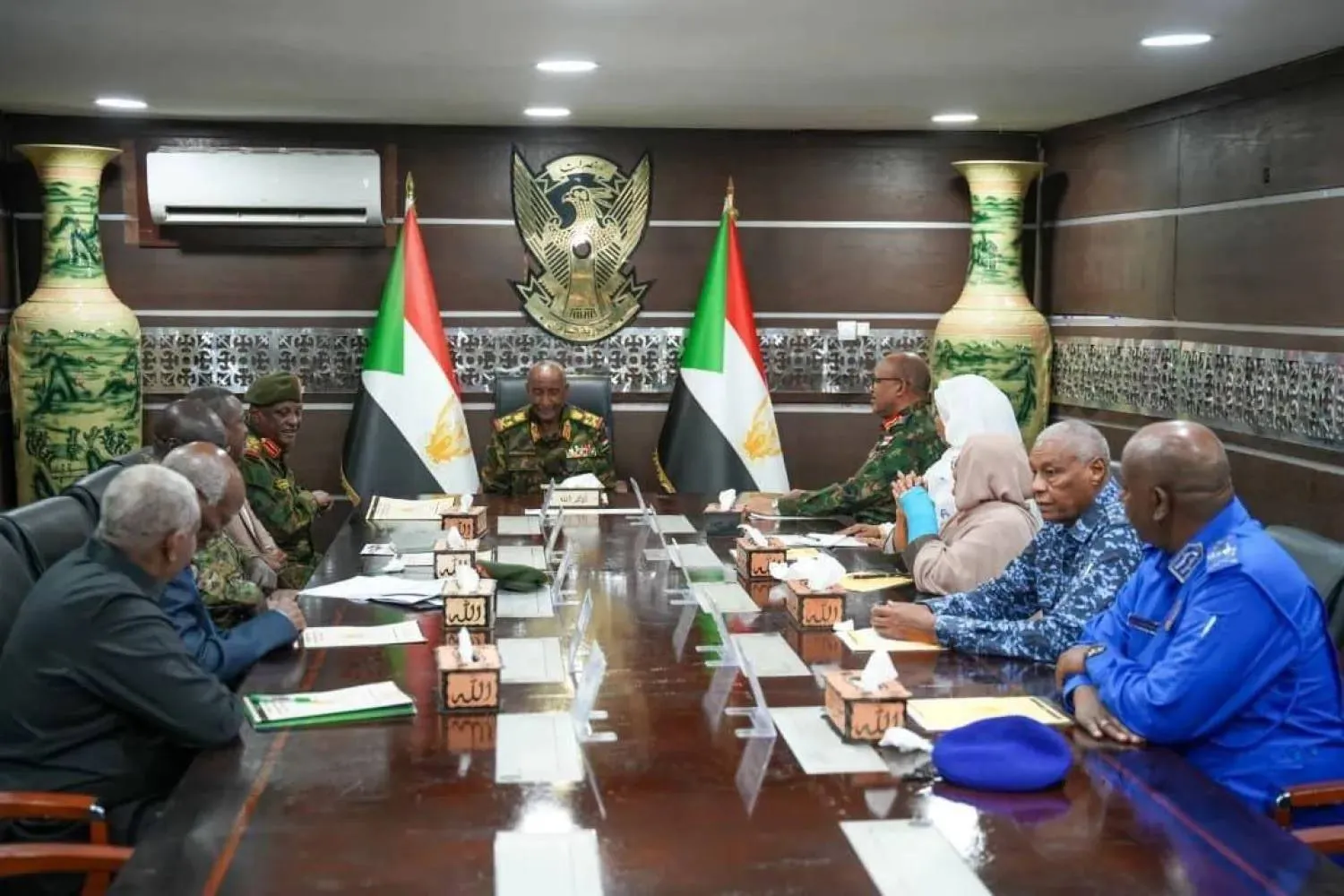
Al-Burhan chairs a meeting of Sudan’s Security and Defense Council on Tuesday (Transitional Sovereignty Council)
 
Al-Burhan chairs a meeting of Sudan’s Security and Defense Council on Tuesday (Transitional Sovereignty Council)  
TT

Sudan’s Security and Defense Council Orders Curbs on Armed Movement Inside Cities

Al-Burhan chairs a meeting of Sudan’s Security and Defense Council on Tuesday (Transitional Sovereignty Council)
 
Al-Burhan chairs a meeting of Sudan’s Security and Defense Council on Tuesday (Transitional Sovereignty Council)  

Sudan’s highest military and security authority has called for tighter controls on the movement of armed personnel, combat vehicles, and security cells inside cities and marketplaces, following reports and videos alleging incidents of “disorder” attributed to armed forces and army-aligned groups in areas recently recaptured by the military or currently under its control.

Following the Security and Defense Council’s regular meeting on Tuesday evening, Sudanese Defense Minister Lt. Gen. Hassan Daoud Kabroun said that the council had instructed the relevant authorities to regulate the movement of armed individuals and vehicles inside cities and markets, and to establish rules governing the work of “security cells” in local districts, with a focus on investigations involving those authorities describe as collaborators with the Rapid Support Forces (RSF).

The term “security cells” refers to groups or units operating in support of military and security agencies. They are typically engaged in surveillance, monitoring, inspections, and intelligence-gathering activities in neighborhoods, markets, and conflict zones.

Authorities say their role is focused on “tracking down collaborators with the RSF, dismantling sabotage cells, and protecting areas retaken by the army.” Critics of the Transitional Sovereignty Council, however, describe them in social media commentary as an extension of Islamist organizations tied to the former regime, alleging that they seek to eliminate political opponents.

The Security and Defense Council is one of Sudan’s most prominent military and sovereign decision-making bodies. It includes executive, military, and security leaders, among them the ministers of defense, interior, foreign affairs, and finance, as well as army commanders and heads of security agencies. The council is chaired by Sovereignty Council President and Armed Forces Commander-in-Chief Gen. Abdel Fattah al-Burhan.

According to media affiliated with it, the council met Tuesday under al-Burhan’s chairmanship, with all members in attendance, to review the country’s security and military situation.

The council’s role in managing security and military affairs has expanded since the outbreak of war between the army and the RSF on April 15, 2023, amid the widening conflict and mounting concerns over security violations in war-affected areas.

On the military front, Kabroun said the armed forces and allied troops had achieved “major victories” in recent weeks on several battlefronts, particularly in South Kordofan, Blue Nile, and Darfur.

He added that the council stressed the importance of adherence to the law, respect for human rights and Sudan’s sovereignty, as well as the need to provide essential services to citizens returning to their areas, especially electricity and water.

Citizens’ Complaints

Residents in some army-controlled areas - particularly the capital, Khartoum, parts of Al Jazirah State, and other states retaken by the military in recent months - have complained of what they describe as growing “security abuses.”

The allegations include looting, arrests, and other violations attributed to armed groups or individuals wearing military uniforms, in addition to the widespread presence of weapons and combat vehicles in neighborhoods and markets.

Videos and local testimonies concerning these incidents have circulated widely on social media platforms, while authorities say they are working to regulate armed movements and pursue those responsible.

Independent verification of all the accounts has not been possible because of the ongoing war and the complexity of the security situation.

Yemen Faces New Phase of Iranian Threat

An image circulated on social media shows an Iranian aircraft at Sanaa airport, which is under the control of the Houthis (X).
TT

Yemen Faces New Phase of Iranian Threat

An image circulated on social media shows an Iranian aircraft at Sanaa airport, which is under the control of the Houthis (X).

Yemen’s internationally recognized government said it has entered a new phase in its confrontation with the Iran-backed Houthi movement after Iran operated a direct flight to Sanaa International Airport, controlled by the group, to transport senior Houthi officials to the funeral of former Supreme Leader Ali Khamenei.

The government condemned the flight as a violation of Yemen’s sovereignty, while the Coalition to Restore Legitimacy in Yemen warned against any escalation threatening either Saudi Arabia or Yemen.

In response, Yemen’s Presidential Leadership Council, chaired by Rashad al-Alimi, held an emergency meeting with senior military and security officials, signaling that it views the issue as more than a civilian flight. The council said it challenged the state’s exclusive authority over its airspace, airports and international crossings.

The council argued the flight underscored the Houthis’ close ties to Tehran and their continued use of state institutions under their control to advance Iran’s agenda. It said the move violated UN Security Council resolutions and international law, testing the international community’s commitment to protecting Yemen’s sovereignty.

The government warned that allowing international flights without its approval would set a dangerous precedent, bypass legitimate institutions and entrench the country’s political division. It vowed to use political, legal and diplomatic means to defend its sovereignty.

The council also linked the flight to a pattern of Houthi actions, including attacks on international shipping and rejection of peace initiatives, saying the group continues to put Iran’s interests ahead of Yemen’s.

Saudi warning

The Saudi-led coalition said the issue extends beyond Yemen’s internal conflict and affects regional security.

Coalition spokesman Maj. Gen. Turki al-Maliki warned that the alliance would respond “with full force and unprecedented strength” to any attempt to target Saudi Arabia or undermine Yemen’s sovereignty.

Analysts say the statement draws red lines against any permanent Iranian presence at Sanaa airport while stressing that any response would remain consistent with international humanitarian law.

Peace efforts under strain

The escalation comes as regional and international mediators seek to preserve Yemen’s fragile truce despite stalled peace talks.

Houthi threats to establish regular Iranian flights to Sanaa have raised fears of a more dangerous phase in the conflict, particularly given longstanding accusations that Tehran supplies the group with weapons, military technology and advisers.

Yemen’s government stressed that Sanaa airport is not merely a humanitarian issue but one of sovereignty and international recognition. It urged the United Nations and the UN Security Council to move beyond condemnations and take concrete action against Iranian violations.

Meanwhile, the Saudi-led coalition supporting Yemen’s internationally recognized government has sought to underscore its continued backing for the Yemeni administration, while issuing clear deterrent signals against any moves that could threaten its security or alter the existing rules of engagement.


Is a New Showdown Looming Between al-Sadr and the Coordination Framework in Iraq?

Sadrist Movement leader Moqtada al-Sadr. (Reuters file)
TT

Is a New Showdown Looming Between al-Sadr and the Coordination Framework in Iraq?

Sadrist Movement leader Moqtada al-Sadr. (Reuters file)

The decision by influential cleric Moqtada al-Sadr, leader of the Sadrist Movement, to break his prolonged silence and publicly back Prime Minister Ali al-Zaidi’s anti-corruption campaign appears to mark a turning point in Iraq’s political landscape.

It raises the prospect of a direct confrontation with the ruling Coordination Framework, after years in which rivalry between the two sides was largely confined to electoral politics and political maneuvering rather than open confrontation.

The first notable response came from former Prime Minister Nouri al-Maliki, leader of the State of Law Coalition, who defended the Framework as a political project that had “proven its success.” His remarks were widely interpreted as an attempt to contain mounting pressure on the ruling Shiite alliance that has varying ties to Iran.

The developments come amid signs of growing divisions within the Framework, which emerged after the 2021 elections as an alternative to the Shiite alliances that had dominated Iraqi politics since 2005.

Al-Sadr’s silence

After the 2021 elections, al-Sadr sought to form a “national majority government” with the Kurdistan Democratic Party, led by Masoud Barzani, and a Sunni alliance headed by former Parliament Speaker Mohammed al-Halbousi.

The effort collapsed because of the so-called “blocking third,” which prevented the election of a president by the constitutionally required majority and prolonged Iraq’s political deadlock.

In the summer of 2022, al-Sadr withdrew his lawmakers from parliament and announced his departure from political life, declaring that he refused to “participate with the corrupt in any form.”

He also said he would not take part in elections “while the corrupt remain,” urging his supporters to preserve their political and grassroots organization in preparation for a future stage should circumstances change.

Since then, al-Sadr has boycotted every subsequent election, including the most recent one, despite repeated calls — including from rivals within the Framework — to return to politics.

Anti-corruption campaign reshapes the landscape

The political equation shifted with al-Zaidi’s recent anti-corruption campaign, which reached its peak with the arrest of 21 political and parliamentary figures in the operation dubbed “Dawn Strike.”

The campaign gained further momentum after investigating judge Diaa Jaafar revealed that part of the embezzled funds had been used to finance election campaigns, raising broader questions about the integrity of the most recent elections and the influence of political money on their outcome.

Observers said these developments have given al-Sadr political ground that aligns with the position he adopted after leaving parliament: refusing to participate in what he considers a political system tainted by corruption.

Settlement or political realignment?

Al-Zaidi became prime minister after the Coordination Framework failed to agree on a candidate from within its own ranks.

After former Prime Minister Mohammed Shia al-Sudani was effectively ruled out for a second term and al-Maliki’s candidacy faltered amid domestic and international objections, specifically from the US, political factions turned to a figure from outside Iraq’s traditional political class.

A businessman in his 40s, al-Zaidi is widely seen as an acceptable choice for Washington, while Iran has reacted with unusual caution, reflecting what many observers see as a decline in its influence in Iraq compared with previous years.

His early decisions attracted attention, including his announcement not to attend the funeral of Iran’s late Supreme Leader Ali Khamenei, which was attended by several Coordination Framework leaders and an official Iraqi delegation headed by President Nizar Amidi.

He has also pledged to strengthen ties with the United States and is expected to visit Washington in July.

Domestically, al-Zaidi has vowed to press ahead with mostly pro-Iran disarming armed factions, giving them until September to surrender their weapons, an issue successive Iraqi governments have failed to resolve because of its political and security complexities.

Al-Sadr breaks his silence

The turning point came when al-Sadr fully endorsed the anti-corruption campaign, describing al-Zaidi as a “soldier of reform.” The move went beyond political support, giving the government broad popular backing.

Pro-government demonstrations followed, while Sadrist leaders began openly supporting the campaign after months of silence awaiting al-Sadr’s instructions.

Observers viewed this as the first broad political and popular alignment against Iraq’s ruling establishment since 2003, particularly because the anti-corruption campaign has targeted figures associated with influential factions within the Coordination Framework.

The political stakes are heightened by the fact that al-Zaidi’s priorities — combating corruption and bringing all weapons under state control — overlap with those of US President Donald Trump’s administration toward Iraq.

Analysts said this creates a convergence of interests between Washington and the Sadrist Movement, despite their fundamental differences on other issues.

Pressure mounts on the Coordination Framework

The convergence does not amount to a direct political alliance between al-Sadr and the US administration. However, it gives al-Zaidi’s government support from two actors traditionally viewed as standing on opposite sides of Iraq’s political divide, thereby increasing pressure on the Coordination Framework.

In response, al-Maliki defended the alliance in a post on X, saying it had served as “the incubator of the national political process” and that its success was reflected in its role in forming three successive governments.

“There is no reason to abandon a project that has proven successful,” he wrote, adding that the Coordination Framework “will remain as it was founded, preserving its principles, identity and founders,” while arguing that any reform should be limited to improving its mechanisms and performance, without altering the essence of the project.


Israeli Military Says Killed Armed Militant in South Lebanon

This picture taken from a position in the Upper Galilee in northern Israel shows Israeli army tanks positioned along the Israel-Lebanon border, on July 1, 2026. (Photo by Jack GUEZ / AFP) /
TT

Israeli Military Says Killed Armed Militant in South Lebanon

This picture taken from a position in the Upper Galilee in northern Israel shows Israeli army tanks positioned along the Israel-Lebanon border, on July 1, 2026. (Photo by Jack GUEZ / AFP) /

The Israeli military said on Saturday that it killed an armed militant in the "security zone" under its control in south Lebanon.

The military said in a statement on Saturday that Israeli soldiers “identified an armed terrorist operating inside the Security Zone, in the Majdal Zoun area in southern Lebanon," adding that troops "opened fire at the terrorist" and, after conducting "extensive searches", then "eliminated" him.

Lebanon's state-run National News Agency (NNA) said an Israeli helicopter carried out "a broad sweep operation on the outskirts" of Majdal Zoun and launched five missiles towards the village, without specifying a target or immediately reporting casualties.

The NNA also reported on Saturday that an Israeli strike on the village of Mansouri wounded one person, and reported Israeli artillery shelling elsewhere.

Hezbollah drew Lebanon into the Middle East war on March 2 with rocket fire at Israel to avenge the killing of Iran's supreme leader in US-Israeli strikes days earlier.

Israel responded with heavy airstrikes and a ground invasion of southern Lebanon, where its troops still occupy swathes of territory near the border.

At the end of June, Lebanon and Israel agreed to a US-backed framework aiming to pave the way for a permanent end to hostilities.