


Oil Gains, Stocks Slip on Uncertain Mideast Peace Prospects

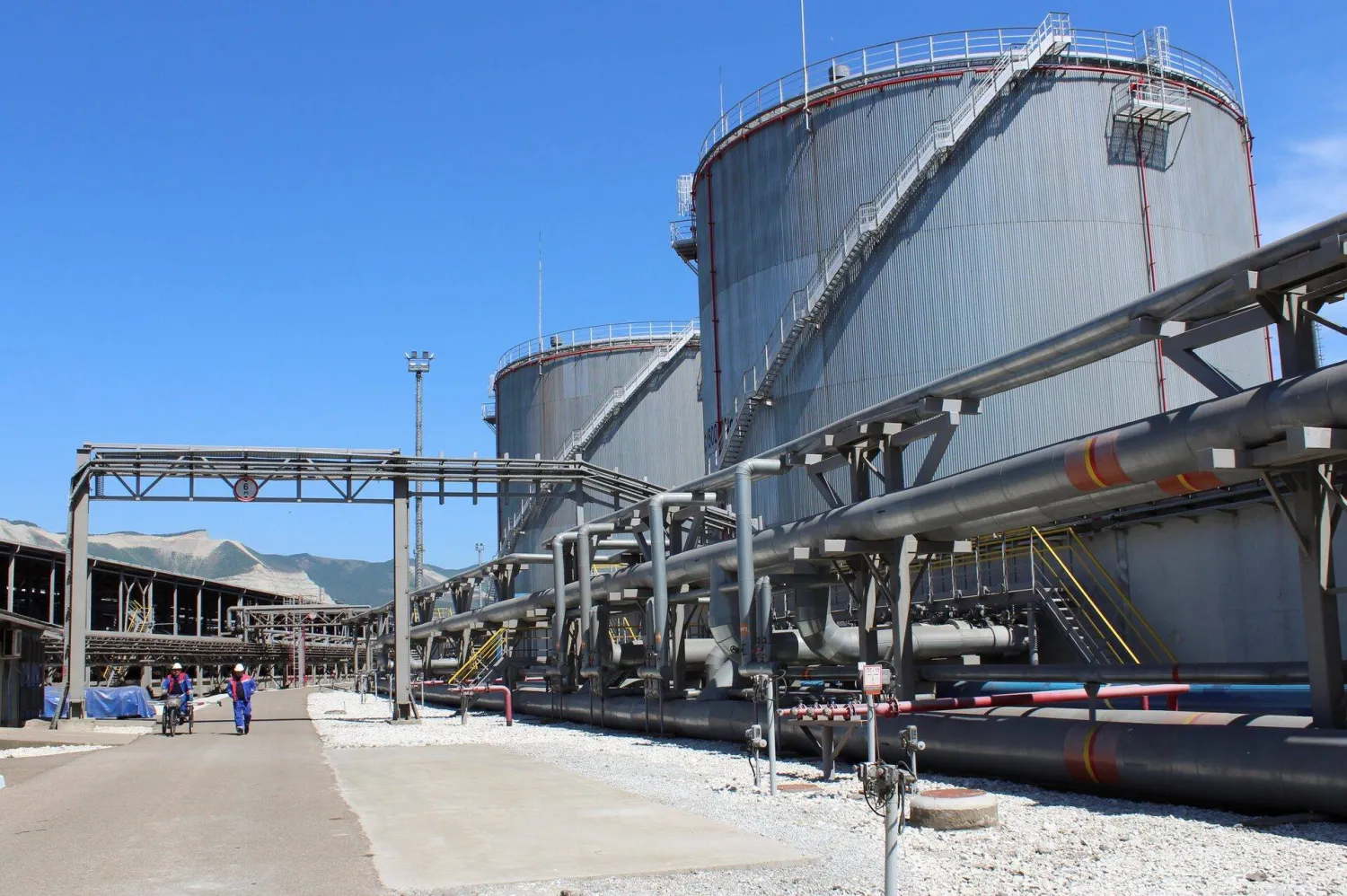
A fuel storage facility at Russia's main oil export hub in the Black Sea port of Novorossiysk (Reuters)
TT

Oil Gains, Stocks Slip on Uncertain Mideast Peace Prospects

A fuel storage facility at Russia's main oil export hub in the Black Sea port of Novorossiysk (Reuters)

Oil prices jumped while stock markets mostly retreated and the dollar firmed Thursday as hopes of a Middle East peace accord faded on conflicting headlines on the state of talks.

US President Donald Trump has described the latest discussions as being on the "borderline" between a deal and renewed strikes.

Pakistan's army chief was due in Iran on Thursday, Iranian media reported, with Islamabad mediating as Tehran examines a new US proposal to end the war, AFP reported.

"Markets pulled back across Europe as the waiting game to end the Iran war rumbled on," said Dan Coatsworth, head of markets at AJ Bell.

Wall Street's main indices also dipped at the open.

There were earlier big gains for technology stocks in Asia after chip giant Nvidia posted record quarterly revenue of $81.6 billion, blowing past analyst forecasts on the voracious demand for artificial intelligence hardware.

Sentiment was also boosted by Elon Musk's filing for a public sale of SpaceX shares, which could be the largest initial public offering in history as the rocket and satellite company seeks to raise up to $75 billion.

"This could be a blockbuster summer for IPOs with OpenAI also expected to list in the coming weeks," said Kathleen Brooks, research director at XTB.

"How the market absorbs these new listings will be crucial for the future of the AI trade, as both companies are at the heart of the AI revolution," she said.

South Korea's benchmark Kospi index surged 8.4 percent, helped by Samsung Electronics shares after unions paused a 18-day strike.

Japan's Nikkei index ended with a gain of 3.1 percent.

But despite the group's profit growth, Nvidia shares failed to get a boost as they have in previous quarters, gaining 0.2 percent after trading got underway in New York.

With tech shares, whose staggering rises helped drive markets to record highs in recent months, now considered by many investors to be overvalued, investment analyst Bret Kenwell at eToro said there were worries that a pullback was in store.

"While geopolitical risks could still flare up, the more pressing issue appears to be macro-related," he said, pointing to the recent rise in sovereign bond yields and the prospect of central banks raising interest rates.

The yields demanded by investors to lend to governments by buying their bonds have peaked in recent days, indicating weakening confidence in their economies and inflation fears.

After tech gains in Asia, attention turned to US-Iran war developments and the potential fallout for economies on the continent, sending European stocks lower.

The EU warned Thursday that eurozone growth would be less than expected this year and inflation significantly higher than forecast, as the Mideast war and subsequent energy shock take their toll.

It came as a key survey revealed that business activity in the eurozone contracted further in May, weighed down by weak demand caused by a conflict.

British private-sector activity also unexpectedly contracted this month, marking the first decline in output in over a year, S&P Global added.

"The UK economy is facing a perfect storm, as rising political uncertainty adds to the growing impact from the war in the Middle East," said Chris Williamson, chief business economist at S&P Global Market Intelligence.

In other corporate news, French video game giant Ubisoft saw its shares plunge around 11 percent after it reported disappointing annual results and forecast further pain in the coming year.

The "Assassin's Creed" and "Rayman" developer had warned in January of the likely impact, with seven games cancelled and six delayed.



US Goods Trade Deficit Hits 14-month High in May as Imports Surge

APM Terminals' facility at the Port of Los Angeles in California. (Reuters)
TT

US Goods Trade Deficit Hits 14-month High in May as Imports Surge

APM Terminals' facility at the Port of Los Angeles in California. (Reuters)

The US trade deficit in goods swelled to a 14-month high in May as businesses boosted imports, likely to avoid shortages and higher prices related to the Middle East conflict, suggesting trade remained a drag on economic growth in the second quarter.

The sharp deterioration in the goods trade deficit reported by the Commerce Department on Friday also reflected a decline in exports.

Recent business surveys have shown front-loading of orders by firms. Sponsors of the surveys attributed the behavior to the US-led war against Iran, which raised commodity prices, including for oil and fertilizers, and disrupted shipping in the Strait of Hormuz.

But after the United States and Iran last week signed a preliminary peace deal, shipments through the strait have picked up, driving oil prices sharply lower. Even if supply chains returned to normal, economists warned that the trade deficit would likely remain elevated because of an artificial intelligence investment boom that is largely reliant on imports.

"The widening trade deficit is bad news for national income growth, and it suggests that net exports might drag down real GDP growth too," said Carl Weinberg, chief economist at High Frequency Economics. "The AI boom had better generate a corresponding increase in services exports to offset the influx of equipment. If it doesn't, then this AI bubble is a losing proposition for the economy."

The goods trade gap increased 27.4% to $105.8 billion last month, the highest level since March 2025, the Commerce Department's Census Bureau said. Economists polled by Reuters had forecast the deficit at $85.0 billion.

Imports of goods increased $10.9 billion, or 3.6% to $313.4 billion, also a 14-month high. They were driven by a 6.3% surge in imports of automotive vehicles. Imports of consumer goods soared 5.7%. Despite high inflation, mostly stemming from the Iran war, consumer spending has remained strong, thanks to large tax refunds this year and a stock market rally.

BROAD INCREASE IN IMPORTS

Imports of industrial supplies, which include petroleum, increased 4.8%. Capital goods imports rose 0.4%. They surged 41.9% on a year-on-year basis, reflecting the AI spending spree.

Imports of foods, feeds and beverages increased 4.3%, while those of other goods advanced 11.5%. Overall imports have remained high despite tariffs imposed by the Trump administration.

Goods exports dropped $11.8 billion, or 5.4%, to $207.7 billion in May. They were weighed down by a 9.2% plunge in exports of consumer goods. Industrial supplies exports tumbled 7.0%, while those of capital goods dropped 5.0%. Exports of other goods decreased 6.8%. But food, feed and beverage exports increased 3.9%. Automotive vehicle exports rose 0.5%.

"Imports are moving sharply higher and this will subtract from GDP growth this quarter," said Christopher Rupkey, chief economist at FWDBONDS. "The import drag on domestic economic growth is back because factories here cannot make it here no matter how Washington economic officials try to spin it."

Trade had been a drag on gross domestic product for two straight quarters. Growth estimates for the second quarter were converging around a 2.5% annualized rate before the trade data.

The economy grew at a 2.1% annualized rate last quarter after expanding at a 0.5% pace in the October-December quarter.


Gold Gains as Dollar Weakens; Still on Track for Fourth Straight Weekly Loss

British gold bars and sovereign coins on display in a London shop. (Reuters)
TT

Gold Gains as Dollar Weakens; Still on Track for Fourth Straight Weekly Loss

British gold bars and sovereign coins on display in a London shop. (Reuters)

Gold edged higher on Friday as the dollar weakened and expectations of US interest rate hikes eased slightly following inflation data, though prices were still on track for a fourth consecutive weekly decline. Spot gold was up 0.51% to $4,046.70 per ounce by 9:39 a.m. EDT (1339 GMT).

US gold futures for August delivery rose 0.35% to $4,061.40 per ounce.

The US dollar eased from recent highs after the release of the Fed's preferred inflation gauge on Thursday. The US Personal Consumption Expenditures Price Index surged 4.1% in the 12 months through May, matching economists' forecasts in a Reuters poll. Traders are pricing in about a 60% chance of a US rate hike in September, lower than an earlier expectation of 64%, according to CME Group's FedWatch Tool.

Gold is seeing a modest rebound after coming under selling pressure earlier this week, said Jim Wyckoff, a market analyst at American Gold Exchange. Higher interest rates and tighter monetary policy reduce the appeal of non-yielding bullion, as they tend to boost bond yields and increase returns on interest-bearing assets. Spot gold hit more than a seven-month low earlier this week and prices were down 2.6% for the week.

TD Securities said in a note that, given gold's inverse relationship with both higher oil prices and a stronger US dollar, sustained strength in energy markets could put further downward pressure on the precious metal in the months ahead. Gold started trading at a premium in India this week for the first time in a month and a half, as a price correction lifted buying, while demand stayed subdued in China, the top consumer. Among other precious metals, spot silver rose 0.42% to $58.1109 per ounce.

Platinum gained 0.21% to $1,604.45 and palladium jumped 1.25% to $1,199.25.


Oil Set for Big Weekly Losses as Tankers Exit Strait of Hormuz

Crude oil storage tanks at the Cushing hub in Oklahoma, USA (Reuters)
TT

Oil Set for Big Weekly Losses as Tankers Exit Strait of Hormuz

Crude oil storage tanks at the Cushing hub in Oklahoma, USA (Reuters)

Crude prices plunged by about 3% on Friday, on course for steep weekly losses, as more oil tankers exited the Strait of Hormuz, easing supply concerns, even though a cargo vessel was hit near Oman on Thursday.

Brent crude futures fell $2.42, or 3.2%, to $72.84 a barrel by 1323 GMT. US West Texas Intermediate lost $1.97, or 2.7%, to $69.95.

The Brent benchmark was heading for a weekly decline of about 9.7%, while WTI traded around 8.8% lower than its close last Thursday before the market closed for a public holiday last Friday, Reuters reported.

"The predominant view, it appears, remains one of imminent oversupply," said PVM analyst Tamas Varga.
Refining giant Saudi Aramco resumed oil loading on Friday at its Ras Tanura terminal in the Gulf after a nearly four-month halt, shipping data from LSEG showed.

Two Very Large Crude Carriers, which can load cargoes of 2 million barrels, loaded crude at the terminal while another waited nearby, the data showed.

"There is a general selloff as the market reacts to the increased flows exiting the Strait of Hormuz and China not yet picking up crude demand," said June Goh, senior oil market analyst at Sparta Commodities.

UNKNOWN PROJECTILE HITS VESSEL

Both benchmark contracts jumped more than 2% on Thursday after a cargo vessel was hit by an unknown projectile near Oman, prompting the UN's shipping agency to suspend its voluntary evacuation scheme.

Two US officials told Reuters that Iran fired on the cargo ship as it attempted to pass through the strait. Iranian authorities said the security of vessels passing outside designated Hormuz routes is not guaranteed. Iran on Friday reasserted its right to control shipping through the Strait of Hormuz. Data on Thursday showed that crude shipments through the strait rose this week to their highest since the US-Israeli conflict with Iran began at the end of February.

Despite the ceasefire deal that reopened the waterway, overall traffic is far below the pre-war daily average.

"If the number of transits does not increase more strongly next week either, scepticism in the market is likely to grow, so that the oil price is likely to rise again," Commerzbank analysts said on Friday. Meanwhile, Russian authorities are considering a diesel export ban for several months, state news agency TASS said on Friday. Although a major diesel exporter, Russia faces fuel supply issues after Ukrainian drone attacks have caused extensive damage to its oil refineries and other energy infrastructure.