


Beirut Plan to Organize the Displaced Ends in Waterfront Camp

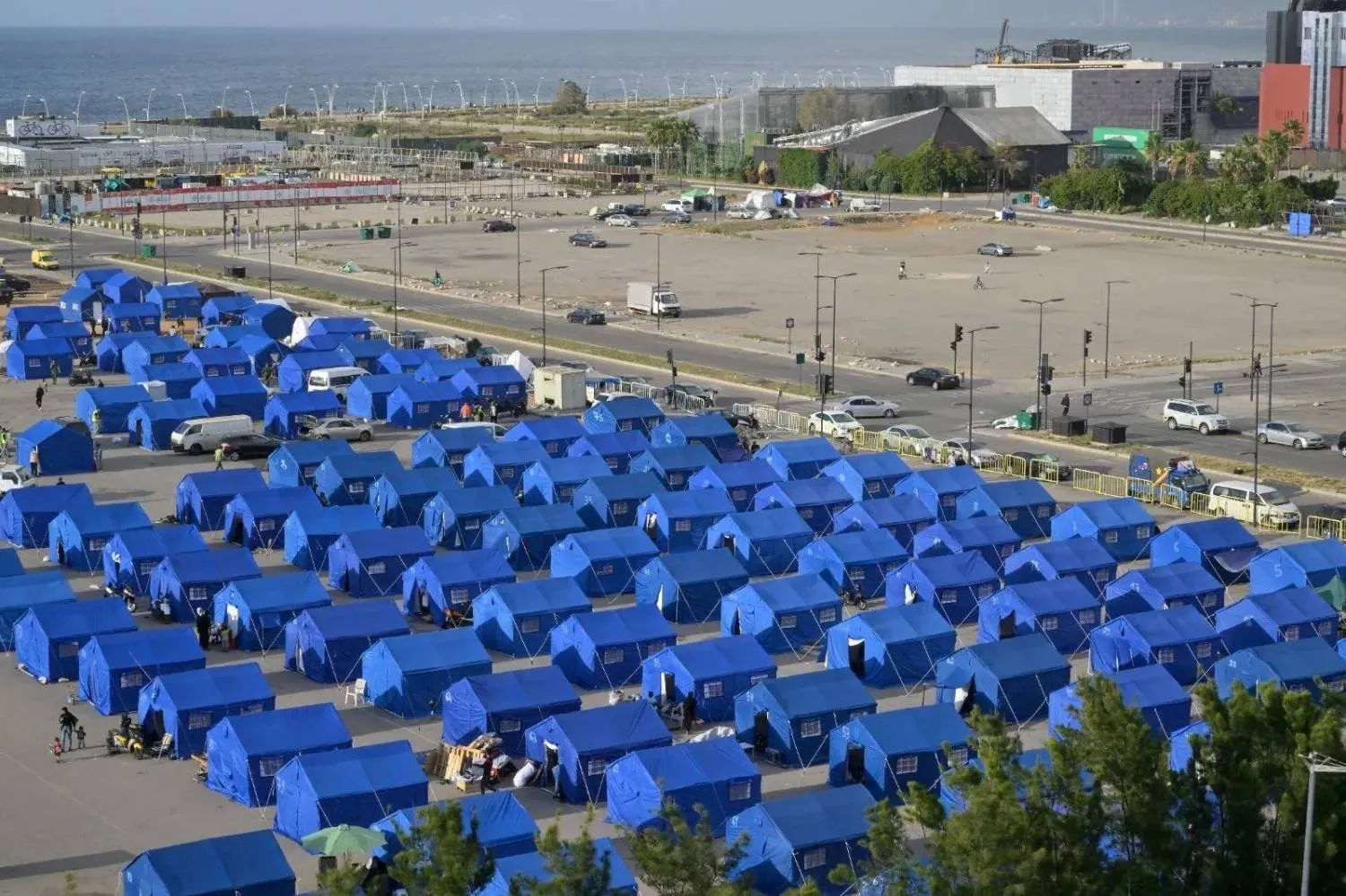
A camp housing displaced people from southern Lebanon and Beirut’s southern suburbs on the Lebanese capital’s waterfront (Asharq Al-Awsat)
TT

Beirut Plan to Organize the Displaced Ends in Waterfront Camp

A camp housing displaced people from southern Lebanon and Beirut’s southern suburbs on the Lebanese capital’s waterfront (Asharq Al-Awsat)

The insistence of about 500 displaced Lebanese to stay along Beirut’s waterfront has raised questions about why they chose to remain in that area despite the lack of basic living conditions.

The displaced say they are staying for security reasons, fearing they could be targeted if they move to larger gatherings, such as the Sports City, and because they want to remain in Beirut rather than in distant areas in the north or the Bekaa.

But Beirut figures and lawmakers say the issue has security dimensions that go beyond the humanitarian aspect, arguing that their continued presence on the waterfront is taking place by a decision from Hezbollah.

The prime minister’s office said, “No infrastructure will be allowed to be built at the newly designated site, nor any additional facilities that could turn this temporary presence into a permanent reality.”

Over the past two days, the displaced were moved only a few meters from privately owned land, where they had been living in inhumane conditions inside random and disorganized tents, to adjacent land owned by the Beirut municipality.

Their presence was organized there, and proper tents were provided, along with security and organizational measures at the new site. But the gathering still lacks bathrooms and basic services.

The official decision to move the tents only a few meters, rather than ending the gathering and distributing the displaced to more suitable shelters, surprised many, especially as it effectively kept the same concentration of people on Beirut’s waterfront, with only limited organizational changes.

Prime minister’s office

The central operations room at the prime minister’s office said in a statement that, “as part of efforts to prevent random gatherings, fixed structures that had been set up on Beirut’s waterfront were removed, especially those made of wood, asbestos and concrete, in a way that prevents any expansion at this site.”

It said the new site, which belongs to the Beirut municipality, accounts for no more than 15% of the area where the tents had previously been set up.

It added that “this measure does not aim to establish a camp or an official shelter, nor to impose a new fait accompli, as some are trying to suggest, but rather to protect public order and security in the capital, and to remove encroachments on private property.”

It stressed that “no infrastructure will be allowed to be built at the newly designated site, nor any additional facilities that could turn this temporary presence into a permanent reality.”

Interior Ministry clarification

Interior Ministry sources said the displaced had been asked to move to Sports City but had refused.

“Because the tents had spread randomly, and under the directives of the prime minister, Beirut Governor Judge Marwan Abboud was tasked with finding a temporary solution to organize the situation. It was decided to confine the tents to land belonging to the Beirut municipality as a temporary measure,” the sources told Asharq Al Awsat.

They said the measure aimed to establish a minimum level of organization, while “the best solution remains for the displaced to move to shelters, in the hope that this crisis ends as soon as possible so they can return to their homes.”

A decision by Hezbollah?

MP Waddah Sadek said the authorities had faced three options, either leave the gathering in the state of chaos it was in on private land, move the displaced within the same area to state owned land in a way that ends the encroachment on private property and allows their presence to be better organized, or remove the tents and gathering by force, which would have led to a security incident given the displaced people’s refusal to leave.

“The officials concerned chose the second option because they considered it the best at this stage,” Sadek told Asharq Al Awsat.

Sadek said, “What is happening is taking place by a clear decision from Hezbollah, because the displaced have no interest in staying in the condition they are in when better alternatives and options exist.”

He warned of “gatherings under the title of displacement at every entrance to Beirut, which reinforces fears over the scenario Hezbollah is preparing.”

Security fears?

One of the displaced people at Beirut’s waterfront said in a television interview that their insistence on staying where they are was “purely” for security reasons.

“We fear being gathered in one large center, such as the Sports City, and then Israel targeting us,” he said.

Although the Social Affairs Ministry had provided buses for weeks to transport them to other areas, where suitable shelters had been prepared, they refused to leave and insisted on staying in the capital.

Deporting Syrians

Beirut municipal council member Mohammad Ballouza said the municipal council had no role in the file and that no council session had been held to take any decision on the matter.

“The decision to move the displaced from private land to land belonging to the Beirut municipality was taken under the directives of Prime Minister Nawaf Salam, under the supervision of the interior minister, and implemented by the Beirut governor. Instead of having tents spread across private property, they were gathered on land owned by the Beirut municipality,” he told Asharq Al Awsat.

Ballouza said, “The displaced do not want to leave the area, so they were only provided with tents. Syrians were deported to Syria or moved to other points.”

He said shelters in Beirut had reached full capacity and that the capital had exceeded its ability to absorb more people. “The Sports City in Beirut can accommodate only about 200 people,” he said.

Fear that the temporary becomes permanent

MP Ghassan Hasbani, a member of the Strong Republic bloc, visited the Grand Serail with MP Fouad Makhzoumi, where they discussed with Prime Minister Nawaf Salam the presence of the displaced on Beirut’s waterfront.

After the meeting, Hasbani stressed the need to move the displaced to other equipped shelters, saying Beirut’s waterfront is not prepared or able to accommodate this population, whether on private or municipal properties.

He also voiced concern that “the temporary could become permanent, especially through public property that must be protected.”


Arms Depots in Residential Areas Keep Libyans on Edge

Remnants of ammunition after a weapons depot explosion in Misrata, western Libya, on Friday (Criminal Investigation Department)
TT

Arms Depots in Residential Areas Keep Libyans on Edge

Remnants of ammunition after a weapons depot explosion in Misrata, western Libya, on Friday (Criminal Investigation Department)

An explosion at a warehouse belonging to an armed group in the northwestern Libyan city of Misrata has revived fears over munitions stored among civilians despite an earlier order to remove such facilities from populated areas.

Weapons and ammunition depots inside residential areas have become a persistent challenge for Libya’s Government of National Unity (GNA) in the west and a growing concern for residents.

Friday’s blast in the Gharian area underscored the risks posed by ammunition depots run by armed groups inside residential neighborhoods. Residents have renewed calls for the facilities to be moved away from populated areas, fearing a repeat of earlier explosions that caused casualties and sparked widespread anger.

Ammunition found on Friday at the site of a weapons depot explosion in Misrata, western Libya (Criminal Investigation Department)

Salem Krawad, a Misrata notable, said public anger had “reached its peak because of the proliferation of weapons without decisive government action.”

“The danger is not limited to warehouses. It extends to homes containing shells, ammunition boxes, and light arms, raising fear among residents,” he told Asharq Al-Awsat.

Medical sources said the explosion at a warehouse belonging to an armed group calling itself the “Hurricane Brigade” caused injuries and panic after rockets and ammunition flew into the surrounding area, raising fears of further blasts.

By early Saturday, the operations room of the government-run Libyan Mine Action Center was still receiving reports from residents of intermittent ammunition explosions, a center source said.

The depots in the city were large and held various types of ammunition, the source added.

GNA Prime Minister Abdulhamid al-Dbeibah had not commented on the incident. He was visiting Misrata, where he toured a power station and attended a sports festival.

The head of the Government of National Unity attended a sports festival in Misrata but did not comment on the explosion (Dbeibeh's Office)

Interior Minister Emad al-Trabelsi ordered security agencies to survey and comb the areas around the blast site and remove remnants.

Local sources ruled out a deliberate attack as the cause of the explosion in Misrata. But the incident recalled a similar blast in August last year in the city’s al-Sukairat area that injured 16 residents.

That explosion sparked protests in Misrata, with residents demanding the removal of weapons and ammunition depots from residential areas.

Abdul Salam al-Zoubi, undersecretary at the Defense Ministry for regions and military affairs, then ordered the formation of a committee to identify alternative storage sites and clear existing depots from populated areas.

But the decision was never implemented, Krawad said, questioning why the depots remained in residential districts despite repeated calls to remove them.

Their continued presence “represents a latent danger threatening civilian lives and means an explosion could occur at any time,” he said.

Libya has faced widespread proliferation of weapons and ammunition since the fall of Muammar Gaddafi’s government in 2011, with military depots located near population centers. UN reports estimate there are about 20 million arms in the country, highlighting the scale of the challenge.

A member of the Military Engineering Department in Tripoli defuses a mine in the Al-Aqrabiyah area near a residential neighborhood (General Staff of the Government of National Unity Forces)

The danger goes beyond warehouse explosions. Official figures show that mines and explosive ordnance have caused 487 casualties since May 2020, including 175 deaths and 312 injuries. Eighty-seven of the victims were children.

Representatives of 10 countries and international partners to Libya warned at a meeting in Rome in May about unsafe ammunition storage, particularly depots near residential areas, saying they posed a continuing threat to civilians.

Despite the warnings, ammunition depots remain scattered through residential areas across Libya, according to the Libyan Mine Action Center. The risks increase in the south as temperatures rise, potentially raising the chances of improperly stored ammunition exploding.

Khaled Jibril, spokesperson for the Libyan Mine Action Center, renewed warnings that unsafe storage of ammunition and explosive remnants of war, especially near residential neighborhoods, posed a constant threat to civilians because explosions and other incidents could occur without warning.

Jibril told Asharq Al-Awsat that protecting civilians and reducing risks posed by ammunition and remnants of war required cooperation among the relevant authorities, with public safety prioritized and practical steps taken to stop haphazard storage and to move sources of danger away from populated areas.

The ongoing risks pose a challenge far beyond Misrata in a country still divided between two governments: The Tripoli-based GNA, headed by Dbeibah, and a parliament-appointed government, headed by Osama Hammad, that administers eastern Libya and southern cities.


Exceptional School Year: South Lebanon Families Weigh Options Amid War Fears

A member of the Red Cross provides learning activities to children inside a tent at Camille Chamoun Sports City stadium turned into a temporary shelter in Beirut, Lebanon, May 8, 2026. REUTERS/Mohamed Azakir
TT

Exceptional School Year: South Lebanon Families Weigh Options Amid War Fears

A member of the Red Cross provides learning activities to children inside a tent at Camille Chamoun Sports City stadium turned into a temporary shelter in Beirut, Lebanon, May 8, 2026. REUTERS/Mohamed Azakir

For many families in southern Lebanon, choosing a school is no longer a decision made months in advance.

With September approaching, parents are still weighing where to enroll their children, watching the security situation and recalling the upheaval of the past two years, when thousands of students were kept out of classrooms, families were displaced and schools shifted from in-person to remote learning.

The uncertainty has produced starkly different choices. Some families are enrolling children in schools in the areas where they were displaced.

Others are opting for lower-cost public schools in case classrooms are forced to close again. Some are seeking schools in safer areas that stayed open during the previous war.

A displaced woman with children sits outside a school-turned-shelter, following an escalation between Hezbollah and Israel amid the US-Israeli conflict with Iran, in Beirut, Lebanon, March 3, 2026. REUTERS/Mohamed Azakir

Normally, most Lebanese schools, particularly private ones, complete enrollment by the end of the previous academic year, allowing the new school year to begin with student lists already finalized.

This year, some schools are keeping registration open through the first two weeks of September as parents hesitate over where to send their children.

“I enrolled my children, but I still haven’t bought their books,” said Abeer, a mother of three.

“Every day I look at the book lists and wonder: Should I wait, or pay for them and have the same thing happen as in the past two years? I’ll wait until mid-September before deciding.”

For Maryam, safety means keeping school close to home.

“My son is in first grade. I enrolled him in the public school near us in the village,” she said. “That way, if anything happens, I can pick him up quickly and flee at any moment.”

Parents from border areas who do not expect to return home soon are among those searching for schools where they have been displaced.

Others are turning to public schools, known for their lower fees, wary of paying high tuition only for schools to close again.

Some families are taking another approach: looking for schools in safer areas that managed to keep classrooms open during the previous war.

For parents reluctant to repeat the experience of remote learning, that has become a key condition.

“We decided to stay in the area where we were displaced,” said Um Ahmad. “So I looked for a school that did not close during the war and enrolled my children there.”

“I don’t believe remote learning is as beneficial as in-person education,” she said. “There is also the severe psychological strain that war places on my children and on us adults alike. So I believe in-person learning is better as long as it remains possible.”

A displaced man, who fled his home after an Israeli evacuation order, sits in a university-turned shelter in Sidon, Lebanon, April 13, 2026. REUTERS/Aziz Taher

Schools prepare for both scenarios

Schools are facing the same uncertainty.

Several schools in southern Lebanon outside areas exposed to bombardment are preparing to open for the new academic year, but they are not assuming in-person learning will remain possible throughout it.

One private school in Nabatieh told parents it was preparing to “adopt in-person learning whenever security conditions allow.”

The message reflects a broader effort by schools to prepare for either in-person or remote teaching, depending on developments on the ground.

The approach is also in line with the Education Ministry’s plan for the 2026-27 academic year, which seeks to keep education running according to conditions in each area: in-person teaching where safety and preparedness allow, and remote learning in areas affected by the security situation.

Between school and home, safety comes first

Some families have made the opposite calculation, choosing remote learning as the safer option.

Leila’s children had been attending a secondary school in Toul, in the Nabatieh district. She decided to move them to another school in Zebdine after their former school said it would return to in-person teaching next year, while the new school announced it would continue remotely.

“I’ll keep them with me at home,” she said. “That will feel safer to me.”

People shelter at a school, which is hosting displaced people, following an escalation between Hezbollah and Israel, amid the US-Israeli conflict with Iran, in Lebaa, Lebanon, March 15, 2026. REUTERS/Raghed Waked

The Tarhini family made a similar choice from abroad.

They left for Africa after the war broke out and enrolled their children in a Lebanese school offering remote learning while they waited for the situation to stabilize.

“The political and battlefield developments do not bode well, and it seems the war will undoubtedly return,” the father said, adding that the family’s decision gave him greater peace of mind for now.


Barrack: Israeli Strike on Syria’s Abu al-Duhur Base Sought to Bait Türkiye

Abu al-Duhur airbase following strikes, Syria, August 18, 2026. REUTERS/Stringer
TT

Barrack: Israeli Strike on Syria’s Abu al-Duhur Base Sought to Bait Türkiye

Abu al-Duhur airbase following strikes, Syria, August 18, 2026. REUTERS/Stringer

The Israeli strike on the Abu al-Duhur military base in northern Syria near the Turkish border last Tuesday, may have been intended to provoke Ankara and is considered a “very dangerous game,” US Special Envoy to Syria and Ambassador to Türkiye Tom Barrack said on Saturday.

Eight Israeli airstrikes hit the airbase early Tuesday, targeting the runway and storage facilities, Syria’s state-run Al-Ikhbariya had reported.

In response, Ankara accused the Netanyahu government of using “cheap politics” for electoral gain and seeking to portray Türkiye as a new threat.

According to Barrack, the incident escalated from another Israeli strike in Syria into a moment that could have triggered a far more dangerous regional confrontation.

The ambassador invoked the downing of a Russian jet in late 2014 that escalated regional tensions.

In a YouTube interview with podcast host Mario Nawfal and in comments to PBS NewsHour, Barrack said the incident in which Israeli jets, without advance warning, struck the airbase in Syria - around 80 kilometers east of the Turkish border - intended to “bait” or provoke Ankara.

He described a situation in which fighter jets operate near a border without coordination or warning as a “very dangerous game.”

Last Tuesday, Israeli Prime Minister Benjamin Netanyahu’s office described the airstrikes as a warning to Türkiye against expanding its military presence in Syria or helping rebuild the Syrian armed forces.

In return, Syrian Foreign Minister Asaad al-Shaibani told Axios that Damascus had previously informed Israel there were no plans to establish a Turkish military base at Abu al-Duhur, which was being rehabilitated for use by the Syrian Air Force.

For its part, the Turkish presidency rejected the Israeli allegations as “baseless,” accusing Netanyahu of promoting them ahead of Israel’s October elections and calling on the international community to curb Israeli actions threatening regional peace and stability.

Barrack said Israel might have received intelligence indicating Turkish military personnel or military assets could be stationed at the Syrian base.

According to Barrack, Israel raised the concern with the United States about six days before the strike.

“We have some intelligence that there might be Turkish movement into this site, which we would be very concerned about,” Barrack said about the message delivered to Washington.
Barrack then confirmed reports that Mossad chief Roman Gofman had spoken with al-Shaibani several days before the strike to convey Israel’s concerns. He described the talks as a two-hour, in-depth conversation.

Despite those contacts, Israeli forces struck the base’s runways without Türkiye receiving advance warning of the operation.

Scenarios of Israeli Strikes on Abu Al-Duhur Base

According to Barrack, one possibility that led to the strikes on Abu al-Duhur is that “the Israelis were baiting the Turks.”

He directly linked this possibility to Israeli politics, saying that the strike may have been a “very aggressive but maybe a well-received pre-election concept.”

He added that another possible reason for the attack on Abu Duhur was a miscommunication between the Israeli military and the country’s intelligence agency.

Barrack said it was likely that Israel had intelligence suggesting Türkiye may be bolstering its presence in the area and “a commander somewhere in the field made a decision ‘We’re not going to let that happen’... What they didn’t do is tell us or Türkiye.”

Barrack said the Turkish leadership exercised “maximum restraint and patience” when they saw Israeli aircraft, and that they did not allow tensions to escalate into direct conflict.

He told PBS NewsHour that Türkiye had explicitly stated it has no aggressive intentions or posture toward Israel and does not want to participate in any military operation or direct conflict. “What the Turks want is a sovereign and independent Syria, and that is what we, Israel, and all the countries of the region want,” he said.

While the American diplomat acknowledged “Israel's legitimate security concerns,” he stressed that diplomacy and maintaining open channels of communication “are a priority under the current circumstances.”

Cheap Politics

For its part, Ankara said the Netanyahu government is seeking to portray Türkiye as a new threat as part of “cheap politics” aimed at gaining an electoral advantage.

Türkiye's Communications Directorate on Friday warned that Israel's increasingly aggressive threat rhetoric poses serious risks to regional and global stability.

It said the “cheap politics” pursued by Netanyahu and his associates, which it said was also designed to secure an advantage in elections, has no resonance in Israeli society, the region, the international community or Türkiye.

The directorate strongly rejected remarks by the Israeli Prime Minister's Office concerning President Recep Tayyip Erdogan.

The office on Friday called Erdogan an “antisemitic dictator.”

The directorate described the comments as an “impertinent rant” devoid of historical facts and political seriousness and another sign of the desperation of an administration seeking to evade accountability for war crimes and crimes against humanity.
