

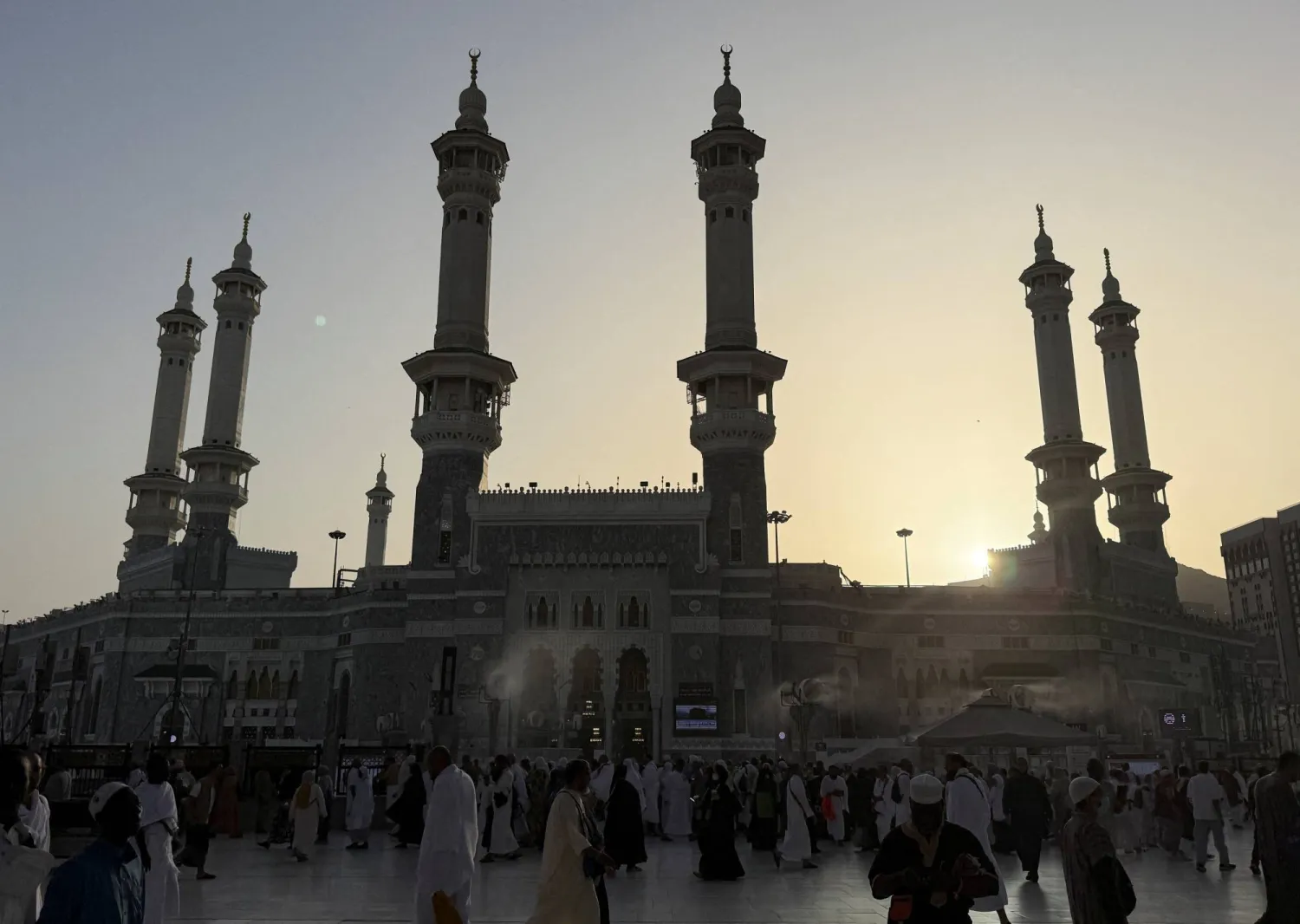

42,000 Iraqi Pilgrims Arrive in Makkah

Muslim pilgrims at the Grand Mosque complex, ahead of the annual hajj pilgrimage, in the holy city of Makkah, Saudi Arabia, May 22, 2026. Picture taken with a mobile phone. REUTERS/Ibraheem Abu Mustafa
TT

42,000 Iraqi Pilgrims Arrive in Makkah

Muslim pilgrims at the Grand Mosque complex, ahead of the annual hajj pilgrimage, in the holy city of Makkah, Saudi Arabia, May 22, 2026. Picture taken with a mobile phone. REUTERS/Ibraheem Abu Mustafa

Sami al-Masoudi, head of Iraq’s High Commission for Hajj and Umrah, said 42,000 Iraqi pilgrims have arrived in Saudi Arabia, praising the Kingdom’s efforts to ensure pilgrims’ comfort through a wide range of services and facilities aimed at helping worshippers perform their rituals with ease.

Al-Masoudi told Asharq Al-Awsat that the arrival of Iraqi pilgrims came amid early and well-organized preparations following directives from Saudi Arabia’s Ministry of Hajj and Umrah, which called for readiness across all sectors, including accommodation, catering, services at the holy sites, and internal and external transportation, to guarantee pilgrims’ comfort and the smooth performance of rituals.

One of the most notable features of this year’s Hajj season for Iraqi pilgrims is the adoption of sacrificial offerings services through the electronic platform after they became managed under the Saudi Project for Utilization of Hady and Adahi, a step al-Masoudi described as “qualitative.”

“It reflects the level of development and organization within the Hajj system,” he said.

“Today, all contracts, including sacrificial offerings, are completed electronically, which has helped simplify procedures, reduce bureaucracy and improve the level of services provided to pilgrims,” he added.

The Saudi Project for Utilization of Hady and Adahi is one of the initiatives of the Royal Commission for Makkah City and Holy Sites.

The project aims to facilitate the performance of Hady and expiation rituals for pilgrims and enable Muslims worldwide to carry out sacrifices, charity donations and aqiqah on their behalf, while distributing the meat to eligible beneficiaries inside and outside the Kingdom.

Al-Masoudi also highlighted the major transformation and development projects supported by artificial intelligence technologies that Saudi Arabia has deployed to serve pilgrims.

“Year after year, we witness continuous progress and major efforts by the Saudi Ministry of Hajj and Umrah and supporting agencies in the Kingdom, especially in automation and digital transformation, which directly improve pilgrims’ comfort and the quality of services provided to them,” he said.

Saudi Arabia has consistently worked to improve services for pilgrims arriving from around the world through projects that are upgraded and expanded annually, reflecting the leadership’s commitment to serving pilgrims and Umrah performers, enhancing service quality and enriching their religious experience in line with the goals of Saudi Vision 2030.

The first groups of Iraqi pilgrims began arriving in the Kingdom through the al-Haditha border crossing in al-Qurayyat and the Jadidat Arar crossing, where entry procedures were completed smoothly within minutes under an integrated service system designed to ease the burden of long-distance travel and provide a more comfortable and reassuring experience for pilgrims traveling by land to Makkah.

Expressions of gratitude were evident among Iraqi pilgrims, many of whom described the reception as “beyond expectations,” saying the welcome they received upon entering the Kingdom gave them a sense of comfort and reassurance even before reaching the holy sites.



Saudi Arabia Urges Security Council to Adopt Firm Stance on Houthi Attacks

Saudi Arabia’s Permanent Representative to the United Nations Ambassador Dr. Abdulaziz Alwasil (United Nations file photo)
TT

Saudi Arabia Urges Security Council to Adopt Firm Stance on Houthi Attacks

Saudi Arabia’s Permanent Representative to the United Nations Ambassador Dr. Abdulaziz Alwasil (United Nations file photo)

Saudi Arabia has strongly condemned the terrorist and criminal attacks launched by Yemen’s Houthis against civilian and economic facilities in the cities of Abha, Khamis Mushait, Jazan, and Najran, which injured 73 civilians, including women and children.

This came in a speech delivered by Saudi Arabia’s Permanent Representative to the United Nations Ambassador Dr. Abdulaziz Alwasil during an emergency session of the UN Security Council convened to discuss the Houthi militia’s attacks against the Kingdom.

Alwasil warned of the seriousness of the Houthi escalation and its repercussions for regional security. He stressed that the attacks threaten not only the Kingdom’s security, citizens, and assets, but also international navigation and trade in the Red Sea and the Bab al-Mandab Strait.

He called on the UN Security Council to adopt a clear, firm stance on these attacks and fulfill its responsibility to maintain international peace and security.

He also stressed the need to ensure the full implementation of relevant Security Council resolutions and to halt all forms of support that enable the Houthi militia to continue its hostile actions and attacks, which threaten regional security and international shipping lanes.

Alwasil reaffirmed the Kingdom’s legitimate right to defend itself and protect its security, sovereignty, citizens, residents, and national assets, in line with the UN Charter and international law.

He stressed the Kingdom’s steadfast position regarding Yemen, based on preserving its unity, sovereignty, independence, and territorial integrity.

He stressed the Kingdom’s continued support for a comprehensive, sustainable, Yemeni-led political solution to the Yemeni crisis that achieves security and stability and fulfills the aspirations of the Yemeni people.


Saudi Arabia Condemns Israeli Prime Minister's Illegal Entry into Syria

Saudi Arabia Condemns Israeli Prime Minister's Illegal Entry into Syria
TT

Saudi Arabia Condemns Israeli Prime Minister's Illegal Entry into Syria

Saudi Arabia Condemns Israeli Prime Minister's Illegal Entry into Syria

The Ministry of Foreign Affairs expressed Saudi Arabia's strongest condemnation and denunciation of the Israeli prime minister's illegal entry into Syria in a flagrant violation of its sovereignty and territorial integrity, and a blatant breach of international law, SPA reported.

The Kingdom stressed the importance of halting Israeli violations and transgressions against Syrian territory and adhering to the 1974 Disengagement Agreement, in a manner that preserves the security and stability of the region.

The Kingdom also reiterated its support for the sovereignty and territorial integrity of Syria.


OIC Permanent Human Rights Commission Condemns Houthi Militia’s Terrorist Attacks on Civilians in Saudi Arabia

OIC Permanent Human Rights Commission Condemns Houthi Militia’s Terrorist Attacks on Civilians in Saudi Arabia
TT

OIC Permanent Human Rights Commission Condemns Houthi Militia’s Terrorist Attacks on Civilians in Saudi Arabia

OIC Permanent Human Rights Commission Condemns Houthi Militia’s Terrorist Attacks on Civilians in Saudi Arabia

The Independent Permanent Human Rights Commission of the Organization of Islamic Cooperation (OIC) strongly condemned the continued cross-border terrorist attacks carried out by the Houthi militia.

The commission said the attacks deliberately target civilians, including women and children, as well as civilian assets and critical energy infrastructure in Saudi Arabia.

The commission expressed solidarity with Saudi Arabia and its people, stressing the need to protect the safety and security of civilians at all times. It described the Houthi attacks as a flagrant violation of international humanitarian law, SPA reported.

It also warned that repeated attacks endangering civilians have serious implications for fundamental human rights, particularly the rights to life, security, and physical integrity, and threaten regional peace and stability.

The commission reaffirmed Saudi Arabia’s right and responsibility under international law to protect its population and civilian infrastructure from unlawful terrorist attacks. It stressed the need to hold the Houthi militia accountable for its grave violations of international law.

The commission also called on the international community, the United Nations, and relevant international and regional mechanisms to unequivocally condemn Houthi attacks against civilians and civilian infrastructure and intensify diplomatic efforts to prevent their recurrence and escalation.