

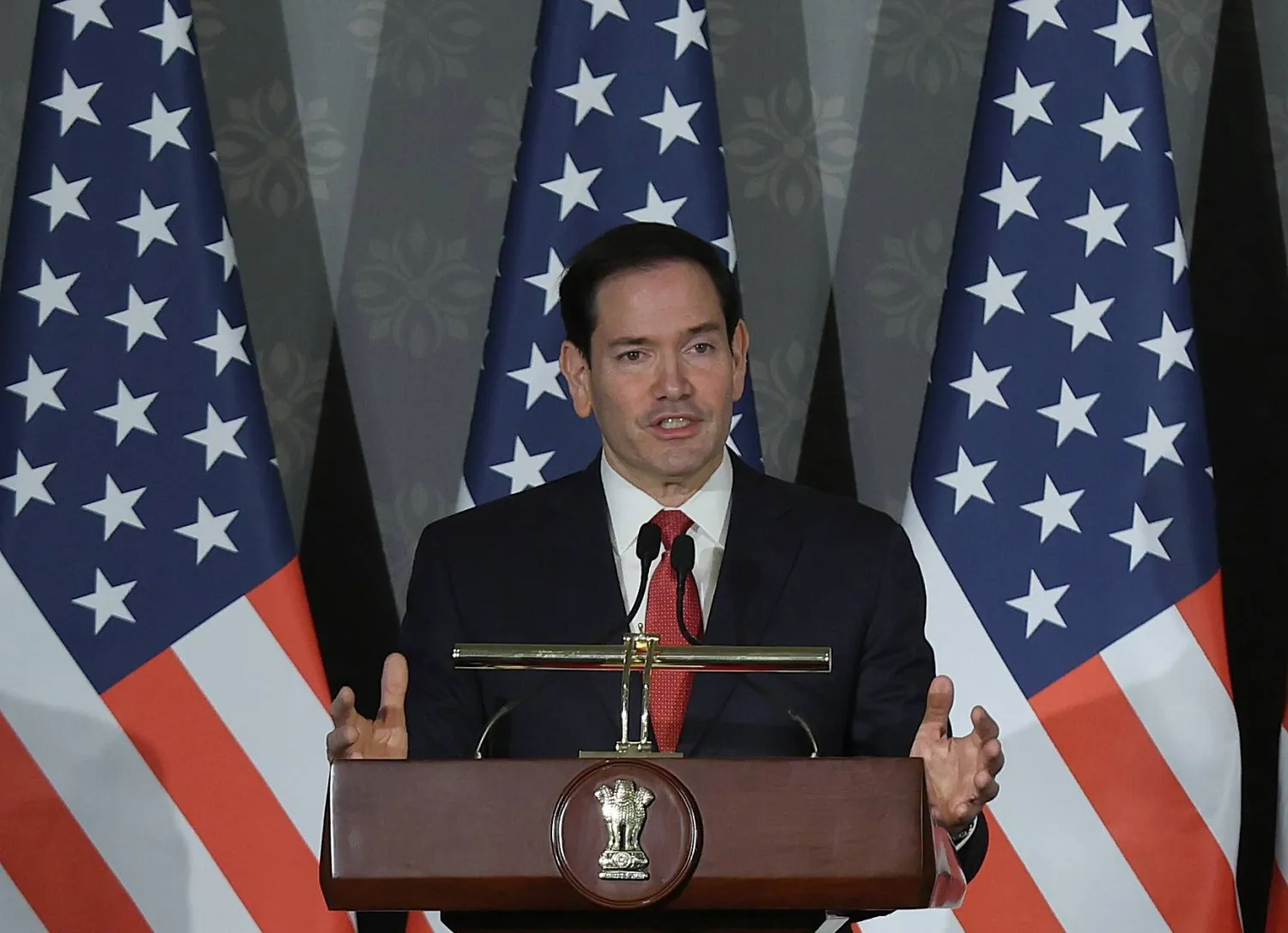

Rubio Accuses Hezbollah of Trying to 'Drag Lebanon Back into Chaos'

US Secretary of State Marco Rubio addresses a press conference with Indian External Affairs Minister Subrahmanyam Jaishankar (not pictured) at Hyderabad House in New Delhi, India, 24 May 2026. EPA/RAJAT GUPTA
TT

Rubio Accuses Hezbollah of Trying to 'Drag Lebanon Back into Chaos'

US Secretary of State Marco Rubio addresses a press conference with Indian External Affairs Minister Subrahmanyam Jaishankar (not pictured) at Hyderabad House in New Delhi, India, 24 May 2026. EPA/RAJAT GUPTA

US Secretary of State Marco Rubio accused Hezbollah in a statement Sunday of trying to plunge Lebanon "back into chaos."

Rubio denounced what he called Hezbollah's "reckless call to overthrow Lebanon's democratically elected government" and said the pro-Iran armed group was "actively trying to drag Lebanon back into chaos and destruction."

Naim Qassem, the leader of Hezbollah, said earlier that "the people have the right to go down onto the streets and to bring down the government" in response to Israeli strikes and US sanctions on the Al-Qard Al-Hassan financial institution.

Al-Qard Al-Hassan is affiliated with Hezbollah and provides interest-free loans to mainly Shia Muslim communities who have faced financial difficulty amid Lebanon's economic crises.

"The aggression against Al-Qard al-Hassan is an aggression against hundreds of thousands of poor people and those with limited income," Qassem said.

The Lebanese government has been under US pressure to take action against the firm, as Washington ratchets up pressure on Iran-backed Hezbollah.

"Hizballah's threats of violence and overthrow will not be allowed to succeed," Rubio said. "The era in which a terrorist group held an entire nation hostage is coming to an end."

The US is negotiating a deal with Iran to end the Middle East war, with a report in Axios suggesting that a draft memorandum of understanding between two sides contains language that "makes clear the war between Israel and Hezbollah in Lebanon would end."

Early on Sunday, Israeli Prime Minister Benjamin Netanyahu said on X that Trump, in a phone call, "reaffirmed Israel's right to defend itself against threats on every front, including Lebanon."

Qassem expressed hope for an agreement between Iran and the US and that Lebanon would be part of its terms.

However, he again called on the Lebanese government to abandon direct negotiations with Israel. A fourth round of talks is scheduled for June 2 and 3 in Washington.

Despite a ceasefire that came into effect on April 17 and was recently extended for several weeks, Israel continues to strike what it describes as pro-Iranian Hezbollah targets in Lebanon, while Hezbollah for its part continues its attacks on Israeli targets in the south of the country.



As Iran Diplomacy Picks Up, Rubio Tours Taj Mahal

United States Secretary of State Marco Rubio poses with his wife, Jeanette Rubio, during their visit to the Taj Mahal in Agra, India, Monday, May 25, 2026. Pool via Reuters
TT

As Iran Diplomacy Picks Up, Rubio Tours Taj Mahal

United States Secretary of State Marco Rubio poses with his wife, Jeanette Rubio, during their visit to the Taj Mahal in Agra, India, Monday, May 25, 2026. Pool via Reuters

As diplomacy intensifies on ending the Iran war, top US diplomat Marco Rubio was spending Monday not in negotiations but at India's world-famous monument to love, the Taj Mahal.

Rubio, on his first-ever visit to India, flew to Agra and spent 45 minutes at the Taj Mahal with his wife Jeanette, who usually shuns the spotlight.

"It's one of the wonders of the world," Rubio said of the Taj Mahal.

"I think it's important to show respect to the culture of the countries that you visit."

Under a blazing sun in 40C heat, Rubio removed the tie from his navy-blue suit, put his arm around Jeanette, who wore a flowing dress with elegant heels.

The couple posed for pictures on the bench from where Princess Diana was photographed alone in an iconic 1992 shot.

The US ambassador to India, Sergio Gor, a high-octane former aide to President Donald Trump, smiled and eagerly joined some of the couple's pictures.

The normally teeming street leading to the Taj Mahal were cleared for Rubio, with other tourists kept 100 meters away from him -- although it was only a partial shutdown unlike when Vice President JD Vance visited.

Rubio was not entirely away from Iranian influence at the Taj Mahal, whose domes and four-way charbagh gardens are heavily influenced by Persian architecture.

The Taj Mahal was built in the 17th century on orders of Mughal emperor Shah Jahan as a mausoleum for his beloved wife Mumtaz Mahal who died in childbirth.

The excursion is unusual for Rubio, who in nearly a year and a half on the job has preferred short, business-like trips and rarely done events outside of government meetings.

Rubio said he was taking advantage of a one-day break in his schedule before a meeting in New Delhi on Tuesday of the Quad -- Australia, India, Japan and the United States.

He will also visit the palace-filled city of Jaipur on Monday to tour the Amber Fort.

Rubio is visiting four cities over four days in India as he seeks to revive ties with a country successive US administrations saw as a like-minded partner in a world dominated by China's rise.

Trump has shaken up that approach since returning to office, temporarily imposing high tariffs, warming to both China and India's historic adversary Pakistan, curbing visas used by Indian professionals and reposting insulting language about Indian immigrants.

Trump, in remarks Sunday by speakerphone to a celebration in New Delhi for the 250th anniversary of US independence, insisted he was on board with the relationship, telling the crowd, "we've never been closer to India, and India can count on me 100 percent".


More and More Plastic Surgeons Are Being Asked to Create an ‘AI Face’

Surgeons have noticed consistencies in the aesthetics of “AI face”. (Shutterstock)
TT

More and More Plastic Surgeons Are Being Asked to Create an ‘AI Face’

Surgeons have noticed consistencies in the aesthetics of “AI face”. (Shutterstock)

Plastic surgeons are increasingly concerned about the rise of “AI face”, as more and more clients arrive in their offices with unrealistic AI-generated visions of what they want to look like, according to The Guardian.

People using AI chatbots to generate their ideal faces are increasingly arriving at surgeons’ offices with briefs demanding flawless skin, sharply sculpted cheekbones, refined noses and near-perfect symmetry – standards that are too time consuming, prohibitively expensive and, in many cases, physically unattainable.

While AI can control every single pixel, “surgery certainly doesn’t work on that microscopic detailed level,” said Dr. Alex Karidis, a surgeon based in west London.

For many clients, however, those expectations are shaped long before they ever meet a surgeon. Karidis and Nugent describe how psychologically effective AI-generated images can be in defining – and reinforcing – clients’ aesthetic ideals.

Dr. Nora Nugent, a cosmetic surgeon from Tunbridge Wells, said: “Once you see an image, it’s wired into you.” Karidis agreed, describing AI images as being “seared” into patients’ minds, and said colleagues had recently been inundated with them.

Surgeons are also keen to emphasize that cosmetic surgery outcomes are far from guaranteed.

“The patient has to understand that there is human variation in how they heal, how they age and what can be done,” said Nugent. “I say to patients beforehand: it’s not limitless what I can do in surgery. Neither of us control everything.”

Surgeons have also noticed consistencies in the aesthetics of “AI face”, particularly hyper-symmetry – something AI can generate effortlessly, but which is often impossible to recreate in real life.

If one of your eyes is a few millimeters higher than the other, AI can alter that in seconds, according to Dr. Julian de Silva, a Harley Street cosmetic surgeon. But rearranging pixels is not the same as rearranging anatomy.

“It’s impossible to change [eye level] because that’s actually set in bone, and your brain sits behind the orbits. You cannot safely change the position of the orbits,” he said.

De Silva added that when AI edits a client’s photo, it frequently defaults to widely accepted beauty ideals: for women, a V-shaped jawline, a sweeping “ogee curve” along the cheekbones and a heart-shaped face; for men, broader jawlines, lower eyebrows and fuller upper eyelids.

But De Silva is also concerned about another growing trend: clinicians sharing surgery results on social media that appear astonishingly effective, but which he suspects may themselves be AI-generated.

“I remember looking at one of these last week and I looked at it over and over,” he said, recalling a video in which a patient appeared to have been made to look 30 years younger. “And then the third time I watched it, I could see ... the hands had six fingers.”


Vessels Carrying Middle East Oil, LNG Exit Hormuz, Head for Pakistan, China

Vessels in the Strait of Hormuz, Iran, May 22, 2026. Majid Asgaripour/WANA (West Asia News Agency) via Reuters
TT

Vessels Carrying Middle East Oil, LNG Exit Hormuz, Head for Pakistan, China

Vessels in the Strait of Hormuz, Iran, May 22, 2026. Majid Asgaripour/WANA (West Asia News Agency) via Reuters

Two liquefied natural gas tankers are exiting the Strait of Hormuz on Monday, heading to ‌Pakistan and China, while a supertanker with Iraqi crude for China left the Gulf on Saturday after being stranded for nearly three months, shipping data showed.

The US-Israeli war on Iran that began on February 28 has severely curtailed shipping through the Strait of Hormuz, through which around one-fifth of the world's supply of oil and LNG normally flows.

The vessels are among a handful of supertankers exiting the Gulf this month via a transit route ⁠that Iran has ordered ships to use. Last week, three Very Large Crude Carriers (VLCCs) made their way to China and South Korea with 6 million barrels of crude, according to Reuters.

LNG tanker Fuwairit is crossing the Strait of Hormuz on Monday and is expected to discharge its cargo in Pakistan on Tuesday, shipping data on LSEG and Kpler showed. The vessel, sailing under the Bahamas flag, loaded LNG at Qatar's Ras Laffan port around March 28.

Separately, the VLCC Eagle Verona, which exited the strait on Saturday, is expected to reach Ningbo port in eastern China on June 12 to discharge its cargo, ⁠shipping data on LSEG and Kpler showed.

The Singaporean-flagged vessel chartered by Unipec, the trading arm of Asia's largest refiner, Sinopec, loaded nearly 2 million barrels of Basrah crude around February 26, according to the data.

The Eagle Verona was among seven ships Malaysia had sought ⁠permission from Iran to transit, two sources earlier told Reuters. Five of the ships have since exited the waterway, while two more remain in the Gulf.

Before the war began, shipping traffic through the strait averaged 125 to 140 daily passages. Some 20,000 seafarers remain stranded inside the Gulf on board hundreds of ships.