

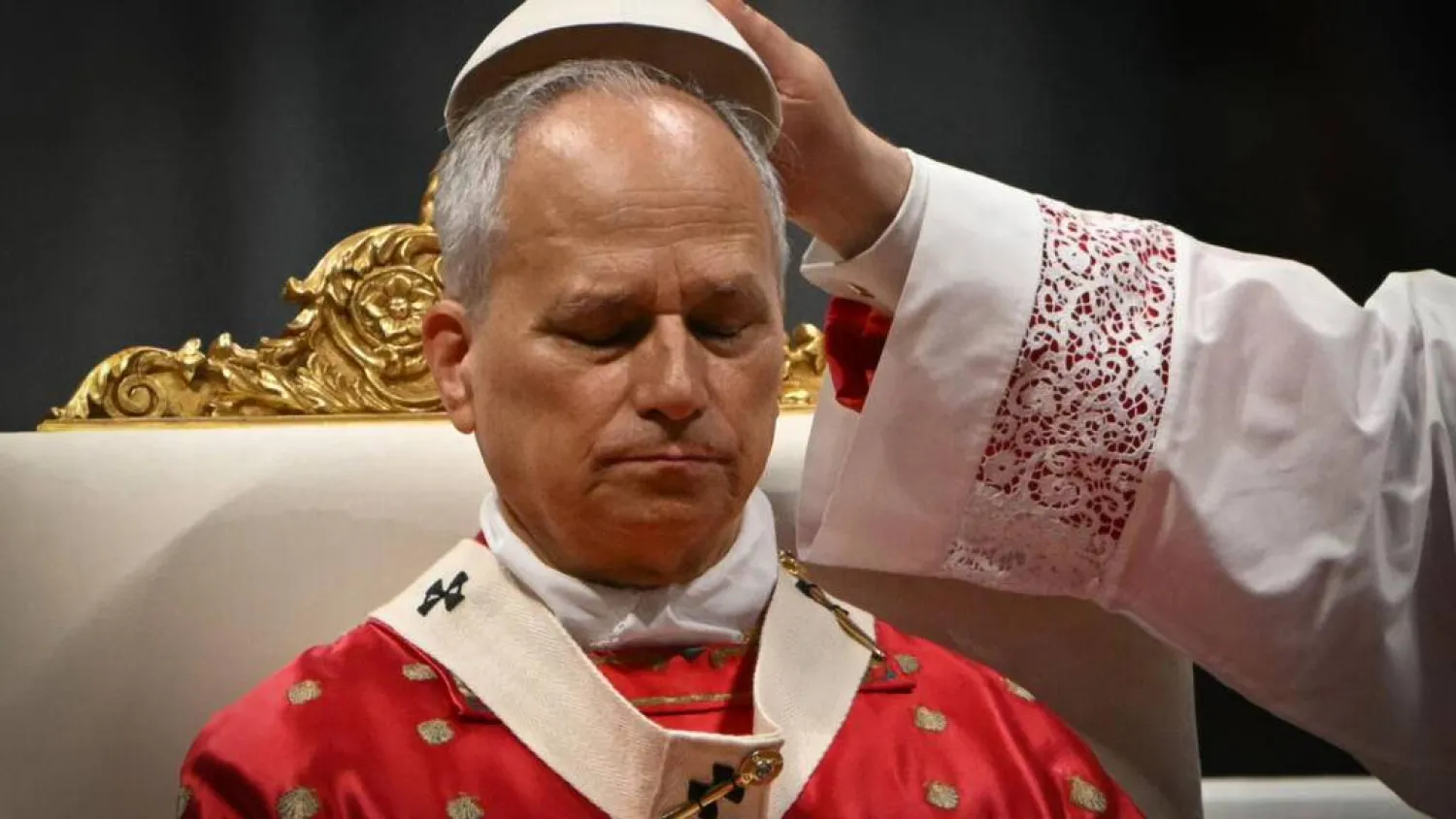

Pope Urges ‘Disarming’ of Artificial Intelligence in Major Manifesto

Leo has denounced the race for AI in the military field. Andreas SOLARO / AFP
TT

Pope Urges ‘Disarming’ of Artificial Intelligence in Major Manifesto

Leo has denounced the race for AI in the military field. Andreas SOLARO / AFP

Pope Leo XIV called Monday for the "disarming" of artificial intelligence in his long-awaited manifesto on the rapidly developing technology, and warned of "new forms of slavery" behind its rise. 

The "just war" theory -- espoused recently by the Trump administration -- was "outdated", Leo wrote in his first encyclical, which he presented in person at the Vatican, alongside AI experts including the co-founder of US giant Anthropic. 

The first US pope, who has clashed with the White House over the Iran war and its use of religion to justify conflict, sounded the alarm over AI-directed weaponry, saying it was "not permissible to entrust lethal" decisions to tech. 

American giant Anthropic, which has staked its position as an ethical AI company, is embroiled in a legal battle with the US military after opposing the use of its technology for lethal autonomous warfare or mass surveillance. 

Without naming US President Donald Trump, Leo stressed it was "important to reaffirm that the 'just war' theory, which has all too often been used to justify any kind of war, is now outdated". 

"No algorithm can make war morally acceptable," he added. 

- 'Armed competition' - 

AI could be worth up to $4.8 trillion by 2033, a 25-fold increase in a decade, while concentrating its profits in the hands of a limited few, according to the United Nations. 

"Disarming AI means freeing it from the mentality of 'armed' competition," the pope wrote in "Magnifica Humanitas" (Magnificent Humanity), a bid to address the ethical and social challenges behind AI. 

He slammed "a race for ever more powerful algorithms and larger datasets, driven by the desire to secure geopolitical or commercial dominance". 

"To disarm does not mean rejecting technology, but preventing it from dominating humanity," Leo wrote. 

AI should be "human-friendly", accessible to all and open to discussion and debate, he added. 

The head of the world's 1.4 billion Catholics has made the hot-button issue a cornerstone of his papacy by dedicating to it his first encyclical -- a document which lays the basis for Church teaching and longer-term debate. 

The manifesto references a range of cultural giants, from Greek philosopher Plato to Beethoven and his Ninth Symphony, even citing a character from JRR Tolkien's "The Lord of the Rings". 

- 'Not magical' - 

"Magnifica Humanitas" was signed on May 15, the 135th anniversary of a 1891 encyclical by Leo XIII which laid the foundations of the Church's social doctrine during the Industrial Revolution. 

Leo warned of new forms of slavery fueling the technological revolution, noting "nothing in the world of AI is immaterial or magical". 

"Every seemingly immediate and flawless response... relies on the silent work of millions of people", from content moderators forced to watch disturbing material, to children who extract the rare earth elements on which AI depends. 

They are "scarred, injured and worn down so that computational flow may continue uninterruptedly", he wrote. 

Greater efficiency or innovation did not excuse "a chain of exploitation that remains deliberately hidden", he wrote, while more must be done to reduce AI's environmental impact and "protect our common home". 

The release of the text follows several years of study by the Church on AI-related technologies. 

As early as 2020, the Holy See launched the "Rome Appeal for an AI Ethic", which called for new technologies to respect human dignity. 

Experts say "Magnifica Humanitas" could prove as influential as Pope Francis's "Laudato Si", a 2015 climate manifesto that triggered political and civic reactions worldwide. 


Kremlin Rejects US Claim Ukrainian Strikes Will Help End War

Smoke rises in the city during a Russian missile strike, amid Russia's attack on Ukraine, in Kyiv, Ukraine July 8, 2026. (Reuters)
TT

Kremlin Rejects US Claim Ukrainian Strikes Will Help End War

Smoke rises in the city during a Russian missile strike, amid Russia's attack on Ukraine, in Kyiv, Ukraine July 8, 2026. (Reuters)

Russia on Thursday hit out at the United States saying Ukrainian strikes on Russian energy sites could help end the war between Moscow and Kyiv.

Ukraine has mounted a retaliatory strike campaign using long-range drones against Russian energy and military facilities, in what Kyiv calls fair retribution for Moscow's drone and missile barrages on Ukrainian cities.

Asked about the strikes during a meeting with Ukrainian President Volodymyr Zelensky on Wednesday, US President Donald Trump appeared to endorse the campaign.

"It's an escalation, but it's also an escalation that can help lead to an end," Trump said.

US Secretary of State Marco Rubio similarly expressed hope the Ukrainian strikes would "create the space now to negotiate the end of this war" that started with Russia's 2022 invasion of Ukraine.

The Kremlin on Thursday said Ukrainian military pressure would not force it into concessions.

"We see certain misconceptions within the White House administration -- that by escalating military pressure it can help move to a peace settlement. That is a mistaken view," Kremlin spokesman Dmitry Peskov told reporters, including AFP.

"Further escalation may prolong the special military operation to some extent," he said, using Russia's preferred term for the offensive.

He also threatened that Moscow's army would respond by "creating a larger security zone" -- a reference to seizing more territory in eastern Ukraine.

Kyiv's attacks on Russian oil depots and refineries have triggered a fuel crisis across Russia, forcing Moscow -- one of the world's top oil producers -- to ban some exports.

More than 90 percent of all Russian regions have introduced some form of rationing or reported shortages in petrol and diesel, according to official statements and local media reports.


Italy Expels 2 Russian Embassy Staff over Spying Case

30 June 2026, Italy, Rome: Carabinieri vehicles transport suspects from the operations unit on Via Selci to prison in Rome. Photo: Francesco Benvenuti/LaPresse via ZUMA Press/dpa
TT

Italy Expels 2 Russian Embassy Staff over Spying Case

30 June 2026, Italy, Rome: Carabinieri vehicles transport suspects from the operations unit on Via Selci to prison in Rome. Photo: Francesco Benvenuti/LaPresse via ZUMA Press/dpa

The Italian government has decided to expel two military attaches at the Russian Embassy in Italy who were allegedly involved in espionage activities, Foreign Minister Antonio Tajani said on Thursday.

Earlier this week, two ⁠people were arrested ⁠on charges of passing classified information to a Russian agent.

Prosecutors said the main suspect was ⁠a former officer of Italy's Carabinieri police force. Five other individuals are also under investigation.

Tajani said on social media platform X that the two Russian officials must leave Rome within three days.

He ⁠said Moscow continued to employ "hybrid tools" against Italy and the West, describing this as "serious and unacceptable interference" that threatens national security.

Russia's foreign ministry said it would respond to the Italian move.


600 Dead in DR Congo Ebola Outbreak

A health worker in personal protective equipment stands near displaced people waiting for the burial of suspected Ebola victims at the Kigonze displaced persons camp, one month after an outbreak was declared, in Bunia, eastern Democratic Republic of Congo, June 18, 2026. REUTERS/Gradel Muyisa Mumbere/File Photo
TT

600 Dead in DR Congo Ebola Outbreak

A health worker in personal protective equipment stands near displaced people waiting for the burial of suspected Ebola victims at the Kigonze displaced persons camp, one month after an outbreak was declared, in Bunia, eastern Democratic Republic of Congo, June 18, 2026. REUTERS/Gradel Muyisa Mumbere/File Photo

The Ebola outbreak in the Democratic Republic of Congo has now claimed 600 lives, figures published by the World Health Organization showed Thursday -- only three days after the figure topped 500.

Updated numbers issued by the UN health agency showed there have been 1,759 confirmed cases in DR Congo since the outbreak was declared in mid-May, including 600 confirmed deaths.

Two other people have died in neighboring Uganda, where 17 patients have recovered out of 20 total confirmed cases.

The WHO's figures for the DRC, which come from the health authorities in the vast country, show that the outbreak there has a case fatality rate of 34 percent, AFP reported.

A total of 285 patients in the DRC have recovered, while 304 suspected cases of the viral hemorrhagic fever are under investigation.

The outbreak in northeastern DRC has hit four provinces but is focused on Ituri province.

The outbreak is being driven by the rare Bundibugyo species of Ebola, for which there are no approved vaccines or treatments.

The trial of two potential treatments for Bundibugyo began in the DRC on July 2.

The trial is evaluating the effectiveness of the monoclonal antibody MBP134 and the antiviral drug remdesivir, alone and in combination.

Ebola spreads through close contact and infected bodily fluids.

The DRC's 17th Ebola outbreak was declared on May 15 after several deaths in mineral-rich Ituri province, which is plagued by armed groups.
