
Israel PM Says Orders Army to Take Control of 70 Percent of Gaza Strip

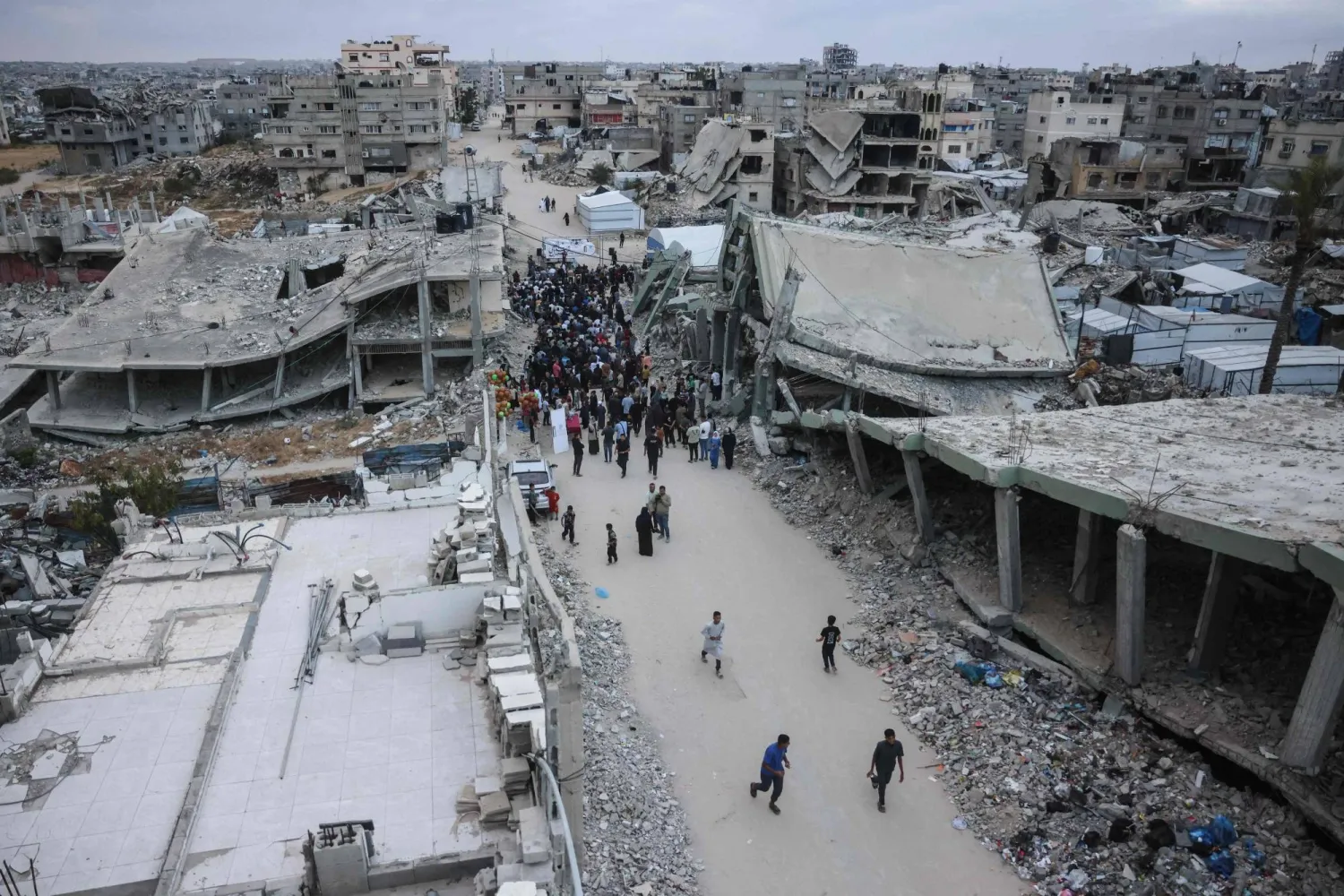
Palestinians gather on a heavily damaged street to perform morning prayers marking the start of Eid al-Adha in Khan Younis in the southern Gaza Strip on May 27, 2026. (AFP)
TT

Israel PM Says Orders Army to Take Control of 70 Percent of Gaza Strip

Palestinians gather on a heavily damaged street to perform morning prayers marking the start of Eid al-Adha in Khan Younis in the southern Gaza Strip on May 27, 2026. (AFP)

Israeli Prime Minister Benjamin Netanyahu said Thursday he had ordered the country's military to take control of 70 percent of the Gaza Strip, in defiance of the terms of a fragile ceasefire that took effect in October.

"We are currently squeezing Hamas. We now control 60 percent of the territory in the strip," he said at a conference in an occupied West Bank settlement, according to a video aired by Israel's Channel 12 network.

He said the military had controlled 50 percent of Gaza under the terms of the ceasefire, adding: "My directive is to move to... 70 percent".

"We're squeezing them from all (sides). We'll deal with what's left afterwards."

The first phase of the truce saw the last hostages seized in Hamas's October 7, 2023 attacks on Israel, which triggered the war in Gaza, released in exchange for Palestinians detained by Israel.

The transition to the second phase, which was supposed to involve Hamas's disarmament and a gradual withdrawal of the Israeli army, has been stalled for months.

Under the terms of the ceasefire, Israeli forces were to pull back behind a so-called "yellow line", a demarcation between the area under Hamas control and that held by the Israeli army.

Netanyahu announced on May 15 that the Israeli army had expanded its grip on the Gaza Strip.

"There were those who said: get out, get out. We did not get out. Today we control... how much? 60 percent. Tomorrow we shall see," he said at the time.

Gaza remains gripped by daily violence, with both the Israeli military and Hamas accusing one another of violating the truce in effect since October 10.

Israel has killed more than 900 people since the ceasefire, according to Gaza's health ministry, which operates under Hamas authority and whose figures are considered reliable by the United Nations.

Israel said on Wednesday it had killed the new head of Hamas's armed wing in Gaza, Mohammed Odeh, after killing his predecessor earlier this month.

Since Hamas's October 2023 attack, Israel has systematically targeted the group's leaders, both in Gaza and across the region.

Odeh is the fourth head of the Ezzedine Al-Qassam Brigades that Israel says it has killed since the start of the Gaza war.

On Wednesday, Israeli Defense Minister Israel Katz repeated Israel's goal of ending Hamas's rule over the Palestinian territory and alluded to a plan for the forced displacement of its residents.

"The plan for voluntary migration from Gaza will also be implemented -- everything will be done at the right time and in the right way," he said.


Israeli Official: Israel in Talks with US over Continuing its Lebanon Troop Deployment

FILE PHOTO: Smoke rises following an Israeli strike on the southern suburbs of Beirut, as seen from Baabda, Lebanon, April 8, 2026. REUTERS/Mohamed Azakir/File Photo
TT

Israeli Official: Israel in Talks with US over Continuing its Lebanon Troop Deployment

FILE PHOTO: Smoke rises following an Israeli strike on the southern suburbs of Beirut, as seen from Baabda, Lebanon, April 8, 2026. REUTERS/Mohamed Azakir/File Photo

Israel is holding negotiations with the US as it seeks to continue its deployment of troops in southern Lebanon, two Israeli officials including a senior Israeli official close to Prime Minister Benjamin Netanyahu told Reuters on Thursday.

The officials, who spoke on condition of anonymity to discuss the sensitive talks, made the comments a day after the US and ‌Iran signed ‌an interim pact that calls ‌for ⁠parties to ensure "the territorial ⁠integrity and sovereignty of Lebanon."

Israel expanded its invasion of southern Lebanon after the Lebanese militia Hezbollah opened fire at Israel on March 2 in support of its ally Iran. It has since staged a devastating ⁠air and ground campaign that it says ‌aims at rooting ‌out Hezbollah.

Israel describes the territory it has seized ‌in Lebanon, Gaza and Syria as "buffer zones" between ‌it and its enemies, a core facet of Israel's recent security policy. Netanyahu has rejected calls for Israel to withdraw from those territories.

The senior ‌Israeli official told Reuters that Israel was "conducting stubborn negotiations" with Washington ⁠over continuing its ⁠deployment of troops in southern Lebanon.

The official said Israel would not back down on its positions, including keeping troops deployed in the area south of Lebanon's Litani River.

A second Israeli official told Reuters that the outcome of the talks would ultimately depend on whether US President Donald Trump "decides to force the issue" by threatening repercussions if Israel does not abide by the interim Iran pact's terms.

Netanyahu's office did not immediately respond to a request for comment.


Israel Military Says 1 Soldier Killed in Lebanon, 7 Injured

TOPSHOT - This picture taken from a position in the Upper Galilee in northern Israel, near the Israel-Lebanon border shows Israeli Merkava tanks driving along a road past destroyed buildings in southern Lebanon on June 17, 2026. (Photo by JACK GUEZ / AFP)
TT

Israel Military Says 1 Soldier Killed in Lebanon, 7 Injured

TOPSHOT - This picture taken from a position in the Upper Galilee in northern Israel, near the Israel-Lebanon border shows Israeli Merkava tanks driving along a road past destroyed buildings in southern Lebanon on June 17, 2026. (Photo by JACK GUEZ / AFP)

The Israeli military announced on Thursday that one of its soldiers had been killed in fighting in southern Lebanon the day before, in an incident that also wounded seven soldiers.

Master Sergeant Alexander Filin, 29, "fell in combat", the military said in a brief statement, adding that an officer, a reserve officer and a reserve soldier were moderately injured.

A combat non-commissioned officer, two reserve soldiers and a female reserve soldier were lightly injured, the military added.

The United States and Iran signed a memorandum of understanding on Wednesday meant to end the Middle East war, with fighting halted on all fronts, including in Lebanon.

Lebanon was drawn into the conflict when Tehran-backed Hezbollah fired rockets at Israel on March 2 in support of Iran.

Lebanon earlier said Israel's massive campaign of airstrikes and ground invasion has so far killed more than 3,800 people.

Israel's side saw 31 soldiers and one civilian contractor killed since March 2.


Lebanon to Transfer 129 Syrian Prisoners Next Week, Withholds Seven Over Security Concerns

Protesters in rural Homs last November demand the release of Syrian detainees held in Lebanese prisons (SANA). 
TT

Lebanon to Transfer 129 Syrian Prisoners Next Week, Withholds Seven Over Security Concerns

Protesters in rural Homs last November demand the release of Syrian detainees held in Lebanese prisons (SANA). 

Lebanon is set to transfer 129 convicted Syrian prisoners to Syrian authorities next week under a bilateral agreement signed in February, while withholding seven others pending further security reviews, a senior judicial source said.

The move reflects growing judicial and security cooperation between Beirut and Damascus after years of strained coordination. It also highlights Lebanon’s efforts to ease chronic prison overcrowding while ensuring that inmates deemed potential security risks are subjected to additional scrutiny before any transfer takes place.

The source told Asharq Al-Awsat that all legal procedures have been completed for the 129 prisoners, allowing them to be transferred to Syria to serve the remainder of their sentences. Seven other Syrian convicts have been excluded from the current transfer because their files contain security-related concerns that require further examination before a final decision is made on their status.

According to the source, Public Prosecutor Judge Ahmad Rami al-Hajj has completed his review of the lists of Syrian prisoners covered by the agreement and forwarded them to the Lebanese premiership for approval.

The Prime Minister’s Office is expected to issue a formal letter stating it has no objection to the names on the list, clearing the way for implementation.

Once that step is completed — likely within two or three days — the file will be referred to Justice Minister Adel Nassar, who will prepare and sign the final decision authorizing the transfer in accordance with the agreement.

The exact timing of the handover has not yet been determined. The source said the operation requires coordination among several security and administrative agencies.

After legal procedures are finalized, the Internal Security Forces will oversee the prisoners’ release from Lebanese jails and complete the necessary administrative and security paperwork. Lebanon’s General Security Directorate will then transport the prisoners to the Lebanese-Syrian border.

The prisoners will be handed over to a Syrian security team at the Masnaa border crossing in the Bekaa Valley under a mechanism agreed upon by the two countries.

The transfer program has become one of the most visible examples of renewed judicial cooperation between Lebanon and Syria. In March, Lebanon transferred 134 convicted Syrians, roughly a month after the agreement was signed, helping address cases that had remained unresolved for years.

The judicial source stressed that withholding some prisoners does not undermine or circumvent the agreement. Rather, it reflects the Lebanese authorities’ determination not to treat the matter as a purely administrative exercise.

Sensitive cases, particularly those involving security-related allegations or suspicions, require thorough judicial and security scrutiny, the source said.

The fate of the seven withheld prisoners will depend on the outcome of ongoing reviews and whether their cases warrant inclusion in a future third transfer or different legal measures.