


'AI Simply Can't Replicate It': Japan Embraces Zine Trend

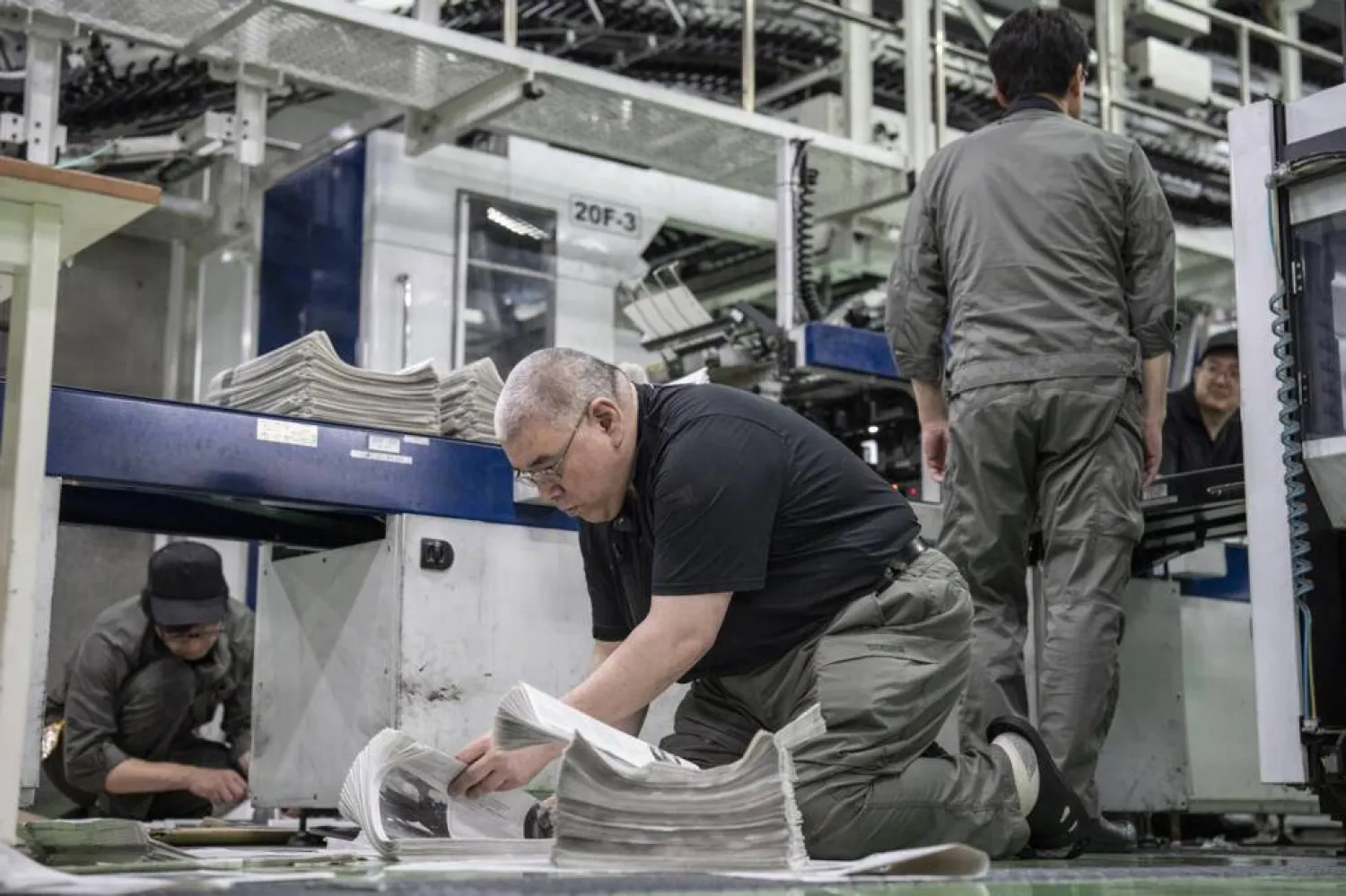
As the machine printed their work on newsprint paper, five technicians in uniform quickly flipped through the pages to check the quality. Yuichi YAMAZAKI / AFP
TT

'AI Simply Can't Replicate It': Japan Embraces Zine Trend

As the machine printed their work on newsprint paper, five technicians in uniform quickly flipped through the pages to check the quality. Yuichi YAMAZAKI / AFP

Through the noise of rushing papers and whirring belts at a print factory in Kyoto, two creators watch their photo essay come to life in broadsheet form -- part of an effort to win new audiences in the age of AI.

Despite the decline of the publishing industry, self-publication and handmade "zine" magazines are growing in popularity in Japan, reflecting the country's enduring love of paper in the digital era.

While speaking to AFP at the plant, his hands black with ink, one of the creators, Kazuma Obara said "I think (paper) is a medium that engages all five senses", unlike social media.

Obara and his creative partner Akihico Mori are among the latest artists to use a printing press offered by the Kyoto Shimbun newspaper, which is aiming to find alternative uses for its machines as subscriptions fall, AFP said.

As the machine printed their work on newsprint paper, five technicians in uniform quickly flipped through the pages to check the quality.

"I think print media is incredibly open. You can hand it to someone, you can read it together," 40-year-old photographer Obara said, calling mobile phones "very insular".

Mori, a 44-year-old writer, said people can "feel the creator's passion when they hold the work in their hands".

"I think that's what makes it so appealing, and AI simply can't replicate it."

- Rise of self-publishing -

The pair's work was later showcased at popular international photography festival Kyotographie that ended in May.

Yoshihiko Okazaki of Kyoto Shimbun Printing said the company's services have been used by artists ranging from teenagers to those in their 70s.

"Surprisingly, it resonates with younger people... I even hear comments like, 'it's interesting precisely because it's old'."

Japan has seen a rapid decline in print media, with book and magazine sales falling to just 40 percent of their 1996 pinnacle of 2.6 trillion yen ($16.3 billion).

Newspaper circulation peaked in 1997 at 53.76 million, but it dropped to more than half that in 2025, according to the Japan Newspaper Publishers & Editors Association.

Many authors and publishers around the world fear the trend will be accelerated by artificial intelligence and social media -- in the UK, a 2025 study showed that half of novelists believe AI is likely to replace their work.

However, like in other countries worldwide, do-it-yourself publication including zines -- which originated in the 1930s with sci-fi fans in the US -- is growing in Japan, especially among younger generations.

Public broadcaster NHK reported, citing one private research firm, the self-publishing market is estimated at 150 billion yen in the year ending March 2026, nearly double the figure four years ago.

- 'Something tangible' -

On one weekend in Tokyo, hundreds of visitors flocked to a zine fair showcasing a wide range of handmade magazines in different sizes and formats -- some incorporating abstract designs, photography or personal monologues.

"AI and social media are driven by algorithms that feed us nothing but what we want to see or what suits us best," said 22-year-old visitor Harumi Kikuchi.

"But the fact that many zine makers are here suggests there are many different worldviews."

Zine creator Watashi Kishino, who hand draws her daily life in black-and-white illustrations, said people can "make a lot of things with AI and digital technology".

"But I believe there's a charm in having something tangible to hold in your hands like this," Kishino said, showing her works.

Major bookstores are also embracing the trend as young people increasingly drift away from physical books.

Sanseido, a 145-year-old bookstore in Tokyo's book district Jimbocho, began putting zines on their shelves almost a year ago.

"We felt that zines could appeal to a different audience than traditional readers," Masato Sugiura, deputy head of the sales promotion unit, told AFP.

"Everyone is looking for something that really speaks to them. Readers are perhaps drawn more to zines, which are niche and cover a broader range of topics," he added.

Kishino remains hopeful that physical books and magazines will endure despite the digital age.

"There's warmth that only paper can offer," she said. "There's definitely people who are looking for that."



French Museum Reports Theft of Arty Banana

Italian visual artist Maurizio Cattelan's conceptual work 'Comedian' has sold for millions. TIMOTHY A. CLARY / AFP/File
TT

French Museum Reports Theft of Arty Banana

Italian visual artist Maurizio Cattelan's conceptual work 'Comedian' has sold for millions. TIMOTHY A. CLARY / AFP/File

A museum in eastern France on Sunday reported to police the theft of a banana that forms a core part of a multimillion-dollar artwork by Italian visual artist Maurizio Cattelan.

The missing fruit -- which was taped to a wall to form the provocative work by Cattelan called "Comedian" -- was noticed by a guard on Saturday to have gone missing.

The Pompidou-Metz museum, which is a branch of the famous Pompidou Center in Paris, said in a statement it had lodged a criminal complaint for theft against persons unknown.

It also said it had replaced the banana.

It is not the first time damage has been dealt to the conceptual artwork, whose perishable banana centerpiece is replaced every three days to keep it contemporary.

In July last year, a visitor to the museum ate the fruit. But guards quickly intervened and stuck up a replacement banana.

Cattelan said at the time he was disappointed the hungry visitor had consumed only the banana and not the tape as well. The museum did not take legal action in that instance.

This time, though, it decided to make its criminal complaint because the perpetrator was unidentified, and therefore "there is no possibility of dialogue".

It also said that "this is the second time this has happened" and it felt it was an issue of respect for the artwork.

Cattelan's edible creation, which aims to question the notion of art and its value, has sparked controversy ever since it made its debut at the 2019 Art Basel show in Miami Beach with an asking price of $120,000.

A performance artist, David Datuna, ate "Comedian" at that 2019 show, saying he felt "hungry".

But the work's value has only risen.

Chinese-born crypto founder Justin Sun in 2024 forked out $5.2 million for one iteration of the work, then days later ate it in front of cameras in Hong Kong.

As well as "Comedian", Cattelan is also known for producing an 18-carat, fully functioning gold toilet called "America" that was offered to Donald Trump during his first term in the White House.

A British court in March found two men guilty of stealing it during an exhibition in 2020 in the United Kingdom, from an 18th-century stately home that was the birthplace of wartime prime minister Winston Churchill.

It was split up into parts and none of the gold was ever recovered.


Patients Find Help with Therapy Donkeys at Psychiatric Hospital Near Paris

 Patients with mental health conditions participate in a therapy session involving donkeys at a psychiatric hospital in Neuilly-sur-Marne, in the eastern suburbs of Paris, Friday, May 29, 2026. (AP)
Patients with mental health conditions participate in a therapy session involving donkeys at a psychiatric hospital in Neuilly-sur-Marne, in the eastern suburbs of Paris, Friday, May 29, 2026. (AP)
TT

Patients Find Help with Therapy Donkeys at Psychiatric Hospital Near Paris

 Patients with mental health conditions participate in a therapy session involving donkeys at a psychiatric hospital in Neuilly-sur-Marne, in the eastern suburbs of Paris, Friday, May 29, 2026. (AP)
Patients with mental health conditions participate in a therapy session involving donkeys at a psychiatric hospital in Neuilly-sur-Marne, in the eastern suburbs of Paris, Friday, May 29, 2026. (AP)

Therapy donkeys are helping patients with mental health conditions recover in a psychiatric hospital unit outside Paris that's unique to France.

The 19th century farm buildings and wooded surroundings are a haven within the Ville-Evrard hospital complex in Neuilly-sur-Marne. On Friday, patients took the five donkeys for a walk and cared for them. Some confidently lifted their hooves to remove dirt. Many ended the session with a hug.

“When you take medication that helps you relax ... it’s exactly the same,” said Nathalie, a 60-year-old patient. She and others were identified by their first names only to protect their privacy.

“I’d call it animal medicine,” she said. “It brings relief. You stop thinking about everything else."

‘It helps you break away from the routine of treatment’

Patients attend the sessions free of charge as part of their treatment, which is funded by France’s public health system.

Participants are usually paired with a donkey — Nono, Pitou, Oscar, Manolo or Malraux. Over time, they become familiar with each other’s personalities.

Audrey Seffar, a nurse at the animal therapy unit, said Nathalie's progress after only a few sessions was significant.

“At first, she wouldn’t get out of the cart (provided for people with physical difficulties). But little by little, with encouragement, she did," Seffar said. "The animal serves as a mediator. It’s such an extraordinary one that today she was able to leave the cart and stand beside her donkey."

Another patient, Jérôme, 52, said the program helps reduce loneliness.

“Talking with people, taking part in activities I wouldn’t normally do, it helps me in my daily life,” he said.

He added: “It helps you break away from the routine of treatment and medication. Staying at home isn’t good for me.”

‘They’re emotional sponges’

The first donkeys arrived at Ville-Evrard hospital in 2016 as part of a project launched by Ermelinda and François Hadey.

Ermelinda, a nurse specializing in psychiatry, strongly believed in animal therapy benefits and thought donkeys, known for their calm and social nature, would be perfect. Her husband learned how to train donkeys for therapy work. Some of the animals were adopted through shelters after experiencing neglect or mistreatment.

“A donkey is very intelligent. It understands things very quickly, but you have to explain slowly,” François Hadey said. “Donkeys are calm, serene animals that are generally close to people. Once they’re involved in these interactions, they connect very well with patients. They’re emotional sponges.”

Since 2022, the animal therapy program has had official status as a health care unit in the hospital, allowing it to employ three full-time nurses. Volunteers with a nonprofit group help care for the animals.

The program has expanded to include guinea pigs, chickens, doves, goats, turtles and rabbits. Sessions are tailored to people’s needs and preferences, and smaller animals can be brought to hospital rooms.

Alicia Fabi, an 18-year-old nursing student, said the activity gives patients a chance to leave the hospital environment.

“Every time we come back from the activity, they say they feel good, calm and relaxed, and that they enjoyed the outing. That’s really positive,” she said.

Walking together also allows patients and health workers to develop a deeper relationship.

“We talk about many different things, their illness, their lives and just about everything else. We don’t focus only on the illness because we don’t want them dwelling on it all the time,” Fabi said.

They seek research into the benefits

Health workers say the sessions are designed as therapeutic interventions for living with anxiety, depression, autism, schizophrenia or other conditions. Staff said they can help improve emotional regulation, communication, social interaction and self-esteem.

“Everything we do with the animals allows us to work with the patient,” Ermelinda Hadey said. “We work on feeding the animal, which helps us address the patient’s own eating habits. We work on the animal’s hygiene, and by mirror effect, we work on the patient’s hygiene as well.”

Many patients take intensive treatments, including antipsychotic medications or sedatives, which can make it difficult to find the motivation to participate in activities, she said. That’s where the relationship to donkeys and other animals play a role, she stressed.

“It does not replace a doctor or a medical prescription, but it can help patients regain confidence and a sense of self-worth," Hadey said.

She said more scientific evaluation is needed. They would like animal therapy to be formally recognized by the psychiatric community as a complementary form of care.

“To do that, we need research. We have plenty of accounts from patients ... Caregivers who accompany them see the benefits every day as well. But doctors have so many other responsibilities that they don’t necessarily witness it firsthand,” she said.

At the end of Friday’s session, as patients chatted, a nurse summed up the program’s appeal: “Donkeys are my best colleagues.”


8 Crested Ibises Released in Japan Decades After Extinction

 A crested Ibis marked with painted wings flies as it was released into wild during an event in Hakui, Japan, Sunday, May 31, 2026. (Kazushi Kurihara/Kyodo News via AP)
A crested Ibis marked with painted wings flies as it was released into wild during an event in Hakui, Japan, Sunday, May 31, 2026. (Kazushi Kurihara/Kyodo News via AP)
TT

8 Crested Ibises Released in Japan Decades After Extinction

 A crested Ibis marked with painted wings flies as it was released into wild during an event in Hakui, Japan, Sunday, May 31, 2026. (Kazushi Kurihara/Kyodo News via AP)
A crested Ibis marked with painted wings flies as it was released into wild during an event in Hakui, Japan, Sunday, May 31, 2026. (Kazushi Kurihara/Kyodo News via AP)

Eight crested ibises were released into the wild in a north-central Japanese town, decades after the birds went extinct in the country.

Eight of the endangered birds took off from each of their wooden cages at a ceremony Sunday in Hakui city in the Noto region, where they were last seen in the wild.

The white birds, called Toki in Japan, are native to East Asia and admired for their orange-pink hues under their wings and bright red marks around their eyes.

Residents cheered when the birds soared into the sky the moment Crown Prince Akishino, his wife Kiko, and other officials cut a ribbon around the wooden cages.

The birds went extinct on the Honshu main island in the 1970s, threatened by overhunting and environmental degradation. The last remaining Japanese native ibis died in 2003 on Sado Island.

But the birds came back to life thanks to China’s support for breeding. In 1999, artificial breeding by a pair donated from China successfully led to the first Japanese crested ibis chick born in captivity, according to the Environment Ministry.

The breeding and conservation efforts have since helped the recovery of the birds’ population. In 2008, 10 of the birds raised at the Sado conservation center were released into the wild on the island, where their population has increased to around 500, the ministry says.

The release of the beloved birds was also seen as a good omen for the Noto region, which is still recovering from the deadly 2024 earthquake.

The eight birds have been raised and protected at a conservation center on Sado in the neighboring prefecture of Niigata. Ten more birds are waiting to be released.
