

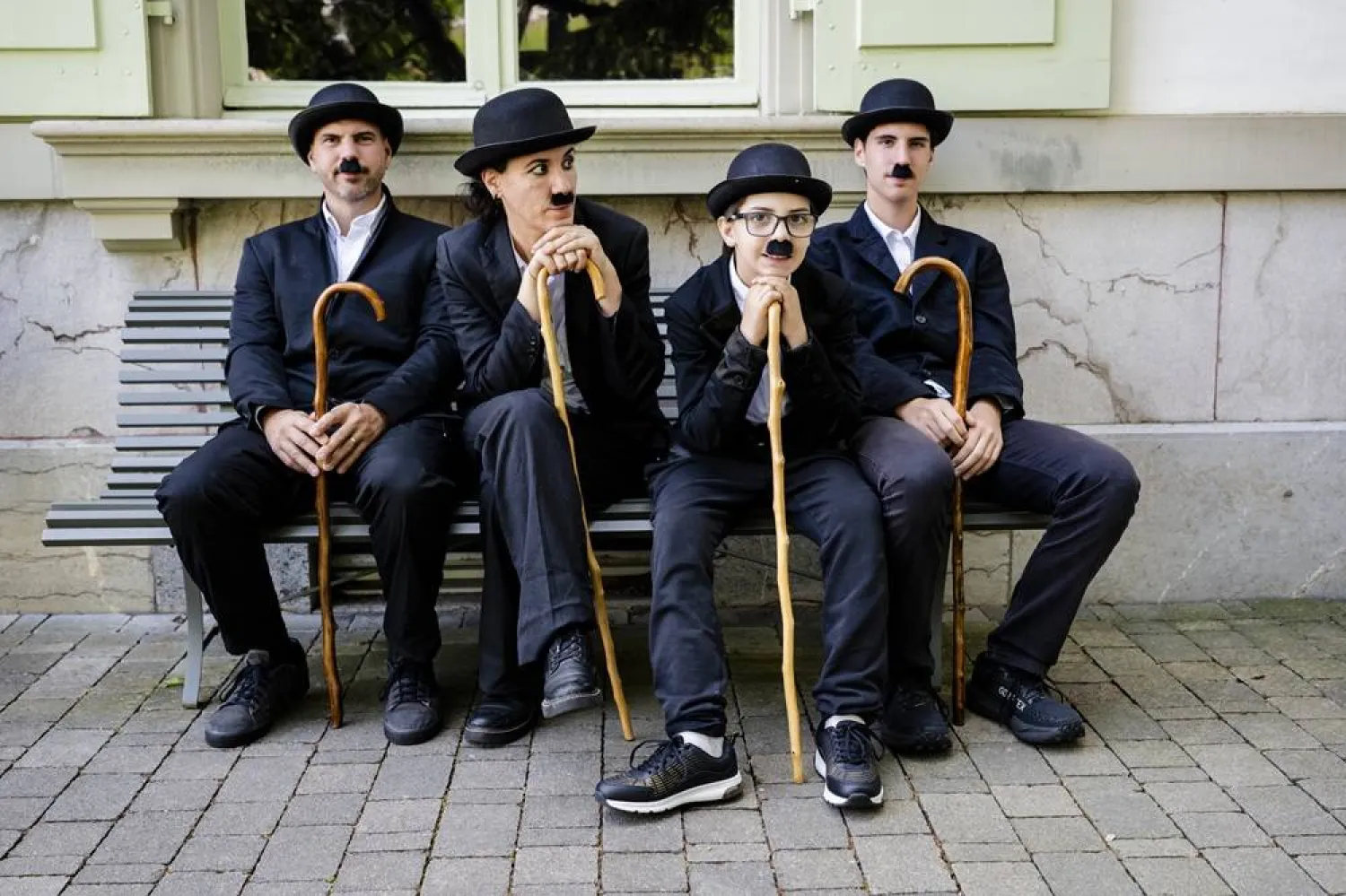

Hundreds of Charlie Chaplin Lookalikes Gather in Switzerland

Some of the 429 people dressed as "The Tramp" pose for a photo during the 10th anniversary of Chaplin's World, the museum dedicated to the life of Charlie Chaplin, in Corsier-sur-Vevey, Switzerland, 07 June 2026. (EPA)
TT

Hundreds of Charlie Chaplin Lookalikes Gather in Switzerland

Some of the 429 people dressed as "The Tramp" pose for a photo during the 10th anniversary of Chaplin's World, the museum dedicated to the life of Charlie Chaplin, in Corsier-sur-Vevey, Switzerland, 07 June 2026. (EPA)

More than 400 people donning black bowler hats, toothbrush moustaches and canes gathered in Switzerland Sunday seeking to break the record for the biggest ever assembly of Charlie Chaplin lookalikes.

The unusual rally, drawing Chaplin fans of all ages, took place at a museum dedicated to the legendary filmmaker at his former home in Corsier-sur-Vevey in western Switzerland.

Timed to mark the 10th anniversary of the museum's opening, the gathering in the end drew 429 Chaplin lookalikes, falling short of the world record set there in 2017, when 662 people took part.

But that did not dampen the mood.

Under a blazing sun, the Chaplins crowded together to form a giant number 10 on the lawn stretching before the large manor where the English movie icon spent the last 25 years of his life.

"I am sincerely the happiest man alive," said Anthony Champeil, a dapper 36-year-old Frenchman who looked the spitting image of Chaplin, explaining that he was an actor who often played the film legend on stage.

"We are at Chaplin's place with people who are passionate about Chaplin," he told AFP.

Suggesting that Chaplin had wanted to encourage people to maintain a childlike capacity for wonder and play for as long as possible, he mused that the actor would have enjoyed having hundreds "of big kids gathered here today".

"I find it marvelous."

The museum is set on the vast estate of Manoir de Ban, about 26 kilometers (16 miles) from Lausanne, where Chaplin lived with his wife Oona and their eight children until his death in 1977, at age 88.

He had moved to Switzerland after being barred from the United States in the 1950s over suspicions that he had communist sympathies, at the height of Cold War paranoia about Soviet infiltration.

Alice Kauffmann, who had brought her young children to participate as miniature Chaplins, said Sunday's gathering was "moving" to behold.

She and other participants said the event brought to mind the humanistic ideas Chaplin promoted with iconic films such as "The Great Dictator", "The Kid" and "Modern Times".

"He defended love, respect and beautiful values," she said.

Sophie Teteule, 52, agreed.

"I love Charlie Chaplin, and I love this place," she told AFP.

"I think it is magnificent that we can gather today, so long after he left us. It is a marvelous moment in his honor."

Organizers of Sunday's event also did not seem too bothered that it had failed to break the world record, which the museum already holds.

"Nothing is lost," spokeswoman Olivia Baliguet told AFP.

"Who knows, we may try again next year, or for the 20th anniversary."



Floating Igloo Leaves France for Polar Exploration Mission

Wind patterns are left in the ice pack that covers the Arctic Ocean north of Prudhoe Bay, Alaska March 18, 2011. (Reuters)
TT

Floating Igloo Leaves France for Polar Exploration Mission

Wind patterns are left in the ice pack that covers the Arctic Ocean north of Prudhoe Bay, Alaska March 18, 2011. (Reuters)

A floating research station resembling a giant aluminium igloo on Sunday set out from France to begin a long-term mission in the Arctic that will see it drift with the polar ice in the most hostile of environments.

The Tara Polar Station's specific shape enables it to withstand ice pressure and drift for months on end in a controlled fashion with the pack ice to explore biodiversity and the impact of climate change.

While the vessel was built in France, some 30 research centers from 12 countries -- including Germany, Canada, Spain, the US, Switzerland, and Japan -- are participating in the expedition.

"The Arctic is an ocean that has been little studied and is already changing significantly. It is undergoing a major transformation," said Romain Trouble, executive director of the Tara Ocean Foundation.

"You cannot understand the environment if you only spend two months a year there," he added.

The vessel sailed from France's western port of Lorient with French Minister for the Sea Catherine Chabaud in attendance and hundreds of people cheering on the quayside.

The floating laboratory -- shaped like an igloo perched on a large buoy -- is designed to withstand sea-ice pressure and endure temperatures as low as -52C.

Starting in mid-August, the station will travel eastward along the Russian coast, with an icebreaker clearing the way.

Trapped in the pack ice by early September, the station is expected to drift at an average speed of 10 kilometers per day, eventually reaching the Fram Strait -- located between Greenland and Svalbard -- by the end of 2027.

Ten such expeditions are planned between 2026 and 2045, taking place every two years.

The vessel will carry 12 people during the winter, including six scientists, and 18 in the summer.

- 'Lose entire chapter of evolution' -

The international crew was carefully selected following medical and psychological aptitude tests and team-building.

"We weren't looking for adventurers who want to head to the North Pole alone. The idea is rather to have people who get along well to experience this confined human environment together," said Clementine Moulin, the expedition director.

Those staying through the winter will have to contend with five months of not just total darkness, claustrophobia and extreme cold, but also the presence of polar bears.

"Bears are a serious matter," said Eric Pelletier, a 58-year-old genomics researcher and crew member. "It's not a simple thing -- the bear is on its home turf and it's used to hunting and hides behind blocks of ice."

Every crew member has received firearms training to deal with potential attacks while a specially trained dog will accompany the crew to help spot approaching animals.

Using an opening in the hull and a wide array of onboard instruments, scientists will collect over 10,000 samples from the water, the atmosphere, and sea ice.

"There is biodiversity at the North Pole that is uniquely adapted to this environment. If the environment changes, that biodiversity might disappear," said Trouble.

"We could potentially lose an entire chapter of the evolution of life on this planet without even having had time to document it," he warned.


Greece Braces for Year’s First Heatwave

A drone view of one of the two fertile regions on the island, the dried-up village of Livadi on the island of Astypalaia, Greece, July 13, 2026. (Reuters)
TT

Greece Braces for Year’s First Heatwave

A drone view of one of the two fertile regions on the island, the dried-up village of Livadi on the island of Astypalaia, Greece, July 13, 2026. (Reuters)

Greece, which was spared the record hot weather that ravaged most of Europe in June, is finally bracing for its first heatwave of the year.

Maximum temperatures in Thessaly, parts of the Peloponnese and the greater Athens area "may hover around or exceed 40C" (104F), with a fall likely on Thursday, prominent meteorologist Theodoros Kolydas said Sunday on Facebook.

He said data for Monday to Wednesday showed that "we are not dealing with a simple warm spell, but with a heat episode with heatwave characteristics, mainly over the mainland."

Weather website meteo.gr on Saturday said the first measurement over 40C for the season had been recorded in the northwestern town of Konitsa, with a reading of 40.4C.

National weather service EMY on Sunday forecast temperatures of 40C to 41C on Monday and Tuesday in mainland Greece.

It is unusual for temperatures to rise so late in July in Greece. Rain spells in June and strong winds this month kept heatwaves at bay this season while heat record after record was broken across most of Europe.

Meteo.gr said it was the third most delayed 40-degree recording since 2011, after July 20 in 2015 and July 30 in 2013.


Wildfire Scorches 12,000 Hectares North of Madrid

A seaplane battles a wildfire that started on Thursday in La Mierla, Guadalajara, July 18, 2026. (EPA)
TT

Wildfire Scorches 12,000 Hectares North of Madrid

A seaplane battles a wildfire that started on Thursday in La Mierla, Guadalajara, July 18, 2026. (EPA)

A wildfire raging 100 kilometers (60 miles) north of Madrid has spread, burning more than 12,000 hectares and forcing several hundred people to evacuate, local authorities announced on Sunday.

The fire that started on Thursday in Guadalajara province, which includes the Sierra Norte Natural Park, has not caused any casualties so far but has been described as "difficult" by regional president Emiliano Garcia-Page and local authorities on X.

It broke out in a forest-covered, mountainous region that is home to endangered species including eagles, wolves and butterflies.

It comes hot on the heels of a blaze that started on Wednesday near Zaragoza, in the northeast, has burned nearly 16,000 hectares and is "far from under control", according to the latest update provided on Saturday evening by the regional government of Aragon.

No casualties have been reported.

Earlier this month, Spain witnessed one of the deadliest wildfires in its recent history, when a blaze in the southern province of Almeria killed 13 people and destroyed 7,000 hectares.

Spain is on the front line of climate change and has experienced increasingly long and frequent heatwaves in recent years, with temperatures well above 40C, creating conditions conducive to devastating fires.

Scientists say human-driven climate change is increasing the length, intensity and frequency of heatwaves, which dry out vegetation and contribute to the likelihood of wildfires.
