


Saudi Arabia Leads Global Coral Reef Efforts as ICRI Adopts Five Key Recommendations

Saudi Arabia Leads Global Coral Reef Efforts as ICRI Adopts Five Key Recommendations
TT

Saudi Arabia Leads Global Coral Reef Efforts as ICRI Adopts Five Key Recommendations

Saudi Arabia Leads Global Coral Reef Efforts as ICRI Adopts Five Key Recommendations

Saudi Arabia has enhanced its global leadership role in coral reef protection by chairing the 39th General Meeting of the International Coral Reef Initiative (ICRI), a step that paves the way for the Kingdom to host the first Global Coral Reef Summit in early November 2026.

The four-day meeting featured high-level dialogue sessions and scientific and policy discussions focused on developing an integrated practical framework that brings together science, policy, and sustainable financing, enhancing international coordination and tangible on-the-ground impact.

The meeting unanimously adopted five strategic recommendations proposed by Saudi Arabia. The recommendations focused on boosting the link between international commitments and actual implementation at the national level, developing supportive regulatory frameworks, unifying scientific references, and enabling sustainable financing, SPA reported.

The recommendations also endorsed the first Global Coral Reef Summit, which Saudi Arabia announced it would host during the Saudi House events at the World Economic Forum (WEF) Annual Meeting 2026 in Davos.

This reflects international consensus on the summit's importance and its pivotal role in supporting a Saudi-led effort to develop a comprehensive global framework that integrates science, policy, and sustainable financing while enabling countries to implement practical and actionable solutions to protect coral reefs.

The meeting also witnessed the acceptance of membership applications from four new countries: Somalia, Papua New Guinea, Vanuatu, and Trinidad and Tobago. In addition, the World Bank and the UN Global Fund for Coral Reefs joined the initiative, reflecting the expanding scope of international partnership and enhancing global momentum toward coral reef protection and sustainability. The total number of member states has now reached 48, accounting for some 84% of the world's coral reefs.



Malaysia Closes Schools in Capital, Parts of Country Due to Haze

Kuala Lumpur's skyline shrouded in haze from regional wildfires, in Kuala Lumpur, Malaysia, October 9, 2026. REUTERS/Hasnoor Hussain
TT

Malaysia Closes Schools in Capital, Parts of Country Due to Haze

Kuala Lumpur's skyline shrouded in haze from regional wildfires, in Kuala Lumpur, Malaysia, October 9, 2026. REUTERS/Hasnoor Hussain

Malaysia closed schools in Kuala Lumpur and other parts of the country on Friday, as haze from fires in neighboring Indonesia again plunged local air quality to among the world's worst.

Toxic smoke from peatland and forest fires has shrouded cities in the region for more than a month, sending respiratory complaints skyrocketing.

The school closures came as Malaysia's leader discussed the choking smoke with his Indonesian counterpart and called for an urgent regional meeting.

Air quality in Kuala Lumpur has been firmly in "unhealthy levels" this week, with a Swiss-based air quality monitor ranking the Malaysian capital among the world's most polluted cities on most days.

Malaysia's Education Minister Fadhlina Sidek said she has instructed whole school closures in four states and two federal territories as well as one partial closure in the central Pahang State.

"In the future, we will ensure that any decision to close schools is notified in advance so that parents have sufficient time to prepare," Fadhlina said late on Thursday.

Malaysia's King Sultan Ibrahim weighed in on the matter on Thursday, saying schools should be closed as air quality readings reached 150 or higher on the Air Pollutant Index (API).

Under Malaysian guidelines, API readings above 100 are classified as unhealthy, above 200 as very unhealthy, above 300 as hazardous, while readings beyond 500 constitute the threshold for declaring a local emergency.

Kuala Lumpur on Friday showed a reading of around 170 API.

The city was the second-most polluted globally behind neighboring Singapore on Friday morning, Swiss-based air monitor IQAir said.

Malaysia's Prime Minister Anwar Ibrahim said Thursday he discussed the fire situation with the Indonesian leader Prabowo Subianto.

"The haze issue is indeed at a worrying level. And I have personally contacted President Prabowo," AFP quoted Anwar as saying.

"And he also agreed to take the necessary steps," Anwar said, without going into specific details.

He said Malaysia has been taking measures to combat the haze, including increasing attempts to trigger rain via cloud seeding.

Experts said the flames are being fanned by a turbo-charged El Nino weather phenomenon, causing the worst pollution conditions in years.

Anwar said he asked Malaysia's Foreign Minister Mohamad Hasan to contact the 11-nation Association of Southeast Asian Nations' secretariat for an urgent meeting between environmental ministers to discuss the matter.

"So these are all the steps we are taking, but we are monitoring and will try the measures that we ought to take next," Anwar said.

Singapore's air quality levels too dipped into the "very unhealthy" range with a reading of 205 on the Air Quality Index, according to the IQAir website.

The AQI converts measurements of pollutants into a single figure indicating air quality and potential health risks.

Readings above 150 are classified as unhealthy, while levels above 300 are considered hazardous.


Underwater Surprise: Sharks Can Hear Sounds from 75 Meters Away

A whale shark (Rhincodon typus) swims near Roca Redonda, a small islet north of Isabela Island in the Galapagos archipelago, Ecuador, during a field expedition with the Charles Darwin Foundation on September 18, 2026. (Photo by Carlos Espinosa / AFP)
TT

Underwater Surprise: Sharks Can Hear Sounds from 75 Meters Away

A whale shark (Rhincodon typus) swims near Roca Redonda, a small islet north of Isabela Island in the Galapagos archipelago, Ecuador, during a field expedition with the Charles Darwin Foundation on September 18, 2026. (Photo by Carlos Espinosa / AFP)

Sharks can hear sounds from considerable distances underwater and even tell where they are coming from, according to a new study that debunks the common misconception that the predators can only detect nearby sounds.

Researchers say blacktip sharks can hear from about 75 meters away and respond by quickly changing direction. Since blacktips seasonally gather off southeast Florida, they offer a rare opportunity to observe free-swimming sharks in clear, shallow water.

Blacktip sharks gather in large numbers along the Palm Beach County coast every year.

Researchers anchored a boat in the shallow nearshore waters of Palm Beach County and deployed an underwater speaker that drifted with the current up to 19 meters away to minimize the boat’s influence on the marine animals.

They tested three ranges of high-intensity, low-frequency sounds – 100-200Hz, 200-400Hz, and 400-800Hz – along with a 10-kilohertz control sound outside the hearing range of sharks.

The intention was to startle the sharks rather than try to attract them.

Sound travels through water, carrying clues about potential prey and predators.

Researchers mapped sound levels at various distances to see exactly what the sharks heard when they responded.

An aerial drone tracked sharks from 40-50 meters above the water, with video analysis used to measure the response distances and swimming-direction changes.

They found the sharks detected low-frequency sounds from up to 74 meters away, significantly farther away than previously demonstrated under similar conditions.

The sharks rapidly changed course away from the source, indicating they could determine the direction of the sound.

“This suggests that they are detecting the particle motion associated with sound even at considerable distances from the source, something we haven’t previously been able to demonstrate in free-swimming sharks,” said Stephen Kajiura, author of the study published in Integrative Organismal Biology and cited by The Independent.

Researchers hope to conduct further studies to understand how the shark sensory system allows the predator to pick up and interpret distant sounds.

The study also shows the value of studying sharks in the wild instead of in laboratory tanks, researchers say.

“Trying to do hearing experiments in a tank results in the sound bouncing off the walls, which causes complex and confusing signals,” Caroline Sullivan, another study author, said.


Saudi Team Successfully Separates Moroccan Conjoined Twins

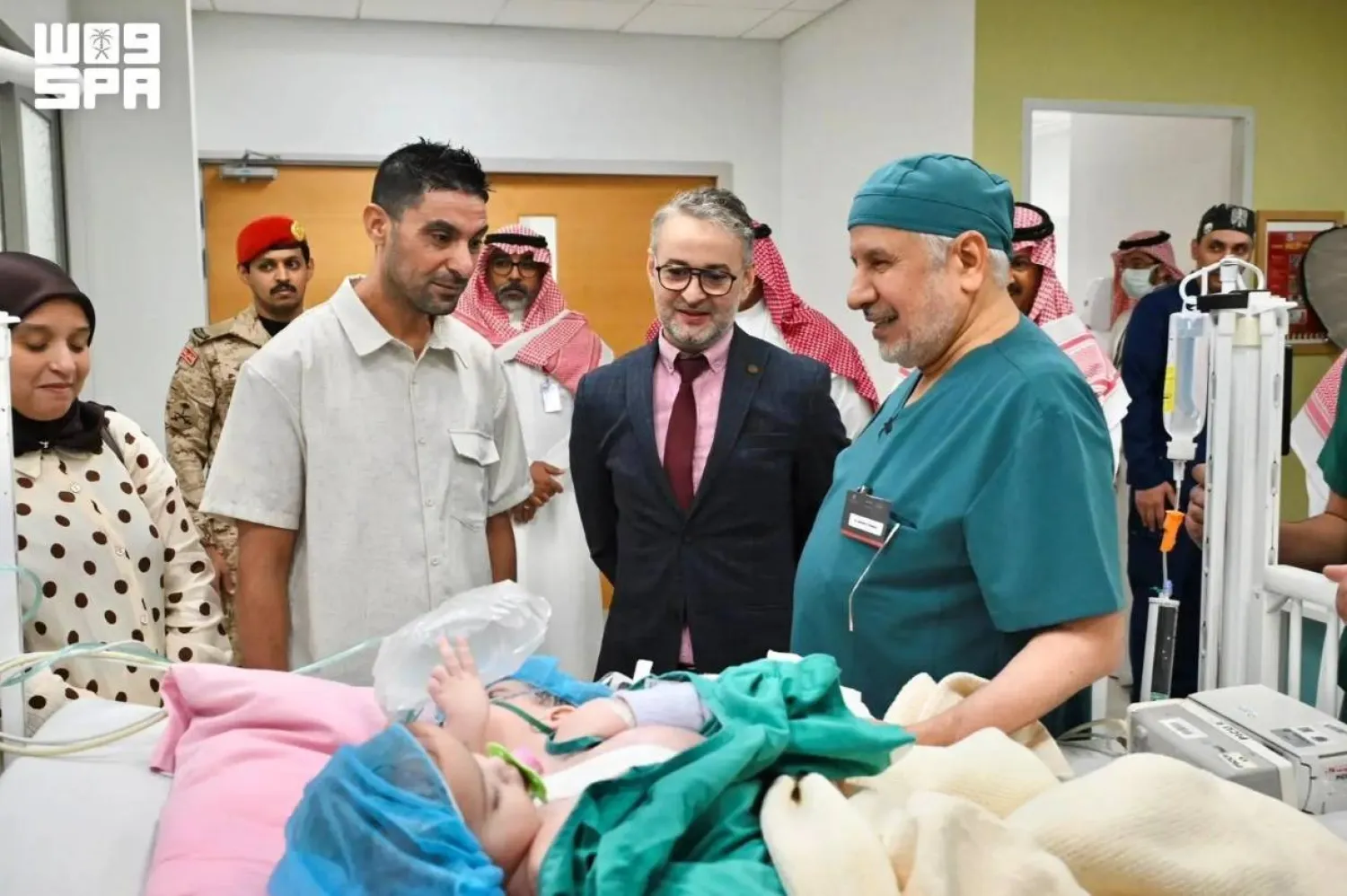
The medical and surgical team of the Saudi Conjoined Twins Program began the separation surgery for 13-month-old Moroccan conjoined twins. SPA
TT

Saudi Team Successfully Separates Moroccan Conjoined Twins

The medical and surgical team of the Saudi Conjoined Twins Program began the separation surgery for 13-month-old Moroccan conjoined twins. SPA

The medical and surgical team of the Saudi Conjoined Twins Program succeeded on Thursday in separating 13-month-old Moroccan conjoined twins Saja and Doha at King Abdullah Specialist Children’s Hospital in Riyadh.

The surgery was in implementation of the directives of Custodian of the Two Holy Mosques King Salman bin Abdulaziz Al Saud and Prince Mohammed bin Salman bin Abdulaziz Al Saud, Saudi Crown Prince and Prime Minister.

Supervisor General of the King Salman Humanitarian Aid and Relief Center (KSrelief) and head of the medical and surgical team Dr. Abdullah Al Rabeeah said the twins arrived in the Kingdom on April 24.

The medical team conducted extensive and detailed examinations and held several meetings, determining that the twins were conjoined at the chest and abdomen and shared the membranes surrounding the heart, liver, and intestines.

He earlier noted that the surgery was being performed in six stages over approximately 10 hours, involving 23 consultants, specialists, nurses, and technical staff. He added that the complex procedure has a success rate of more than 70%.

He also noted that this is the fourth separation surgery performed for conjoined twins from Morocco and the 73rd case undertaken by the Saudi Conjoined Twins Program, which has cared for 159 sets of twins from 28 countries across five continents since 1990.