
Arab Push Seeks Lebanon Ceasefire Arrangements

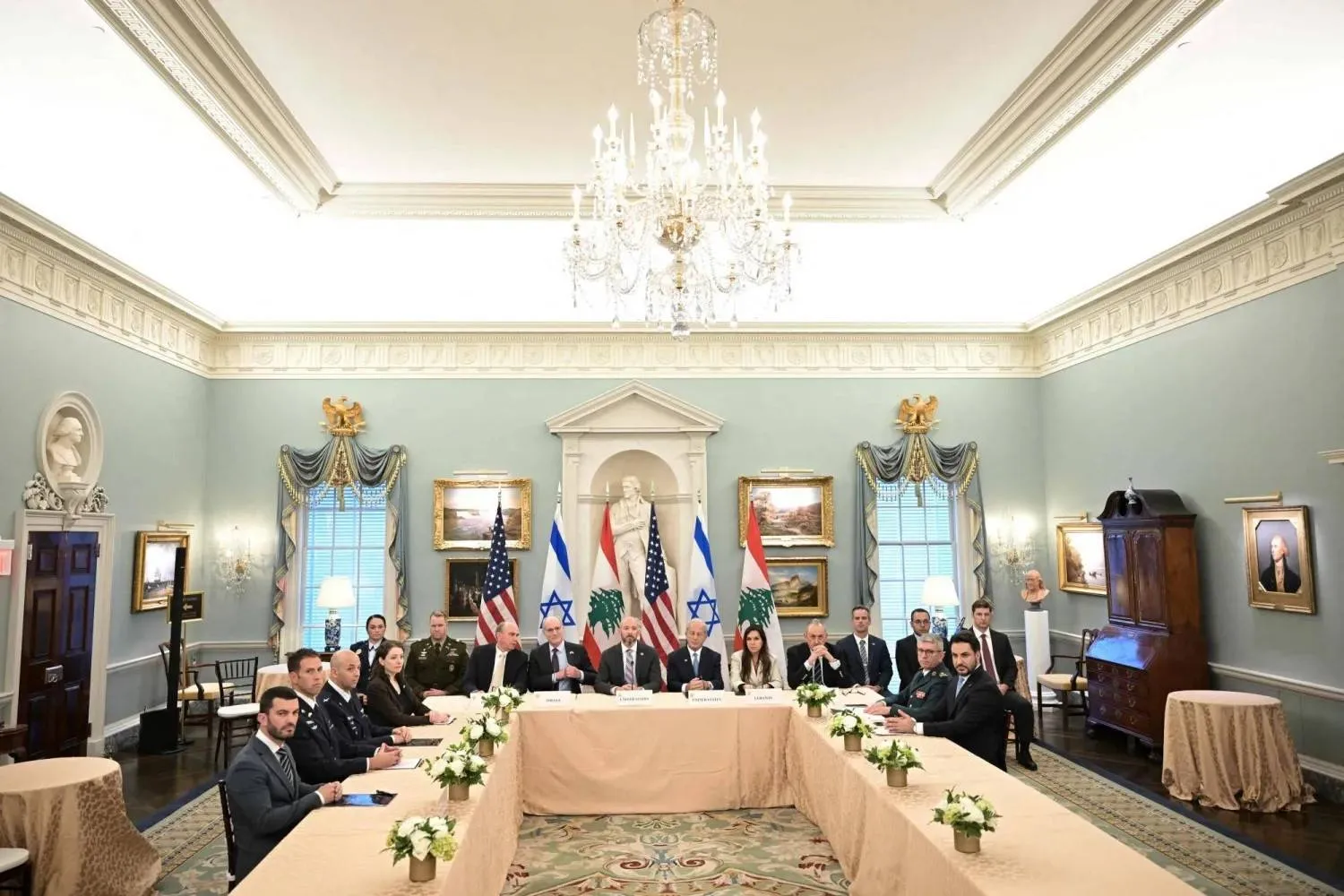
From a session of bilateral negotiations between Lebanon and Israel, held under US sponsorship at the US State Department. (AFP)
TT

Arab Push Seeks Lebanon Ceasefire Arrangements

From a session of bilateral negotiations between Lebanon and Israel, held under US sponsorship at the US State Department. (AFP)

An Arab diplomatic push is moving alongside talks involving Pakistan to increase pressure for a ceasefire agreement in Lebanon, after the country was pulled into a wider contest between Iran and the United States on one side, and Israel and Hezbollah on the other, Lebanese sources told Asharq Al-Awsat.

The phased effort would begin with enforcing a ceasefire, followed by a plan to carry out subsequent steps, the sources said.

Details of the Iranian-US understanding have yet to be announced, including whether Lebanon is included and under what formula.

But Israeli leaks offered no sign of calm on the Lebanese front.

Israel’s Channel 14 quoted an Israeli source as saying “the situation in Lebanon will remain as it is,” adding that Israel would “retain freedom of action against any threat inside Lebanese territory.”

The source said: “Iran’s attempts to link the arenas have failed.”

Lebanese sources, however, do not see the two files as separate in practice, even as Lebanon pursues an independent track through bilateral negotiations with Israel in Washington and prepares for a new round of talks.

Any US-Iranian understanding “will inevitably reflect on the Lebanese file, and we hope it will,” the sources said. The two sides concerned, they added, “can impose arrangements” through pressure from Washington on Tel Aviv and from Tehran on Hezbollah.

Supporting the Arab push

As the outcome of the Iranian-US talks takes shape, another factor has entered the Lebanese scene: an Arab effort to prepare the ground for any shift in those negotiations.

Lebanese sources following international contacts said a friendly Arab push on Lebanon’s behalf had gained momentum over the past two days and was working to shape a position that could support the negotiations.

Such a position, the sources said, “would pave the way for a tripartite meeting” between President Joseph Aoun, Parliament Speaker Nabih Berri and Prime Minister Nawaf Salam “to assess the situation and proceed with a plan that begins with implementing a ceasefire and carrying out the post-ceasefire phase.”

The effort is moving on several tracks, the sources said. It begins with enforcing a ceasefire, then moves to further steps: withdrawals by both sides, with the Israeli army pulling out of occupied territory and Hezbollah withdrawing its fighters; deployment of the Lebanese army; and the handover of Hezbollah’s weapons.

The process would be backed by international guarantees to prevent renewed fighting, allowing residents to return and restore stability in the south.

A helpful domestic development also emerged over the past week, with renewed contact between Aoun and Berri. The speaker is handling internal talks with Hezbollah.

Israel’s “intransigence” and Hezbollah’s insistence

Despite the regional and international moves, Lebanon is pressing ahead with its Washington negotiating track with Israel in pursuit of a ceasefire, a goal on which the Lebanese president has insisted.

Sessions are scheduled for June 22, 23 and 24, Lebanese ministerial sources told Asharq Al-Awsat. The first meeting will be military-diplomatic, the second day will be limited to military talks, and the third will be devoted to diplomacy.

So far, however, all initiatives have collided with Israeli “intransigence” and Hezbollah’s insistence on continuing the fight.

Israel has not provided answers to Lebanese demands in previous sessions, the sources said. At the latest session, Lebanon’s ambassador threatened to leave before US Secretary of State Marco Rubio intervened, the Lebanese presidency said last week.

The Israeli side “is intransigent and has not offered anything that would move the negotiations forward,” the sources said, citing its insistence on linking any step, including a ceasefire or a model zone, to Hezbollah’s prior disarmament.

Hezbollah, for its part, has told mediators it will not give answers before a full and comprehensive ceasefire across Lebanese territory. It has also halted contact with Aoun.

Caught between those positions, Lebanon has received US support for shielding Beirut and its southern suburbs from bombardment, but not enough pressure to secure a ceasefire in the south, the sources said.

The Israeli side “has enough freedom of movement in the south to continue bombardment and fighting,” they added, describing a reality in which some areas, namely the south, appear designated for combat while others remain spared.

The model zone

The previous negotiating session proposed a “pilot zone” for a model weapons-free area from which both sides would withdraw.

But the proposal never got a real chance to succeed before a practical implementation plan became clear. Hezbollah and Israel both rejected it, according to the sources.

The plan also carries risks for the Lebanese army if implemented without a ceasefire. It would leave troops unable to move safely between combat zones and amid incoming fire, placing soldiers directly in danger.

Awaiting Hezbollah’s answers

Against this deadlock, Lebanon is watching the Iranian-US talks and their possible impact at home.

Sources following the domestic push said, “Hezbollah’s margin for maneuver is narrowing,” and that the group must now provide answers on whether it will withdraw from the proposed model zones and whether it will hand over its weapons under any initiative.

It remains unclear whether, if Hezbollah agrees, it would provide such guarantees to the Lebanese state or to the Iranian negotiator.

“If it rejects both points, it must also provide an alternative to stop the war,” the sources said.

Hezbollah’s parliamentary bloc, Loyalty to the Resistance, on Friday condemned “the latest round of direct negotiations” and renewed its rejection “in full and in detail of all the unjust outcomes of the meeting, which imposed unilateral obligations on Lebanon.”

The bloc said it rejected “the conditions and dictates put forward by the enemy and adopted by the Lebanese negotiating delegation, despite the commitments containing no reference to what the enemy should commit to in terms of halting hostile operations, withdrawing from our land, the return of the displaced and reconstruction, which constitute national priorities and constants that the political authority should not overlook.”



Morocco Signs Agreement to Join Gaza International Force

 Palestinians gather around a blacksmith shop in Gaza City's Sabra neighborhood after it was hit by an Israeli military strike on Sunday, July 12, 2026. (AP)
Palestinians gather around a blacksmith shop in Gaza City's Sabra neighborhood after it was hit by an Israeli military strike on Sunday, July 12, 2026. (AP)
TT

Morocco Signs Agreement to Join Gaza International Force

 Palestinians gather around a blacksmith shop in Gaza City's Sabra neighborhood after it was hit by an Israeli military strike on Sunday, July 12, 2026. (AP)
Palestinians gather around a blacksmith shop in Gaza City's Sabra neighborhood after it was hit by an Israeli military strike on Sunday, July 12, 2026. (AP)

Morocco signed an agreement on Wednesday to participate in the International Stabilization Force (ISF) for Gaza, state media reported.

The agreement was signed in Rabat at a meeting attended by Moroccan Foreign Minister Nasser Bourita, senior defense officials ‌and Nickolay ‌Mladenov, the Board ‌of Peace ⁠envoy for Gaza, along ⁠with a delegation including the commander of the ISF, the state news agency MAP said.

The agreement "reflects the shared determination to contribute, through ⁠concrete humanitarian and security ‌actions, to the ‌establishment of a climate of ‌peace and security in the region," ‌MAP quoted a statement from the Moroccan defense administration as saying.

The Gaza Peace Council and ISF ‌leadership welcomed Morocco's decision to join the initiative, citing ⁠its ⁠planned deployment of senior military officers, gendarmerie and police personnel, as well as the creation of a military field hospital, MAP said.


Could Hezbollah Launch a New War in Support of Iran?

Supporters of Hezbollah carry Iranian and Hezbollah flags during a memorial ceremony for slain Supreme Leader Ali Khamenei in the southern suburbs of Beirut, Lebanon, 08 July 2026. (EPA)
TT

Could Hezbollah Launch a New War in Support of Iran?

Supporters of Hezbollah carry Iranian and Hezbollah flags during a memorial ceremony for slain Supreme Leader Ali Khamenei in the southern suburbs of Beirut, Lebanon, 08 July 2026. (EPA)

Amid deteriorating regional conditions and faltering US-Iranian understandings, Lebanese people fear that Hezbollah may once again launch a new round of war in support of Iran. This follows the party’s previous interventions, including its 2023 campaign backing Gaza and its retaliation for the late Iranian Supreme Leader Ali Khamenei in March this year.

Lebanon has witnessed a drop in Israeli military operations, which have reached their lowest levels in weeks, despite Israel's continued occupation of a security zone extending up to ten kilometers deep inside Lebanese territory. Hezbollah has also halted all military operations since the ceasefire was announced in mid-June.

However, the resumption of attacks between the US and Iran leads observers to believe that Tehran could once again request its regional proxies, including Hezbollah, to reignite all fronts in its support, should it perceive that the situation is heading toward a major escalation against it.

These fears are compounded by past statements by Hezbollah lawmakers and leaders. Most recently, MP Ali Ammar pledged to stand behind Iran in the event of a new war.

Conversely, during his latest appearance, Hezbollah Secretary-General Naim Qassem insisted on maintaining the diplomatic track between the US and Iran, while fiercely attacking the path of direct negotiations between Lebanon and Israel.

Political analyst Qassem Qassir, who is close to Hezbollah's positioning, noted that “no one can definitively determine the red lines drawn by Hezbollah, which, if crossed, would prompt a return to resistance in its broadest sense.”

“However, it is expected that a broad Israeli assault on the Ali al-Taher hill would naturally compel the group to defend it,” he told Asharq Al-Awsat.

“The same applies if attacks target other Lebanese areas still outside direct Israeli control, or if the enemy resumes wide-scale offensives and attacks against Nabatieh, Tyre, the southern suburbs of Beirut or other regions,” he added.

“Ultimately, the decision rests with Hezbollah's leadership, which has confirmed through its Secretary-General that it will not accept a return to the status quo prior to March 2” when the war with Israel erupted, he said.

“Consequently, matters remain contingent upon favorable conditions on the ground as well as the political climate. For instance, should direct Lebanese-Israeli negotiations hit a dead end, it could prompt the resistance [Hezbollah] to resume direct military operations,” he remarked.

Security and defense analyst Dr. Riad Kahwaji said: “The red lines that could prompt Hezbollah to resume fighting are determined by Iran, not the party's own leadership.”

Speaking to Asharq Al-Awsat, he added: “Tehran alone decides when the party will reopen the support front.”


Israeli NGO Slams Investment Plan for West Bank Settlements

Construction cranes tower above a construction site in Givat HaMatos, an Israeli settlement suburb of Israeli-annexed east Jerusalem on January 2, 2026. (AFP)
TT

Israeli NGO Slams Investment Plan for West Bank Settlements

Construction cranes tower above a construction site in Givat HaMatos, an Israeli settlement suburb of Israeli-annexed east Jerusalem on January 2, 2026. (AFP)

An Israeli NGO on Wednesday condemned a government plan to invest around $2.7 billion in infrastructure and thousands of new residential units across several settlements in the occupied West Bank.

Since Prime Minister Benjamin Netanyahu took office in 2022, his government has rapidly expanded settlements in the West Bank, drawing criticism from rights groups and the UN.

Earlier this week, Netanyahu and far-right Finance Minister Bezalel Smotrich signed an umbrella agreement to invest in settlements in the north of the Palestinian territory.

"This is another significant step in the settlement revolution we are leading in Judea and Samaria," Smotrich said on X, using the biblical name for the West Bank.

"As part of the agreement, approximately 12,000 new housing units will be established, alongside an investment of more than eight billion ILS (approximately $ 2.7 billion) in infrastructure, public institutions and settlement development."

Netanyahu hailed the agreement.

"Not only do we defend this place, we elevate it," he said.

Israeli anti-settlement watchdog Peace Now slammed the decision, accusing the government of squandering public funds and entrenching the occupation of the West Bank.

The group said the move would complicate any future withdrawal from the West Bank and the creation of a Palestinian state.

"Umbrella agreements are used for the rapid development of large-scale projects," Hagit Ofran, a spokeswoman for Peace Now, told AFP.

"From the government's perspective, it is a double win: unbridled construction in the settlements, along with shackling the next government to commitments that will make it difficult to roll back this terrible government's reckless policy."

Since taking office, Netanyahu's government, widely seen as one of the most right-wing in the country's history, has approved the establishment of 102 settlements in the West Bank, according to Peace Now.

All Israeli settlements are illegal under international law.

Excluding east Jerusalem, more than 500,000 Israelis live in settlements in the West Bank, which Israel has occupied since 1967, among some three million Palestinians.