
French Chef Gets 'Beautiful Revenge' After Unjust Michelin Star Loss

Guy Savoy, the first chef to join the Academy of Fine Arts (The New York Times)
TT

French Chef Gets 'Beautiful Revenge' After Unjust Michelin Star Loss

Guy Savoy, the first chef to join the Academy of Fine Arts (The New York Times)

Paris: Elaine Sciolino

Guy Savoy, who worked his way up from modest beginnings and a recent setback, has become the first chef inducted into the prestigious Académie des Beaux-Arts.

One of France’s premier chefs, he accompanied two French presidents on formal visits to the White House.

He was given the Légion d’Honneur, the highest award of the French state, for his contributions to the nation’s gastronomy. He has written and co-written several books, most recently, a two-volume collection of French literary figures on food — with recipes. His signature Paris restaurant, Guy Savoy, has welcomed dignitaries and celebrities for more than four decades.

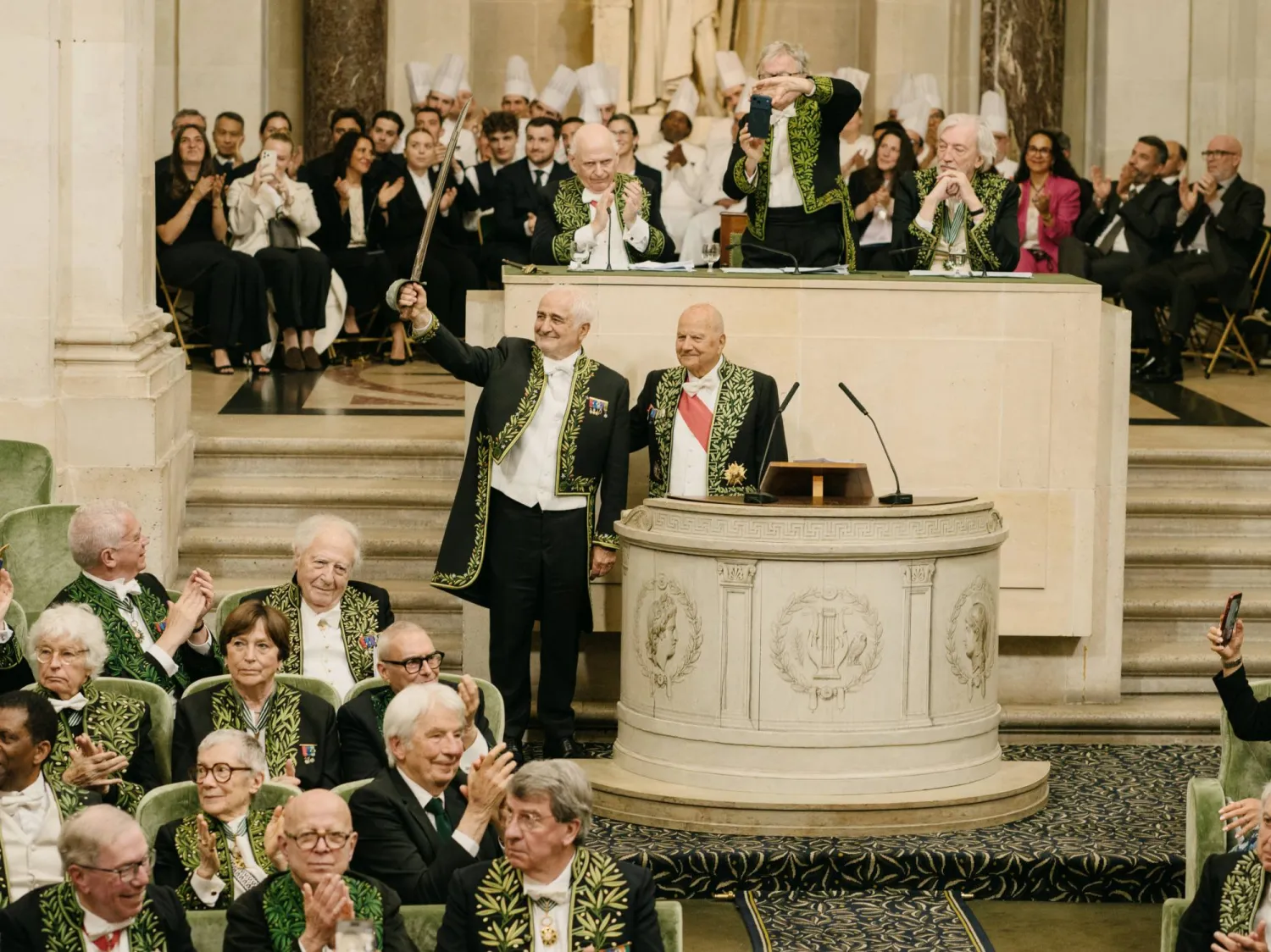
But on Wednesday, he snagged an honor that may top all others. He became the first chef in the 110-year history of one of France’s loftiest cultural institutions, the Académie des Beaux-Arts, to be welcomed into its ranks of artists, composers and other creative professionals.

At a formal ceremony in its gilded-domed headquarters at the Institut de France, Savoy was presented a long ritual saber he had designed himself. Blinking back tears, he held it high over his head, to a standing ovation and shouts of “Bravo!”

“So here I am, an artisan, and perhaps an artist thanks to my election,” he told the hundreds in attendance. The award, he added, also belongs to “all the artisans who contribute to gastronomy, to the land of France, to the art of food and wine, to graciousness, to the art of hosting, in short, the art of living well the French way.”

The Académie’s decision to admit him is especially sweet for Savoy, who made headlines in 2023 when the Michelin Guide removed one of the three stars his restaurant had held for 21 years.

“It was a real scandal, so shameful and not at all justified,” Laurent Petitgirard, the Académie’s permanent secretary, said in an interview. “Guy Savoy’s welcome into the Académie is the most beautiful revenge.”

The Académie des Beaux-Arts is one of five academies that reside in the Institut de France, led by the royal Académie Française founded under Louis XIV. Among the Académie des Beaux-Arts’ more than 60 members — called “immortals” — are painters, sculptors, architects, photographers, choreographers, musicians and film and museum directors.

In recent years, the organization has sought to shed its reputation as a stuffy state institution for old and safe artists, opening its doors to younger members, including Jean-Michel Othoniel, an artist who works in glass, and Catherine Meurisse, an illustrator and regular contributor to the satirical magazine Charlie Hebdo. (A more controversial member is Roman Polanski, the filmmaker who fled the United States to his native France in 1978 after pleading guilty to unlawful sex with a minor.)

The inclusion of a chef, even in a country where gastronomy has historically been a sort of state religion, represents a tectonic cultural shift. The ballot to join the Académie is secret, and not all its members were delighted to welcome a culinary figure, Petitgirard said in his interview. But Savoy won on the first round, unlike the painter Eugène Delacroix and the composer Hector Berlioz, who were rejected several times.

Savoy, 72, is one of the last of a generation of French chefs dedicated to the art and craft of turning foods into perfect objects of desire. His cuisine belongs to an era of long meals, grand dining rooms, orchestrated service, luxury ingredients and abundant time.

Eating habits in France have changed. Takeout services that took off during Covid continue to expand. With the French economy suffering, fast-food consumption has soared.

Savoy comes from a modest background. His mother, Léonie, opened a buvette, a small bar and informal restaurant attached to their family home in Bourgoin-Jallieu, not far from Lyon.

His Swiss-born father, Louis, was the town gardener, and grew the fruits and vegetables for the restaurant.

Savoy credits his mother for teaching him how to transform simple ingredients into culinary artistry. Working alongside her, he has said, he discovered the driving force behind his own cooking: “Pleasure.”

Mocked at school when he expressed interest in cooking, he left at 15 to become an apprentice to a local chocolate maker.

After training as an apprentice with the Troisgros brothers, he worked in various restaurants, learning classic French cuisine. In 1980, at age 27, he struck out on his own in Paris with the restaurant that holds his name today. The restaurant moved in 2015 into a grand 4,300-square-foot top-floor space in the building that houses the Monnaie de Paris, the French mint.

For the last nine years, Guy Savoy has been named the world’s No. 1 restaurant by La Liste, a restaurant guide that aggregates scores from hundreds of gastronomic guides, websites and press reviews. Savoy prides himself on being present there just about every day, greeting all his guests as if they were old friends.

For the Wednesday ceremony, Savoy shed his starched, double-breasted chef’s whites and donned a custom-made version of the Académie’s embroidered uniform that he designed with Laure de Sagazan, who is best known for her wedding dresses.

The saber he designed has a bronze hilt shaped to resemble large artichoke leaves, symbolizing his favorite vegetable and his signature dish: an artichoke soup with black truffle and Parmesan, served with a toasted mushroom brioche slicked in truffle butter.

His lifetime motto was engraved into the sword: “Cuisine is the art of instantly transforming products steeped in history into joy.” So were the first names of his parents, his two children and his seven grandchildren.

“Your humanism and life experience are a great source of learning for us, making us feel as though you have always been with us,” Petitgirard, a composer and conductor, said in introducing him. Comparing Savoy to a composer, performer and soloist, he added, “You are going from the status of indispensable to that of immortal.”

In his speech, Savoy paid tribute to Michel David-Weill, an investment banker and scion of the Lazard banking dynasty, who had previously occupied the seat that is now Savoy’s — an assigned place in the “free section” reserved for academicians who don’t fit into more classical artistic categories.

David-Weill, who died in 2022 at age 89, was one of Europe’s most important art collectors, a major donor and trustee of the Metropolitan Museum of Art and chairman of France’s official art acquisition committee.

Like David-Weill, Savoy is a passionate art collector, but on a much smaller scale. His restaurant is filled with contemporary works by artists like Fabrice Hyber, Adel Abdessemed and Pierre et Gilles, and African and Asian sculptures.

“It’s marvelous that a chef takes the seat held by my husband,” said David-Weill’s widow, Hélène. “Both sought the same perfection — one from food, the other from art.”

At an outdoor reception after the ceremony, Savoy set up food stations under white umbrellas around the courtyard so his staff could serve many of his favorite creations. Much of the talk was about the creativity and refinement of the food — a terrine made with 13 different meats, and a fowl suprême with foie gras and artichoke.

“Iced poached oysters in gelatin!” exclaimed Emmanuel Guibert, a graphic novelist and Académie member. “I’ve never eaten an oyster so sublime. Try them, try them!”

The most popular food station was the one serving Savoy’s famous artichoke soup. Guests waiting in line joked that in honor of Savoy — at least for the day — the Académie des Beaux-Arts should be renamed the Académie des Beaux-Artichauts, the Academy of Beautiful Artichokes.

Jean-Robert Pitte, an Académie member and geographer whose expertise is the French countryside, said he had long been pushing to have Savoy admitted into the Académie. He said he stepped up his campaign after the two of them conceived the project that in 2010 led to UNESCO’s recognition of the French mealtime tradition as part of the world’s Intangible Cultural Heritage.

“I have been waiting 15 years for this day,” Pitte said. “They kept telling me that they didn’t want a chef, because a chef wasn’t an artist. They said that eating and drinking was vulgar not an art. Finally it happened. And it’s a great day.”

The New York Times


Prince Harry, Wife Meghan Arrive in the UK as They Make a Fresh Start in Britain

Britain’s Prince Harry and his wife, Meghan. (AP)
TT

Prince Harry, Wife Meghan Arrive in the UK as They Make a Fresh Start in Britain

Britain’s Prince Harry and his wife, Meghan. (AP)

Prince Harry and his wife Meghan arrived in the United Kingdom on Wednesday, as they make a fresh start in Britain after six years in the United States, UK media reported.

The news comes less than a week after the couple surprised fans and critics alike with plans to return to Britain. The return was reported by media outlets including the BBC and Sky News, with the Daily Telegraph reporting their plane landed at Birmingham International Airport around noon.

Flight tracking websites showed a private charter flight from Van Nuys, California, arrived at the airport at 11:56 a.m.

The couple’s children, Prince Archie, 7, and Princess Lilibet, 5, have already enrolled at British schools and will start classes in September. The family plans to live at a private, nonroyal residence outside of London, but haven’t said exactly where that will be.

Harry and Meghan gave up their royal duties and moved to California more than six years ago to earn their living through lucrative contracts with Netflix and Spotify.

Relations with the rest of the royal family quickly soured as the couple said palace staff had been insensitive to Meghan’s mental health and leveled charges of racism and media manipulation at members of the royal family.

Harry recently expressed an interest in reconciliation so he could spend more time with his father, King Charles III, who is being treated for an undisclosed form of cancer. But relations with his brother, Prince William, who is heir to the throne, remain tense.


Social Media Use on the Rise Among Australian Under-16s After Ban

The TikTok logo is displayed on signage outside TikTok social media app company offices in Culver City, California on September 30, 2025. (AFP)
TT

Social Media Use on the Rise Among Australian Under-16s After Ban

The TikTok logo is displayed on signage outside TikTok social media app company offices in Culver City, California on September 30, 2025. (AFP)

Australian under-16s are increasing their use of social media apps, such as Instagram and TikTok, despite a world-leading ban, data provided by a parental control software company showed Wednesday.

Australia implemented legislation barring children from social media platforms in December, with the UK, France and others following suit.

Youngsters' use of social media fell across the board when the legal restrictions were first implemented, data from parental control app Qustodio showed.

But since then their social media activity has climbed -- even approaching pre-ban levels for some apps.

The use of apps TikTok, Instagram and Snapchat among 10–12-year-olds and 13- to 15-year-olds was on the rise, data from parental control app Qustodio showed.

In the case of video-sharing site TikTok, 25.9 percent of 13-15 year-olds are still using the app -- just over a percentage point lower than before the ban came into force.

And use among 10–12-year-olds was just 0.06 percentage points below where it was before the ban.

"They could be accessing these platforms with VPNs, or obfuscating their ages," Yasmin London, Global Online Safety Expert for Qustodio, said.

"But it could really be as simple as they're just accessing these apps because the restrictions aren't working."

The data also showed children increasingly turning to messaging platform WhatsApp, which is not affected by the ban.

Qustodio said the data was gathered by analyzing anonymized monthly social media app usage among Australian children and showed the percentages of kids that had used the app for more than five consecutive minutes at least once in a given month.

Australian officials have said the ban is designed to protect children from online bullying and "predatory algorithms".

A team of Australia-based researchers in a peer-reviewed study published in June found little evidence to suggest teenagers have turned away from social media as a consequence, however.

New Zealand's government also this week said it would introduce legislation that could see firms like Meta fined up to 10 percent of their global revenue if they fail to comply.


Drought-Hit Danube Gives Way to Fossil Hunt in Bulgaria

This photograph taken on August 21, 2026, shows unidentified remains found in the dried-out Danube riverbed near the village of Ryahovo, during an organized fossil hunt after a record low water level revealed mammoth bones there at the end of July. (AFP)
TT

Drought-Hit Danube Gives Way to Fossil Hunt in Bulgaria

This photograph taken on August 21, 2026, shows unidentified remains found in the dried-out Danube riverbed near the village of Ryahovo, during an organized fossil hunt after a record low water level revealed mammoth bones there at the end of July. (AFP)

Volunteers scanned the dried-up bank of the Danube in northern Bulgaria, close to where receding waters laid bare mammoth bones last month, hoping to find more fossilized fragments exposed by Europe's parching drought.

"I've found a tooth!" exclaimed Aleksandar Denkov, a 30-year-old amateur photographer, holding up a yellowish fragment protruding from the sand.

Denkov last week joined some 20 other volunteers, many hoping to find more mammoth fossils during the search organized by the regional history museum of the nearby city of Ruse, around 250 km (155 miles) northeast of Sofia.

Though their hopes were not fulfilled, the group found remains of a mammal -- "probably an aurochs or a European bison," according to the museum -- a horse jawbone in a subfossil state and a cluster of fossilized oysters dating back around 60 to 65 million years.

Europe's drought, exacerbated by human-induced climate change according to experts, has seen major rivers slow to a trickle, causing serious problems for cargo shippers and nuclear plants normally cooled by river water.

But the low waters have also revealed remains and historical artefacts not seen for decades -- or even millennia.

Finds in recent weeks along the Danube, Europe's second-longest river, have included World War II shipwrecks in Austria and Serbia and the remains of two German soldiers and a motorbike in the middle of Budapest.

- 'Close to history' -

Ruse Regional History Museum curator Krasimir Kirov said the museum decided to organize the field day "to teach people how to recognize different finds, show them what they might uncover, and give them safety tips."

"After the mammoth was discovered, I started getting dozens of calls from people telling me about what they'd found," he told AFP.

Last month, a resident of the village of Ryahovo -- some 30 kilometers from Ruse -- spotted by chance what museum specialists then identified as a mammoth jaw bone, fragments of tusks, part of a shoulder blade and a femur.

Announced on social media, the initiative to gather near Ryahovo for a guided search quickly sparked keen interest, with requests already pouring in for the next outing, according to Kirov.

The search began with a few instructions: the volunteers must advance in a line and, if someone spots something, raise a hand so that the whole group stops.

Above all, they must not touch any metal objects, which could be ammunition or explosives.

But the walk had barely begun when the line broke apart: enthusiasm won out over discipline.

"It's a very rare opportunity to feel this close to history," Ekaterina Yordanova, a 34-year-old psychologist, told AFP.

"Seeing the Danube in this state is worrying, but it also gives us the chance to discover new things."

Vladimir Tsvyatkov, a 44-year-old business owner, said he, his wife and their two children mainly came "for the adventure".

Having grown up on the banks of the river, he said he had "never seen the Danube so dried up."

- WWII remnants -

Further upstream in Bulgaria, the low Danube levels have also allowed archaeologists to document the foundations of a bridge, more than two km long, inaugurated under Emperor Constantine I in 328.

And elsewhere along the Danube, World War II weaponry and other remnants have been found.

In central Austria, two wrecks of German warships are protruding from the water.

Damaged in fighting with American tanks in 1945, they were later sunk by their own crews, according to local media.

In Serbia, near Prahovo, the receding river has likewise exposed wrecks of German warships, which were among dozens sunk by their own side in 1944 in an attempt to slow the Soviet Red Army's advance along Europe's second-longest river.

And in Budapest, a motorbike and the remains of two German soldiers were found, according to the German War Graves Commission.

The findings come as vast tracts of many of Europe's largest rivers have fallen to levels never recorded before in the month of July, according to data from European climate observatory Copernicus.