


Israel Pushes Beyond ‘Yellow Line’ in Lebanon to Target Hezbollah and Bolster Negotiating Leverage

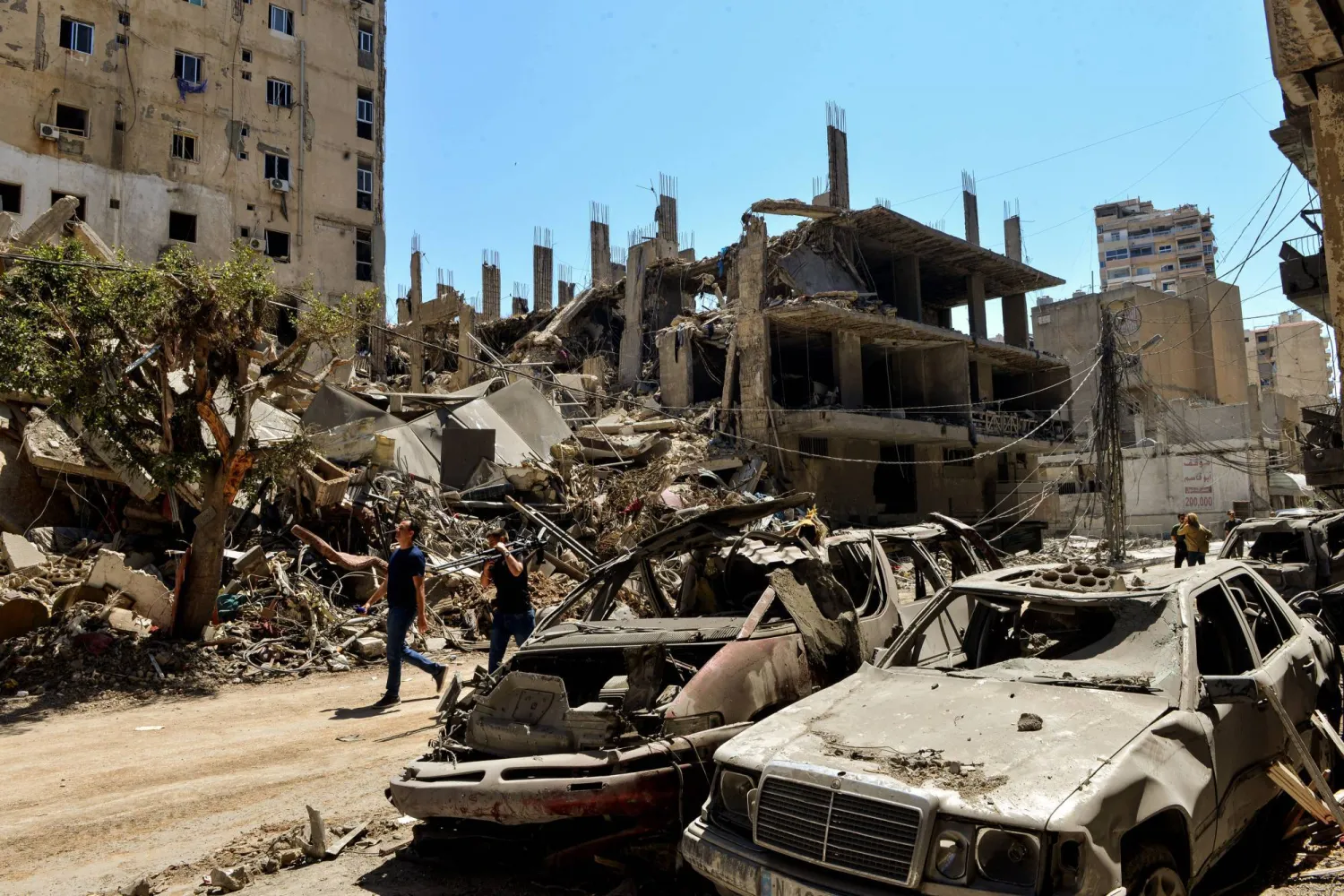
Residents walk amid buildings destroyed by Israeli bombardment in the city of Tyre, Lebanon (dpa). 
TT

Israel Pushes Beyond ‘Yellow Line’ in Lebanon to Target Hezbollah and Bolster Negotiating Leverage

Residents walk amid buildings destroyed by Israeli bombardment in the city of Tyre, Lebanon (dpa). 

Israel’s latest advance beyond the self-declared “Yellow Line” in southern Lebanon has raised questions about whether the expansion is driven solely by military objectives or also reflects broader political calculations, particularly as it coincides with reports of a US-Iran agreement that would include a comprehensive ceasefire in Lebanon.

On Saturday, Israeli forces made fresh gains along both the western and eastern fronts beyond the Yellow Line. Troops advanced toward the outskirts of Majdal Zoun following four days of artillery and air strikes, while forces also pushed into Kfartebnit, reaching the approaches to the strategically important Ali al-Taher Heights, which overlook the city of Nabatieh and much of the surrounding region.

The “Yellow Line” is the term adopted by the Israeli military in spring 2026 for a belt of territory inside southern Lebanon that it considers a military buffer zone, similar to the model previously employed in Gaza. The zone extends roughly 4 to 10 kilometers into Lebanese territory and encompasses about 55 border towns and villages.

Retired Brig. Gen. Mounir Shehadeh said military operations beyond the Yellow Line are concentrated in Kfartebnit, Zawtar al-Sharqiya, Yahmar al-Shaqif, Arnoun, and the Beaufort Castle area.

Speaking to Asharq Al-Awsat, Shehadeh argued that Israel is “racing against time” because it believes any US-Iran agreement could force an end to hostilities. As a result, he said, Israel is seeking to advance as far as possible before negotiations begin, allowing it to bargain from a position of strength.

He noted a distinction between villages entered by Israeli troops and those brought under operational control. Some communities have been incorporated into what Israel describes as a security zone, where residents are barred from returning and where Israeli forces maintain control through surveillance and firepower, even without a permanent troop presence.

According to Shehadeh, Israeli-controlled areas now extend between 5 and 10 kilometers inside Lebanese territory and include villages whose residents have been prohibited from returning.

Israel’s stated goal, Shehadeh underlined, is to push Hezbollah forces farther from its northern border, prevent future cross-border attacks on Galilee communities, destroy military infrastructure and weapons stockpiles, and establish a buffer zone to protect border settlements.

Its unstated objectives, however, may be broader. These include creating a new security belt resembling the zone Israel occupied between 1982 and 2000, turning border villages into sparsely populated areas that would make it difficult for Hezbollah to reestablish itself, and securing strategic high ground and transportation corridors. Such gains could provide Israel with significant leverage in future negotiations involving Lebanon and the postwar regional order.

For his part, Dr. Riad Kahwaji, defense and security analyst, said Israel is advancing along three separate axes, primarily to eliminate Hezbollah infrastructure, some of it located beyond the Yellow Line.

The eastern axis runs from Beaufort Castle through Kfartebnit and the Ali al-Taher Heights, placing Israeli forces in a position overlooking Nabatieh and potentially opening the way toward the Iqlim al-Tuffah region, where Hezbollah is believed to maintain tunnel networks.

The central axis stretches north of Bint Jbeil and Tebnine toward Ghandouriyeh in an effort to encircle Wadi al-Hujayr, long regarded as a key defensive zone and another suspected tunnel hub.

The western axis centers on Majdal Zoun and extends toward Qlayleh, potentially bringing Israeli forces closer to the approaches of the coastal city of Tyre.


UKMTO: Container Vessel Fired upon and Boarding Attempted by Skiff off Yemen Coast

Patrol boats affiliated with the Yemeni coast guard off the port of Mokha in the southern Red Sea (Saba News Agency)
TT

UKMTO: Container Vessel Fired upon and Boarding Attempted by Skiff off Yemen Coast

Patrol boats affiliated with the Yemeni coast guard off the port of Mokha in the southern Red Sea (Saba News Agency)

The United Kingdom Maritime Trade Operations received a report on Monday ‌that ‌a container ‌vessel was ⁠approached and fired upon ⁠by a small skiff 14 ⁠nautical miles south ‌off the ‌coast of ‌Yemen, ‌with an attempted boarding.

Authorities are investigating, ‌and vessels are advised ⁠to transit ⁠with caution and report any suspicious activity to UKMTO, it said.


Lebanon’s Aoun Hopes US-Iran Deal Will Put ‘Definitive End’ to Israel-Hezbollah War

 A man walks amidst rubble in the aftermath of Israeli strikes in Nabatieh, Lebanon, June 15, 2026. (Reuters)
A man walks amidst rubble in the aftermath of Israeli strikes in Nabatieh, Lebanon, June 15, 2026. (Reuters)
TT

Lebanon’s Aoun Hopes US-Iran Deal Will Put ‘Definitive End’ to Israel-Hezbollah War

 A man walks amidst rubble in the aftermath of Israeli strikes in Nabatieh, Lebanon, June 15, 2026. (Reuters)
A man walks amidst rubble in the aftermath of Israeli strikes in Nabatieh, Lebanon, June 15, 2026. (Reuters)

Lebanese President Joseph Aoun on Monday expressed hope that a deal between Washington and Tehran to end the Middle East war would put a "definitive end" to the conflict between Israel and Hezbollah.

In a statement issued by his office, Aoun praised the memorandum's affirmation that "Lebanon's security and safety are an integral part of any effort to consolidate stability in the region".

The Lebanese people "look forward to these understandings transforming into practical steps that put a definitive end to the cycle of violence and establish a phase of stability, security, recovery and reconstruction," the statement added.

Israel’s defense minister said Monday that Israel won’t withdraw from land occupied in Lebanon as the interim deal between Iran and the United States is pending.

Katz said Israel plans to stay “indefinitely” in lands it holds in Lebanon, as well as Syria and the Gaza Strip.

Iran has tied the interim deal over the war to halting Israel’s attacks on Hezbollah in Lebanon.

Meanwhile, two Israeli far-right ministers denounced the deal.

"We must not settle for anything less than the dismantling of Hezbollah. We must not withdraw from a single inch of territory that our soldiers have captured and cleared of terrorist infrastructure," National Security Minister Itamar Ben-Gvir said on his Telegram channel said.

Finance Minister Bezalel Smotrich also echoed the sentiment, calling the deal "bad for Israel".

He also called for a stronger campaign in Lebanon.

"We will be judged in Lebanon. This is our war, our soldiers, and the immediate security of our northern residents," he said.


Lebanon ‘Not Informed’ of Terms of Iran-US Deal, Says Official

A photograph taken from the southern area of Marjeyoun shows smoke rising from fires reportedly ignited at a site targeted by Israeli artillery shelling in the southern village of Kfar Tibnit on June 15, 2026. (AFP)
TT

Lebanon ‘Not Informed’ of Terms of Iran-US Deal, Says Official

A photograph taken from the southern area of Marjeyoun shows smoke rising from fires reportedly ignited at a site targeted by Israeli artillery shelling in the southern village of Kfar Tibnit on June 15, 2026. (AFP)

Lebanon has not been informed of details of an agreement between the United States and Iran to end the Middle East war on all fronts including in Lebanon, an official source told AFP on Monday.

Lebanon's state-run National News Agency (NNA) reported intermittent artillery shelling in the country's south on Monday but no airstrikes -- a lower level of violence compared to previous days.

Hezbollah has not commented on the agreement, but the Iran-backed group has not claimed any fresh attacks on Monday on Israeli targets.

"Lebanon was not informed of the terms of the agreement or the time of the ceasefire," the source said on condition of anonymity.

Few details have been made public about the agreement announced overnight.

Lebanese parliament Speaker Nabih Berri, a Hezbollah ally who acts as an intermediary between the group and the US, praised the deal, thanking the United States and Tehran for their "insistence on including... an essential and binding clause on halting the Israeli aggression on all of Lebanon".

Israel and Hezbollah have been at war since March 2 when the Iran-backed group fired rockets at Israel to avenge the killing of Iran's supreme leader in US-Israeli strikes days earlier.

Israel responded with a campaign of airstrikes and a ground invasion. Previous ceasefire announcements have failed to stop the fighting.

Pakistan's Prime Minister Shebhaz Sharif, whose country has been mediating between Tehran and Washington, said that "both sides have declared the immediate and permanent termination of military operations on all fronts, including in Lebanon".

Iran's Deputy Foreign Minister Kazem Gharibabadi said that "a permanent and immediate end to the war has been declared on all fronts, including Lebanon".

AFP correspondents on Monday reported a cautious return of some residents to their homes in areas of south Lebanon not occupied by Israel's army.
