


Positive Signs Emerge on Gaza Deal after Mladenov-Hamas Talks

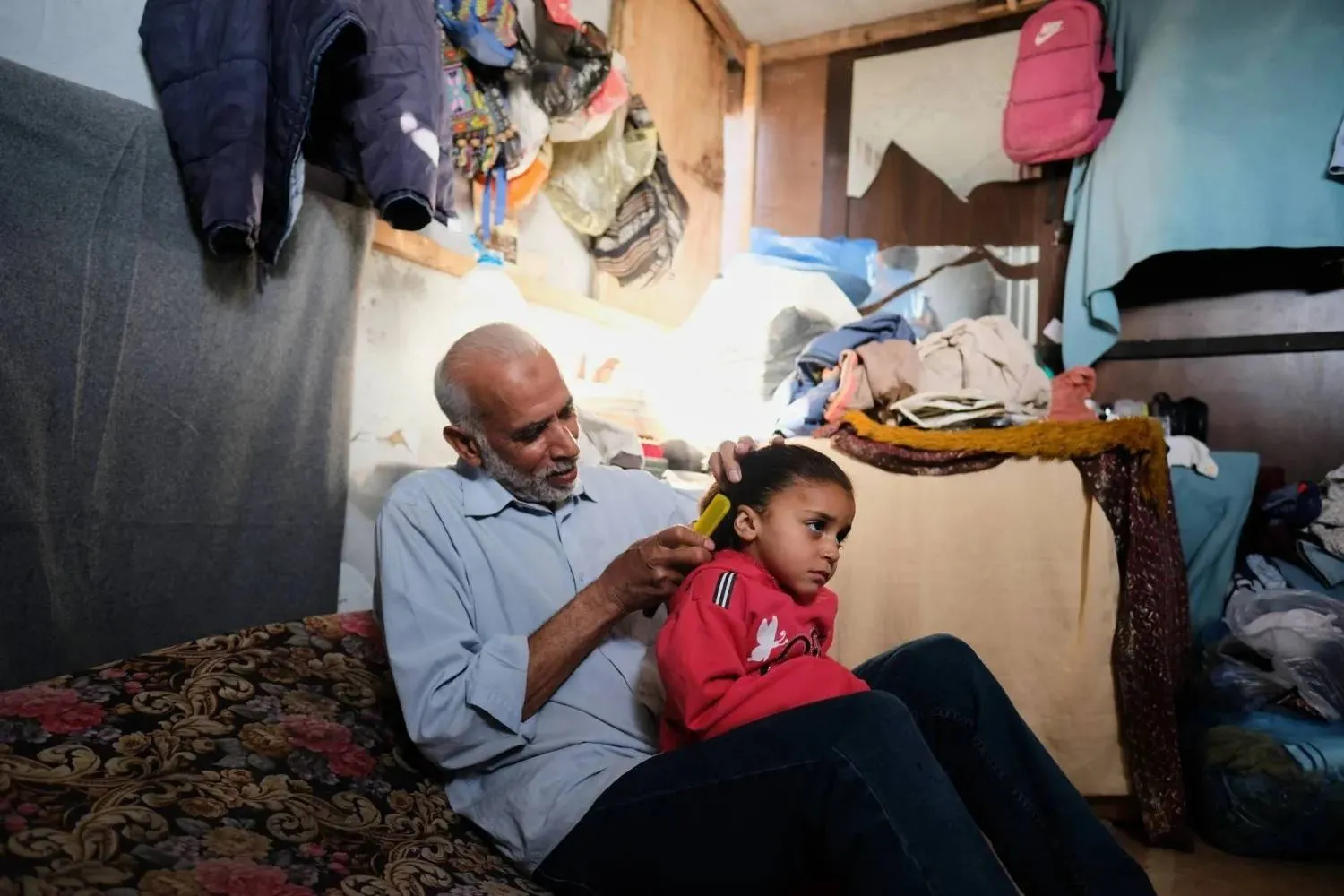
Palestinian Mahmoud Nofal combs the hair of Raneen, his 3-year-old granddaughter, whom he is caring for after her parents were killed in an Israeli strike in Khan Younis. (AP)
TT

Positive Signs Emerge on Gaza Deal after Mladenov-Hamas Talks

Palestinian Mahmoud Nofal combs the hair of Raneen, his 3-year-old granddaughter, whom he is caring for after her parents were killed in an Israeli strike in Khan Younis. (AP)

A source from the team of Board of Peace envoy Nickolay Mladenov and another from Hamas said there were “positive” signs toward completing implementation of the fragile ceasefire agreement in Gaza, announced last October.

The two sources spoke separately to Asharq Al-Awsat about the mood around meetings Mladenov held in Cairo with a Hamas delegation and representatives of the mediator states, Egypt, Qatar, and Türkiye.

The talks aimed to advance US President Donald Trump’s Gaza plan, which the UN Security Council adopted in a resolution last November.

The source from Mladenov’s team said the meeting with Hamas had ended with “very positive” results and that gaps had been bridged on all provisions of the road map, referring to the first version presented by Mladenov.

The source said Hamas told Mladenov it would respond to the proposals after internal consultations, before the middle of next week.

New amendments from Mladenov

Asharq Al-Awsat learned from factional sources and others close to the Cairo talks that Mladenov made new amendments before his meetings, in light of the latest response from Hamas and the Palestinian factions, which the mediators received days ago.

Indirect talks between Israel on one side and Hamas and the factions on the other had been stalled over moving to new stages of the ceasefire agreement, which Israel has repeatedly breached. Israel has killed nearly 1,000 Palestinians since then.

The Palestinian side insists on implementing the requirements of the first phase, including the withdrawal of the Israeli army from the territory it occupies and the entry of aid and goods into the enclave. Israel, meanwhile, is pressing for the disarmament of the factions, the most prominent item in the second phase.

A Hamas source told Asharq Al-Awsat that the Egyptian mediator delivered the amended wording to the movement’s leadership in Cairo after midnight Tuesday into Wednesday. The leadership has been in the Egyptian capital for about 10 days.

Hamas meeting with Mladenov

According to the same source, the Hamas delegation met Mladenov in Cairo on Wednesday afternoon to explain the importance of the amendments made to the road map and try to speed up the movement’s response. The source said the amendments would be discussed with the Palestinian factions before a reply is given.

Later Wednesday, after the source’s comments, Hamas announced it had met Mladenov. In a statement, it said discussions with the mediators had produced “broad understandings” and that Tuesday had seen “significant convergence” toward ensuring implementation of what remains of the first phase, alongside discussion of second-phase files.

Hamas said it discussed the entry of the “national committee” into Gaza, international forces and the handling of Palestinian weapons “within a logical and reasonable approach acceptable to all parties.”

A source from a Palestinian faction in Cairo confirmed that Hamas had notified them of the meeting with Mladenov and of comments that would be presented to the factions later in the day.

A source from Mladenov’s team said the meeting was held as a procedural step to brief Hamas on the amendments required for approval.

The source said, “These amendments were made in coordination with US envoy Jared Kushner and the mediators, with the aim of narrowing the gap between the Palestinian and Israeli positions in a way that allows negotiations to move forward.”

The source said amendments had been made to all 15 provisions of the road map, not only Article 8 on weapons, “where it can be said that the gaps have been fully closed.”

Article 8 focuses on how to carry out a gradual process to inventory and store weapons in Gaza. Hamas has insisted that this be done under the supervision and custody of a Palestinian party and in parallel with Israel’s withdrawal from the areas it occupies in Gaza, which account for more than 60% of the enclave.

Last month, public differences between Hamas and Mladenov were sharp, and a meeting between the two sides had been considered unlikely.

But the sources said, “positive developments during the Cairo meetings pushed toward this meeting, with the support of the mediators.”

Mediators, the US want to push the agreement forward

The Hamas source said the movement received assurances from the mediators on Tuesday evening that “the atmosphere is positive, and that there are some comments from the Board of Peace representative, which require more time.”

The source said, “The mediators want to accelerate reaching an agreement, and representatives of most of the factions taking part in the meetings therefore remained in place to settle the matter more quickly.”

The source assessed that “there is a strong desire among the mediators, Mladenov and the US administration to push toward an agreement as quickly as possible, in a way that would bring stability to the entire region.” The source added that “there are moves and Arab support from other countries with no direct role in the mediation to advance an agreement that would fully end the war on Gaza.”

From midday Tuesday until this report was prepared at midday Wednesday, Gaza time, the Gaza Strip saw noticeable calm on the ground, with no new casualties recorded.

Asharq Al-Awsat asked the source from Mladenov’s team whether arrangements had been made between the Board of Peace representative and Israel to halt strikes on the enclave. The source said the Israelis “gave us 48 hours of calm.”



Atef Najib’s Fifth Closed-Door Hearing Held Amid Public Pressure on His Lawyer

 Former security official Atef Najib is questioned during a fifth closed-door hearing on Tuesday (Syrian Justice Ministry)
Former security official Atef Najib is questioned during a fifth closed-door hearing on Tuesday (Syrian Justice Ministry)
TT

Atef Najib’s Fifth Closed-Door Hearing Held Amid Public Pressure on His Lawyer

 Former security official Atef Najib is questioned during a fifth closed-door hearing on Tuesday (Syrian Justice Ministry)
Former security official Atef Najib is questioned during a fifth closed-door hearing on Tuesday (Syrian Justice Ministry)

Atef Najib denied all charges against him during the fifth closed-door session of his trial before Damascus’ Fourth Criminal Court, which adjourned proceedings until the 21st of this month.

Tuesday’s session was devoted to hearing witnesses for the public prosecution and civil claimants, amid reports that the defense lawyer retained by Najib had faced public pressure.

Fadel Abdulghany, chairman of the Syrian Network for Human Rights, who attended the hearing, said the court heard 14 testimonies from people who said they had been directly subjected to abuses by Najib.

As in the previous hearing, Najib denied responsibility for all charges against him.

Abdulghany said the next session would continue hearing witnesses. More than 51 claimants have joined the case, requiring the court to hear further testimony and examine documents and other evidence related to the charges.

Najib had denied the accusations during earlier sessions, saying he was not in Daraa when the Omari Mosque was stormed. He also denied that the Political Security branch he headed had detained children.

The fifth session was presided over by Judge Fakhreddin Mustafa al-Aryan, alongside judges Abdul Hamid Mohammed al-Hamoud and Hossam Hussein Abdul Rahman. Judge Omar Mahmoud al-Radi attended as the representative of the public prosecution.

Relatives of victims from Daraa province also attended, along with members of the National Commission for Transitional Justice, representatives of the United Nations Office of the High Commissioner for Human Rights, the Syrian Network for Human Rights, activists and representatives of international and official bodies following the proceedings.

Syrian Bar Association President Mohammed Ali al-Tawil told Asharq Al-Awsat that Najib’s trial was Syria’s first and most prominent transitional justice case and carried significant symbolic importance.

He said the bar association was closely following the proceedings, which he described as moving in a “good, smooth, lawful and positive manner,” despite the abuses suffered by Syrians under the former government and at Najib’s hands.

Al-Tawil said the first session was devoted to preliminary questioning, while the indictment was read during the second and Najib was allowed to respond.

The third, fourth and fifth sessions were devoted to hearing public prosecution witnesses. Around 35 testimonies have been heard, and the court will continue hearing witnesses at the next session.

Should the defense call witnesses, Najib’s lawyer will submit their names to the court, which will decide whether to hear their testimony, al-Tawil said.

He said the defense lawyer, a member of the Quneitra branch of the bar association, had come under considerable pressure for representing Najib.

The association supported the lawyer “to guarantee the defendant’s right to a defense, which is protected by law,” al-Tawil said, despite its conviction that Najib had played a prominent role in events in Syria in 2011.

He said a criminal court could not be properly constituted without a defense lawyer and that the bar association would appoint one if none were retained.

Al-Tawil said Syrian trials had undergone a significant qualitative transformation, citing the assessment of representatives of United Nations organizations monitoring Najib’s trial.

Hearing public prosecution witnesses is a key stage in criminal proceedings and one of the means of evidence used by the court in reaching its judgment. The court examines testimony alongside documents and other evidence in the case file, while guaranteeing the defense the right to question witnesses.

Ahead of the fifth session, the Justice Ministry released video clips of testimony given during previous hearings. The witnesses’ faces and identities were concealed in coordination with the witness protection program.

The testimony included details of torture and physical abuse suffered by detainees, particularly in the 2011 case involving children in Daraa, and Najib’s alleged responsibility.

Najib was a Political Security officer with the rank of brigadier general and is a maternal cousin of Bashar al-Assad. He served at several Political Security branches in Damascus and Tartous before becoming head of the branch in Daraa.

His name became associated with the detention of children accused of writing anti-government slogans on school walls at the start of the uprising in Daraa.


Barghouti’s Son to Asharq Al-Awsat: Father Shot, Denied Treatment as Incitement Continues

Prominent Palestinian leader Marwan Barghouti appears in court in Jerusalem. (AP file)
TT

Barghouti’s Son to Asharq Al-Awsat: Father Shot, Denied Treatment as Incitement Continues

Prominent Palestinian leader Marwan Barghouti appears in court in Jerusalem. (AP file)

Arab Barghouti, the son of detained prominent Palestinian leader Marwan Barghouti, 67, said an Israeli prison guard fired a rubber bullet at his father last week at Ganot Prison in the Negev desert in southern Israel and that he received no treatment for the injury.

“The guard shot my father in the foot,” he told Asharq Al-Awsat, adding that the family learned of the incident through Barghouti’s lawyer, prominent Israeli civil rights attorney Avigdor Feldman.

The Israel Prison Service told AFP that the allegation was “false and baseless”, saying its staff operated “in accordance with the law and under continuous judicial oversight”.

Barghouti remains a prominent figure in Palestinian politics despite having been imprisoned for nearly a quarter of a century. He won the highest number of votes among those elected to Fatah’s Central Committee in an internal vote held two months ago.

His son described the shooting as “a new attempt to undermine him amid continued Israeli incitement”, which he said had intensified in recent weeks as an international campaign for his father’s release expanded.

He said the scale of the targeting reflected Marwan Barghouti’s stature, influence and symbolic importance, and expressed confidence that he would ultimately regain his freedom.

Many Palestinians regard Barghouti as a potential savior because of his broad popularity within Fatah and other factions, including Hamas, which has repeatedly sought his release through prisoner-exchange deals. Israel has refused.

The latest Israeli campaign against him was led by the Israel Prison Service, which sought to compare him to Hamas leader Yahya Sinwar, whom Israel killed during the war in Gaza.

The reported incident was not the first assault alleged against Barghouti.

A lawyer who visited him on April 12 said he had been attacked three times, on March 24, March 25 and April 8, leaving him bleeding from several parts of his body without adequate medical treatment.

Israeli lawyer Ben Marmarelli said Barghouti had been severely beaten and, on one occasion, left bleeding for more than two hours. The Israel Prison Service said it was unaware of the incident.

Marwan Barghoutyi's son, Arab. (AFP file)

Call for international investigation

The Arab League called on Sunday for an international committee to investigate the “repeated assaults” against Barghouti and for the perpetrators to be brought before an international court.

Barghouti is believed to have been held in solitary confinement for two and a half years.

Last year, Israel’s far-right National Security Minister Itamar Ben-Gvir posted a short video showing him confronting Barghouti inside his cell and speaking to him in a condescending and threatening manner.

The confrontation brought Barghouti further into the spotlight, and US President Donald Trump later said he was considering his case and whether he should be released.

Trump said last October that he might call on Israel to free Barghouti and had discussed the possibility with White House aides.

His remarks increased Barghouti’s political importance among Palestinians, many of whom describe him as the “Palestinian Mandela”.

Informed Palestinian sources told Asharq Al-Awsat after Trump’s comments that Barghouti would certainly run in the next presidential election.

“He will most likely be Fatah’s candidate,” the sources said. “But even if that does not happen for any reason, he will run because he is Marwan.”

An election process canceled at the last moment five years ago indicated the path Barghouti intended to take.

He formed a list with Nasser al-Qudwa, then an expelled member of Fatah’s Central Committee, to challenge the movement’s official list. Barghouti’s name was not included because he planned to run for president.

The reported shooting came as the Israel Prison Service issued an unusually harsh report against him.

The service said Barghouti had not fundamentally changed but had changed his image, replacing weapons with words and the image of a convicted terrorist with that of Nelson Mandela, while continuing to direct matters from his isolation cell.

The report, published on Friday in the “Seven Days” supplement of Yedioth Ahronoth, said Barghouti no longer fired weapons but that his ideology and ideas had become “a form of intellectual terrorism”.

It accused him of trying to influence Israel’s Arab community and its voting patterns before the next election.

The report said he had built “relationships with Arab members of the Knesset to interfere in Israeli politics, influence elections in Israel and affect voter turnout among Arab citizens of Israel”.

“He is like Yahya Sinwar, only more cunning,” an Israeli officer was quoted as saying. “A wolf in sheep’s clothing. He will mobilize an extremist force and, as soon as he has the opportunity, he will attack us. He is far more dangerous.”

Israeli journalist Raviv Drucker rejected the report, writing in Haaretz that it was so disgraceful that he wondered whether it was Barghouti’s way of mocking Israel.

Drucker accused Israeli intelligence of acting as a tool for Ben-Gvir.

A view of an art installation of Marwan Barghouti in his birthplace, the West Bank village of Kobar, north of Ramallah, November 27, 2025. (AP)

He said Barghouti could play an important role in building a new Palestinian leadership and expressed hope that someone in the security establishment would know how to deal with him more wisely than Israeli intelligence.

Israel’s right-wing Channel 14, which is close to Prime Minister Benjamin Netanyahu, responded that Drucker had not yet understood the new reality and was supporting a political role for “a terrorist convicted of five murders”.

Channel 14 presenter Lital Shemesh rejected the idea that a Palestinian leadership seeking peace could emerge.

“Barghouti must remain in prison until the last day of his life,” she said. “Without hope, without glory and without a single moment of freedom.”

International campaign for his release

Barghouti’s wife, lawyer Fadwa Barghouti, issued a statement on Monday in response to the latest Israeli campaign against her husband.

She said the Israel Prison Service report coincided with the expansion of the international “Freedom for Marwan, Freedom for Palestine” campaign, the participation of international figures and leaders, and growing official and public support around the world.

“What the occupation has failed to understand throughout the past quarter of a century, and still fails to understand today, is that Marwan has never abandoned his conviction that freedom is a right and that the occupation will come to an end,” she said.

“Incitement and assault will not change this truth. They will not remove Marwan from the consciousness of his people or from the conscience of free people around the world, nor will they take from Marwan his love for his homeland, his love for the people and his commitment to them.”

“We will meet again soon, Marwan,” she added. “And our people have an appointment with life, freedom and dignity.”


Lebanon Arrests ‘Israeli Agent’ Whose Intel Led to Assassination of Top Hezbollah Officials

Mourners gather during the funeral of Hezbollah senior commander Fuad Shukr, who was killed in an Israeli strike, in Beirut's southern suburbs, Lebanon August 1, 2024. (Reuters)
TT

Lebanon Arrests ‘Israeli Agent’ Whose Intel Led to Assassination of Top Hezbollah Officials

Mourners gather during the funeral of Hezbollah senior commander Fuad Shukr, who was killed in an Israeli strike, in Beirut's southern suburbs, Lebanon August 1, 2024. (Reuters)

Lebanese security and judicial authorities have opened a new espionage case involving Israel after arresting a Lebanese man suspected of links to Israel’s Mossad intelligence agency and of passing detailed security information about Hezbollah leaders and targets.

The military judiciary took over the case after the Internal Security Forces’ Information Branch completed its preliminary investigation.

A Lebanese judicial source familiar with the case said the detainee was considered one of the most dangerous agents because of his ties to Hezbollah officials and his ability, according to initial investigations, to access sensitive information used in operations targeting senior leaders.

The source told Asharq Al-Awsat that security forces arrested the man, a member of the Khalifeh family, at Rafik Hariri International Airport last week after previously tracking him, monitoring telephone numbers that were in contact with suspicious numbers abroad, and obtaining detailed information about his dealings with Israel.

The source described him as “a high-level Israeli agent” who posed a serious threat.

The suspect was preparing to leave Lebanon for Iraq when he was arrested.

The source said he traveled between Beirut and Iraq and was married to an Iraqi woman. Initial investigation findings indicated that he traveled from Iraq to Türkiye to meet people linked to Mossad, where he handed over information collected in Beirut about specific targets.

The judicial source said the information he passed to Israel helped identify targets that led to the assassination of Hezbollah officials in 2024, including four senior security commanders.

They are believed to have included Fuad Shukr, who was assassinated in August 2024, and Ibrahim Aqil, who was assassinated in September that year.

The arrest comes amid a series of detentions involving dozens of people who formed espionage networks for Israel, particularly after the latest war, which saw complex security and intelligence operations targeting Hezbollah leaders and facilities.

The source said the case’s seriousness was linked not only to the accusations against the detainee but also to his position and relationships.

According to the investigation, he was close to several Hezbollah leaders, giving him access to sensitive information.

The detainee underwent preliminary questioning and was referred to the Military Court to begin his trial.

The case is expected to face further scrutiny because of the volume of information he is believed to have collected and the parties with which he is suspected of communicating.