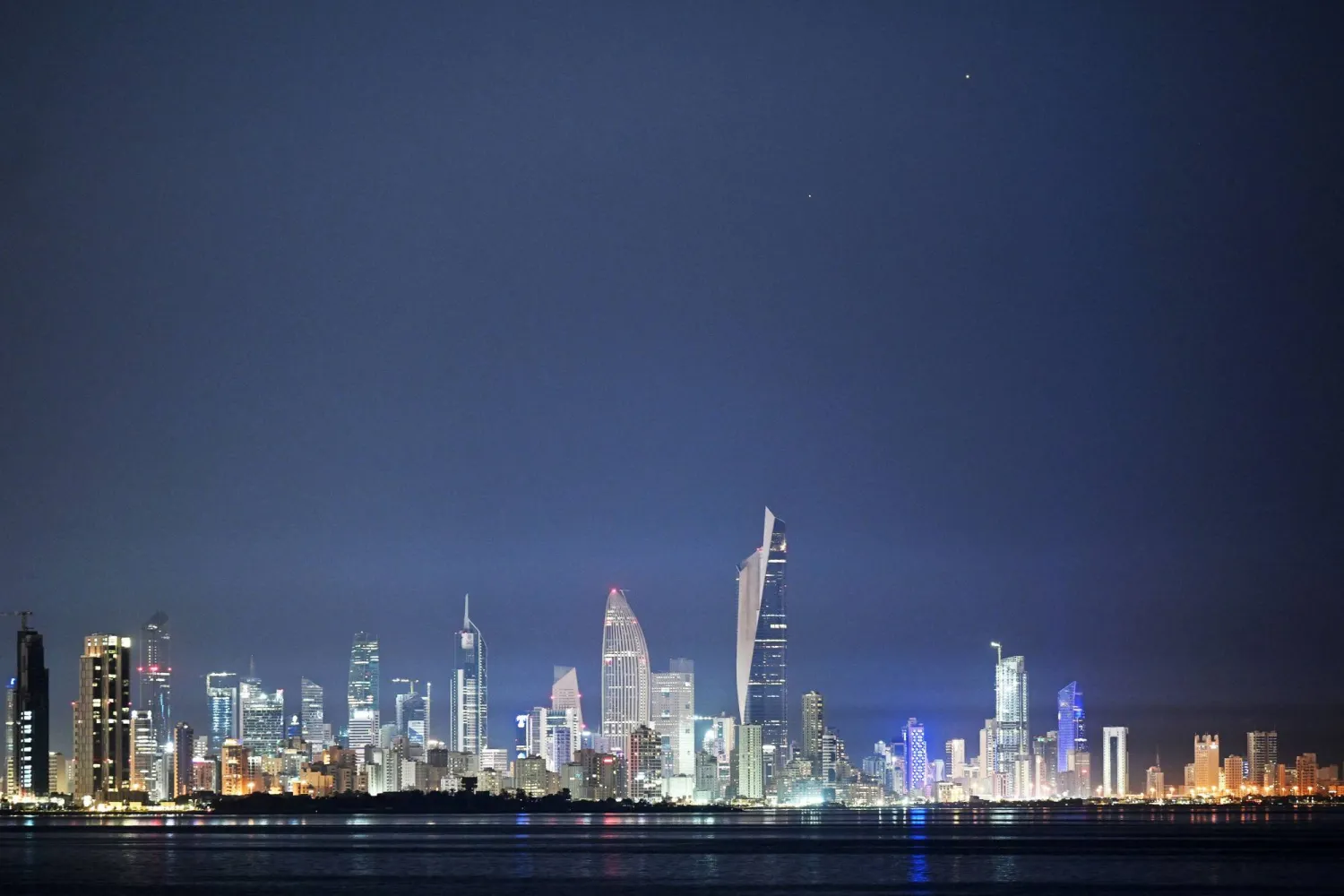
Kuwait Says All Force Majeure Issued During War Lifted

This photograph shows the conjunction of Jupiter and Venus over the skyline of Kuwait City on June 9, 2026. (Photo by YASSER AL-ZAYYAT / AFP)
TT

Kuwait Says All Force Majeure Issued During War Lifted

This photograph shows the conjunction of Jupiter and Venus over the skyline of Kuwait City on June 9, 2026. (Photo by YASSER AL-ZAYYAT / AFP)

Kuwait's Petroleum Corporation said on Thursday that all force majeure notices issued during the war have been lifted ⁠with immediate effect, ⁠government communication center reported on X.

Kuwait's oil ⁠production would increase to 2 million barrels per day within a week coinciding with the opening of Strait ⁠of Hormuz ⁠and resumption of commercial shipping, KPC added.


Saudi Aramco Weighs Global Oil Storage Facilities to Boost Energy Security

The Public Investment Fund governor addresses attendees at the summit in Rome, Italy. (Asharq Al-Awsat)
TT

Saudi Aramco Weighs Global Oil Storage Facilities to Boost Energy Security

The Public Investment Fund governor addresses attendees at the summit in Rome, Italy. (Asharq Al-Awsat)

Saudi Arabia laid out a new strategy in Rome to strengthen global supply chains and build a broader partnership model with Europe, seeking to move beyond current geopolitical pressures and deepen economic ties across regions.

Public Investment Fund Governor and Saudi Aramco Chairman Yasir Al-Rumayyan said Aramco was studying plans to establish additional oil storage facilities in strategic locations worldwide to strengthen energy security.

At the same time, he said the PIF was preparing about 140 new investment opportunities for European partners worth 10.4 billion euros by 2030, after its investments helped support European GDP by $80.6 billion and create 160,000 jobs.

The targets came as Riyadh activated 41 contingency and business continuity plans to address the fallout from the closure of the Strait of Hormuz and Bab al-Mandab and secure shipping and air traffic.

Italian Prime Minister Giorgia Meloni called for European-Gulf relations to move toward an untapped strategic integration linking three continents, while Saudi Arabia’s tourism sector continued to show resilience, supported by domestic and religious tourism despite regional pressures.

The remarks came during al-Rumayyan’s participation in a high-level panel at the FII PRIORITY Europe 2026 summit, affiliated with the Future Investment Initiative Institute, held in the Italian capital.

Al-Rumayyan said Saudi Aramco already owns vital oil storage facilities in several major global markets, particularly in Asia, South Korea and Japan. He said the company was now seriously studying additional storage facilities in different regions to help stabilize markets and protect supply lines from sudden shocks.

The Aramco chairman said recent crises had underscored the importance of long-term planning. The company, he said, maintained continuity in more than 99% of its operations during recent periods of tension and restarted facilities previously hit by missile attacks in record time, reflecting the efficiency of its infrastructure and the resilience of its supply chains.

On partnership with Europe, al-Rumayyan said the PIF planned to offer about 140 new investment opportunities to expand cooperation with European partners. The opportunities linked to joint projects are worth a total of 10.4 billion euros ($11.97 billion) and extend through 2030, he said.

He also pointed to regulatory and legal challenges that have slowed the expansion of Saudi investments in Europe and affected major companies such as Aramco, SABIC and the sovereign wealth fund.

Some rules, he said, not only limit new capital flows but also threaten the sustainability of existing projects. Still, he said European policymakers and regulators were aware of the obstacles, raising hopes for better solutions in the coming period.

On the wider energy transition, al-Rumayyan called for “energy realism,” saying new and renewable energy sources were an important strategic addition but not a full replacement for oil and gas.

Vital industries such as petrochemicals, fertilizers and food production still depend on fossil fuels, he said, while global energy demand is rising with the rapid expansion of artificial intelligence applications and data centers.

Europe and the Gulf

Meloni said the next phase required Europe and Gulf states to move toward a deeper relationship based on strategic partnership and economic integration. The two sides, she said, have major potential to link three continents and expand trade, energy flows and investment.

Speaking at the FII PRIORITY Europe 2026 summit in Rome on Thursday, Meloni said Europe needed to strengthen its independence and industrial and technological capabilities, while cooperation with the Gulf offered an opportunity to build a shared path that supports global stability and growth.

She said strengthening cooperation between Europe and Gulf states was a priority for the next phase, adding that the partnership had significant untapped potential and could become a decisive bridge between West and East, and between Africa and Asia.

Meloni said Italy intended to play a leading role in that effort as a gateway to Europe and a natural hub for energy, logistics and trade in the Mediterranean.

Europe and the Gulf, she said, could together offer a strategic cooperation model that can be replicated and expanded, turning energy, trade, infrastructure and connectivity networks into sources of stability rather than vulnerability.

Treaties of Rome

Meloni said the choice of Rome for the summit carried special significance. The city hosted the signing of the Treaties of Rome in 1957, which laid the foundations of today’s European Union. As the 70th anniversary of those treaties approaches, she said Europeans should reflect on the Europe they want and need to build.

She said that vision was aligned with the Future Investment Initiative’s role as a global agenda bringing together ideas, capital, technology and practical projects to build the future. She voiced hope that Rome would become the initiative’s permanent European stop, where results are measured, progress is reviewed and new priorities are set jointly.

Hormuz crisis

Saudi Transport and Logistics Services Minister Saleh al-Jasser said the current Strait of Hormuz crisis had required countermeasures, prompting Riyadh to activate 41 business continuity and emergency plans that had already been prepared and tested. That readiness, he said, allowed the kingdom to respond quickly from the earliest days of the crisis.

Speaking at the summit, al-Jasser said the region was facing difficult conditions, but Saudi Arabia was ready to address the developments. He cited a 2013 experience when the kingdom faced challenges in the Red Sea and had to redirect its trade eastward toward the Arabian Gulf, while protecting trade flows and preserving supply chain resilience.

Al-Jasser said the kingdom helped manage disrupted flights and evacuate passengers who had landed at different airports. It also rerouted ships bound for ports in the Eastern Province to ports in the western region.

The minister said the challenges were not limited to the closure of the Strait of Hormuz but also included ongoing difficulties in Bab al-Mandeb.

Some international shipping companies, he said, were hesitant to cross, requiring coordination, information sharing and a greater role for the private sector. Since the start of the current crisis, more than 23 new shipping services have been launched in coordination with the private sector, he said.

Saudi tourism developments

Saudi Tourism Minister Ahmed al-Khateeb said domestic tourism represents between 60% and 65% of total tourism activity in the kingdom, making it a key source of balance and stability during periods of disruption to international travel.

Strong local demand, he said, helped keep Saudi Arabia’s tourism sector moving, particularly during seasons and holidays when domestic destinations reach full bookings. That demand strengthened the sector’s ability to withstand external shocks.

Al-Khateeb said the global and Saudi tourism sectors had faced pressure in recent months from geopolitical tensions, higher travel costs and fluctuations in air traffic. Even so, he said the system had shown an ability to recover and maintain relative stability.

Global tourism has fully recovered from the fallout of the coronavirus pandemic, he said, with the number of travelers worldwide reaching about 1.5 billion last year and total spending hitting about $2.2 trillion. Yet travelers still represent only about 20% of the world’s population, he said, pointing to significant room for growth.

In Saudi Arabia, he said, the kingdom received about 123 million visitors in the previous year. Tourism now accounts for 5.2% of GDP, with a strategic target to raise that share to 10%.

Al-Khateeb said the sector has created about 1 million jobs since the launch of tourism transformation programs, driven by expanding investment in destinations, infrastructure and related services.

“The start of this year was strong for Saudi Arabia and Gulf states, before tourism movement was affected by regional tensions, higher fuel costs and the cancellation of a number of flights, which affected demand levels and travel costs,” he said.

Despite those pressures, he said the kingdom ended the first five months of the year with positive performance and only a slight decline of about 5% to 6% compared with the same period last year. He described that as a “resilient” performance under global conditions.

Al-Khateeb said religious tourism remains a core pillar of stability, as Saudi Arabia hosts the Two Holy Mosques, ensuring a steady flow of visitors throughout the year for Hajj and Umrah.

Former president of the Future Investment Initiative Institute Richard Attias said Europe was at a turning point as the world undergoes rapid and unprecedented change.

According to Attias, artificial intelligence is reshaping industries, capital flows are shifting, energy systems are being redrawn, supply chains are being restructured, geopolitical balances are changing and new global centers are emerging at an exceptional pace.


Syrian Petroleum Company to Asharq Al-Awsat: Syria to Receive 56% Share of US Gas Development Deal

During the signing of the agreement between the Syrian Petroleum Company and US firms ConocoPhillips and Novaterra Energy. (SANA)
TT

Syrian Petroleum Company to Asharq Al-Awsat: Syria to Receive 56% Share of US Gas Development Deal

During the signing of the agreement between the Syrian Petroleum Company and US firms ConocoPhillips and Novaterra Energy. (SANA)

Mohammad Nour Al-Ahdab, Director of Media Relations at the state-owned Syrian Petroleum Company (SPC), revealed on Thursday that under the contract signed with US companies ConocoPhillips and Novaterra Energy to develop and increase production from Syria’s gas fields, the Syrian side will receive a 56 percent share under the agreement, while the two investing companies will hold the remaining 44 percent.

Al-Ahdab told Asharq Al-Awsat that the arrangement is “favorable for Syria, particularly since gas-development contracts are typically structured close to a 50-50 split because of the scale of investment, technical and operational risks, and the nature of rehabilitation and production activities.”

He added: “What matters most to us is that the contract was designed to safeguard the national interest and deliver clear economic and technical returns through increased domestic production, stronger energy security, a gradual reduction in imports, and the transfer of expertise and technology to Syrian personnel.”

In what represents the most significant strategic breakthrough in economic and political relations between Damascus and Washington since the fall of the regime of Bashar al-Assad in late 2024, SPC on Tuesday signed a major implementation agreement with ConocoPhillips and Novaterra Energy to develop gas fields and increase production.

The move marks the country’s first major US energy deal in years and serves as a tangible indication of the beginning of a phase of “full-scale implementation,” supported by US President Donald Trump’s decision to lift sanctions in July 2025.

The contract follows earlier US initiatives launched at the beginning of 2026 through memoranda of understanding signed by other companies, including Chevron for offshore exploration and HKN Energy for the onshore Rmeilan fields.

However, the ConocoPhillips agreement stands out as the largest binding implementation contract aimed at developing the domestic gas sector, backed by Gulf and European partnerships and financing arrangements intended to help end the country’s severe energy crisis.

Al-Ahdab described the agreement as an important milestone in the rehabilitation and development of Syria’s gas sector because it moves cooperation with international partners beyond the memorandum-of-understanding stage and into formal contractual commitments and practical implementation.

“The importance of the agreement stems from several factors,” he said. “First, it targets the development of a number of existing gas fields and an increase in their production, which will support the energy system, particularly gas supplies needed for the electricity sector and other vital industries. Second, it opens the door to the introduction of international expertise and technologies in assessment, rehabilitation, processing, and operational-efficiency enhancement.”

According to Al-Ahdab, the agreement also reflects a clear commitment by SPC and the Ministry of Energy to building strategic partnerships capable of accelerating the recovery of the energy sector, gradually reducing reliance on imported gas, and preserving the role of Syrian professionals by empowering them through training and knowledge transfer.

“For us, this is not merely a production agreement,” he added. “It is part of a broader vision to rebuild the energy sector on sustainable technical and economic foundations in a manner that serves the national economy and meets citizens’ needs over the medium and long term.”

Al-Ahdab said the contract includes implementation phases related to the development of existing fields, the rehabilitation of operational infrastructure, and the gradual increase of gas production.

“There are also subsequent phases linked to additional development and exploration activities, subject to technical and contractual approvals agreed upon by the parties,” he said.

He added that the duration of the contract “is tied to the nature of the technical work and the various stages of implementation and production. Details that can be officially disclosed will be announced through the approved channels.”


Saudi Arabia and Russia: A Strategic Partnership Beyond the Oil Barrel, Shaping Global Economic Stability

Saudi Arabia and Russia: A Strategic Partnership Beyond the Oil Barrel, Shaping Global Economic Stability
TT

Saudi Arabia and Russia: A Strategic Partnership Beyond the Oil Barrel, Shaping Global Economic Stability

Saudi Arabia and Russia: A Strategic Partnership Beyond the Oil Barrel, Shaping Global Economic Stability

Economic relations between Saudi Arabia and Russia have entered an advanced stage of strategic transformation, moving beyond traditional cooperation in energy markets toward a multidimensional partnership encompassing investment, technology, industry, and space. This development comes amid growing coordination between the two countries, strengthening their influence within the global economic landscape and providing greater stability to energy markets in an increasingly volatile geopolitical environment.

This momentum in bilateral relations coincides with Saudi Arabia’s prominent role as a principal guest of honor at the St. Petersburg International Economic Forum, reflecting the Kingdom’s growing presence at major international economic gatherings and underscoring the level of mutual trust between Riyadh and Moscow. The forum also served as an important platform for signing several agreements and memoranda of understanding that have expanded cooperation in investment, technology, and industry, advancing the partnership toward deeper strategic integration.

According to economists and specialists, the Saudi-Russian partnership has evolved beyond a conventional bilateral relationship into an influential balancing force within the international economic system, particularly through its contribution to energy market stability and support for economic diversification efforts aligned with the goals of Vision 2030, including increasing the contribution of non-oil sectors and localizing knowledge and expertise.

In this context, Saudi Shura Council member Fadl bin Saad Al-Buainain told Asharq Al-Awsat that the Kingdom has reshaped its economic relations in recent years around principles of balance and openness toward major global economic powers. He noted that Russia represents an important partner given its weight in global energy markets, making enhanced cooperation with Moscow a strategic choice that serves the interests of both countries while supporting the stability of international markets.

He added that coordination between Riyadh and Moscow—whether bilaterally or through the OPEC+ alliance—has helped achieve notable balance in oil markets and mitigate sharp fluctuations driven by geopolitical tensions. According to Al-Buainain, this model of cooperation has proven effective not only in the energy sector but also across broader economic and development fields.

He pointed out that the most significant areas of cooperation recently agreed upon during the St. Petersburg Economic Forum include the economy, energy, and food security, in addition to defense industries and technology, as well as important agreements facilitating travel and mobility between the two countries.

Al-Buainain emphasized that mining, technology, and space represent key pillars of bilateral cooperation due to their strategic importance to both sides. He explained that mining is among the Kingdom’s most promising sectors and a priority within its economic diversification plans, making it a natural area for cooperation with Russia. He also highlighted technology cooperation—particularly in artificial intelligence, digital transformation, and space technologies—as a priority under Vision 2030 because of its long-term strategic value.

He stressed the importance of moving from agreements to implementation, noting that serious efforts to activate these understandings would generate tangible economic benefits and provide greater momentum for the partnership in the coming years, thereby strengthening the strategic relationship between the two countries.

High-Quality Bilateral Cooperation

For his part, Dr. Abdulrahman Baashen, head of the Al-Shorouq Center for Economic Studies in Jazan, southern Saudi Arabia, said there is a growing Saudi-Russian drive to elevate bilateral cooperation to its highest possible level. He noted that this would lay the groundwork for a distinctive form of economic and industrial integration and establish a joint framework for addressing geopolitical challenges in the region and Europe, helping preserve economic stability at both the regional and international levels.

Baashen told Asharq Al-Awsat that relations between Riyadh and Moscow have accelerated across multiple sectors as the culmination of agreements signed over previous years, alongside ongoing coordination within OPEC+. He noted that this cooperation has supported global energy market stability amid geopolitical tensions, including the repercussions of the US-Iran conflict, while also expanding into technology, industry, space, and satellite-related fields.

He believes that several Vision 2030 initiatives have found significant opportunities for integration with Russian partnerships. In his view, bilateral cooperation has become a long-term strategic path carrying both political and economic dimensions, helping shape a new reality amid rapidly changing geopolitical conditions while providing greater opportunities for economic diversification and political stability.

Baashen also noted that the Saudi-Russian Joint Governmental Committee has helped launch more than 70 joint projects valued at over $70 billion. He added that the signing of 13 agreements and memoranda of understanding on the sidelines of the St. Petersburg Forum reflects a clear commitment to high-quality bilateral cooperation aimed at diversifying the economy, increasing joint investments, localizing advanced technologies, strengthening both countries’ regional and global presence, and fostering more balanced international relations that support economic and political stability worldwide.

Riyadh and Moscow as Drivers of Economic Stability

Former Chairman of the Federation of Saudi Chambers, Engineer Abdullah Al-Mubty, told Asharq Al-Awsat that Saudi Arabia and Russia maintain “full and continuous coordination to manage market imbalances through joint decisions to increase or reduce production, ensuring fair prices that serve both producers and consumers.” He explained that the importance of this cooperation stems from the fact that the two countries rank among the world’s largest oil producers and exporters. He added that Vision 2030’s objectives of economic diversification, attracting investment, and localizing technology make Russia a vital partner in Saudi Arabia’s pursuit of balanced international relations.

Al-Mubty argued that this Saudi-Russian alignment has created a safety net that prevents oil prices from either collapsing or soaring uncontrollably. The presence of both countries, he said, helps maintain global economic balance, ensures secure energy supplies, and supports the uninterrupted flow of oil to meet international demand. Beyond energy coordination, he noted, the two countries have also moved toward broader economic agreements aimed at promoting global stability.

Mining, Technology, and Space

Al-Mubty said that mining, technology, and space have become the principal pillars shaping the future of Saudi-Russian cooperation. Both countries are actively working to implement joint investment agreements that support economic diversification while advancing knowledge-transfer initiatives and enhancing the resilience of supply chains between them.

Regarding the mining sector, he highlighted the significant opportunities available to Saudi Arabia through Russian expertise, particularly in exploration activities. Russia’s long-standing leadership in geological surveying, he explained, can contribute substantially to assessing the Kingdom’s mineral resources and expanding joint investment opportunities in rare minerals. He also noted that Saudi Arabia’s major investment opportunities have become a strong attraction for leading Russian mining companies.

In the technology sector, recent developments have opened promising avenues for cooperation focused primarily on integrating artificial intelligence and digital transformation applications to improve operational efficiency and competitiveness in Saudi industry and mining. In this regard, Al-Mubty stressed the strategic importance of the partnership between the Public Investment Fund and the Russian Direct Investment Fund, manifested through dedicated investment vehicles aimed at financing and localizing advanced technologies.

He also highlighted the longstanding cooperation in the space sector, noting that agreements related to space exploration have paved the way for a new phase of joint work. This cooperation now extends to ongoing coordination with the Russian space agency Roscosmos in training Saudi personnel for space missions and collaborating on satellite navigation systems.

Investment and Trade

Al-Mubty stated that current trade exchange between Riyadh and Moscow stands at approximately $4 billion. He also expects Saudi Arabia to attract around $1.5 billion in direct Russian investment over the coming years. According to him, both countries are clearly committed to expanding these figures through new joint ventures, while the Saudi-Russian Business Council has set a strategic target of increasing bilateral trade to $12 billion in the years ahead.

He concluded that close cooperation between Riyadh and Moscow has become an indispensable pillar of global economic and energy-market stability by helping maintain a delicate balance between supply and demand. Expanding this partnership, he added, directly contributes to strengthening food security and diversifying investments in key sectors such as technology and agriculture, reducing the impact of geopolitical volatility on economic growth in both countries. He emphasized that the partnership’s greatest significance lies in three core areas: stabilizing energy markets, strengthening food security, and expanding non-oil investments.

A Deeply Rooted Partnership

Saudi economist Dr. Ibrahim Al-Omar, supervisor of the consultancy firm Sharah Studies, told Asharq Al-Awsat: “The partnership between Riyadh and Moscow extends beyond oil toward global economic stability. Saudi-Russian relations are no longer tied solely to the oil barrel, even though oil remains their backbone.”

Al-Omar elaborated on the operational dimensions of the partnership, saying: “As the two pillars of OPEC+, Saudi Arabia and Russia have led the coalition’s decisions to raise production ceilings by roughly three million barrels per day during 2025—equivalent to nearly 3 percent of global demand—through carefully phased increases that can be paused or reversed whenever market stability requires.”

Discussing recent crises, he added: “When the US-Iran conflict intensified and disruptions affected supplies through the Strait of Hormuz last May, most of the agreed production increase came from Saudi Arabia and Russia. This was the clearest demonstration that coordination between the two major producers acts as a safety valve that restrains volatility, eases inflationary pressures, and protects energy-dependent economies from geopolitical shocks.”

According to Al-Omar, the center of gravity in the relationship is increasingly shifting from traditional trade toward manufacturing and knowledge transfer. While energy in all its forms—conventional, renewable, and nuclear—remains at the forefront, greater emphasis is now being placed on industry, mining, the digital economy, artificial intelligence, and space sciences.

He said: “I saw this clearly during the Saudi Minister of Industry and Mineral Resources’ visit to Russia, where mining exploration opportunities covering 50,000 square kilometers across the Nuqrah, Suhaibrah, and Al-Duwaihi belts were presented. Discussions also included launching a joint technology platform worth $1 billion and expanding space cooperation that leverages Russia’s extensive experience in the field.”

Reviewing the broader indicators, Al-Omar said: “These developments are the product of a well-established institutional framework managed efficiently by the Joint Governmental Committee, which held its ninth session in Riyadh last December. The figures speak for themselves: more than 70 joint projects worth over $70 billion, alongside non-oil trade that surged from SAR 1.84 billion ($490.6 million) in 2016 to SAR 12.5 billion (around $3.3 billion) in 2024. In addition, 13 new agreements and memoranda of understanding were signed during the latest St. Petersburg Forum, where Saudi Arabia participated as the guest of honor.”

Al-Omar concluded that strengthening strategic cooperation between Riyadh and Moscow is no longer merely a bilateral matter. Instead, it has become a genuine and decisive balancing factor within an increasingly turbulent international system. It supports the goals of Vision 2030 by diversifying sources of income, localizing knowledge, and increasing the contribution of the non-oil sector, thereby fostering economic stability that extends beyond the two countries to the wider region and the global economy.