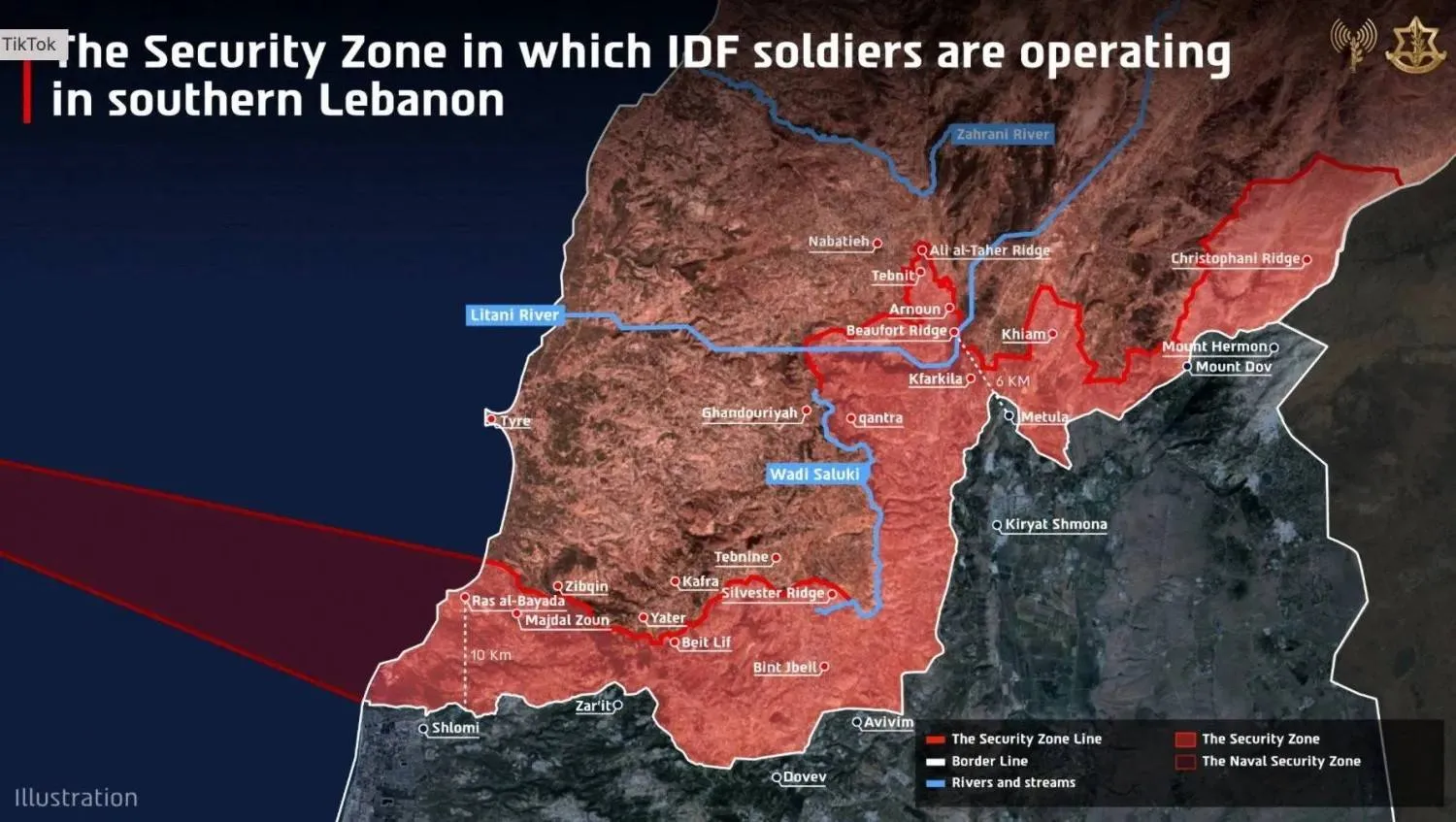

The map published by the Israeli army showing the areas where its forces are deployed in south Lebanon has raised questions about the implications of the US-Iranian agreement, as military operations continue and the issues of withdrawal and redeployment remain tied to anticipated Lebanese-Israeli negotiations in Washington.
While Israel speaks of a “security zone” inside Lebanese territory, Israeli army spokesman Avichay Adraee said Israeli forces are deployed “based on operational necessity” within an area extending roughly 10 kilometers into Lebanon, with the aim of removing what he described as threats and improving the defense of residents in northern Israel.
On the ground, two people were killed and another wounded in an Israeli drone strike that targeted a vehicle at the Kfar Tebnit roundabout. Drones also struck Hadatha without causing casualties, while another drone dropped a bomb on Beit Yahoun, wounding two people. An Israeli drone also dropped a stun grenade on a family inside a house in Nabatieh al-Fawqa near the teachers’ college.
Artillery shelling struck the outskirts of Nabatieh al-Fawqa, while the Israeli army carried out bulldozing operations in Khiam.
As Lebanese army troops and members of the Al-Risala Health Emergency Association entered Hadatha, Israeli forces opened fire toward civilians and Lebanese soldiers in the town. Villages in the eastern sector and the Marjayoun district remained relatively calm compared with other parts of southern Lebanon.
A field source in south Lebanon told Asharq Al-Awsat that the map “effectively reflects an attempt to impose a new reality on the ground following the US-Iranian understanding by treating vast areas of south Lebanon as zones under Israeli security and military control.”
The source said the boundaries shown on the map extend beyond what is known in some places as the “Yellow Line” and include areas where the Israeli army was unable to establish a permanent presence during the war, such as Ali al-Taher Hill and the southeastern outskirts of Hadatha.
The source noted that the Lebanese army is deployed inside Hadatha itself, while Israeli forces continue attempting to advance toward the surrounding high ground.
According to the source, “including these areas on the Israeli map has heightened residents’ fears and slowed the return of displaced people to Nabatieh and its surroundings.”
The concern, the source added, extends beyond Nabatieh city to include Dweir, Jibshit, Harouf, Zebdine, Mifadoun, Shoukine, Kfar Tebnit and Nabatieh al-Fawqa. These areas still lack basic living conditions, while near-daily artillery shelling continues, prompting many residents to delay their return.
The source said, “The boundaries Israel is drawing today closely resemble those that existed before its withdrawal from south Lebanon in 2000, stretching from the western sector through the central sector and into large parts of the eastern sector toward Khiam.”
Israel did not include in its current map some areas it previously occupied as far as the outskirts of Jezzine, the source said. In practice, however, it has treated the entire western and central sectors, together with the highlands extending east of Nabatieh toward the Marjayoun-Khiam axis, as falling within its security sphere of control.
The source said the most significant outcome of the period following the US-Iranian understanding has been Israel’s effort to draw what it described as “occupation boundaries” and establish them as a fait accompli on the ground by effectively turning these areas into an undeclared security belt.
According to the source, the line Israel is seeking to consolidate runs through the central sector along the Bint Jbeil and Wadi al-Salouqi axes, reaching Hadatha, Baraachit and Beit Yahoun.
Although Israeli forces are not physically deployed inside these towns, the source said they are treated as part of an advanced security zone and a new line of contact in south Lebanon.
No Signs of Israeli Withdrawal
Retired Brig. Gen. Bassam Yassin told Asharq Al-Awsat that the US-Iranian agreement has not yet translated into any tangible changes on the ground in south Lebanon.
The situation on the ground, he said, still reflects continued Israeli deployment in the areas under its control, while issues related to withdrawal and post-war arrangements remain under discussion in negotiations currently taking place in Washington.
Yassin said the map recently published by the Israeli army suggests that Israel views the areas it marked as territory under its military control, “as though it is saying these areas are under Israeli occupation, should not be approached, and that any movement within them will be treated as a security threat.”
He said one of the most important of these areas is Ali al-Taher. Many people, he noted, reduce it to a hill or small elevation, “when in fact Ali al-Taher is a mountain ridge extending between three and four kilometers from the area around Kfar Tebnit toward Kfar Rumman. Including large parts of it in what Israel considers an area under its control therefore carries important operational implications.”
“The Israeli occupation is currently consolidating the positions where it is deployed, while attempts to advance toward Ali al-Taher are still continuing,” he said.
Artillery and rocket fire in the Nabatieh area has also continued in recent weeks, he added, stressing that “there are still no real indications of Israeli withdrawals, contrary to what some believe.”
Yassin said the issues related to an Israeli withdrawal, redeployment or the deployment of the Lebanese army “are not decided on the ground but are being discussed within the framework of ongoing Lebanese meetings and negotiations in Washington.”
Any talk of withdrawal or new arrangements, he added, “remains premature at this stage.”
No Withdrawal
Meanwhile, Israel’s Channel 14 reported that “the future of the Israeli deployment in south Lebanon will be discussed during negotiations with the Lebanese side in Washington.”
Israel’s public broadcaster also reported that the issue of withdrawing from positions where Israeli forces remain deployed inside Lebanon will be raised during the next round of negotiations.
Yedioth Ahronoth reported that “the Israeli army has demanded that it retain a buffer zone inside south Lebanon while insisting on the dismantling of weapons in the south.”