
Lebanese Villagers Return to Find Homes in Ruins

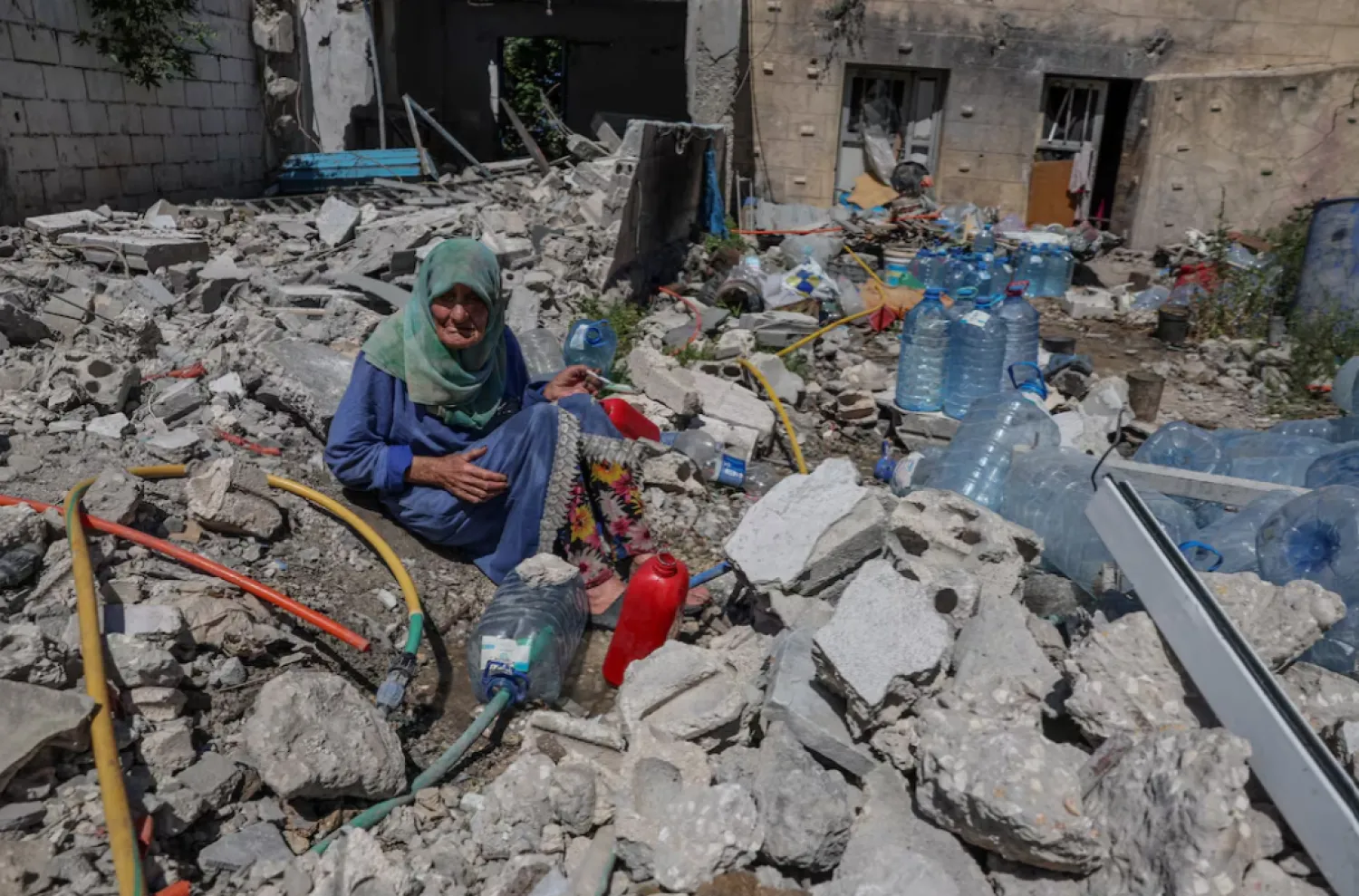
Khadija Amara, whom local residents said had not left her home, fills a jerrycan with water as she sits among the rubble of a house, which was damaged by an Israeli strike, in Qlaileh in the Tyre district, southern Lebanon, June 19, 2026. REUTERS/Zohra Bensemra
TT

Lebanese Villagers Return to Find Homes in Ruins

Khadija Amara, whom local residents said had not left her home, fills a jerrycan with water as she sits among the rubble of a house, which was damaged by an Israeli strike, in Qlaileh in the Tyre district, southern Lebanon, June 19, 2026. REUTERS/Zohra Bensemra

Abed Hachem rebuilt his home when it was damaged in a conflict between Israel and Lebanon's Hezbollah militants in 2024, but is at a loss now that most of his village has been destroyed in Israel's latest round of strikes.

Where his house once stood in Qlaileh is now rubble; where his garden bloomed, dust, with more dust covering the toys and furniture strewn around the remains of his living room.

"Oh dear... Oh God. There was a building here... here... there was a building here," the 46-year-old father of three said as he pointed to the husks of buildings that once housed his neighbors, Reuters reported.

The spire of the local mosque is one of few structures still standing.

The latest round of fighting between Hezbollah and Israel erupted on March 2, when Hezbollah fired at Israel in support of its ally Iran, drawing Lebanon into the regional war. Israel responded with air strikes and a ground invasion that occupied parts of southern Lebanon.

More than 3,900 people have been killed, and 1.2 million people have been displaced, with Israel's forced evacuation orders emptying entire villages in southern Lebanon.

Israel says its campaign was aimed at Hezbollah's forces and military infrastructure.

Now, as people like Hachem return to their homes and try to stitch their lives back together, they are reckoning with the heartbreak of seeing their communities wiped out.

"The whole village is destroyed. My house is destroyed. The village is destroyed. Where are we supposed to go now?" he said. "There is nothing left. A lifetime's work is all gone."

His neighbor, a man Hachem saw as a brother, and with whom he shared a cup of tea every morning, has been killed, along with his son.

"They have nothing to do with political parties, nothing to do with weapons, nothing to do with wars," he added, his frustration mounting. "The man was just trying to support his family, and he and his son died for nothing."

The interim deal announced between the United States and Iran brought a lull to the fighting in Lebanon earlier this week, allowing displaced people like Hachem to return home. Fighting flared again before a new ceasefire came into effect on Friday afternoon.

Hachem just wishes peace had come sooner.

"This agreement they reached, they should have made it from the very beginning," he said. "Not after people were destroyed."


US, Domestic Pressures Seen Behind Baghdad Dismissals

 Iraqi Prime Minister Ali al-Zaidi meets US envoy Tom Barrack in Baghdad, June 16, 2026. Iraqi government media/Handout
Iraqi Prime Minister Ali al-Zaidi meets US envoy Tom Barrack in Baghdad, June 16, 2026. Iraqi government media/Handout
TT

US, Domestic Pressures Seen Behind Baghdad Dismissals

 Iraqi Prime Minister Ali al-Zaidi meets US envoy Tom Barrack in Baghdad, June 16, 2026. Iraqi government media/Handout
Iraqi Prime Minister Ali al-Zaidi meets US envoy Tom Barrack in Baghdad, June 16, 2026. Iraqi government media/Handout

A shake-up by Iraqi Prime Minister al-Zaidi in security and economic posts has raised questions over the messages he is trying to send: is he seeking to redraw the balance of power inside the state, or responding to external demands tied to his expected visit to the United States next month?

The moves came as talks to complete the cabinet lineup were still under way, giving them added political weight. Iraqi prime ministers have often avoided sweeping decisions in sovereign institutions before fully securing their governments, wary of clashing with the political forces that have anchored the system since 2003.

The changes touched some of the state’s most sensitive institutions, including the National Security Service and the central bank.

Supporters say the move shows a push to bring in new faces and project the prime minister’s ability to act independently. Critics say some of the decisions amount to recycling familiar figures within the ruling system.

Coordination Framework reaction

What drew more attention than the reshuffle itself was the response from the main political forces, especially the Coordination Framework, which backed al-Zaidi’s rise to office.

So far, there has been no strong public objection, although the decisions affected figures long tied to centers of influence inside the state.

Yassin al-Bakri, a political science professor at Al-Nahrain University, said the steps carried several messages at once. He described them as an early show of force, a test of political reactions and an attempt to present al-Zaidi as a figure able to move from business into the management of Iraq’s complex political balances.

Al-Bakri told Asharq Al-Awsat that the prime minister had stepped into an area several predecessors had avoided by moving to reorder influential posts before completing his cabinet.

That could give him wider room to negotiate over the remaining ministries, especially the Interior Ministry, which remains contested by several political parties.

Between home and abroad

The timing of the decisions carries added weight as al-Zaidi’s expected visit to the United States approaches, along with an anticipated meeting with US President Donald Trump next month.

Observers believe the changes may be meant to reassure Washington that the new government is ready to take steps on institutional reform and strengthening state authority, especially after meetings al-Zaidi held with US officials in recent weeks.

Basil Hussein, head of the “Kloatha” center for studies, said the timing of the changes, alongside a meeting with US envoy Tom Barrack, makes it difficult to dismiss the possibility that they are linked to understandings with Washington.

But Hussein said a broader reading also suggests that al-Zaidi is trying to reshape what he called the “hard core” of the security and financial agencies, ensuring their loyalty to the prime minister’s office rather than to the political forces that brought them in.

Under this reading, the reassignment of some figures affected by the reshuffle suggests the prime minister is trying to gradually loosen existing networks of influence without directly confronting powerful forces inside the Coordination Framework. But this view is weakened by the fact that some dismissed figures were replaced by others from the same party-linked circles or their allies.

Analysts are divided over whether al-Zaidi’s decisions mark the start of a confrontation with the political class or merely a calculated maneuver within existing understandings.

On one hand, his background as a businessman and his previous ties with influential actors give him deep knowledge of the system’s power centers and weak points. That could give him more room to maneuver than some of his predecessors had.

On the other hand, the limits of that room remain tied to several factors: the outcome of his expected visit to Washington, the level of external support he may secure and the willingness of Iraqi political forces to adapt to his efforts to redistribute influence inside state institutions.

Some decisions also looked, to observers, more like political settlements than a rupture. Influential figures were moved to other posts rather than pushed out entirely, suggesting the continued need to preserve the balances that govern Iraq’s political system.

In the end, al-Zaidi’s changes look like an early test of the limits of executive power in Iraq. They carry reformist elements and messages of strength, but they have not yet amounted to a break with the forces that brought him to power.


Aoun to Rubio: Ceasefire Is Fundamental Pillar for Lebanese-US-Israeli Talks in Washington Next Week

Smoke billows from southern Lebanon following an Israeli strike, as seen from Nabatieh, southern Lebanon, June 19, 2026. (Reuters)
TT

Aoun to Rubio: Ceasefire Is Fundamental Pillar for Lebanese-US-Israeli Talks in Washington Next Week

Smoke billows from southern Lebanon following an Israeli strike, as seen from Nabatieh, southern Lebanon, June 19, 2026. (Reuters)

Lebanese President Joseph Aoun received on Friday a telephone call from US Secretary of State Marco Rubio to discuss the current situation in Lebanon and the region in light of the lates developments, reported Lebanon’s National News Agency.

Rubio stressed that the United States stands with Lebanon and is working to achieve security and stability in the country, extend the authority of the state over all its territory, and support its legitimate, security, and military institutions, especially the army.

Aoun expressed his gratitude to Rubio for "his country's support for Lebanon," stressing "the need to stop the Israeli attacks on Lebanese territory by achieving a comprehensive ceasefire.”

Lebanon considers achieving a ceasefire a “fundamental pillar for the progress of the Lebanese-US-Israeli negotiations scheduled in Washington next week to reach the goals and principles from which these negotiations were launched to restore Lebanon's security, stability, sovereignty, and territorial integrity.”

Fighting flared anew in Lebanon on Friday, with authorities reporting 47 killed in Israeli airstrikes and Israel announcing the deaths of four of its soldiers.

The violence is the worst since the sealing of a US-Iran deal to halt the wider Middle East war, which was supposed to also pause fighting between Israel and Hezbollah in Lebanon.


Gaza Factions Consult on Response to Mladenov's Amendment

Mourners react during the funeral of Palestinians killed in an Israeli strike on a vehicle, according to medics, in Gaza City, June 18, 2026. REUTERS/Dawoud Abu Alkas
TT

Gaza Factions Consult on Response to Mladenov's Amendment

Mourners react during the funeral of Palestinians killed in an Israeli strike on a vehicle, according to medics, in Gaza City, June 18, 2026. REUTERS/Dawoud Abu Alkas

Palestinian factions are reviewing amendments presented by Nickolay Mladenov, the High Representative for Gaza at the Board of Peace, to Hamas during a meeting with mediators in Cairo on Wednesday.

Asharq Al Awsat has learned from sources within Hamas and other Palestinian factions that consultations are underway both within individual factions and among the factions collectively.

A Hamas source and two Palestinian faction sources said that faction representatives will hold an extended meeting in Cairo to discuss Mladenov's response to the latest amendments that the factions submitted to mediators several days ago.

According to the Hamas source, Mladenov's amendments covered all provisions, not only the eighth clause concerning the restriction and storage of weapons. The source added that the term "infrastructure," which has been a point of disagreement both among the factions and in discussions with mediators, was also included.

The source said Hamas leaders are holding internal consultations, as well as discussions with relevant bodies, including the leadership of the movement's military wing, the Izz ad Din al Qassam Brigades, inside Gaza, regarding the proposed amendments. He added that specific wording will be agreed upon before being presented to the factions for review and comment, with the aim of reaching a unified national position to submit to the mediators.

The source also noted that a representative of the US administration, one of the aides to US envoy Jared Kushner, participated in the meeting between Mladenov and Hamas leaders held in Cairo on Wednesday in the presence of the mediators.

Two Palestinian faction sources said that internal consultations are taking place within each faction and that a comprehensive national meeting will be convened to formulate observations on Mladenov's amendments. They said the latest proposals will be examined and compared with the revisions made by the factions in their most recent response, with efforts focused on narrowing differences in wording to facilitate further progress following recent advances.

One of the remaining points of contention is the term "infrastructure" and how it should be defined. Some factions had advised Hamas to include the term within the eighth clause dealing with the restriction and storage of weapons. However, the movement's leadership considered the definition too broad and argued that consensus on its meaning must be reached before Mladenov incorporates it into his amendments in coordination with the mediators. As a result, the issue has become a central focus of consultations both within and among the factions.

Some faction leaders had advised Hamas that the definition of infrastructure should be limited to tunnels, weapons manufacturing workshops, and weapons storage facilities, without extending to additional elements such as personnel, military sites, vehicles, or other assets.

Palestinians sit overlooking a tent camp sheltering displaced people, in Khan Younis in the southern Gaza Strip, June 18, 2026. REUTERS/Ramadan Abed TPX IMAGES OF THE DAY

These developments come amid continued Israeli military escalation on the ground. Early Friday, three Palestinians were wounded when an artillery shell landed near their tent in Khan Younis in southern Gaza. Two others were injured by gunfire from military vehicles and drones in areas near the Yellow Line.

On Friday morning, members of armed gangs in northern Gaza advanced the Yellow Line by approximately 200 meters westward from the Al Alami area of Jabalia camp, causing a new wave of displacement among families living nearby. The move aimed to expand the areas of Gaza under Israeli control, following similar steps taken by Israeli forces in several locations across the Strip in recent days.

Meanwhile, a number of Israeli military and engineering vehicles advanced east of Deir al Balah toward the south, west of the Yellow Line, carrying out demolition operations against homes in the area.

On Thursday, Israeli forces killed five Palestinians in two airstrikes and through gunfire from military vehicles and drones in several areas of the Gaza Strip.

The number of Palestinian casualties since the ceasefire entered into force on October 10, 2025, has risen to more than 1,000 dead and over 3,000 wounded.