


Lebanese, Int’l Contacts Contain South Lebanon Security Deterioration

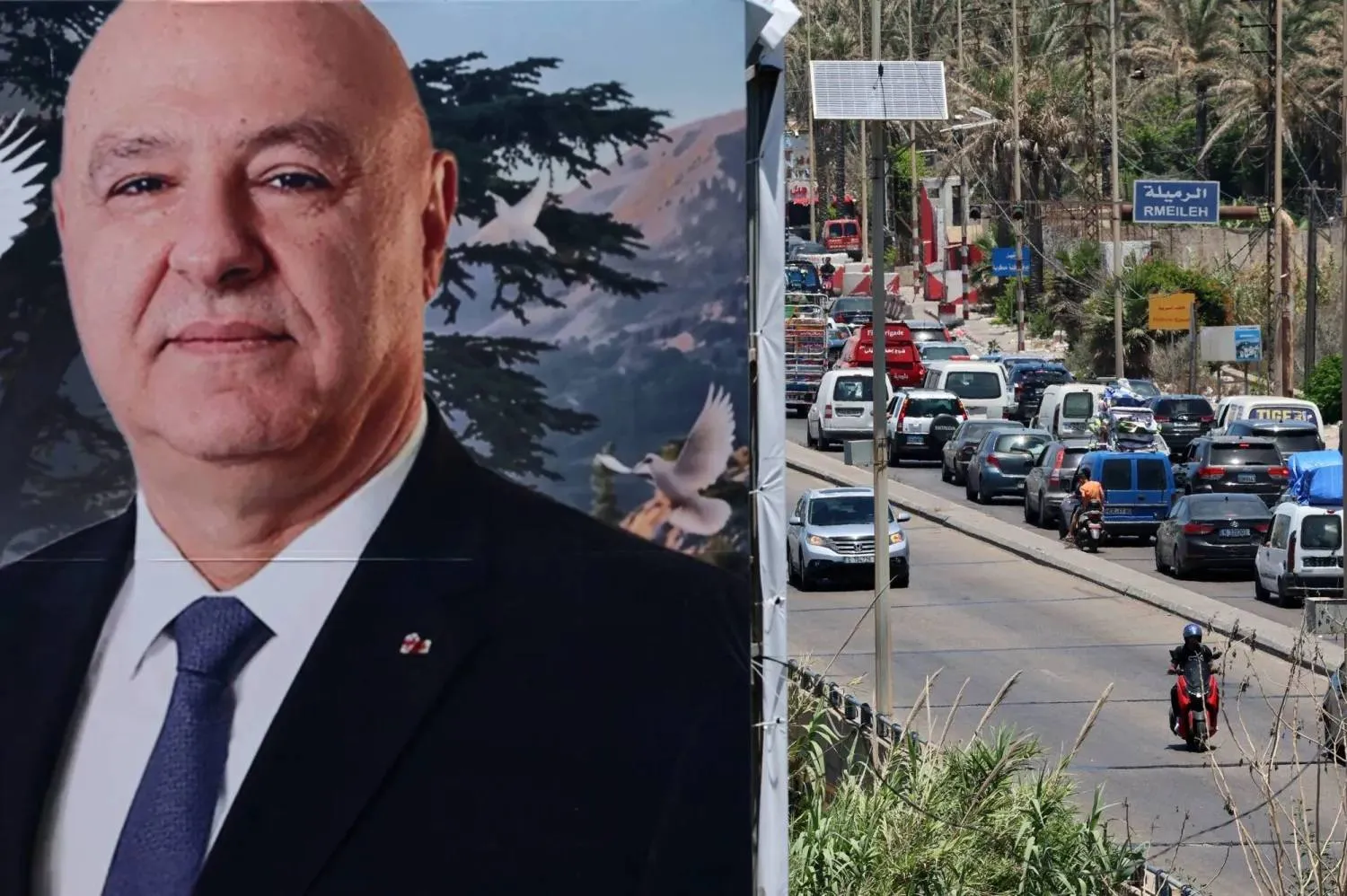
A giant portrait of Lebanese President Joseph Aoun hangs at the northern entrance to Sidon, as cars carrying displaced people from southern Lebanon head toward Beirut. (EPA)
TT

Lebanese, Int’l Contacts Contain South Lebanon Security Deterioration

A giant portrait of Lebanese President Joseph Aoun hangs at the northern entrance to Sidon, as cars carrying displaced people from southern Lebanon head toward Beirut. (EPA)

Lebanese and regional contacts contained a sharp deterioration in Lebanon’s security situation after a major military escalation between Israel and Hezbollah, and threats by Tel Aviv to escalate further.

Lebanese sources said Israel was seeking to undermine the ceasefire agreement, pressure Lebanese negotiators ahead of a fifth round of talks with Lebanon in Washington, and secure gains on the ground.

Reuters quoted a US official as saying Israel and Hezbollah had agreed to a ceasefire starting at 4 p.m. local time, after a major escalation that killed 47 Lebanese, including children and civilians, and four Israeli soldiers in clashes with Hezbollah in southern Lebanon. The Israeli air force carried out more than 150 strikes in southern and eastern Lebanon.

“Hezbollah and Israel agreed to a ceasefire,” the US official said, adding that US and Qatari negotiators reached the agreement with help from Iran.

“We understand that after the exchange of fire earlier today, Israel and Hezbollah are now in a ceasefire,” the official said.

Israel and Hezbollah both said they were ready to respect the ceasefire and respond to violations.

Lebanese and international contacts

The security deterioration triggered a flurry of regional, international and local contacts.

Official sources told Asharq Al-Awsat that Lebanese President Joseph Aoun “began a series of international contacts in the morning with influential countries to lower the escalation, prevent further deterioration and ensure commitment to the ceasefire.”

The contacts focused mainly on the United States and Qatar.

Aoun also condemned “the continuing Israeli escalation.”

“What we are witnessing today in the south and the Bekaa, with the expansion of Israeli attacks and further killing and destruction, is a dangerous and condemnable escalation, especially as it has affected dozens of innocent people, including women and children,” Aoun said.

He said the escalation “effectively targets all ongoing efforts to consolidate the ceasefire and end the war, especially after the latest developments between the US and Iran.”

“But this will not prevent work to achieve a comprehensive ceasefire as quickly as possible. This is what I instructed the Lebanese negotiating delegation to pursue in the next round in Washington,” he said.

“There can be no leniency on this issue because a comprehensive ceasefire is the entry point for discussing other issues, most importantly the Israeli withdrawal, the deployment of the army and the return of prisoners.”

On the international level, Hezbollah parliamentary bloc member MP Hassan Fadlallah said Iran had informed the group that negotiations with the United States could not continue without the implementation of a comprehensive ceasefire.

Fadlallah urged the Lebanese government to reject any direct negotiations with Israel while Israeli attacks on Lebanon continue. He said Washington was responsible for ensuring Israel stops its attacks and implements the terms of the agreement.

Geographic expansion and pressure on Lebanon

The sudden deterioration appeared to signal an Israeli attempt to bypass the agreement that took effect last Monday.

Sources in the Shi’ite duo told Asharq Al-Awsat that Israel was “pressuring to strike the agreement directly and target it.” They said Tel Aviv was also trying to pressure the Lebanese negotiator before the fifth round of direct negotiations with Israel opens in Washington next Tuesday. The talks are due to run for three days.

The sources said Israel was trying to “seize additional cards with which to pressure Lebanon.”

They cited “an Israeli desire for geographic expansion after its failure to achieve a major expansion during 110 days of war.” The area where Israel made significant advances in the first weeks of the war, they said, was the same area Hezbollah evacuated and where it committed to restricting weapons to the Lebanese state.

But attempts to expand beyond that area “met fierce resistance that slowed the push,” the sources said.

The source said a fourth reason was “an internal crisis linked to the rising far-right mood in Israel,” adding that “military failure is driving it to target civilians in Lebanon.”

Ceasefire before any arrangements

Lebanese observers say Israel’s failure to abide by the ceasefire agreement is not driven only by Prime Minister Benjamin Netanyahu’s sense of being “sidelined” after the agreement was signed.

They say Israel is also trying to reach an agreement with the Lebanese state in exchange for withdrawal from occupied territory, and to begin disarming Hezbollah in exchange for halting the escalation.

Hezbollah rejects this. The group is relying on US-Iranian understandings and continues to criticize the Lebanese state’s negotiating track.

Still, Lebanese authorities are proceeding with the sessions scheduled to begin Tuesday.

Lebanese ministerial sources told Asharq Al-Awsat that the instructions to the negotiating delegation are clear: demand a full and comprehensive ceasefire before discussing any other arrangements.

The sources said Beirut “is holding to its demands.”

Singling out Lebanon

Hezbollah, however, rejects the direct negotiating track.

Sources following Hezbollah’s escalation against the track said the group “believes there is an overlap of interests between Tel Aviv and the state within the framework of the track on which the state is relying to achieve withdrawal and a ceasefire.”

The sources said Hezbollah believes the direct negotiating track rests on the view that Israel is uncomfortable with US performance in the agreement with Iran, while Lebanon is uncomfortable with Iran’s performance.

They said Hezbollah had “sensed that Lebanon was being singled out” through the US statement issued after the first negotiating session. This, they said, was reinforced in the declaration of intent paper in the fourth round, which appeared to show bias toward Israel in the negotiations.

Hezbollah MP Hussein Hajj Hassan said: “The authorities agreed to a joint statement with the Americans and Israelis containing language to the effect that Hezbollah is a common enemy of Israel, America and Lebanon. This was stated by US Secretary of State Marco Rubio, while the Lebanese delegation did not utter a word. No Lebanese official in power objected to this language. Therefore, what is required from them is a position clarifying whether they agree with this language or not.”

He called on Lebanese officials “to bridge the gap they created with the resistance and its public, and to bridge the gap they created with the Islamic Republic of Iran, for Lebanon’s interest and not for Iran’s interest.”



Israel Defense Minister Vows to Keep Troops in Syria During Visit

25 June 2024, Jerusalem: Israeli Defense Minister Israel Katz is pictured in Jerusalem. (dpa)
TT

Israel Defense Minister Vows to Keep Troops in Syria During Visit

25 June 2024, Jerusalem: Israeli Defense Minister Israel Katz is pictured in Jerusalem. (dpa)

Israeli Defense Minister Israel Katz made a rare visit to troops in southern Syria on Tuesday, reiterating a pledge to keep forces in the area as long as there were "threats" to his country's security.

Damascus slammed Katz's "illegal entry" into the country, which came a week after Israel bombed the disused Abu al-Duhur base in northwestern Syria, claiming it wanted to prevent Turkish troops deploying to the facility. Ankara has denied any visit to the site.

In southern Syria, Israeli forces have been stationed in a "security zone" since the fall of longtime ruler Bashar al-Assad in December 2024.

They occupy what was previously a buffer zone patrolled by the United Nations that had separated Israeli and Syrian forces in the Israeli-occupied Golan since 1974.

"There is daily activity here to thwart threats, to eliminate remnants of the old regime, to prevent dangerous consolidation of the new regime," Katz said according to a video statement from his office.

"The message is clear to the president of Syria as well: when you wake up in the morning in your palace in Damascus, look up at Mount Hermon and see the Israeli army -- you know we are here to protect our communities and our border," he added.

"As long as there are threats, the army will remain here to guarantee our security -- this is what we have done and this is what we intend to continue doing in the future," Katz said.

Syria's foreign ministry said Katz's visit was a "flagrant violation of the country's sovereignty and territorial integrity".

It went on to urge the international community to take "the necessary measures to force the occupying authorities to halt these repeated violations".

Israel has carried out hundreds of strikes in Syria since the fall of Assad and made repeated incursions into Syrian territory.

Officials have also repeatedly vowed to keep troops in the security zone, where Israel is seeking a broader demilitarized area.

Israeli army chief Lieutenant General Eyal Zamir visited troops in the security zone last week, saying the military would not allow threats to "establish themselves" on the border.

During his visit on Tuesday, Katz addressed the strike on the Abu al-Duhur air base, saying Israel had "acted against a Turkish attempt to entrench itself in Syria, at the risk of Israel's security interests".


Kurdish-Led SDF Says It Has Dissolved After Merging with Syrian Army

 Syrian President Ahmad al-Sharaa, right, meets with the commander of the Kurdish-led Syrian Democratic Forces, Mazloum Abdi, center left, at the presidential palace in Damascus, Syria, Tuesday, Aug. 25, 2026. (AP)
Syrian President Ahmad al-Sharaa, right, meets with the commander of the Kurdish-led Syrian Democratic Forces, Mazloum Abdi, center left, at the presidential palace in Damascus, Syria, Tuesday, Aug. 25, 2026. (AP)
TT

Kurdish-Led SDF Says It Has Dissolved After Merging with Syrian Army

 Syrian President Ahmad al-Sharaa, right, meets with the commander of the Kurdish-led Syrian Democratic Forces, Mazloum Abdi, center left, at the presidential palace in Damascus, Syria, Tuesday, Aug. 25, 2026. (AP)
Syrian President Ahmad al-Sharaa, right, meets with the commander of the Kurdish-led Syrian Democratic Forces, Mazloum Abdi, center left, at the presidential palace in Damascus, Syria, Tuesday, Aug. 25, 2026. (AP)

The commander of the Kurdish-led Syrian Democratic Forces on Tuesday announced the official dissolution of the group, which once controlled a de facto autonomous zone in Syria's northeast.

Speaking during a news conference at the presidential palace in Damascus, Mazloum Abdi said the SDF has completed a merger with the Syrian army and would cease to operate as an independent force. The Kurdish-led force lost most of its territory in northeast Syria to a government offensive in January and then signed the deal to merge with the army.

The SDF was once the main partner of the United States in Syria as it battled the ISIS group. But after the ouster of former Syrian President Bashar al-Assad in December 2024, Washington formed close ties with the new government in Damascus led by interim Syrian President Ahmad al-Sharaa.

The SDF “carried a heavy responsibility during one of the most difficult periods in Syria’s history,” Abdi said.

“Today, circumstances have changed, and the country has entered a new phase, one of peace and participation in building a new Syria,” he said, announcing the “end of the SDF’s mission” and “its dissolution as an independent military force.”

Under the 50-year rule of the Assad dynasty in Syria, Kurds were marginalized, with many denied citizenship.

Shortly after the uprising against the Assad government began in 2011, the Kurds filled the vacuum created by the withdrawal of government forces from wide areas of Syria’s northeast. The SDF at one point controlled about 25% of Syria.

The Kurds were initially circumspect about the new post-Assad government and unwilling to give up their de facto autonomy. Some of the opposition groups that took part in the offensive that ousted Assad were Turkish-backed forces that had clashed with the SDF in the past.

Türkiye considered the SDF to be a terrorist organization because of its ties to the Kurdistan Workers’ Party, or PKK, a separatist group that staged a decades-long insurgency in Türkiye. A peace process is now underway.

Kurds questioned whether the new authorities would give them true representation in the new government, while al-Sharaa tried to woo them.

During ceasefire negotiations with the SDF in January, he issued a decree strengthening Kurdish rights. It made Kurdish an official language along with Arabic, and adopted Nowruz as a national holiday. It also restored the citizenship of tens of thousands of Kurds in northeastern Hasakeh province after they were stripped of it during the 1962 census.

Abdi said that al-Sharaa had promised that Kurds would have the right to education in their own language, an important issue for the country’s Kurdish population.

Questions remain, including the fate of the SDF's all-female fighting units.

But the success of the integration agreement with the SDF is a major boost to al-Sharaa's government, which has struggled to unify the country as it begins to recover from a nearly 14-year civil war. Most of the country is now under the control of the central government in Damascus.

The exception is southern Syria's Sweida province, which is now controlled by Druze factions that are hostile to Damascus after clashes last year. The Druze factions have received support from Israel, which is also occupying a strip of land in southern Syria near the border with the Israeli-annexed Golan Heights.


Iraq’s Ruling Coalition Discusses Arrests of Armed Faction Members

Iran’s Supreme National Security Council Secretary Mohsen Rezaei receives Iraq’s top judge Faiq Zidan in Tehran on Tuesday (Mehr)
TT

Iraq’s Ruling Coalition Discusses Arrests of Armed Faction Members

Iran’s Supreme National Security Council Secretary Mohsen Rezaei receives Iraq’s top judge Faiq Zidan in Tehran on Tuesday (Mehr)

Mohsen Rezaei, secretary of Iran’s Supreme National Security Council, said on Tuesday that regional countries would shape their own future and that the United States would have no place in the region.

Rezaei made the remarks in Tehran during talks with Faiq Zidan, head of Iraq’s Supreme Judicial Council.

He said Iran wanted a strong and independent Iraq and called for a resolution to the status of Iranian opposition groups based along the two countries’ border, an apparent reference to Iranian Kurdish parties in Iraq’s Kurdistan region.

His comments came days after Iranian parliament Speaker Mohammad Baqer Ghalibaf visited Baghdad, as Iraqi Prime Minister Ali Faleh al-Zaidi’s government faces growing pressure to press ahead with its plan to bring all weapons under state control.

During Ghalibaf’s visit, Iraqi National Security Adviser Qasim al-Aboudi said the government was moving forward with the plan.

He said the constitution did not allow armed groups to threaten the security of other countries and reaffirmed Baghdad’s commitment to its security agreement with Tehran.

The circumstances surrounding the visit suggested that armed factions were a central focus of the talks, even if the issue did not formally appear on every publicly announced agenda.

Iraqi reports said Ghalibaf conveyed Tehran’s position on government measures targeting the factions’ weapons as Baghdad’s deadline for completing the process approached.

Separately, leaders of the Coordination Framework discussed the arrests of Popular Mobilization Forces (PMF) members and commanders at a meeting in Baghdad attended by Mohsen Qomi, a representative of Iran’s supreme leader.

Local media said the leaders objected to how the arrests were carried out. They argued that those wanted by the authorities could have been summoned through formal judicial procedures instead of military force.

Underscoring the sensitivity of the issue, PMF later said what it called a “misunderstanding” over the arrests of several members had been resolved. It said they had been handed over to PMF security services to pursue their cases in court.

The developments come as al-Zaidi’s government seeks to enforce a state monopoly on weapons, bringing it into direct confrontation with armed factions that wield extensive political and security influence.

The weapons issue poses a sensitive test for al-Zaidi, who is also under US pressure to dismantle armed groups operating outside state control.

Baghdad ‘appreciates Tehran’s support’

In Tehran, Rezaei and Zidan focused their talks on security and judicial ties.

Zidan said Iraq appreciated Iran’s support and stressed the need for regional cooperation and security along the shared border.

He arrived in Tehran on Tuesday at the head of a senior judicial delegation following an official invitation. The delegation included the heads of the Judicial Supervision Commission and the Public Prosecution Service, as well as the director-general of the Judicial Protection Department.

Zidan was received by the Iranian judiciary’s deputy chief for international affairs and Nasser Seraj, secretary of the judiciary’s Human Rights Council.

During the visit, Zidan also met Iranian judiciary chief Gholam-Hossein Mohseni-Ejei to discuss closer judicial and legal cooperation.

Ejei said more than 131 Iranian convicts had been transferred from Iraqi prisons over the past year. He called for better prisoner-transfer and exchange mechanisms and measures to ease the difficulties facing their families.

He also said Iranian and Iraqi security were interconnected and urged closer coordination against activities threatening their shared border.

Zidan praised relations between the two countries and said the Iraqi government and people stood with Iran against what he described as “US and Israeli aggression.” He also recalled Iran’s support for Iraq during its war against ISIS.

Zidan also discussed several issues of common interest with Ghalibaf, according to Iraq’s state news agency.