

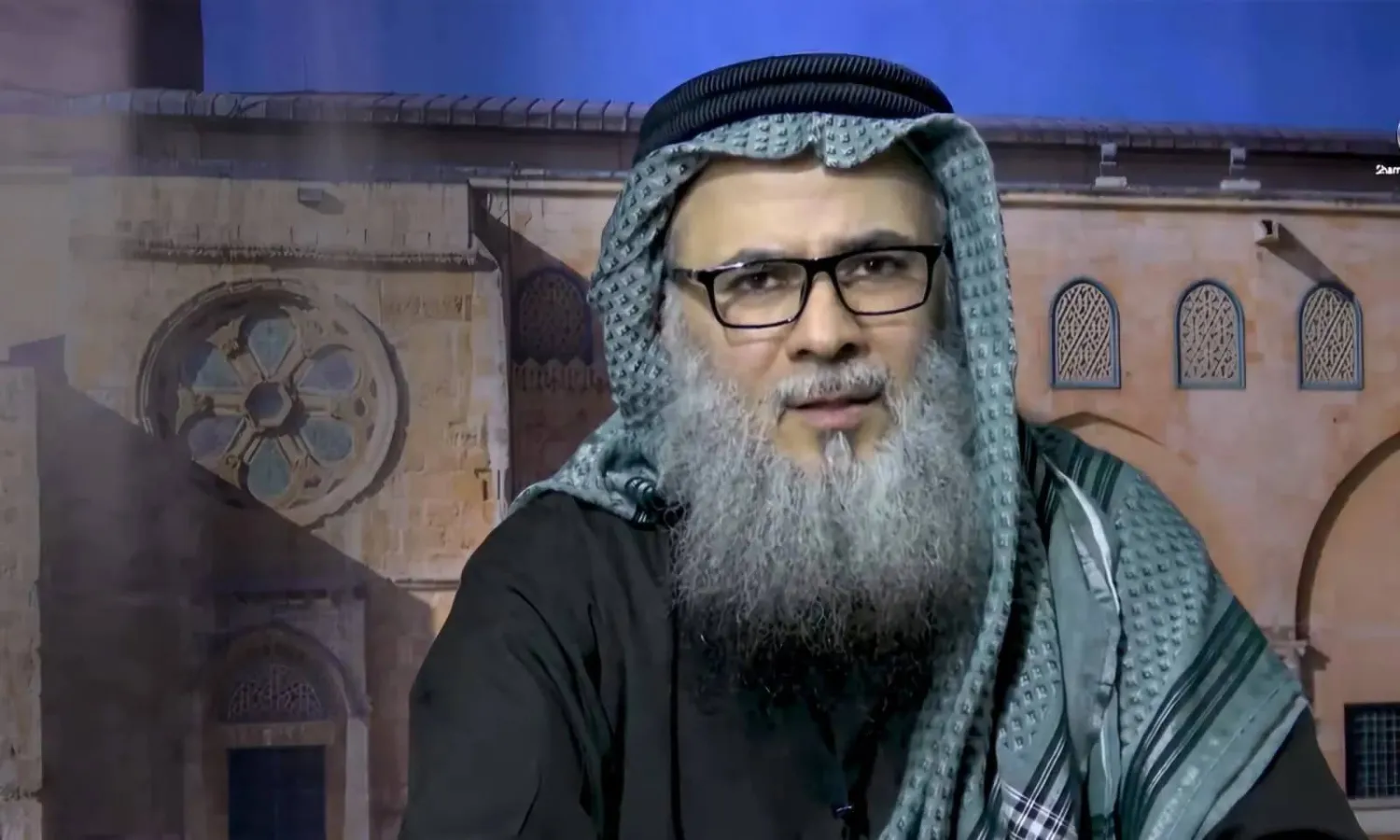

Reports: Senior Al-Qaeda Ideologue Sami Al-Uraydi Killed in Syria

Sami Al-Uraydi. (Shaam Network)
TT

Reports: Senior Al-Qaeda Ideologue Sami Al-Uraydi Killed in Syria

Sami Al-Uraydi. (Shaam Network)

The issue of extremist groups in Syria has returned to the spotlight following reports that Sami Al-Uraydi, one of the most prominent religious ideologues associated with Al-Qaeda’s network in Syria, was killed in a strike by the US-led international coalition overnight Friday into Saturday.

Syrian state television reported that a drone struck a motorcycle near Mashhad Rouhin in the northern Idlib province, killing an unidentified individual, without providing further details.

Local sources in Idlib said four explosions were heard in quick succession.

Sources told Asharq Al-Awsat that the target was later identified as Al-Uraydi, also known as Abu Mahmoud Al-Shami, a senior figure in the now-defunct Hurras Al-Din group.

According to the sources, the man had been living in hiding in recent months to evade arrest.

The sources said he and other leaders of Al-Qaeda-linked factions remained targets of coalition operations. They noted intensified drone activity over the Idlib countryside in recent days. Coalition aircraft routinely patrol the region, including areas along the Turkish border.

While neither coalition forces nor the Syrian government have officially confirmed the target’s identity, several local media outlets reported that Al-Uraydi was killed.

A Jordanian national, Sami Mahmoud Mohammad Al-Uraydi was born in Amman in 1973 and held a doctorate in Islamic law. He authored numerous works on hadith and Islamic doctrine and became known in Salafi circles as a close associate of Abu Mohammad Al-Maqdisi, one of the movement’s leading ideologues.

After the outbreak of the Syrian uprising against President Bashar Al-Assad in 2011, Al-Uraydi moved to Syria, where he served as chief religious authority of Jabhat Al-Nusra, Al-Qaeda’s Syrian affiliate, from 2014 to 2016. He emerged as one of the group’s most influential religious theorists and spokesmen on ideological and organizational matters.

When Jabhat Al-Nusra severed ties with Al-Qaeda in 2016 and rebranded itself as Jabhat Fatah Al-Sham, Al-Uraydi opposed the move. The resulting disputes led to his detention in 2017 alongside several other senior figures.

After his release, he helped establish Hurras Al-Din in 2018 under the leadership of Farouq Al-Suri, serving as the group’s chief religious official and a member of its Shura Council.

Al-Uraydi continued to criticize the policies of Jabhat Fatah Al-Sham, which later evolved into Hayat Tahrir Al-Sham.

In 2022, the European Union designated Hurras Al-Din a terrorist organization and imposed sanctions on both Al-Suri and Al-Uraydi.

The US State Department designated Al-Uraydi a Specially Designated Global Terrorist in 2023. Washington had previously placed him on its terrorism list in 2019 and offered a reward of up to $5 million for information leading to his identification or location.

Although Hurras Al-Din formally dissolved itself in 2025 under mounting pressure, its leaders remained targets of coalition operations. Al-Uraydi reportedly continued to live in hiding under the protection of allied factions.

The presence of such groups remains one of Syria’s most complex security challenges. Although Damascus has joined the international coalition against terrorism, several organizations, including ISIS and remnants of dissolved extremist factions, continue to oppose the Syrian government.



Al-Burhan’s Agreement to Conditional Dialogue Sparks Debate in Sudan

 Chairman of the Transitional Sovereignty Council and Commander of the Sudanese Army Abdel Fattah al-Burhan delivers a speech at the presidential palace in Khartoum. (SUNA)
Chairman of the Transitional Sovereignty Council and Commander of the Sudanese Army Abdel Fattah al-Burhan delivers a speech at the presidential palace in Khartoum. (SUNA)
TT

Al-Burhan’s Agreement to Conditional Dialogue Sparks Debate in Sudan

 Chairman of the Transitional Sovereignty Council and Commander of the Sudanese Army Abdel Fattah al-Burhan delivers a speech at the presidential palace in Khartoum. (SUNA)
Chairman of the Transitional Sovereignty Council and Commander of the Sudanese Army Abdel Fattah al-Burhan delivers a speech at the presidential palace in Khartoum. (SUNA)

The agreement by Chairman of the Transitional Sovereignty Council and Commander of the Sudanese Army Abdel Fattah al-Burhan to launch intra-Sudanese dialogue has sparked debate among political forces in the war-torn country.

The questions raised went beyond whether to take part or boycott, but to whether political dialogue held during war can stop the fighting and unify the country, or will it just be confined to regions held by the army.

Burhan declared last week that he was agreeing to an initiative to form an independent national mechanism that would prepare “comprehensive dialogue”. He vowed to provide legal, security, political and logistic guarantees for the participants, saying no foreign powers would be involved.

While agreeing to the dialogue, al-Burhan also rejected peace that would return the paramilitary Rapid Support Forces (RSF) and its supporters to power.

Peace begins with the RSF laying down its weapons, otherwise the army will continue its operations against it, he warned.

Prime Minister Kamil Idris said on Sunday that his government wants to restore peace and preserve Sudan’s unity.

He also added that the RSF should be designated a terrorist organization, vowing that the army will not be lenient with its forces.

Lawyer Nabil Adib, who was part of the committee that proposed the dialogue, told local media that his committee does not aim to end the war, but reaching political consensus.

He hastily added, however, that that “ending the war may be one of the outcomes of the dialogue if the participants agree to it.”

His statements reveal a dilemma: if the dialogue participants reach a consensus demanding an end to the war, implementing it would require the approval of both warring parties. Should the RSF remain outside the process, the dialogue may succeed in producing a political stance against the war, but it lacks a mechanism to enforce a ceasefire.

Adib notably kept the door open to members of the RSF-aligned Sudan Founding Alliance (Tasis) to take part in the dialogue. The alliance includes political and armed factions that are opposed to the army.

“Alliance parties that do not carry weapons can take part in the dialogue,” he confirmed.

The pro-army Democratic Bloc welcomed the dialogue initiative, saying it was a step forward in “resolving the crisis through national political means”.

On the other side of the divide, the Somoud civilian alliance, led by former PM Abdalla Hamdok, rejected any dialogue held while the war rages.

In a statement, it said that any “political process - independent of the warring parties - must start with an end to the war and addressing the humanitarian catastrophe.”

It warned against holding dialogue in areas held by the army, saying it would “consolidate the unofficial division” of Sudan.

Sudan’s People's Liberation Movement-Revolutionary Democratic Current (SPLM-RDC), led by Yasir Arman, said the current crisis “goes beyond the war.”

It is tied to building the state and the presence of several armies and militias in the country, it noted in a statement. It warned against dialogue that does not address the root causes of the crisis.

The National Umma Party demanded dialogue that includes all segments of society, except for the National Congress Party.

Umma Party leader Mubarak al-Fadil al-Mahdi called for an end to the fighting, as well as national reconciliation and negotiations over security arrangements that would lead to the unification of the army.

He echoed warnings that holding the dialogue in army-held regions would consolidate divisions in the country and fuel the fighting.

The army believes that excluding the RSF from power is a refusal to grant political legitimacy to a force that took up arms against it. However, the RSF’s continued control over parts of the country will undermine any constitutional or governmental arrangements produced by the dialogue in areas under its authority.


Egypt Warns Ethiopia against Plans to Control Nile River Flows

The Ethiopian national flag is seen at the Grand Ethiopian Renaissance Dam (GERD) in Guba, Ethiopia, Feb. 19, 2022. (AFP)
TT

Egypt Warns Ethiopia against Plans to Control Nile River Flows

The Ethiopian national flag is seen at the Grand Ethiopian Renaissance Dam (GERD) in Guba, Ethiopia, Feb. 19, 2022. (AFP)

An official Egyptian source warned on Sunday Ethiopia against plans to control the flows of the Nile River to downstream countries, in the latest tensions between Cairo and Addis Ababa over the Grand Ethiopian Renaissance Dam (GERD).

The official made the warning in wake of Ethiopia’s Minister of Water and Energy Habtamu Geleta saying that his country may build more dams on the river, effectively controlling its flow to Egypt and Sudan.

The source said Egypt has “several means at its disposal and is capable of defending the interests of its people when it comes to the Nile,” reported the state news agency MENA.

“Egypt will not accept or allow any party to control the Nile’s flow to downstream countries,” he declared.

Diplomats and observers told Asharq Al-Awsat that Ethipoia’s comments prove that the construction of the dam aimed to apply political pressure on Cairo and was not a development project as it had claimed.

The dispute over the Nile goes back 15 years since Ethiopia began constructing the dam and which it inaugurated around a year ago. Egypt fears that the dam will impact its share of the river water, which is vital for the people.

Arab and local media reported Geleta as saying that his country “will control the flows of the Nile” and that it is “determined to build more dams as part of its right to the fair use of its waters and achieve sustainable development.”

The Egyptian source, however, slammed the statements as more evidence of Addis Ababa’s unilateral actions and violation of international law.

They reflect its “delusions about its ability to impose control over a river it shares with others,” he added.

He warned that the statements are “dangerous” because they reveal an intent to impose a status quo on the ground and impose monopoly over a joint international water source.

“Ethiopia is using its geographic location to threaten the water rights and interests of downstream countries in violation of international law. Egypt will not allow it,” he vowed.

Cairo had previously declared before the UN Security Council that it will resort to all means at its disposal to protect the rights of people to the Nile, he noted.

‘Several options’

Salah Halima, former Assistant Foreign Minister and Deputy Chairman of the Egyptian Council for Foreign Affairs, said Cairo has “several options” at its disposal to protect its interests.

It can again resort to the Security Council and demand measures to resolve conflicts in line with Chapter 6, he told Asharq Al-Awsat.

Failure to comply, means it can resort to Chapter 7, which would then view the GERD as an act of aggression and a threat to human life, which demands self-defense, he added.

Chapter 6 calls for resolving disputes peacefully through negotiations and mediations, while Chapter 7 allows the Security Council the authority to impose measures through military and non-military means to preserve international peace and security.

Halima said Ethiopia’s latest statements demonstrate that the construction of the GERD was politically motivated to pressure Egypt.

The dam has already caused damage to Sudan where water levels are low, he noted.


Eight Muslim Countries Condemn Israel’s Rejection of Trump’s Gaza Plan

 Displaced Palestinian children carry food portions in Deir al-Balah, central Gaza Strip, Friday, Aug 14, 2026. (AP)
Displaced Palestinian children carry food portions in Deir al-Balah, central Gaza Strip, Friday, Aug 14, 2026. (AP)
TT

Eight Muslim Countries Condemn Israel’s Rejection of Trump’s Gaza Plan

 Displaced Palestinian children carry food portions in Deir al-Balah, central Gaza Strip, Friday, Aug 14, 2026. (AP)
Displaced Palestinian children carry food portions in Deir al-Balah, central Gaza Strip, Friday, Aug 14, 2026. (AP)

The foreign ministers of eight Muslim countries on Sunday condemned Israel's rejection of a recently released roadmap for fully implementing US President Donald Trump's Gaza peace plan.

The foreign ministers of Saudi Arabia, Egypt, Jordan, Pakistan, Indonesia, Türkiye, Qatar, and the United Arab Emirates said the rejection amounts to a “direct repudiation” of the peace plan, “jeopardizes its implementation, and fundamentally undermines the collective efforts to achieve a just and lasting peace.”

“Such rejection confirms that Israel now bears responsibility for obstructing the efforts to bring peace in Gaza and the rest of the Occupied Palestinian Territory,” they said in statement.

The roadmap, which has been accepted by the Palestinian factions, is the conclusion of extensive efforts exerted by the mediators, namely Egypt, Qatar, Türkiye, the US, the High Representative of Gaza and the Board of Peace and constitutes a vital milestone for the decommissioning of weapons concurrently with the withdrawal of Israeli forces, the deployment of the International Stabilization Force, the transfer of the administrative authority to the National Committee for the Administration of Gaza and the reconstruction of Gaza as stipulated in the Comprehensive Plan, they went on to say.

Rejecting the roadmap is “an explicit refusal to proceed with the implementation of the peace plan, and directly threatens to derail the extensive efforts exerted by Trump to bring an end to the war in Gaza and establish the conditions for lasting peace.”

The ministers underscored “the importance of sustained and active US engagement to ensure and enforce Israel’s full compliance with the commitments and arrangements envisaged under the peace plan and its roadmap, and to prevent further obstruction of their implementation.”

“Israel bears direct and full responsibility for any consequences resulting from its continued rejection, obstruction, delay or non-compliance, including any resulting deterioration of the situation on the ground and disruption of ending the war in Gaza,” they added.

They underlined the urgent need for the full and immediate implementation of the peace plan in order to address the grave humanitarian situation, ensure security and stability for all in Gaza, and pave the way for reconstruction and recovery and advancing a just and lasting peace grounded in the Palestinian right to self-determination and statehood in accordance with international law, paving the way for security and stability for all countries and peoples of the region.

They categorically rejected any attempt to deny or foreclose Palestinian statehood including through unilateral actions.

“A just, lasting and comprehensive peace only will be achieved by the implementation of two-state solution, by the realization of an independent and sovereign Palestinian State based on the 1967 borders, with East Jerusalem as its capital in accordance with international law and relevant United Nations resolutions,” they added.

“Any attempt to deny or foreclose Palestinian statehood therefore directly undermines the prospects for peace, security and stability throughout the region,” they warned.

The ministers underscored the importance of the continued role of the Board of Peace and call all parties to support its efforts for the implementation of the roadmap and advancing the second phase of Trump’s peace plan.

The ministers called on the Board of Peace, with the active support and engagement of the US, to take immediate and concrete measures within its mandate to uphold the integrity of the peace plan and prevent any party from obstructing its implementation.