


More than Oil and Gas: Stranded Fertilizer Ships Reveal Another Side of Hormuz Crisis

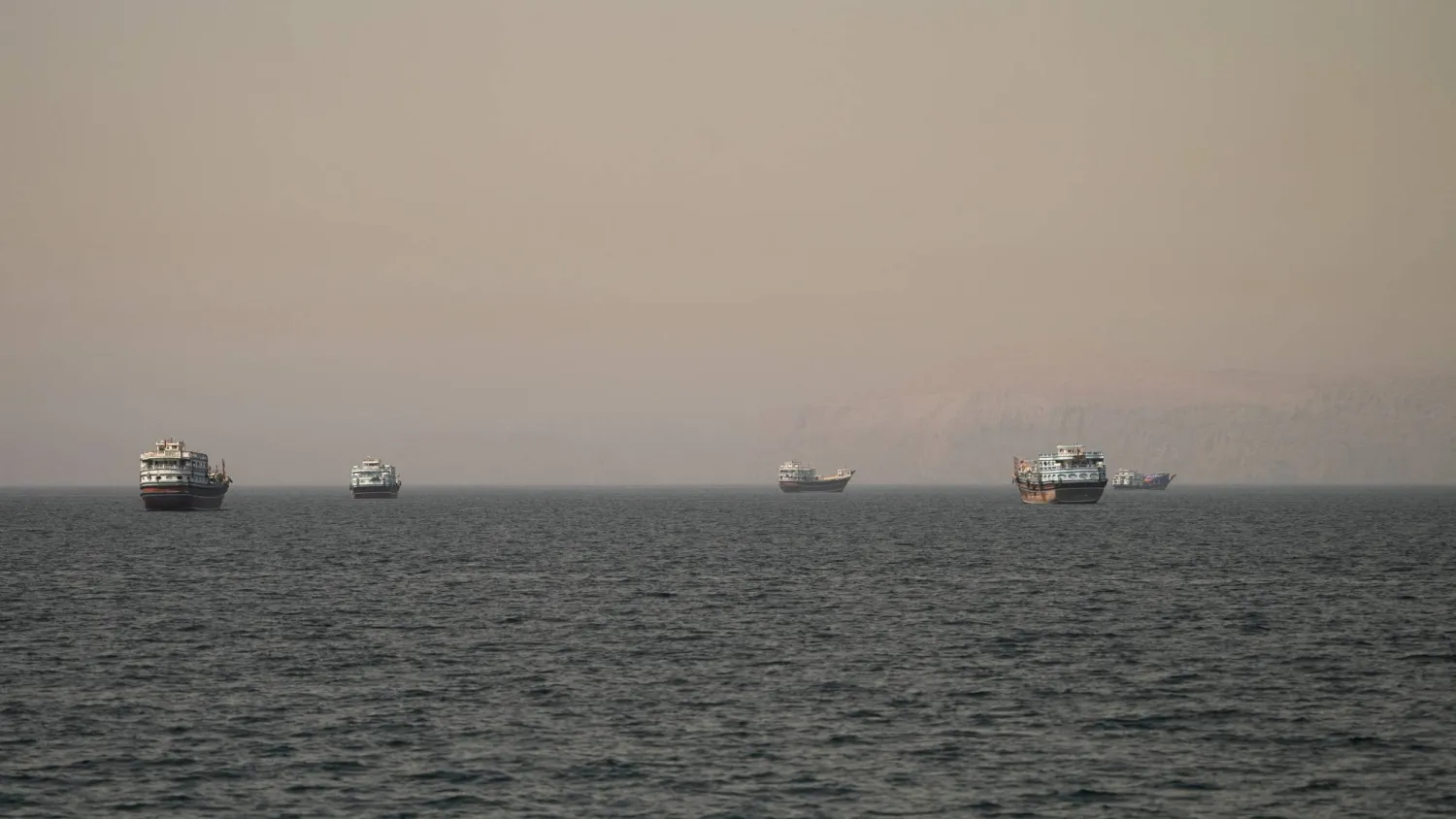
 Vessels at the Strait of Hormuz, as seen from Musandam, Oman, June 18, 2026. (Reuters)
Vessels at the Strait of Hormuz, as seen from Musandam, Oman, June 18, 2026. (Reuters)
TT

More than Oil and Gas: Stranded Fertilizer Ships Reveal Another Side of Hormuz Crisis

 Vessels at the Strait of Hormuz, as seen from Musandam, Oman, June 18, 2026. (Reuters)
Vessels at the Strait of Hormuz, as seen from Musandam, Oman, June 18, 2026. (Reuters)

The temporary agreement announced by the United States and Iran to end months of conflict and reopen the Strait of Hormuz does not mark an immediate end to a commercial disruption that has unfolded largely away from the spotlight that focused mostly on oil and gas.

While energy markets await the resumption of crude and LNG shipments, shipowners carrying fertilizer cargoes remain trapped in uncertainty, awaiting operational guidance on transit procedures and safety.

The situation highlights the gap between a political agreement and the actual restoration of global supply chains, as the world’s most important maritime chokepoint enters what experts describe as its most difficult logistical phase.

Hormuz is not only an energy artery. It is also a critical route for fertilizers, urea, potash and petrochemicals — commodities that underpin global food security.

One million tons waiting

Data illustrate the scale of the disruption. According to tanker-tracking firm Kpler, more than 40 fertilizer vessels carrying roughly one million tons of cargo have been stranded behind the strait since the US-Israel war on Iran started at the end of February.

As a result, weekly fertilizer exports through Hormuz plunged by 90 percent, falling from about 600,000 tons a week in late February to just 60,000 tons in early June, reflecting the near paralysis of dry-bulk commodity traffic.

Logistics expert Nashmi Al-Harbi told Asharq Al-Awsat that Gulf fertilizer producers account for about 15 percent of global supply, warning that any disruption to this corridor has ripple effects on food security and agricultural prices from Asia to Latin America.
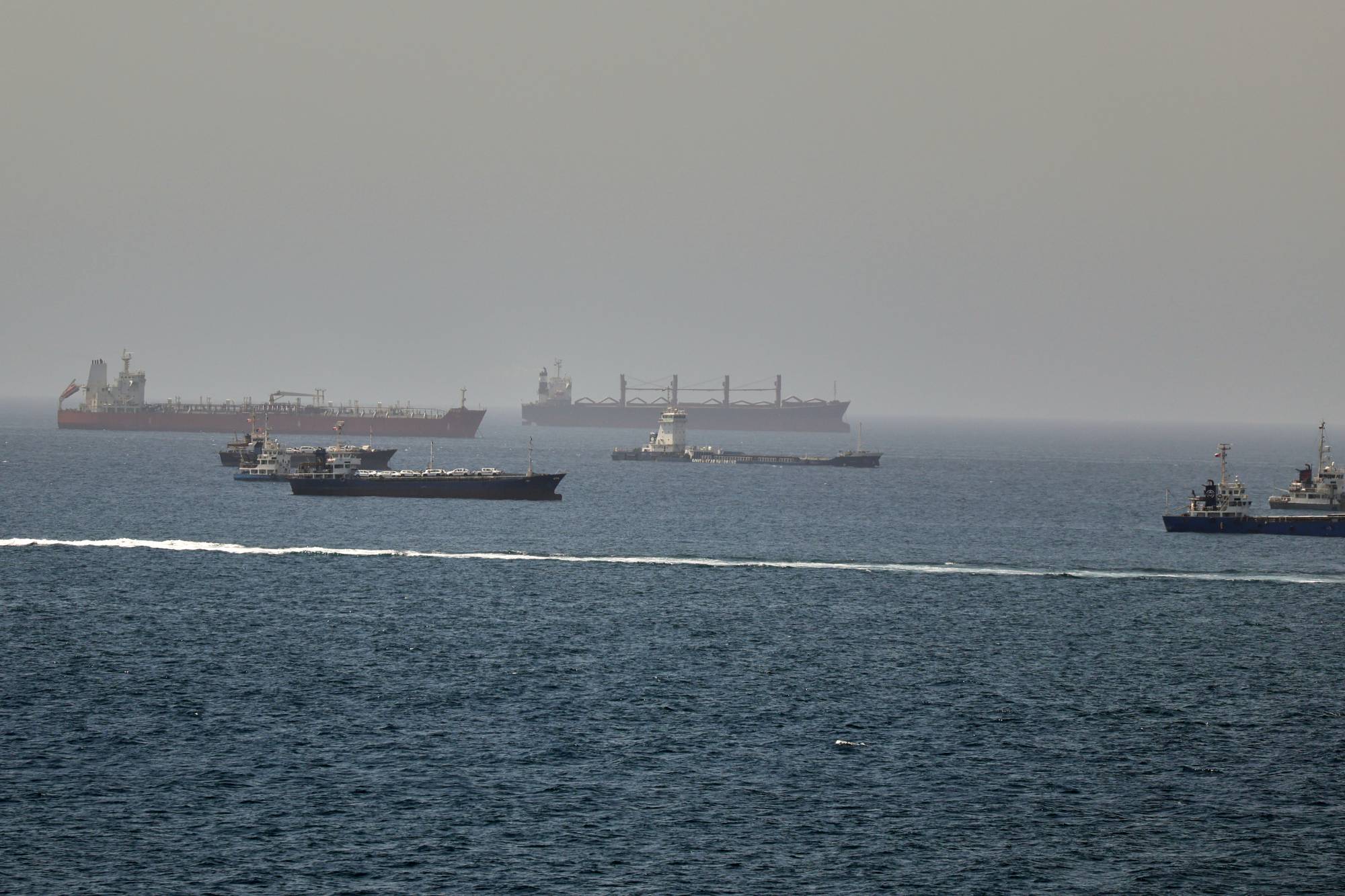
Tankers and cargo vessels are seen in the Gulf of Oman, along shipping routes linking the Strait of Hormuz and the Arabian Sea, Tuesday, June 16, 2026. (AP)

India offers perhaps the clearest example. Bandana Preyashi, an official at India’s Ministry of Chemicals and Fertilizers, said 16 fertilizer vessels bound for India had been stranded near the strait. The delayed shipments include eight vessels carrying 330,000 tons of urea and four carrying 257,000 tons of diammonium phosphate, in addition to ammonia and sulfur cargoes.

Despite the disruption, India has already imported five million tons of fertilizer this year and has issued a global tender for an additional 1.7 million tons to meet summer crop demand, underscoring the urgency of domestic requirements.

Energy first

Analysts expect oil and liquefied natural gas shipments to receive priority once traffic resumes.

Alexis Ellender, Kpler’s senior dry-bulk freight analyst, said oil and LNG tankers are likely to receive immediate priority, arguing that fertilizers do not carry the same strategic importance during the initial reopening phase.

Al-Harbi agreed, noting that transit decisions will depend on factors including demurrage costs, cargo conditions and destination-port capacity. He argued that the real bottleneck is no longer Hormuz itself but receiving ports in India and East Africa.

Logistics specialist Hassan Al Heliel expects authorities to implement a “wave transit” system, allowing groups of eight to 12 vessels to pass at a time. Delayed shipments are expected to account for 30 to 40 percent of the initial traffic, while higher-risk cargoes such as ammonia will remain under close scrutiny.
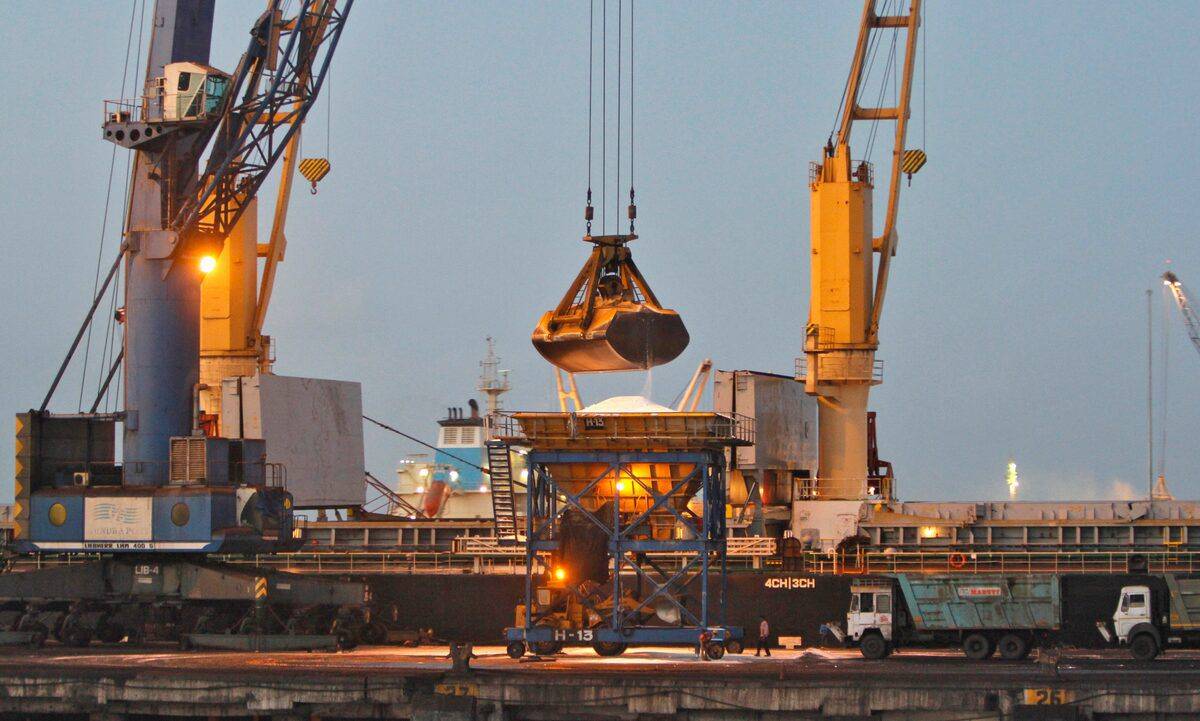
A crane unloads a shipment of fertilizers from a cargo ship at Mundra Port in Gujarat, India. (Reuters)

Insurance costs and market shifts

The crisis has sharply increased shipping costs. Marine insurance premiums have risen by between 300 and 600 percent on some routes, adding roughly $40 per ton to transportation costs.

According to Al-Harbi, the increase has temporarily eroded the competitive advantage of Gulf producers against rivals in Russia and Morocco, particularly in Asian and Latin American markets.

Al Heliel estimated that total delivered costs have risen by 12 to 25 percent per ton, prompting exporters to focus on nearby and more stable markets such as India and Southeast Asia while reducing exposure to Latin America.

Although Gulf producers retain a structural cost advantage of 25 to 35 percent over competitors, he said competition has shifted from product pricing to delivery efficiency.

New challenges

Both experts argued that the political breakthrough marks the beginning, not the end, of market disruption.

Al-Harbi described the next phase as “the most operationally challenging,” noting that vessels rerouted during the crisis will not immediately return to normal patterns and that emergency supply contracts signed during the disruption must be rebalanced.

He estimated it could take six to nine months for shipping networks to fully normalize.

Al Heliel warned that rescheduling delayed vessels could create significant congestion at Asian ports, many of which are already operating at 80 to 90 percent of capacity, potentially extending waiting times by an additional five to 10 days.

“The breakthrough does not signal the end of disruption,” he said. “It marks a deeper reshaping of global supply chains around a new balance of risk and efficiency.”


Sudan’s War Economy Sends Pound into Freefall

Army Commander Abdel Fattah al-Burhan stated that the high cost of living is 'part of the battle' and pledged to emerge victorious (AFP).
TT

Sudan’s War Economy Sends Pound into Freefall

Army Commander Abdel Fattah al-Burhan stated that the high cost of living is 'part of the battle' and pledged to emerge victorious (AFP).

Sudan has entered a new phase of economic turmoil after its currency, the pound, fell sharply against foreign currencies, with the dollar trading above 9,000 pounds in some parallel-market transactions in recent days.

The pound later temporarily recovered some of its losses, but severe volatility disrupted markets, prompting some traders to suspend sales and close their shops.

Exchange-rate movements illustrate the scale of the deterioration. The dollar, which traded at about 4,400 pounds on the parallel market in June, surged to more than 9,000 pounds at the height of this month’s September turmoil.

The number of pounds needed to buy one dollar has nearly doubled in about three months.

Rates quoted by several banks remained far below those on the parallel market, reflecting a widening gap between the official banking rate and the price at which traders obtain foreign currency outside the banking system.

After a limited improvement on Friday, the dollar again rose above 8,000 pounds on Saturday amid a shortage of US currency in banks.

Sovereign Council Chairman and army chief General Abdel Fattah al-Burhan directly linked the economic crisis to the war.

“The battle has taken many forms,” Burhan said after Friday prayers in Khartoum’s Burri district. He described the economic crisis, rising prices and scarcity of resources as “part of this battle” and pledged that Sudan would emerge “victorious, just as we drove the rebellion out of Khartoum and other cities.”

Exchange-rate, market and gold-production figures suggest that the “economic battle” is more complicated than controlling currency speculators. It involves the wartime economy, shortages of foreign currency, declining production, foreign-trade imbalances and gold smuggling.

Prices surge

The pound’s depreciation is having a direct effect on people’s lives.

During a tour of markets in Khartoum and Wad Madani on Sept. 18, local broadcaster Radio Tamazuj reported that the price of a 50-kg sack of sugar had risen to 470,000 pounds from 380,000 pounds, an increase of about 24%.

A sack of flour climbed to 120,000 pounds from 80,000 pounds, an increase of about 50%.

The broadcaster said most of the shops visited during the tour were closed. Traders had stopped selling because prices were changing so rapidly that they could not determine how much it would cost to replace the goods they sold.

Closures spread to other cities. Local reports from Atbara in River Nile state said that a growing number of shops had closed and traders were refusing to sell. Reports from Duwaim said about three-quarters of shops had closed, citing local traders.

In Tamboul in Gezira state, activists circulated a local account describing the city’s market as almost at a standstill, with shops closed and goods scarce.

The account put the price of a 50-kg sack of sugar at 600,000 pounds, a sack of sorghum at 500,000 pounds, a 36-pound container of cooking oil at 400,000 pounds and a sack of flour at 150,000 pounds.

The prices could not be independently verified, nor could it be confirmed whether the closures affected the entire market.

The crisis is reflected in the experience of grocery store owner Ibrahim Idris, who said his capital was no longer sufficient to stock the range and quantities of goods he had previously sold.

Idris said the price of a 36-pound container of cooking oil had risen to nearly 350,000 pounds from about 170,000 pounds over the past month, more than doubling.

Customers were buying smaller quantities, he said, while increasing numbers were asking to purchase goods on credit.

Nahla Khalifa, a homemaker from Omdurman, previously told Asharq Al-Awsat that her family had often gone without meat, milk and vegetables, while obtaining medication for her husband, who has diabetes, had become increasingly difficult.

Osman al-Jundi, a supervisor of community kitchens, or takayas, in Khartoum, told Asharq Al-Awsat days before the sharp currency decline that falling donations, rising prices and the pound’s depreciation had forced several free kitchens to close.

Only two kitchens in his area were still operating daily, he said, even as the number of people in need continued to grow. They included displaced people from Kordofan, as well as children, women, older people and people with disabilities.


The Sudanese pound continues its slide to a record low against the dollar (Reuters)


Gold production declines

The sharpest contradiction emerges in Sudan’s gold sector.

According to data from the Sudanese Mineral Resources Company, recorded gold production exceeded 70.15 metric tons in 2025. That included about 58.38 tons from traditional mining, roughly 5.68 tons from mining-waste processing companies and about 5.96 tons from concession companies.

However, the amount of gold entering official export channels was far below recorded production.

Data attributed to the Central Bank of Sudan showed that about 14.7 tons of gold, worth nearly $1.54 billion, were exported in 2025. In a separate estimate, the finance minister said about 20 tons had entered official channels.

The difference cannot be treated entirely as smuggled gold because of existing stockpiles, domestic consumption and trade, as well as differences in how the data are calculated. It nevertheless reveals a substantial gap between recorded production and the amount appearing in official exports.

An official at the Sudanese Mineral Resources Company previously estimated that about 48% of the country’s 2024 gold production had been smuggled, depriving the banking system of a significant source of foreign currency.

Gold is also intertwined with the war. A study by the Chatham House think tank said both sides in the conflict had benefited from the gold economy and its production and trading networks, although through different methods and in different areas of influence.

The study linked gold-sector revenues to the warring parties’ ability to finance operations and obtain resources, weapons and supplies.

That does not mean all proceeds from official gold exports are used for military spending. The state also uses foreign currency to finance imports of fuel, wheat and other goods and necessities.

A further contradiction has emerged within the gold sector itself.

Twenty-three mining companies have threatened to begin gradually suspending production on Sept. 30 and halt it entirely on Oct. 1 in protest against the Central Bank of Sudan’s mechanism for purchasing gold.

The companies say they produce about 17% of the country’s gold and that the central bank’s purchase price does not cover rising fuel, transportation, wage and operating costs caused by the pound’s depreciation.

The distortions extend beyond the gold market.

While the dollar rose above 9,000 pounds in some transactions in government-controlled areas, it traded at about 4,600 pounds in cash in Nyala. Its price through transfers using the Bankak banking application reached about 6,500 pounds.

The cash price of the dollar in Nyala was, therefore, at roughly the same time, about half the rate recorded in some markets in government-controlled territory.

That does not mean the economy in areas controlled by the paramilitary Rapid Support Forces is stronger.

Experts and traders attribute much of the difference to the shortage of banknotes, or cash liquidity, in Darfur, as well as different trade routes and foreign-currency flows. Markets in western Sudan are also linked to Chad, Libya and South Sudan.

The difference within Nyala itself — 4,600 pounds in cash versus 6,500 pounds via bank transfer — illustrates the distortions created by the liquidity crisis.

Seeking solutions

As the pound’s decline accelerated, the National Committee for Economic Management, headed by Prime Minister Kamil Idris, formed a committee led by Finance Minister Gibril Ibrahim to address the exchange-rate crisis.

The announced measures include increasing agricultural, livestock and mining production; encouraging manufacturing and exports; reducing imports; regulating the gold trade and combating smuggling; requiring exporters to repatriate export proceeds; and confronting currency speculation and foreign-exchange trading outside official channels.

But the figures present those measures with a clear test.

The dollar has risen above 9,000 pounds despite previous interventions. Gold production has exceeded 70 tons, yet far smaller quantities have appeared in official exports. Companies producing 17% of the country’s gold are threatening to halt operations, while shops have closed because traders can no longer set stable prices for their goods.

The contradiction between Burhan’s pledge to prevail in the “economic battle” and the economic data is stark: Sudan produces more than 70 tons of gold annually but suffers from a shortage of foreign currency.

The dollar trades above 9,000 pounds in one market and at about 4,600 in another, while flour prices in some markets rose by 50% during the latest bout of volatility.

For Sudanese people, the question is therefore no longer merely when the dollar will fall. It is how much real value the pound retains — and how much food and medicine it will be able to buy the following day.


IMF: AI Could Boost EU Growth But Increase Economic Strains

AI Artificial intelligence words, miniature of robot and EU flag are seen in this illustration taken December 21, 2023. REUTERS/Dado Ruvic/Illustration/File Photo
TT

IMF: AI Could Boost EU Growth But Increase Economic Strains

AI Artificial intelligence words, miniature of robot and EU flag are seen in this illustration taken December 21, 2023. REUTERS/Dado Ruvic/Illustration/File Photo

Artificial intelligence could lift European productivity by about 1% over five years, but risks widening inequality, straining power networks and increasing dependence on foreign technology unless governments deepen economic integration, an International Monetary Fund paper said.

The background note, prepared for an informal meeting of European Union finance ministers in Dublin on September 18-19, said the benefits and costs ⁠of AI were likely to be distributed unevenly across countries, regions and workers, according to Reuters.

It said completing the EU single market would help spread AI adoption and its gains more evenly across the 27-nation bloc.

The paper echoes concerns raised by former European Central Bank President Mario Draghi and the European Commission that Europe's fragmented capital, labor and energy markets are holding back investment and innovation.

The IMF estimated that around 60% of workers in advanced European economies are employed in occupations highly exposed to AI. While some could become more productive through AI tools, others faced displacement as routine tasks become automated, it ⁠said, particularly in jobs where AI is more likely to replace labor than complement it.

The paper said Europe's data centers already consume roughly 3% of the continent's electricity and that demand would rise sharply as AI use expands.

Major technology hubs such as Frankfurt, London, Amsterdam, Paris and Dublin are among the areas most ⁠exposed, with data-center clusters already putting pressure on local power networks.

To address that, the EU should invest in cross-border grid infrastructure and deepen integration of the European energy market, the IMF said.

The paper also warned that Europe ⁠risks developing another strategic dependency because the US and China dominate the development of AI models.

It said Europe would need significant investment in its own AI industry to avoid becoming reliant ⁠on foreign technology.

AI's gains are also likely to be unevenly distributed across and within the EU, the paper said. More advanced economies are expected to benefit disproportionately because they are better prepared for and more exposed to the technology.


Bolivia Approves $1.9 Billion IMF Deal, Eliminates Diesel Subsidies

A person is counting dollars in La Paz, Bolivia, 10 July 2026. (EPA)
TT

Bolivia Approves $1.9 Billion IMF Deal, Eliminates Diesel Subsidies

A person is counting dollars in La Paz, Bolivia, 10 July 2026. (EPA)

Bolivian lawmakers approved a $1.9 billion loan agreement with the International Monetary Fund on Friday, delivering the conservative government a key victory in its efforts to ease the country's deep economic crisis as unions threatened renewed protests.

Just hours after Congress approved the loan, President Rodrigo Paz announced an immediate end to subsidies for the diesel powering Bolivia’s trucks, buses and tractors — a step toward meeting IMF demands. Gasoline, used mainly in private cars, would remain subsidized for now, though Paz had already scaled back that support in recent months, The Associated Press said.

The Senate ratified the IMF agreement a day after the lower house approved it, clearing the final legislative hurdle for the three-year financing program aimed at replenishing dwindling foreign reserves and stabilizing the ailing economy marked by high inflation and weak growth. The IMF first announced the staff-level agreement in July after months of negotiations with Paz’s market-friendly government, which took power last year after nearly two decades of socialist rule as part of a wave of new Latin American leaders allied with the Trump administration.

The program still requires approval from the IMF’s executive board before funds can be disbursed. Economy Minister Christian Morales told senators that the deal would give other lenders, including the World Bank and the Inter-American Development Bank, greater confidence in the government and help it secure about $5 billion in additional financing.

But the assistance is conditioned on tough economic measures, including the elimination of fuel subsidies, that threaten to reignite unrest in Bolivia, where weeks of road blockades in June and July paralyzed much of the South American nation as demonstrators demanded Paz’s resignation. Congress on Thursday extended for another 90 days a state of emergency that Paz had declared to clear roads during the protests. It allows for military intervention and the suspension of some civil liberties.

The Bolivian Workers’ Central, the country’s main labor federation, and other unions have voiced fierce opposition to the IMF loan, warning that the government spending cuts required under the deal would drive up living costs and deepen hardship for struggling families.

Although Paz’s Christian Democratic Party lacks a majority in Congress, the centrist and right-wing lawmakers that dominate both chambers rallied behind the deal. The Movement Toward Socialism, the party that dominated Bolivian politics after the former coca growers’ union leader Evo Morales won the presidency in 2005, now holds just two of the 130 seats in the lower house and none in the 36-member Senate.

Declining natural gas exports have deprived Bolivia of dollars needed to import gasoline and diesel, contributing to chronic fuel shortages that began in 2023 and have persisted under Paz. The Iran war has pushed up global fuel costs, making fuel subsidies an even greater burden on public finances.

“No one can buy something expensive and sell it cheap,” Paz said in his late-night declaration that diesel in Bolivia would now be sold at international prices.

To cushion the blow, he announced about $79 million in cash assistance for 2.9 million Bolivians, along with loans on preferential terms for truckers, small businesses and producers facing higher diesel costs. He pledged to redirect subsidy spending toward schools, hospitals and roads.
