

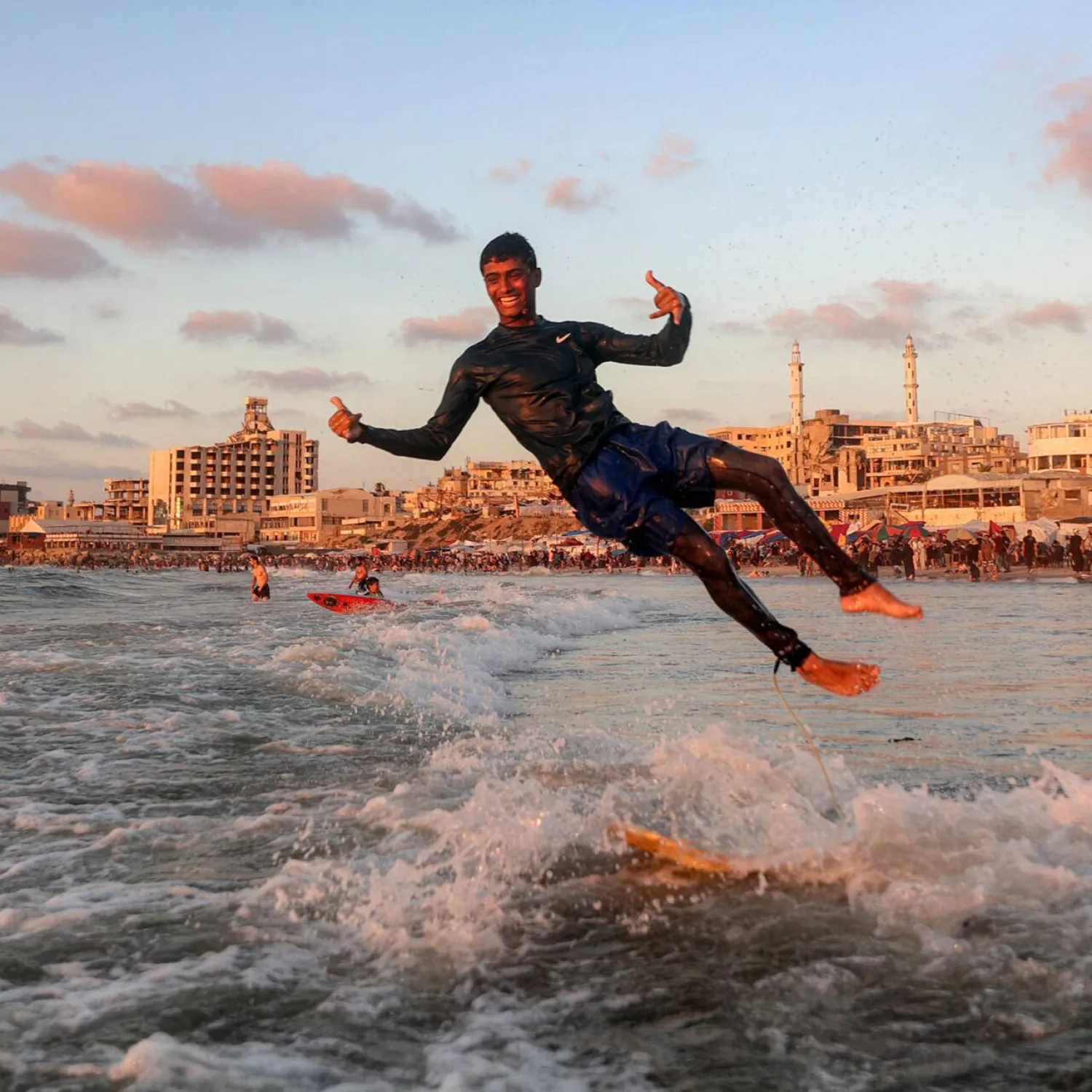

Gaza's Surfers Seek Solace in the Sea

Surfers still ride the waves off Gaza City, despite the devastation wreaked on the Palestinian territory during the recent conflict. Omar AL-QATTAA / AFP
TT

Gaza's Surfers Seek Solace in the Sea

Surfers still ride the waves off Gaza City, despite the devastation wreaked on the Palestinian territory during the recent conflict. Omar AL-QATTAA / AFP

Carrying their boards past tents and bombed-out buildings, a group of Gazan surfers headed for the sea, seeking solace in the waves despite the risk of Israeli attacks.

On the beach in Gaza City, the trio laid out their boards on the sand while they warmed up their limbs and readied their gear.

A few children splashed in the shallows as the surfers paddled out to sea, fighting the crashing waves.

"This sport is indescribable. When you catch a wave, ride it, glide along it, that feeling can't be put into words," said 23-year-old Tahseen Abu Assi, who learned how to surf from his father.

"I used to see him practicing it at the beach with his father, and I watched and learned from them," he told AFP.

"We learned little by little, and even with the war, the shelling, and the destruction, we're still continuing with this sport, because it lets us breathe and makes us feel safe."

A ceasefire between Israel and the Palestinian movement Hamas came into effect in Gaza in October after two years of devastating war.

But the tiny coastal territory remains gripped by bloodshed, with each side accusing the other of near-daily violations.

Even out at sea, the violence persists.

In mid-May, Nasser Hospital in Khan Yunis reported receiving two fishermen who had been injured by Israeli naval gunfire near the beach in the southern Gaza Strip.

A few days later, a Gazan security source reported that three fishermen were wounded by Israeli fire near the coast off Gaza City.

"The situation is still unstable," Abu Assi explained.

"At any moment, shells or explosives could land near you."

- Candle wax -

Out at sea, the surfers glide effortlessly across the crests of waves, momentarily free from the hardships of daily life in Gaza.

But the severe shortages caused by the war and ongoing Israeli import restrictions have posed obstacles for the sport.

"One of the biggest challenges and difficulties we face as surfers in the Gaza Strip is the lack of tools and equipment specific to this sport," Abdel Rahim Al-Ustadh, 19, told AFP.

"Surf wax, which we put on the boards, is not available at all in Gaza, so we resort to candle wax so we can keep this sport going," he added.

Ustadh said preserving old equipment was also essential, clutching a battered red and blue surfboard that was nearly two decades old.

"As surfers, we treat these boards like great treasures to us, because losing any board or having it confiscated threatens our ability to continue in this sport," he said.

The war in Gaza flattened swathes of the territory, displaced most of the population at least once, and left hundreds of thousands of people living in tents and temporary shelters.

Khalil Abu Jiyab, 18, said that before the war there had been a team of 17 surfers in Gaza.

Now, he said, there were just the three of them, pointing to shortages and a lack of boards.

"I've been surfing for 13 years now, and my hopes have almost been shattered," Abu Jiyab told AFP, but said he still dreamed of one day being able to surf in competitions outside the Gaza Strip.

"There's nothing in Gaza you can really look forward to except the sea," he added.

"The only outlet in Gaza is the sea; without it, life would have vanished long ago."


T. Rex Dinosaur Could Become Most Expensive Fossil Ever

A Tyrannosaurus Rex dinosaur (Sotheby's) 
TT

T. Rex Dinosaur Could Become Most Expensive Fossil Ever

A Tyrannosaurus Rex dinosaur (Sotheby's) 

In 1997, Sotheby's hosted a natural history auction selling wonders of our prehistoric world - but for the first time a dinosaur was on the books.

It was a niche event mostly attended by the world's museums looking for specimens to add to their collections.

The dinosaur in question was a Tyrannosaurus Rex called Sue - she was eventually sold for $8 million (£6 million) to the Field Museum in Chicago.

Nearly 30 years later, on Tuesday, another T. rex will make an appearance at the annual auction - one of the most complete specimens of this kind ever found, according to BBC.

And this time it is not just scientists who are dinosaur-hunting but also the super-rich.

The new specimen, known as Gus, has already been valued at $30 million but it could fetch more, possibly even becoming the most expensive dinosaur ever sold.

It adds to a growing debate in the natural history world – should specimens of such scientific importance be reserved for museums and their scientists?

Or - as auctioneers would argue - should fossil hunters be rewarded for their discovery of dinosaurs lost to science and saving them from a second extinction?

Cassandra Hatton, global head of natural history at Sotheby's, knows very well the lengths some fossil scientists - paleontologists - are willing to go to in the search for these creatures.

“People die on excavations,” she said.

And for many of these hunters, the ultimate prize is the Tyrannosaurus Rex.

This dinosaur that lived millions of years ago hardly needs describing, having been immortalized in culture by appearances in films like King Kong and Jurassic Park, and as the namesake of an English rock band.

“The people that look for these fossils will spend months out in the field with tents and their food in their backpacks and they're camping out in the middle of nowhere with the rattlesnakes and the bugs and the mountain lions,” she explained.


Heat Wave Smashes Records Across Central US

A man sits in the shade of a tree to protect from the sun during a heatwave at the Bois de Vincennes park in Paris on July 11, 2026. (Photo by Behrouz MEHRI / AFP)
TT

Heat Wave Smashes Records Across Central US

A man sits in the shade of a tree to protect from the sun during a heatwave at the Bois de Vincennes park in Paris on July 11, 2026. (Photo by Behrouz MEHRI / AFP)

A record-breaking heat wave baked the central United States on Sunday, smashing temperature records from the northern plains to the Rocky Mountains region.

In Salt Lake City, the state capital of Utah, and Billings, the largest city in Montana, temperatures reached a peak of 109F (43C), according to preliminary data from the US National Weather Service.

Both temperatures are all-time highs for each city since records started being kept over 150 years ago, surpassing the previous records of 107F and 108F (42C), respectively.

The blistering heat has also hindered efforts to fight massive wildfires raging in Colorado and Utah, and the high temperatures are expected to persist through Tuesday, AFP reported.

Just over a week ago, the eastern United States was gripped by another heat wave that pushed temperatures to around 104F in New York and Philadelphia.

Around the world, heat waves are becoming more common and intense due to climate change, primarily caused by the burning of coal, oil and gas and emission of greenhouse gases.

Western Europe experienced its hottest June on record. The heat wave left more than 1,300 people dead across the region, according to the World Health Organization.


Huge Fire Rages in Fontainebleau Forest Near Paris

Flames rise in the Fontainebleau Forest after a forestfire broke out late afternoon on July 12, 2026. (Photo by GEOFFROY VAN DER HASSELT / AFP)
TT

Huge Fire Rages in Fontainebleau Forest Near Paris

Flames rise in the Fontainebleau Forest after a forestfire broke out late afternoon on July 12, 2026. (Photo by GEOFFROY VAN DER HASSELT / AFP)

French officials rushed two firefighting planes to the Paris region Sunday, after a fire erupted south of the French capital, disrupting traffic during a busy summer travel weekend and piling more misery on a region sweltering through its latest heatwave.

The fire, which officials described as "very virulent" and of "exceptional scale", began late afternoon in the sprawling Fontainebleau forest about 60 kilometers (40 miles) south-east of the capital, a onetime royal hunting preserve that today is dotted with quiet villages.

It had raced across 800 hectares and was still spreading, officials said early Monday, causing the partial closure of the A6 highway, the country's main north-south artery.

And with nightfall, firefighting aircraft had been forced to suspend their operations.

Around 15 homes had been evacuated in the nearby village of Vaudoue and firefighters were defending several other towns in the area, said the local Seine-et-Marne fire service.

Residents anxiously gathered in the village, watching emergency vehicles race past and making calls to try to find out if their homes were still at risk.

Evacuated residents Valerie and her husband Daniel described the moment authorities and firefighters told them to leave their home.

"We could see the ash falling," Valerie told AFP, sitting outside near the war memorial in Vaudoue, unsure where they would sleep.

"We put the cats and dogs in the car... we could see the fire on both sides," she said.

Without the firefighting planes, other villages would already have been evacuated, said Olivier Compta, who is overseeing the firefighting operation.

Around 400 firefighters worked to contain the flames, which erupted just ahead of the July 14 national holiday and on the first major weekend for departures for the summer holiday season.

Traffic was disrupted along highways in the area, as well as along the high-speed rail line leading to the south-east of the country.

Eric Brocardi, of France's national federation of firemen, said it was the first time fire bomber planes had been sent up from the normally drier and hotter south of the country to extinguish fires in the Paris region.

Two firefighting helicopters and an observation aircraft were also helping to fight the blaze, he added.

"The aim is to save lives and property," he said later, as the fire advanced.

Earlier, firefighters dealt with a fire that had blocked a highway running east from Paris and disrupted a high-speed train line to the south of France.

French rail company SNCF said on Sunday evening there were delays of up to six hours for trains arriving at or leaving from Paris's Gare de Lyon.

At the station, 34-year-old physiotherapist Kelly took the delay in stride.

"It's global warming," she said. "It's the disruption of the seasons...there are political decisions to be taken."

The Paris region -- and large parts of the rest of France -- is currently experiencing the third heatwave since May, increasing the risk of fires.

The three heatwaves have seen temperature records broken in several countries across Europe and have caused thousands of excess deaths, according to estimates in Belgium, Britain, France and Spain.

The June heatwaves would have been "virtually impossible" without climate change, the World Weather Attribution group of scientists said.

Several other European countries have faced record-breaking average temperatures.

In France, the heatwave has also led officials to shut down three of the country's nuclear power stations.

And organizers of the Tour de France cycling race shortened Sunday's stage by 30 kilometers (19 miles) as temperatures on the route approached 40C.

Interior Minister Laurent Nunez, whose office announced he would visit Fontainebleau on Monday, said that forest fires had already consumed 17,000 hectares this year.

Once the figures had all been tallied, that would come to 25,000 hectares -- "twice as much as the same period" in 2025, he added.
