

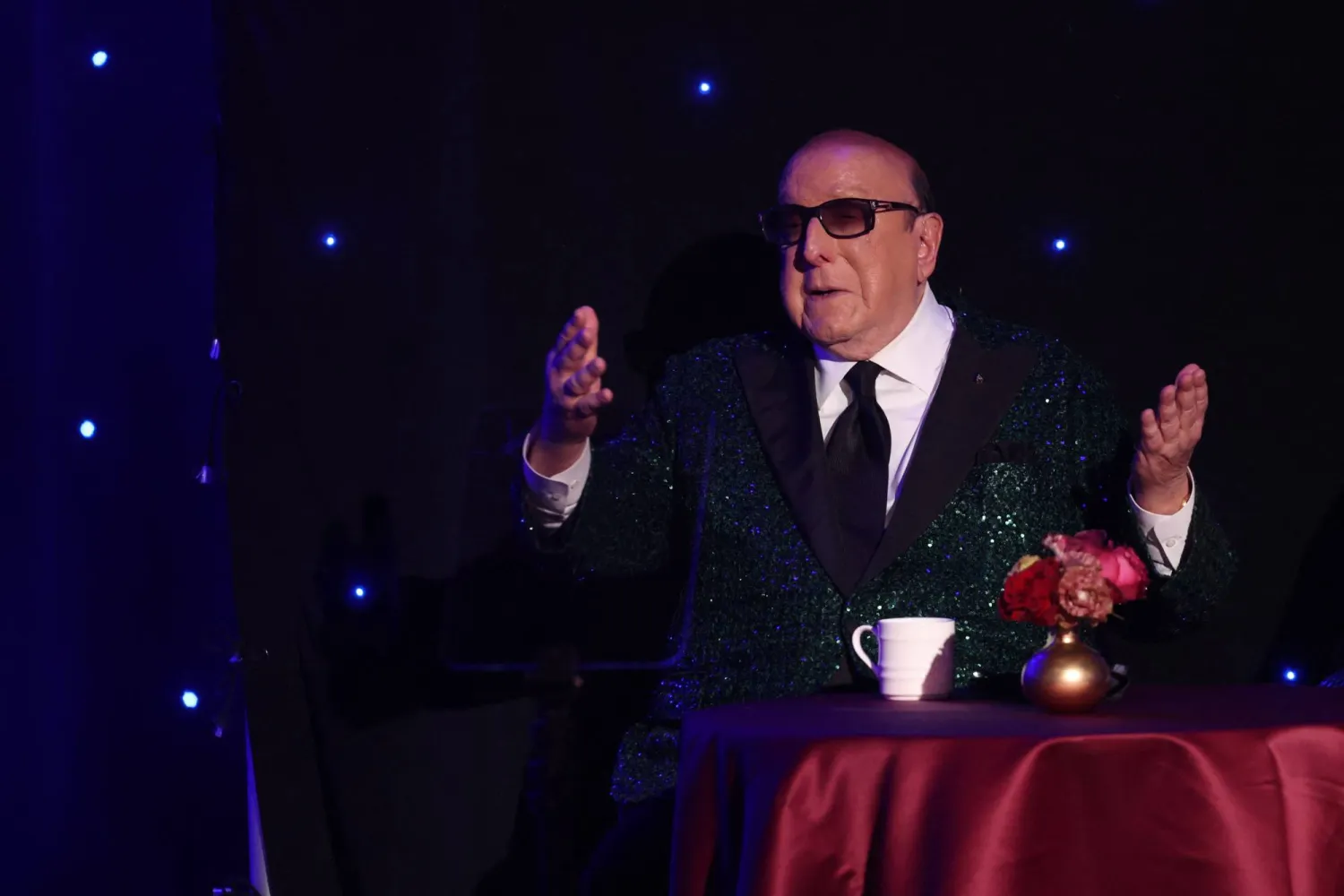

Clive Davis, Music Industry Starmaker, Dies at 94

Legendary US record producer Clive Davis speaks during the “Recording Academy and Clive Davis' Salute To Industry Icons” pre-Grammy gala at the Beverly Hilton hotel in Beverly Hills, California on January 31, 2026. (AFP)
TT

Clive Davis, Music Industry Starmaker, Dies at 94

Legendary US record producer Clive Davis speaks during the “Recording Academy and Clive Davis' Salute To Industry Icons” pre-Grammy gala at the Beverly Hilton hotel in Beverly Hills, California on January 31, 2026. (AFP)

Clive Davis, the record company lawyer who became one of the music industry's most powerful figures, launching or resurrecting the careers of such superstars as Janis Joplin, Whitney Houston, Carlos Santana and Alicia Keys, has died, his family confirmed to the New York Times. He was 94.

Earlier this year, Davis was hospitalized following an upper respiratory issue and was released a few days later. He died in his Manhattan apartment, the Times reported. Messages sent to representatives for Davis were not immediately returned Monday.

Unlike other record moguls whose influence waned as they got older, Davis' might only seemed to grow over his career, which spanned more than five decades, various genres and multiple labels. Into his 80s, he was directing the careers of everyone from Barry Manilow to “American Idol” winners Carrie Underwood and Kelly Clarkson.

His success stories were staggering, with Houston a crowning achievement and devastating tragedy: Davis signed her to his Arista record label when she was just a teen and turned her into America's reigning pop princess: She racked up multiple No. 1 hits and became one of the top-selling artists in pop history before drug abuse hobbled her career. She died in a Los Angeles hotel room in 2012 just hours before she was to appear at the annual pre-Grammy Awards gala hosted by Davis, who had been convinced she was turning her life around.

“Maybe I should have been more skeptical,” Davis wrote in his 2013 memoir, “The Soundtrack of My Life,” “but I’ve always been optimistic, and I felt hopeful. It felt like old times.”

He also launched the career of multiplatinum, multiple Grammy winner Keys — and was quick to note other talents he signed, including Joplin and Billy Joel, Blood Sweat & Tears and other “all-timers,” as he so often put it.

“I signed Patti Smith, the great Renaissance woman ... I signed Lou Reed ... I signed the Grateful Dead,” he proudly touted in an interview with The Associated Press in 1999.

But Davis didn't simply have an eye for new talent — he also knew how to keep veterans relevant decades after their first hit. Aretha Franklin, whose legend was made at Atlantic Records, flourished in her later years at Arista Records, as did Luther Vandross, who made his last albums for another Davis label, J Records.

Davis was also responsible for conceiving of the 1999 album “Supernatural,” which paired guitar god Santana with some of the day's hottest talents. The record went on to win a record tying eight Grammys and gave Santana more success than he had ever enjoyed in his decades-long career.

He had middle aged star Rod Stewart trade in his rock hits for standards from “The Great American Songbook.” The album, released in 2003, sold millions and was so successful it spawned four titles in all.

Davis didn’t always make the right choices; he turned down a chance to sign up Meatloaf. And he and his collaborators didn’t always agree. He and producer David Foster fought bitterly over the arrangement for Houston’s all-time hit, a cover of Dolly Parton’s “I Will Always Love You.” Manilow strongly objected to recording “I Write the Songs,” noting that he didn’t even write the song, a Bruce Johnston ballad that became a signature hit for Manilow, who would have similar latter-day success mining the music of the 1950s, 60s and '70s.

“He's just brilliant at picking ideas he thinks the public will connect,” raved Manilow, who had worked with Davis since he was a budding singer at Columbia Records.

Davis also had his struggles. Though he became president of Columbia Records in 1967 after joining the label in 1960 as a lawyer, by 1973 he was gone in a bitter fallout. The label accused him of mismanagement of funds and he was fired. Although Davis says he was later cleared, it wasn't the end of his problems; he later was indicted on tax evasion charges, pleaded guilty to one count and had to pay a $10,000 fine.

However, Davis would declare victory: he says Columbia gave him the money to start Arista Records to resolve the dispute, and the label would become a huge success with artists like country superstars Brooks & Dunn, sassy R&B group TLC, Babyface, Houston, Franklin and others.

The label had huge success with a debut act — Milli Vanilli. But the male pop duo would become the embarrassment of the industry when, after winning a Grammy, it was revealed that they weren't actually singing their songs (Davis blamed the debacle on the label's European division, which he said signed them; the group was later stripped of its best new artist Grammy).

In 1999, as Arista was celebrating its 25th anniversary, Davis faced another crisis: the label's then-parent company, BMG Entertainment, a division of German media conglomerate Bertelsmann, wanted him to retire; most of its executives were eased out by 60, and Davis was in his mid-60s.

In 2000, despite support from his superstar roster, the company ousted him in favor of producer and songwriter Antonio “L.A.” Reid, who would later become chairman of Island/Def Jam.

However, instead of severing its ties with Davis, BMG helped him launch J Records in what BMG has described as the largest record company startup ever created. Vandross was one of his initial artists, along with forgettable acts like the boy-band O-Town.

J Records was a success from the start, though, and only grew in stature with the arrival of a young singer named Keys, a piano-playing singer-songwriter with powerful pipes and dramatic R&B songs. Keys' albums would go on to sell millions and win several Grammys.

His influence grew even more when Davis was tapped for BMG's US division.

He became a key backer of the careers of the winners of “American Idol,” guiding many albums to platinum status. The show's link to Sony BMG came through a deal between Davis and 19 Recordings Unlimited, the label managed by “Idol” creator Simon Fuller.

In 2007, however, Davis disagreed with the direction of Clarkson's “My December,” and she publicly criticized him. The album was a flop, and she later apologized.

In 2008, Sony BMG replaced Davis as chairman and chief executive officer of the BMG label group, giving him the title of chief creative officer.



‘Toy Story 5’ Rakes in the Biggest Box-Office Debut of the Year with a Franchise-Best $160 Million

 This image released by Disney shows characters Buzz Lightyear, voiced by Tim Allen, left, and Woody, voiced by Tom Hanks, in a scene from "Toy Story 5." (Pixar-Disney via AP)
This image released by Disney shows characters Buzz Lightyear, voiced by Tim Allen, left, and Woody, voiced by Tom Hanks, in a scene from "Toy Story 5." (Pixar-Disney via AP)
TT

‘Toy Story 5’ Rakes in the Biggest Box-Office Debut of the Year with a Franchise-Best $160 Million

 This image released by Disney shows characters Buzz Lightyear, voiced by Tim Allen, left, and Woody, voiced by Tom Hanks, in a scene from "Toy Story 5." (Pixar-Disney via AP)
This image released by Disney shows characters Buzz Lightyear, voiced by Tim Allen, left, and Woody, voiced by Tom Hanks, in a scene from "Toy Story 5." (Pixar-Disney via AP)

“Toy Story” still has a friend in moviegoers.

The fifth installment in the Pixar series debuted with $160 million in domestic ticket sales, according to studio estimates Sunday, easily setting a new franchise record and notching the biggest opening weekend of the year.

Launching 31 years after the original “Toy Story” first landed in theaters, “Toy Story 5” far surpassed the previous series-best debut: $120 million for “Toy Story 4” in 2019. Internationally, it was just as successful, with $152 million in opening-weekend sales, for a worldwide haul of $312 million.

The “Toy Story” franchise is one of the most profitable for The Walt Disney Co. Before “Toy Story 5” launched, the movies had collectively grossed more than $3 billion, while also pulling in billions from merchandising.

Though the series seemed to reach a conclusion with 2010’s “Toy Story 3,” the decision to revive the franchise almost a decade later — while controversial — has been extremely lucrative. “Toy Story 4” exceeded $1 billion in ticket sales, and “Toy Story 5” is all but certain to as well.

Among animated films, only 2018's “Incredibles 2” had a bigger opening weekend ($182.7 million) than “Toy Story 5.”

Keeping the “Toy Story” movies going has gotten more expensive, though. The fifth movie cost $250 million to make, not including marketing. It returns a voice cast led by Tom Hanks (as Woody), Tim Allen (as Buzz Lightyear) and Joan Cusack (as Jessie).

In the sequel, the toys are pushed aside when Bonnie gets a new tablet. It’s directed by Andrew Stanton, the Pixar veteran who helmed “Finding Nemo” (2003) and “WALL-E” (2008). “Toy Story 5” also features a new song by Taylor Swift, “I Knew It, I Knew You.”

Reviews have been very good and audiences gave “Toy Story 5” an “A” CinemaScore, suggesting it should remain a force in theaters for weeks.

After its chart-topping debut, Steven Spielberg’s “Disclosure Day” slipped to second place with $17 million in its second weekend. That’s not the hold that Universal Pictures was hoping for. Dropping 61% from its first weekend suggests “Disclosure Day” might not find the legs Spielberg’s sci-fi thriller needs to break out this summer.

Still, the $115 million budgeted movie, starring Emily Blunt, Josh O’Connor and Colman Domingo, has grossed $160.4 million globally in two weeks. “Disclosure Day” stands a good chance of remaining the top adult-oriented option in theaters in the coming weeks.

“Toy Story 5” faced little competition from newcomers.

‘Robin Hood’ misses the bullseye

A24’s “The Death of Robin Hood,” a violent revisionist approach to the old legend, flopped with $2.6 million on 1,762 screens. The film, starring Hugh Jackman and directed by Michael Sarnoski, was modestly budgeted at $20 million. But after finding mixed reviews, audiences didn’t go for the movie, either. It earned a “C+” CinemaScore.

The top horror choice remained “Obsession,” the microbudget phenomenon by 26-year-old Curry Barker. In its sixth weekend, it nearly equaled its $17 million opening weekend from mid-May. The Focus Features release, which cost less than $1 million to make, added $14.2 million to bring its domestic total to $215.8 million and its global haul to $333.3 million.

With “Toy Story 5” and “Obsession” driving sales, the summer box office is up 15% from the 2025 summer, according to Rentrak. More impressively, summer ticket sales are nearly equal to the 2019 summer at the same point, not accounting for inflation. The summer to date is just 1.9% down from that year.

Paul Dergarabedian, head of marketplace trends for Rentrak, expects that Hollywood is heading for its best summer since before the pandemic. And the success is coming from both expected and unexpected places.

“To me, this is a hybrid summer and this could be the new blueprint for how you build the perfect summer box-office beast,” says Dergarabedian. “You throw in a mix of very eclectic films and not just the usual suspects — the big franchise films, the known brands — but also films like ‘Backrooms’ and ‘Obsession’ and original films like ‘Disclosure Day.’”


Former Child Actor Daveigh Chase, 'The Ring' Villain and Lilo Voice, Dies at 35

FILE - Actor Daveigh Chase poses at the Season 5 premiere of HBO series "Big Love," in Los Angeles on Jan. 12, 2011. (AP Photo/Chris Pizzello, File)
TT

Former Child Actor Daveigh Chase, 'The Ring' Villain and Lilo Voice, Dies at 35

FILE - Actor Daveigh Chase poses at the Season 5 premiere of HBO series "Big Love," in Los Angeles on Jan. 12, 2011. (AP Photo/Chris Pizzello, File)

Former child actor Daveigh Chase, known for her youthful voice in Disney's “Lilo & Stitch” and her villainous performance in the thriller “The Ring," has died. She was 35.

Chase's father, John David Schwallier, confirmed to The New York Times she died from complications of bacterial meningitis and a blood infection. She had been homeless in Los Angeles with her boyfriend near the hospital where she died, he told the newspaper.

TMZ first reported Wednesday that Chase died Tuesday.

She voiced the lead role of Lilo in the 2002 animated film, a role she auditioned for at age 8. Years later, a Hawaiian actress was cast as Lilo for the live-action remake.

For her role as long-haired Samara in the 2002 horror film, Chase won an MTV movie award for best villain.

Chase also voiced another lead in the 2001 animated film “Spirited Away.”

She had roles in the 2001 movie “Donnie Darko” and the 2003 show “Oliver Beene,” according to internet movie database IMDb.com.

She was born in Las Vegas and raised in Albany, Oregon. In her small hometown, she began singing and dancing at age 3, according to IMDb.

Chase struggled with drugs since she was 13 years old, Schwallier said in an interview with the Times. He said his daughter was estranged from her parents, who are divorced.

Schwallier said he was in touch with Chase's boyfriend, and just before she died, arrived at the Los Angeles hospital where she was being treated.


‘Toy Story 5’ Tackles Tech Tensions and Tween Girl Trials

This image released by Disney shows characters Bullseye, left, and Jessie, voiced by Joan Cusack, in a scene from Disney and Pixar's "Toy Story 5." (Disney/Pixar via AP)
TT

‘Toy Story 5’ Tackles Tech Tensions and Tween Girl Trials

This image released by Disney shows characters Bullseye, left, and Jessie, voiced by Joan Cusack, in a scene from Disney and Pixar's "Toy Story 5." (Disney/Pixar via AP)

For actor Joan Cusack, who voices the animated cowgirl Jessie in Disney's “Toy Story 5,” it was important that the film tell a different kind of story — one centered on the experiences of girls.

“I mean, we’re half the population,” she told Reuters.

Cusack emphasized the value of stories told from a female perspective, saying they bring a distinct emotional depth.

“Girl stories are great because they offer a different point of view. If you do it well, there’s real emotion in it. I think it’s real,” the “Working Girl” actor added.

Alongside Cusack, franchise veterans Tom Hanks and Tim Allen return as the toys Woody and Buzz Lightyear.

In the latest installment, the toys confront a ⁠new threat: the rise ⁠of electronics, which increasingly replace them in children’s lives.

At the center is Bonnie, a little girl who feels pressured to swap her toys for a high-tech tablet called Lilypad, voiced by Greta Lee, in order to fit in with a judgmental group from her dance class.

The conflict sparks an emotional journey for Jessie as she supports Bonnie while questioning her own place in a tech-driven world.

“Toy Story 5,” directed by Andrew Stanton and co-written by Stanton and Kenna ⁠Harris, is the fifth installment in Pixar’s popular franchise and a sequel to "Toy Story 4," which was directed by Josh Cooley.

The film is projected to deliver the franchise’s strongest domestic box office debut, with an opening weekend estimated between $150 million and $175 million, according to Paul Dergarabedian, head of media analytics at Rentrak, a global measurement and research company serving the entertainment industry.

Daniel Loria, senior vice president of content strategy and editorial director at Boxoffice Pro, similarly forecasts an opening in the $150 million to $175 million range. He said "Toy Story 5" could become one of the highest-grossing films of 2026 and potentially surpass $500 million domestically, marking a new franchise record.

The franchise is vital to Disney, which relies on the popularity of its stories and characters to bring ⁠visitors to its theme ⁠parks, sell merchandise and watch its Disney+ streaming service.

The "Toy Story" films have brought in about $3 billion in global box office, according to Rentrak.

Tim Allen said he was surprised by how deeply the film affected him when he first watched it.
“This was horrifying to watch as an adult,” he told Reuters, explaining that the film’s themes of bullying struck an emotional chord for him as a father of girls.

For Tom Hanks, the franchise’s lasting appeal lies in the toys’ compassion for one another.
“Being part of this ensemble - friends who will do anything for each other whenever they are needed - that’s powerful,” the two-time Academy Award winner said.

“There’s no jealousy. There might be confusion, but there is always care for one another. And the fact that this is Jessie’s story, and she reaches out and says, ‘I need your help,’ we are right there.”

"Toy Story 5" arrives in theaters on Friday.