


Israel Fire Kills Two in Lebanon, Testing Iran-Linked Ceasefire

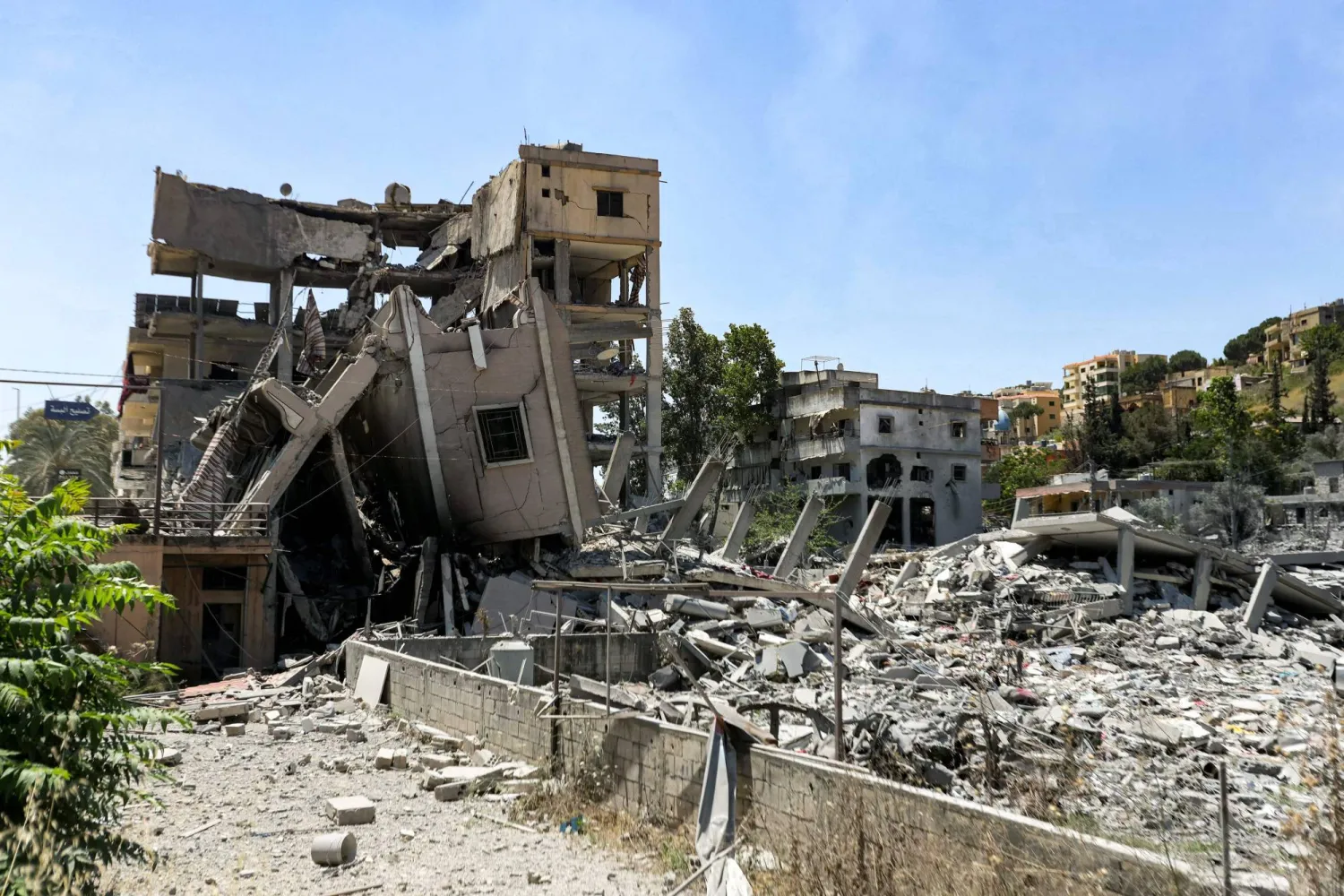
The rubble of a collapsed building is pictured following Israeli bombardment, in Nabatieh in southern Lebanon on June 21, 2026. (AFP)
TT

Israel Fire Kills Two in Lebanon, Testing Iran-Linked Ceasefire

The rubble of a collapsed building is pictured following Israeli bombardment, in Nabatieh in southern Lebanon on June 21, 2026. (AFP)

Israeli gunfire killed two people in southern Lebanon on Tuesday, Lebanon's Civil Defense and health ministry said, prompting Iran-backed Hezbollah to accuse Israel of violating a ceasefire that has largely held since Sunday.  

The lull in fighting is the longest yet in the war that was ignited by the US-Iran conflict on March 2, when Hezbollah opened fire at Israel in support of Tehran, prompting Israel's second offensive in the country since 2024. 

The highway south was clogged with cars on Tuesday as the relative calm encouraged displaced people to return home, despite concerns about the ceasefire's solidity and with Israeli forces still deployed deep inside Lebanon. 

The war has loomed over diplomacy towards resolving the US-Iran conflict, as Tehran has demanded Israel halt attacks in Lebanon as part of its interim deal with Washington, tying the fate of the wider negotiations to the Lebanon conflict. 

'UNQUESTIONABLE PART' OF AGREEMENT 

The ‌shooting marked the first ‌fatalities since Sunday. 

Israeli soldiers opened fire at a group of people near a bulldozer clearing a ‌road ⁠in the al-Deir ⁠neighborhood of Nabatieh al-Fawqa, the local mayor and Lebanon's state news agency NNA said. 

The Israeli military later said its troops had fired warning shots at four people on a bulldozer and motorcycle that had crossed into the zone Israeli troops are still holding in southern Lebanon. It described them as "Hezbollah terrorists operating under civilian cover". 

After the group of people continued to approach, "additional fire was conducted in order to remove the threat." 

In a separate incident, the Israeli military said it "struck armed terrorists who posed an immediate threat" to soldiers in the Ali al-Taher ridge area - located within the same area of the south. 

Hezbollah, in a statement, said two civilians were killed in the Nabatieh al-Fawqa shooting and accused Israel of violating the ceasefire. 

It did not say whether ⁠it intended to respond. Asked about the latest incident, Iran's ambassador to the United Nations in Geneva, ‌Ali Bahreini, told reporters that any violation of the memorandum of understanding in Lebanon would create ‌challenges for peace talks. 

"Lebanon is an unquestionable part of the agreement, and whatever happens in Lebanon affects the whole process, and it is the United ‌States which should use all its leverage against Israel to make it to stop attacks against Lebanon," he said. 

A joint statement ‌issued at the end of US-Iranian talks in Switzerland said the parties had agreed to create "a de-confliction cell" to ensure adherence to the termination of hostilities in Lebanon. 

On Tuesday, US Vice President JD Vance and Secretary of State Marco Rubio told Lebanese President Joseph Aoun in a phone call that they were committed to forming the cell to solidify the ceasefire in Lebanon, and that details of its formation and how it would operate were still under review. 

Israeli Prime Minister Benjamin Netanyahu ‌said on Monday that troops had full freedom of action to thwart any Hezbollah direct or emerging threat against them or Israeli citizens, and would remain in Lebanon for "as long as is necessary". 

A ⁠separate Israeli drone strike on Tuesday ⁠afternoon hit a parked car in southern Lebanon, with no casualties recorded, Lebanese state media said. 

'PEOPLE ARE SCARED', LOCAL OFFICIAL SAYS 

Nabatieh and the nearby Ali al-Taher ridge have been the focal point of heavy fighting in recent weeks, as Israeli forces sought to advance there. 

Israeli attacks have forced some 1.2 million people from their homes in Lebanon, according to Lebanese authorities. 

Zein Ghandour, the mayor of Nabatieh al-Fawqa, said residents had begun returning to check on their homes, but were being urged to stay away after Tuesday's shooting. 

"People were scared," he said, speaking to Reuters by phone. 

Further from the frontline, hundreds of families had returned to the southern town of Zrarieh, said local official Rida Abed al-Khalik. "We are expecting more to come tomorrow depending on what will happen in the meetings today," he said, referring to talks in Washington between Lebanese and Israeli government officials. 

In the nearby village of Toura, an official said 60-70% of residents had returned, though some had no homes to return to. 

Israeli attacks in Lebanon have killed more than 4,100 people, including 773 women, children and healthcare workers, according to the Lebanese health ministry. The toll does not say how many combatants are among the dead. 

Israel's death toll from this round of hostilities with Hezbollah includes at least 32 soldiers and four Israeli civilians. 


Analysts: Bab al-Mandab Tests Limits of Saudi-Iranian Reconciliation

Beijing faces a difficult challenge in ensuring Tehran fulfills its commitments under the agreement with Saudi Arabia, according to analysts. (SPA)
TT

Analysts: Bab al-Mandab Tests Limits of Saudi-Iranian Reconciliation

Beijing faces a difficult challenge in ensuring Tehran fulfills its commitments under the agreement with Saudi Arabia, according to analysts. (SPA)

More than three years after Saudi Arabia and Iran signed their agreement in Beijing, brokered by China, the reconciliation between Riyadh and Tehran is facing one of its most difficult tests, amid accusations that Iran is supporting armed groups in Yemen and Iraq that have targeted Saudi Arabia, and as the Houthis move toward the Bab al-Mandab Strait, raising concerns over the Kingdom's security and navigation in the Red Sea.

AFP reported, citing two Houthi military sources, that experts from Iran's Revolutionary Guard Corps had visited the Bab al-Mandab area, the port and airport of Mokha, and the Jabal al-Nar camp east of the city. The sources said the experts had supervised the digging of tunnels in the mountains overlooking Mokha and the Bab al-Mandab Strait and had discussed installing radars near Mokha and on Zuqar Island in the southern Red Sea.

Analysts who spoke to Asharq Al-Awsat said the latest developments not only test Tehran's commitment to its pledges, but also put China's role under scrutiny. The issue is no longer limited to maintaining diplomatic relations between Saudi Arabia and Iran, but also concerns the agreement's ability to curb sources of indirect threats and prevent armed groups from being used to pressure countries in the region.

Riyadh and Tehran signed an agreement in Beijing under Chinese sponsorship to resume diplomatic relations after a break of nearly seven years.

Bab al-Mandab: A Serious Test for the Agreement

Dr. Abdulaziz bin Sager, Chairman of the Gulf Research Center, said the Beijing Agreement, signed in March 2023, was based on three main components: restoring diplomatic relations after seven years of estrangement, reactivating bilateral cooperation agreements, and respecting the sovereignty of states and noninterference in their internal affairs. He described the third component as "the most important and most sensitive."

In an interview with Asharq Al-Awsat, bin Sager said Iran's actions through the Houthis near the Bab al-Mandab Strait "represent a serious test of the Saudi-Iranian agreement" because they violate both its provisions and its spirit, which was based on building trust. He added that the commitments should not be limited to Iran's direct actions, but should also cover the conduct of groups linked to the Iranian Revolutionary Guard Corps.

"There is no meaning to any agreement with Iran that does not cover the actions of its regional proxies that threaten regional and international security," he said, considering support for the Houthis or incitement to threaten the Kingdom's security a "blatant violation" of the commitment to respect sovereignty and refrain from interference.

Abdulaziz Al-Shaibani, a researcher and adviser on Chinese and Asian affairs, takes a different view. He said Iranian actions near the Bab al-Mandab Strait test the Beijing Agreement but do not mean that it has collapsed. The agreement was designed primarily to restore relations and open channels for dialogue, not to end the rivalry between Riyadh and Tehran or establish a strategic partnership between them.

The Proxy Policy

Saudi political analyst Dr. Khalid Al-Habbas said the militia policy is one of Tehran's most important tools for expanding its regional influence. He said the Iran Revolutionary Guard Corps supports, trains, and organizes these groups, enabling them to play roles that serve Iranian objectives when needed.

Al-Habbas places the latest Houthi moves, as well as the earlier activities of Iran-aligned factions in Iraq, within the context of growing military and economic pressure on Tehran and its efforts to open alternative fronts of pressure. He said moves toward the Bab al-Mandab Strait could threaten maritime navigation, drive up energy prices, and disrupt supply chains.

Dr. Khalid cautioned against relying on Houthi pledges not to target ships, saying that the experience of the Red Sea since late 2023 has demonstrated otherwise. He stressed that protecting maritime navigation "is an international responsibility, not one that falls on the Kingdom alone," given the global importance of the waterway.

According to Al-Habbas, Saudi Arabia, while remaining committed to resolving disputes peacefully and keeping the door to diplomacy open, has the right to defend itself under Article 51 of the United Nations Charter. It also has the right to "demand that Iran comply with the terms of the agreement and review it in light of the extent to which Tehran has honored its commitments."

Has the Testing Period Ended?

Dr. Samir Salha, a professor of international law and international relations at Istanbul University, takes a more forceful position. "We have moved beyond the question of testing the understandings. It is clear that the Iranian side has departed from their spirit and begun pursuing a regional policy different from what it had pledged," he said.

He added that the central question is no longer simply whether Tehran is complying, but who is arming the Houthis, training them, and directing their operations.

"The threats appear Houthi on the surface, but at their core they are Iranian," he said, arguing that the mobilization of Iran-aligned groups in Yemen, Iraq, and Lebanon reflects an Iranian priority that has not changed despite the restoration of relations with Riyadh.

In Salha's assessment, Saudi Arabia will not base its options solely on waiting for China to act. Instead, it will continue exploring strategic alternatives to ensure its security while keeping the diplomatic track open, a process he said has already begun in recent months.

Beijing: Opening the Way Is Not Enough

The analysts agree that China has significant tools for influencing Iran, given the depth of their economic, political, and military ties. But they say Beijing is being called upon to move from its symbolic role as sponsor of the agreement to a more decisive role in monitoring its implementation.

Bin Sager said Beijing "is capable of verifying Iranian conduct that violates the agreement," but tends to favor ambiguity and avoids taking decisive positions when crises do not directly affect its national security. What is needed now, he said, is a clear mechanism for verifying Tehran's compliance and restraining its proxies.

Salha, meanwhile, said China faces a difficult choice between simply protecting its relationship with Iran and defending its broader interests with the Gulf states and the trade routes that pass through the Red Sea. "This is primarily a test for Iran, but secondarily a test for Beijing," he said.

"Beijing faces a difficult, sensitive, and delicate situation. There have been positive indications in its positions and political messages toward Iran recently, but betting that Tehran will accept and heed what Beijing says is difficult," he added.

Dr. Samir noted that "Beijing succeeded in opening the way for a new test in Saudi-Iranian relations, but it now needs to go further if it wants to protect its interests and relations with the Gulf states."

Al-Shaibani, for his part, said Beijing tends to favor diplomacy and avoid direct intervention, and is not expected to decisively side with either party. He concluded that the future of the agreement will depend on China's ability to keep dialogue open and contain crises, while Saudi Arabia retains the right to protect its security and interests through its own capabilities and regional partnerships.


Israeli Forces Raid Town of Suspected Palestinian Gunman

Israeli forces take part in a raid in the Palestinian town of Biddu, in the Israeli-occupied West Bank, September 21, 2026. REUTERS/Mohammed Torokman
TT

Israeli Forces Raid Town of Suspected Palestinian Gunman

Israeli forces take part in a raid in the Palestinian town of Biddu, in the Israeli-occupied West Bank, September 21, 2026. REUTERS/Mohammed Torokman

Israeli forces on Monday raided the hometown of a Palestinian man suspected of shooting dead an Israeli settler in the occupied West Bank the day before, local authorities said.

Sunday's shooting occurred near the Israeli settlement of Neveh Tzuf, north of Ramallah, on the eve of the Jewish holiday of Yom Kippur, with the suspected assailant apprehended by soldiers after being located at a hospital.

Israel's military told AFP on Sunday that its troops had raided the home of the attacker's family in the Palestinian village of Biddu, northwest of Jerusalem in the West Bank.

The Jerusalem Governorate, the Palestinian local authority for the area, said Israeli forces then raided Biddu at dawn on Monday and "carried out a large-scale arrest campaign targeting dozens of young men".

"The raid was accompanied by searches, vandalism, and the smashing of property inside a number of homes, as well as physical assaults on several residents," it said, adding that the raid was ongoing.

When asked by AFP, the Israeli military said it was checking the reports.

An AFP photographer saw Israeli forces in the town on Monday morning.

Biddu's mayor, Nazmi Mansour, told AFP that the military had stormed the town after midnight with "dozens of military jeeps and hundreds of soldiers".

"The soldiers began house-to-house searches and set up field interrogation centers in buildings they had taken control of," he said, adding that dozens of people were questioned.

"The army is still present in the town and has closed off its entrances, and all commercial shops are shut," he told AFP by telephone.

Israel's army chief Lieutenant General Eyal Zamir said at the site of the attack Sunday that the military remained "on high alert".

"We will impose a closure on the village and conduct investigations, through which we will reach everyone who assisted the terrorist," Zamir said.

Far-right National Security Minister Itamar Ben Gvir called for the attacker to be the first person executed under a recently approved death penalty law.

The new law imposes the death penalty by default on Palestinians from the West Bank convicted on terror charges for deadly attacks.

Israel has occupied the West Bank since 1967 and violence there has surged since Hamas's October 7, 2023 attack on Israel which sparked the Gaza war.


Lebanon Seeks UNIFIL Mandate Extension amid Lack of Agreement on Alternative

Jordan’s King Abdullah II, French President Emmanuel Macron and Lebanese President Joseph Aoun pose for a photo before an Aqaba Process meeting in support of the Lebanese Armed Forces at Les Invalides in Paris. (AFP)
TT

Lebanon Seeks UNIFIL Mandate Extension amid Lack of Agreement on Alternative

Jordan’s King Abdullah II, French President Emmanuel Macron and Lebanese President Joseph Aoun pose for a photo before an Aqaba Process meeting in support of the Lebanese Armed Forces at Les Invalides in Paris. (AFP)

Lebanon is intensifying international and Arab diplomatic efforts to avert a security vacuum in the south when the mandate of the United Nations Interim Force in Lebanon (UNIFIL), tasked by the UN Security Council with implementing Resolution 1701, expires at the end of the year.

President Joseph Aoun raised the issue at a summit with French President Emmanuel Macron and Jordan’s King Abdullah II on the sidelines of a preparatory conference in Paris to support the Lebanese Army and Internal Security Forces.

The matter is also expected to top Prime Minister Nawaf Salam’s agenda during his meetings in New York, where he is leading Lebanon’s delegation to the 81st UN General Assembly, and later in Washington, where he is due to meet US Secretary of State Marco Rubio.

Lebanon is placing importance on peace talks in New York and on a meeting with Rubio to prevent a security vacuum in the south if UNIFIL withdraws, amid a lack of agreement on an international body to replace it.

UNIFIL commander Major General Diodato Abagnara warned of the issue, questioning which authority would take over from the mission, saying that “more than half of our positions in southern Lebanon are under Israeli control.”

A ministerial source said Aoun raised concerns about a potential vacuum during his talks with Macron and King Abdullah.

The source told Asharq Al-Awsat that both leaders shared those concerns and promised to contact US President Donald Trump to seek his approval, at Aoun’s request, for extending UNIFIL’s mandate by six months to a year.

Such an extension, the source added, could help activate the “framework agreement” and expand “pilot zones” where the Lebanese Army could deploy with UNIFIL support.

Macron and King Abdullah are also counting on Trump’s commitment to help Lebanon implement the agreement under UNIFIL supervision or that of any UN force that might replace it, according to the source.

European Union countries understand Lebanon’s concerns and are working to formulate a proposal before the end of October that would preserve an international presence in the south to accompany a phased Israeli withdrawal if efforts to persuade Trump to extend UNIFIL’s mandate fail.

The source stressed that any replacement should operate under UN auspices rather than leave the international presence limited to the US-dominated “Mechanism” committee, from which Washington has excluded France.

A European official was quoted as saying that Lebanon should not be left alone in calling for an international force to replace UNIFIL and that European countries would support efforts to prevent a vacuum, including during meetings on the sidelines of the UN General Assembly.

Lebanon is also insisting that Israel evacuate the Ali al-Taher hills and hand them over to the Lebanese Army, alongside the establishment of a monitoring post there with a predominantly US presence.

Israel has refused to hand the area to the army and wants the Lebanese request placed on the agenda of an eighth round of negotiations, which Rome would host for a third time. No date has yet been set.

The ministerial source said Washington, as sponsor of the framework agreement, is responsible for setting up the date. The United States is currently pressing Israel to agree to expand the “pilot zones,” he added.

But US Ambassador to Israel Mike Huckabee’s statement that Israeli forces would remain in the south until the Lebanese Army becomes strong offered little grounds for optimism, the source said. Israel has continued targeting areas retaken in the south, preventing the Lebanese Army from deploying there, and has yet to agree to a verification mechanism to ensure areas are free of Hezbollah weapons and fighters.

A Western diplomat said Lebanon’s friends, particularly several European countries, have begun questioning why Trump has not followed through on commitments he made to Aoun during their Washington summit.

Concerns over a possible UN vacuum in the south are expected to feature prominently in Arab and European discussions with Trump and senior US officials.

The diplomat said Lebanon’s allies had little choice but to support Aoun and Salam’s government in strengthening the state’s position vis-à-vis Hezbollah, questioning what the seventh round of negotiations had achieved.

He argued that Lebanon could not afford to postpone implementation of the framework agreement until after Israel’s Knesset elections.

The ministerial source accused Israeli Prime Minister Benjamin Netanyahu of continuing to bulldoze towns and systematically destroy homes on the pretext of eliminating remaining Hezbollah military infrastructure. He said Netanyahu was primarily seeking to push Lebanon into abandoning the negotiations and boycotting the eighth round unless Israeli attacks ceased.

Aoun, however, remains committed to negotiations and will not be drawn into what the source described as Netanyahu’s strategy. In the source’s view, Netanyahu accepted the framework agreement under US pressure but has avoided implementing it ahead of the Israeli elections.

The source also pointed to parliament’s third renewal of confidence in Salam’s government as evidence that a majority of lawmakers remained committed to the framework agreement and to the principle that weapons should be held exclusively by the state.

He nevertheless warned that Lebanon’s worsening cost-of-living crisis could put the government at odds with much of the population unless it finds ways to ease pressure on low-income households — something that would require financial assistance from Arab and international partners.

Hezbollah, meanwhile, continues to insist on retaining its weapons and rejects the framework agreement. The group was surprised by the renewed confidence vote in Salam’s government, particularly after Free Patriotic Movement leader MP Gebran Bassil unexpectedly proposed it at the end of parliament’s questioning of the government.

Hezbollah left the chamber before voting began.

The group has also rejected local and Arab mediation efforts urging it to hand over an initial batch of offensive weapons as long as it stays committed not to respond to Israeli attacks.

The source underlined that such a move would open the way for Hezbollah to join the state project rather than remain isolated, particularly as it bets on an Iranian-US memorandum of understanding whose implementation reached an impasse, compounded by Washington’s refusal to link Lebanon to the Iranian track.
