Aoun Hails Gulf Support, Says Lebanon Remains Committed to Strongest Ties with GCC States

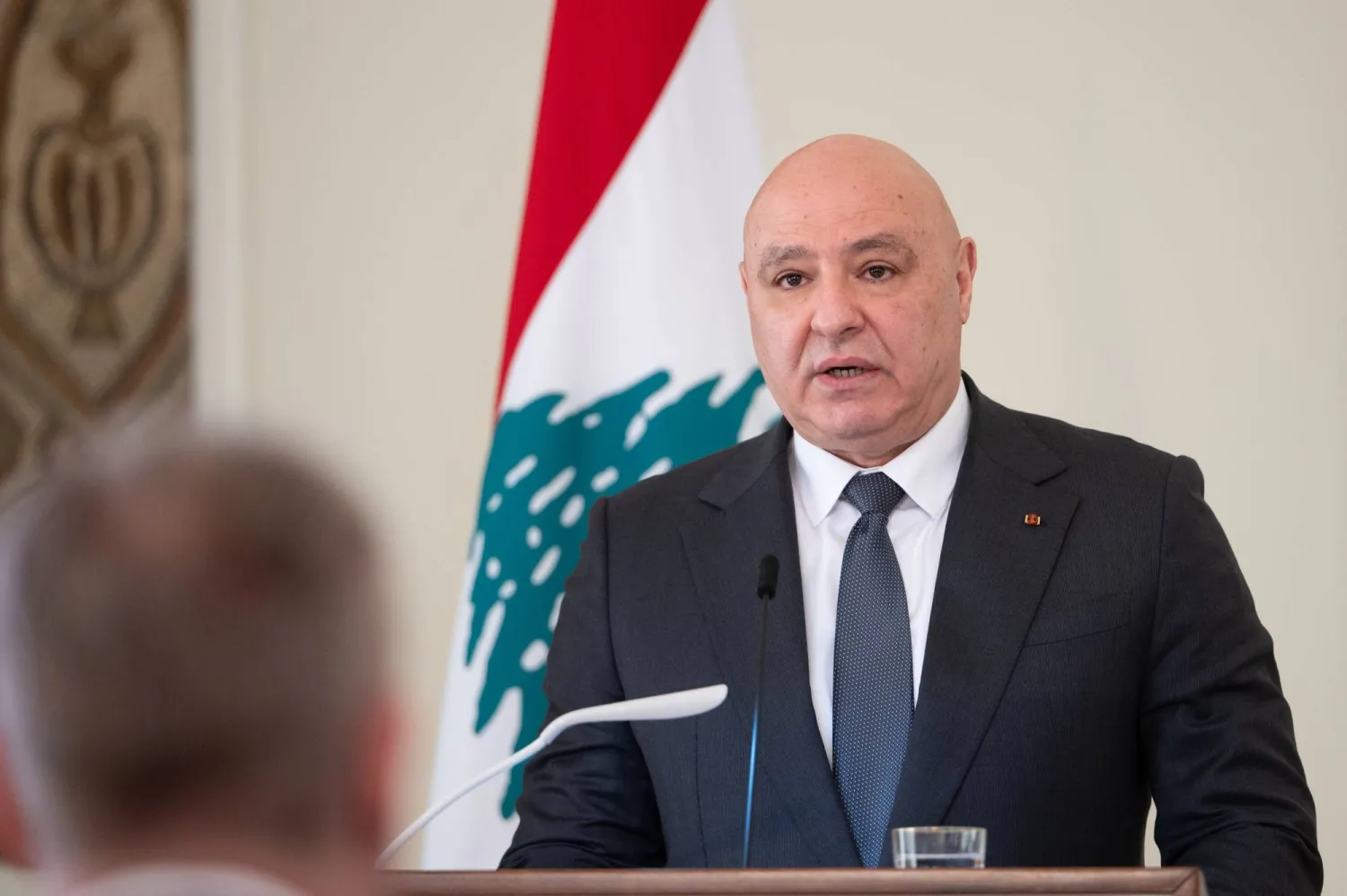
FILED - 16 February 2026, Lebanon, Beirut: FILE PHOTO - Lebanese President Joseph Aoun speaks during a press conference. Photo: Markus Lenhardt/dpa
TT

Aoun Hails Gulf Support, Says Lebanon Remains Committed to Strongest Ties with GCC States

FILED - 16 February 2026, Lebanon, Beirut: FILE PHOTO - Lebanese President Joseph Aoun speaks during a press conference. Photo: Markus Lenhardt/dpa

Lebanese President Joseph Aoun welcomed the statement issued by the General Secretariat of the Gulf Cooperation Council expressing support for Lebanon and its people as they confront current challenges, describing it as a reflection of the deep historical and fraternal ties between Lebanon and the GCC member states.

Aoun praised the GCC's reaffirmation of the importance of preserving Lebanon's security, stability, and territorial integrity, as well as its commitment to supporting the country's reform agenda and strengthening state institutions in line with the Lebanese people's aspirations for a strong, capable, and just state.

In a statement, Aoun also expressed his appreciation for the GCC's call for the Lebanese state to exercise sovereignty over its entire territory and for all weapons to remain exclusively in the hands of the country's legitimate institutions, in accordance with the Lebanese Constitution, relevant international resolutions, foremost among them UN Security Council Resolution 1701, and the decisions adopted by the Lebanese government in this regard.

The Lebanese president further expressed his deep gratitude for the Gulf states' readiness to continue providing humanitarian and development support to Lebanon, saying such assistance would help ease the country's economic burdens and improve the living conditions of the Lebanese people.

Aoun reaffirmed that Lebanon remains committed to maintaining the strongest relations with its Arab partners, particularly the Gulf Cooperation Council states, and to further expanding cooperation across all fields in a manner that serves shared interests and reinforces regional stability.

Also, Aoun welcomed on Friday France and Italy's efforts to set up a multinational coalition to succeed the UN peacekeeping force in his country, whose mandate expires at the end of the year.

In his statement, he called the initiative "a sincere expression of the international commitment to supporting Lebanon's sovereignty and stability".

On Thursday, French President Emmanual Macron said that France and Italty "want to launch a coalition for the post-UNIFIL arrangement, obviously in coordination with the European Union and the United Nations, to strengthen Lebanon's sovereignty and that of its armed forces" and prevent its territory from being "a foothold for regional escalation".


Ground Fighting Eases in Sudan as Drone Warfare Intensifies

Sudanese army chief Abdel Fattah al-Burhan inside the presidential palace on March 26, 2025. (Reuters)
TT

Ground Fighting Eases in Sudan as Drone Warfare Intensifies

Sudanese army chief Abdel Fattah al-Burhan inside the presidential palace on March 26, 2025. (Reuters)

Ground fighting has eased on Sudan’s main fronts after army advances and a retreat by the Rapid Support Forces (RSF) in North Kordofan in recent days. Drone attacks have increased, while limited skirmishes continue on several fronts.

Witnesses and field sources said the lull followed heavy fighting that significantly changed the areas held by each side in North Kordofan.

The army captured several towns, strengthened its hold on Bara and the surrounding area, and secured the export road. It also opened a supply route from Omdurman through White Nile and North Kordofan states to El Obeid.

The RSF withdrew to the north and northwest.

The sources said the army’s advance west of El Obeid stopped abruptly when its forces reached Umm Sumaymah. A counterattack forced them back toward the outskirts of El Obeid. No further major attempt to advance has been reported on that front.

Activists said the army also pulled back from around Sodari and Mazrub after extending its defensive lines through several nearby towns. The RSF returned to the strategic town of Mazrub, which it had left during the army’s wider offensive.

In Blue Nile state, the army held its positions. Pro-army sources said its forces repelled RSF attacks and inflicted casualties and equipment losses, preventing the RSF from making further gains. The RSF and its allies still control Kurmuk and Geissan.

Direct ground fighting there has also eased in recent days, though both sides have continued attacks with drones and artillery.

Drone warfare

The army said on Thursday that its air defenses had shot down a long-range FH-95 drone it described as hostile. The announcement came days after intensive drone attacks on military sites in El Obeid.

North Kordofan residents said the RSF had stepped up drone attacks on government-held cities in the state, disrupting daily life and deepening their sense of insecurity.

Reuters recorded footage of the aftermath of major attacks this month on two cities along the front line. Residents described them as part of a new wave of strikes, following weeks in which the RSF appeared to have reduced its drone use under international pressure.

Drone use has increased sharply during Sudan’s three-and-a-half-year war. Both the army and the RSF use technology that has become central to other conflicts, including the war in Ukraine.

The United Nations says drone attacks by both sides killed more than 1,000 civilians in the first half of this year. The toll highlights the growing cost to civilians as such attacks spread beyond traditional front lines.

On September 8, a drone struck a crowded courtroom in the government-held city of Umm Rawaba. The city is in North Kordofan, a central Sudanese state that has become one of the war’s main fronts.

Emergency Lawyers, which describes itself as an independent volunteer professional group defending rights, said about 10 people were killed and dozens wounded. The courthouse was extensively damaged, with columns from its facade and debris from one of the city’s prominent buildings strewn around the site.

A day later, a drone struck the College of Development and Technological Sciences in El Obeid, the capital of North Kordofan. The strike destroyed its roof and extensively damaged its buildings.

Standing amid the wreckage as workers cleared debris, the college’s dean, Abdelaziz al-Sheikh, said a security guard had been killed and eight lecture halls badly damaged.

“We lost the college guard. Eight halls were targeted and completely destroyed,” he said. Other parts of the college had also sustained extensive damage, he added.

Omnia Abulgasim, a student who had taken an exam at the college the day before the attack, stood beside the rubble. “The whole college was destroyed. We feel our dreams and our future have been destroyed,” she said.

At a hospital in Umm Rawaba, Salah Bakhit said his arm had been crushed and his body struck by shrapnel in the courthouse attack. He had fled El Obeid for safety after months of drone attacks on the city earlier this year, as the RSF sought to increase pressure on it.

As ground fighting eases on several fronts, drones are playing a growing role in attacks on military positions, as well as on cities and civilian facilities relatively far from the fighting. Residents and vital infrastructure are bearing an increasing share of the war’s cost.


Thousands of Syrians Face Legal Fallout From Assad-Era Cases

Syrians queue at Aleppo International Airport. (Civil Aviation Authority)
TT

Thousands of Syrians Face Legal Fallout From Assad-Era Cases

Syrians queue at Aleppo International Airport. (Civil Aviation Authority)

For many Syrians, the fall of Bashar al-Assad’s government did not end the cases against them. Activists and politicians are still discovering convictions issued in their absence and criminal wanted notices that remain in force, despite government measures to end security prosecutions of opponents.

Syria’s People’s Assembly has taken a leading role in transitional justice, repealing exceptional laws, including the law establishing the terrorism court.

But criminal cases brought during the conflict remain unresolved. Some Syrians returning by land or air discover the problem only when they reach the border.

Successive decisions and decrees have sought to dismantle the former government’s legacy. Yet thousands still face legal complications. Rights advocates say implementation has lagged behind legislative change, leaving people caught between promises of justice and institutional bureaucracy.

In March 2025, the Interior Ministry canceled travel-ban notices covering requests for arrest, notification or reporting, as well as failure to perform compulsory or reserve military service.

It said more than eight million people, roughly a third of Syrians, had been wanted by the former government’s intelligence and security agencies.

Last December, Justice Minister Mazhar al-Wais announced the abolition of exceptional courts and their rulings, in line with the repeal of Law No. 22 of 2012, which established the Court of Terrorism Cases. The judges who ran the court were removed.

The measure covered political cases, cases involving expressions of opinion and malicious charges. It excluded serious felonies involving personal rights, such as causing a person’s death, and organized crimes such as drug trafficking.

Those cases were referred to the regular military judiciary for consideration under fair legal procedures, leaving criminal prosecutions in place.

Repeal does not erase charges

People’s Assembly member Aqil Hussein says the assembly must legislate to repeal the terrorism and military courts and the “exceptional” security decisions and decrees issued against Syrians during the uprising. That must include canceling all resulting decisions and rulings, he said.

The measure does not cover criminal convictions, which the relevant institutions must resolve, Hussein said. But it could speed up that work and end the suffering of those affected. Agencies are working together on a mechanism to process cases faster and respond directly, he added.

Security sources told Asharq Al-Awsat that the former government used criminal charges, among other means, to pressure Syrians. It focused on terrorism allegations because of their international sensitivity, they said.

A large share of those allegations has been resolved, the sources said. Criminal charges and cases involving personal claims are harder to untangle because of technical complications and the number of agencies involved.

The sources acknowledged delays caused by the volume of cases and their links to complex civil matters. Claims brought by individuals can create further difficulties.

They said people affected by exceptional problems, such as a wanted notice that remains active after a case has been closed, or a lost case file, can approach the relevant offices in Damascus.

Records that outlast the cases

For many people still listed as wanted, settling their legal status means navigating a long bureaucratic process that restricts their freedom and civil rights.

Some said they learned that individuals had filed criminal complaints against them while they were abroad. Others said they could find no complainant.

Some returnees discovered arrest orders on criminal charges, only to learn from judicial offices that their case documents had been lost or damaged while the proceedings remained active.

People caught in this process cited poor links between databases and limited experience among new staff. Some said judicial offices and criminal investigation branches in Damascus had removed their records, but arrest warrants sent to border crossings were still in force.

Rights sources said political and security decisions had not been fully reconciled with prosecutors’ and courts’ records. Criminal entries are not removed automatically.

Canceling a wanted notice or overturning a conviction issued in a person’s absence requires a lengthy legal process, starting with a request to withdraw the notice and a visit to the judicial authority that issued it.

A proposed solution

“The new authorities have taken important steps in this direction, but they are still insufficient. The continued suffering of those affected shows the problem has not been resolved,” lawyer and rights activist Michel Shammas told Asharq Al-Awsat.

Issuing a general decision is one thing; carrying it through to every database, agency and case file is another, Shammas said. The former government created the files, but the new state inherited its institutions and records and must review and correct them.

Repealing the terrorism court and ending the exceptional laws used against opponents are necessary steps, he said. Neither automatically erases the effects of thousands of rulings, warrants and records issued by the court or other agencies.

Shammas proposed an independent judicial committee and a unified database to separate genuine criminal cases from political and security cases.

Political entries could then be removed collectively, he said, while an official service would let people check their legal status without an intermediary.



Sisi Stresses Egypt’s Support for Iraq’s Security, Stability

Egyptian President Abdel Fattah al-Sisi holds talks with the head of Iraq’s Hikma Movement in Cairo on Thursday. (Egyptian Presidency)
TT

Sisi Stresses Egypt’s Support for Iraq’s Security, Stability

Egyptian President Abdel Fattah al-Sisi holds talks with the head of Iraq’s Hikma Movement in Cairo on Thursday. (Egyptian Presidency)

Egyptian President Abdel Fattah al-Sisi met Ammar al-Hakim, head of Iraq’s Hikma Movement, in Cairo on Thursday and pledged continued support for Iraq’s security and stability.

Sisi said Egypt backed measures taken by the Iraqi state to protect its sovereignty, unity and territorial integrity. The talks also covered Baghdad’s efforts to fight corruption and bring weapons under state control.

Hikma Movement deputy head Mohsen al-Hakim, adviser Ahmed al-Hakim, Egyptian intelligence chief Hassan Rashad and Iraqi Ambassador Qahtan Taha al-Janabi attended the meeting.

Sisi visited Baghdad in June 2021, becoming the first Egyptian president to travel to Iraq in decades. The visit was part of a trilateral initiative with Iraq and Jordan to deepen political, economic and security coordination.

Egyptian presidential spokesperson Mohamed al-Shennawy said Sisi stressed the countries’ historic ties and Egypt’s commitment to engaging with Iraqi state institutions and political groups.

Sisi praised Iraq’s fight against terrorism and extremist ideology. He also commended al-Hakim’s efforts to strengthen stability, narrow political differences and put Iraq’s national interests first.

Al-Hakim said Egypt played a central role in regional security and stability, including by supporting Iraq’s efforts to regain its leading place in the Arab world and the wider region.

He said he wanted Sisi’s views on how to ease current regional tensions and shield Iraq from their effects.

Security and stability

Salah Halima, a member of the Egyptian Council for Foreign Affairs and a former assistant foreign minister, said some elements in Iraq were at odds with efforts to secure the country.

Action was needed to prevent activities beyond the control of Iraq’s governing authorities, he said.

“The situation may require a very high degree of cooperation between Egypt and Iraq,” Halima told Asharq Al-Awsat.

“Iraq’s national security is an integral part of Arab national security and closely linked to security and stability in the Red Sea and the Gulf.”

Halima said al-Hakim’s visit underscored the need for agreement on removing threats in Iraq and preventing any escalation that could destabilize the country. It could also spur broader cooperation between Cairo and Baghdad, he said.

The Egyptian presidency said the two leaders discussed the regional situation and its impact, particularly on Egypt and Iraq. Sisi outlined Egypt’s call for peaceful solutions to crises and conflicts, support for legitimate institutions and an inclusive nation-state.

He also described Egyptian efforts to lower tensions and avert another round of escalation. Iraq should continue playing a constructive role in strengthening collective Arab security and safeguarding the region’s resources, he said.

Visits gather pace

Contacts between Cairo and Baghdad have intensified. Sisi received former Iraqi Prime Minister Mohammed Shia al-Sudani on Aug. 27, 2024, for talks on energy, trade, investment and reconstruction. The two countries’ foreign ministers have also discussed ways to ease regional tensions.

In late August, Iraqi Prime Minister Ali al-Zaidi met Egypt’s intelligence chief, who delivered a message from Sisi.

According to the Iraqi cabinet, Sisi praised the countries’ strategic ties and expressed his readiness to support efforts to meet the aspirations of their peoples.

A senior delegation from Iraq’s Ministry of Water Resources visited Egypt early this month to strengthen technical cooperation and exchange expertise.

The Palestinian issue also featured in Thursday’s meeting. Sisi described Egypt’s efforts to implement the second phase of the Sharm el-Sheikh agreement and the US peace plan, deliver aid and expand humanitarian relief in Gaza.

He reiterated Egypt’s position that a Palestinian state with East Jerusalem as its capital must be established in accordance with international resolutions, calling it the only comprehensive and just solution to the Palestinian issue.